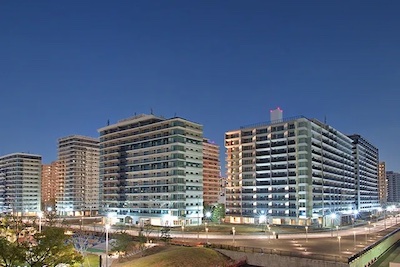
Harumi Flag unfurls

As we’ve pointed out in previous posts, the prices of new condos in Tokyo have risen considerably in the past few years owing to the high cost of construction, lowering supply, and an increase in sales to investors, whether Japanese or foreign. A June 20 article in the Asahi Shimbun about the cheap yen includes remarks from realtors who say that new condos in central Tokyo will remain expensive for the near future, with some, in fact, explaining that now they only deal with high-earning double income couples and rich investors. 

In light of this situation, the news surrounding one large Tokyo condo complex has been instructive. Harumi Flag, which was originally built to be the athletes village for the 2020 Tokyo Olympics, finally started receiving residents in January after renovations to turn the living quarters into condominiums was delayed almost two years by the pandemic. However, according to a June 7 report by NHK, as of the end of May a good portion of the units in the 17 buildings that have been sold so far are empty, which NHK finds strange since the demand for the Harumi Flag condos was quite intense owing mainly to the fact that prices were reasonable compared to other real estate in the area. NHK’s investigation found that many of the units were bought by investors, which shouldn’t sound strange given the current real estate climate in Tokyo, but the Harumi Flag project was initiated by the Tokyo prefectural government for the secondary purpose of eventually selling the residences to people who would live in them, in particular families. That’s supposedly why the initial prices were set lower.

NHK checked the title registrations of 1,089 units of the 2,690 that have been sold so far in the Sun Village part of the complex. Mitsui Fudosan Residential, the company that headed the consortium of 11 developers involved in the project, has been selling the condos in phases, and in the most recent phase there were an average of 71 applications for each unit. There were no limits to how many applications a potential buyer could submit or units they could purchase if their luck was good. Under such circumstances, institutional investors applied for as many units as they could, since they could buy as many units as possible by borrowing money more easily. In fact, NHK discovered that 292 units out of the 1,089 they checked were owned by companies, or one out of four. Sales began in 2019, and four sales phases were carried out in 2021 and 2022, with the largest number of companies registered as owners with the justice ministry following the last of these. However, when NHK checked with the Chuo Ward office it found that there were no resident registrations (juminhyo) listed for 30 percent of the condos, meaning that, technically, no one is living in these condos. In fact, more than half the units sold during the last phase were bought by companies, with many purchasing more than one unit. The investors who own the 292 units in question comprise 147 companies, most of them dealing in real estate and investment. On further investigation, NHK found that only five of these units were being used by their corporate owners as offices. NHK makes a special note in the report that all these corporate owners are Japanese, which they think is surprising considering all the media attention being paid to foreign buyers of Tokyo real estate. 

One investment company from Fukuoka, in fact, owns 38 units, and while they wouldn’t talk to NHK, their home page mentions their involvement in Harumi Flag “at an early stage” to “ensure stable returns on investments.” Two other companies did talk to NHK on condition of anonymity. One had 3 units in the complex and owned properties in Tokyo and Yokohama, as well as in the U.S. Their total real estate investments amount to ¥3 billion. A different company owns “more than 4 units” in Harumi Flag, and says they applied for and bought condos during each sales phase. In the beginning, they weren’t sure if the investment was wise, but now they are very happy because they are sure they can sell them for a hefty profit, and that seems to be the case. NHK says that so far hundreds of units have already been resold or are on the market for prices that are from 50 to 100 percent higher than their initial sales price. According to one real estate portal site, a 4LDK, 100-square meter unit in Sun Village that originally sold for ¥106 million is now on sale for ¥238 million. 

But the market is still hot, so many of the investor-buyers are not planning on selling for a while and instead are renting out their units. Unfortunately, there are too many units for rent in the complex so few have found tenants, though there are other reasons for the low occupancy rate. Harumi Flag is 20 minutes from the nearest station and all the leases have a limit of two to five years, because the owners may want to sell the units if the price peaks. NHK doesn’t mention the cost of rent, but when we checked portal sites we found one 86-square meter unit asking for ¥420,000 a month and a 65-square meter unit going for ¥280,000 a month.

NHK talked to one couple in their 60s who made 7 attempts to buy a unit in Harumi Flag and failed. Their budget was ¥80 million, which was more than sufficient for a good-sized condo during the initial sales phases but not enough to buy one that is being resold, so they’ve given up, even though several buildings in the complex are still under construction.

Read More

Future shock

We’ve written extensively about Tokyo’s current condo boom without really addressing what it will lead to in the long run. Most commentators seem to expect a burst bubble, like the one that happened in the early 90s following a similar over-valuation of properties in the late 80s. However, there is an important difference in that the current Tokyo bubble is being pumped up by rich people. The average price of a new condo in the capital has exceeded ¥100 million. In the late 80s, the bubble was caused by everyone, since the huge boomer cohort had secured its lifetime employment and banks were willing to lend them money. Even though housing interest rates are low in Japan compared to the bubble era, younger families with average incomes who still insist on buying new condos are finding it difficult to find anything they can afford in the 23 wards, according to local media.

A recent video on the YouTube real estate channel Rakumachi put the present bubble in perspective, especially in terms of what it holds for the future. According to Tomohiro Makino, a “real estate producer” whose career started in the 80s, people who say the Tokyo condo market is “over-heated” need to look at classic supply-and-demand. “Over-heated” suggests that the market will eventually cool, but since this particular bubble is being caused by rich people and institutional or business investors, it isn’t that simple. Scarcity is one of the factors fueling the over-heated prices: the number of new condos on sale in recent years is one-third the number that were on sale in a given year two decades ago. Much of the reason for this scarcity is the high cost of building materials and lack of labor. Building a condominium is much more time- and capital-intensive than it used to be, so developers have scaled down. And with prices so high, buyers trend toward people who benefit from certain financial realities, such as foreign investors who can exploit the historically cheap yen. Even rich elderly Japanese who don’t necessarily need a new place to live are buying high-end condos in Tokyo as hedges against taxes their heirs will have to pay when they die. So they invest their cash in real estate, which can lower the inheritance tax burden by as much as 70 percent. Those who do buy new Tokyo condos for living purposes tend to be so-called power couples—married people whose combined incomes exceed ¥15 million a year. 

So the high condo prices are essentially being maintained by a small group of people. Nomura Securities says the number of “very wealthy” households in Japan, meaning they are worth more than ¥500 million each, is around 90,000, for combined assets (not counting debt) of ¥105 trillion. Merely “wealthy” households (¥100-¥500 million) number around 1.4 million with ¥259 trillion in assets; “less wealthy” (¥50-¥100 million) number 3.3 million with ¥258 trillion; upper middle class (¥30-¥50 million) number 7.2 million with ¥332 trillion; and the vast middle class (less than ¥30 million), numbering 42 million, is worth ¥678 trillion. Though the top two tiers account for a bit more than 2 million households, the amount of assets they control is considerable. Much has been made of the global income gap in recent years, and Makino says the top 1 percent in Japan has seen its wealth increase by 80 percent since 2013, when Abenomics. The investment market was flooded with easy money, but average households received no comparable benefit from the policy. Makino says that its effect on real estate has led to the over-heated condo market, putting Tokyo real estate out of the reach of the middle class. Developers don’t even think about this group of consumers, because they know that even if every condo they build is luxury-class, they can still sell them. Consequently, they don’t have to build that many in order to make as much money as they used to make when they sold to everyone. The average price of a new condo in the 23 wards as recently as 2015 was ¥60 million. Last year it was ¥115 million. And due to the lag in construction costs, prices will continue to go up for the near future. 

And it’s construction costs that are the main concern for developers, since right now they account for 70 percent of the cost of a condo, the other 30 percent being land. This aspect is very significant, because while land prices vary greatly depending on location, construction costs do not. It costs almost the same to build a condo in the suburbs as it does to build one in the center of Tokyo, so most developers are putting as much of their money and resources as they can into the city. Even mid-sized developers that tend to do all their work in the suburbs are foregoing new construction to invest in new condos in Tokyo by borrowing money to buy them from major developers. Then they quickly resell them to make money. The most prevalent example of this kind of practice in the news right now is the Harumi Flag complex on the waterfront, which was built as the Tokyo 2020 Olympic athletes village and then sold or rented out afterwards. A substantial number of the condos remain empty because they’ve been bought by corporations, including developers, as investments, thus pushing the price of individual units up. According to Makino, some companies have bought from 10 to 20 units in Harumi Flag.

Makino sees this trend continuing as long as interest rates remain low, since most investors don’t use their own money to buy real estate. Once rates start to rise, he says, the market will cool as investors pull out. Now that the era of the “negative interest rate” has ended in Japan, he thinks that such a change is on the horizon, even if many experts believe the Bank of Japan won’t increase interest rates due to the amount of government bonds it has. But the BOJ doesn’t control interest rates. Other factors, including environmental disasters, international politics, even rumors, will always come into play, and once they do “the party will be over,” meaning even foreign investors will bail regardless of the exchange rate. This could prove to be a huge shock to the system. After all, young Japanese adults today know nothing about interest, having been born without any experience of bank deposits earning interest. It’s unrealistic to think that this kind of environment will persist indefinitely, but until it does change it’s also unrealistic to thing that average Japanese people will step in when wealthy investors drop out. It’s just too risky for the average household to buy a condo in Tokyo now or in the near future.

If Makino were to give advice to potential middle class homeowners who want to live in Tokyo, it would be to wait, probably until 2030, by which time he says the “market will surely change.” Not only will prices for condos, used and new, go down, but so likely will rents. And his reasons for thinking so are grounded in an unavoidable truth. Households headed by people over 65 in the Tokyo metropolitan area now number 9 million, with half of those headed by people over 75. That number will steadily increase. After 2025 all the 1.5 million boomers living in the metro area will be over 75, and while lifespans are also increasing, it won’t be long before this cohort starts dying out in record numbers, which means their property will either be left to heirs or abandoned, if it hadn’t already been sold. These people came to the metro area in their youth to work, and they bought homes. But their children, now middle aged, mostly own their own homes, too, and so won’t need their parents’, which means they’ll sell it or do something worse (pretend to ignore it?), but in any case there will be a lot of empty homes on the market. This, as Makino points out, is the heart of the akiya problem, which will only intensify by the end of the decade, throwing the real estate market, including Tokyo’s, into turmoil. Oversupply will become a chronic issue unless the construction industry and the authorities change their tune with regard to building new residences, which is pretty much all they think about now. 

Read More