We’re the top

What we’re talking about: Palm Springs in Inzai!

Earlier this week the Sankei-affiliated web magazine Zakzak published this year’s results of business journal Toyo Keizai’s annual survey of “urban power,” meaning the most livable cities in Japan. Toyo has been doing the survey since 1993 in conjunction with the publication of a periodical data book that compiles statistics about local economies. The survey uses “14 types of information” released by a number of government organs, including the Ministry of Economy, Trade and Industry, comprising five criteria for satisfactory urban living: safety, convenience, comfort, affluence, and housing standards. The survey covered 787 cities and the 23 wards of Tokyo, and this year the municipality that came out on top was Inzai in Chiba Prefecture, which just happens to be where we live.

Our reaction was pleasant surprise mixed with doubt, and as we read the Zakzak article it became clear what Toyo Keizai’s priorities are with regard to a satisfactory living situation. Inzai ranked #3 in the nation in the convenience category because of its retail accessibility. There are lots of discount stores that are easy to reach and with plenty of free parking. People of a certain aesthetic disposition will, of course, find this aspect of Inzai life somewhat off-putting. The retail outlets in question line route 464, which runs parallel to the Hokuso train line through three stations. Many of these outlets are gathered into rather sterile shopping malls. The article also quotes a 35-year-old resident as praising the “large choice of restaurants” along the main road, though such effusiveness should be qualified by the information that almost all these restaurants belong to national chains. For sure, if there’s one thing that characterizes Inzai’s abundance of commercial choice it’s the almost total lack of distinction. There’s nothing here that’s any different from other suburban commercial districts in Japan except maybe more of it; or less, since you’d be hard pressed to find anything that could be described as “typically Japanese.” If anything, the retail tone is strikingly American. Read More

Home Truths, June

Here is this month’s Home Truths column in the Japan Times. Almost everything we discuss in the article we’ve already discussed in more detail somewhere on this blog, but this is a fairly concise overview of the whole cramped housing development issue. Since this is a situation that almost anyone who buys a house must contend with, we’d be grateful to hear comments from readers, especially those who have direct experience with the problem–if, in fact, it is a problem. We’ve sort of come to the conclusion it’s something you have to live with.

Field diary: Yukarigaoka

Monorail at rest

Centrally planned communities have been around in Japan since the 60s with the advent of the “new town” movement, based on the similarly named British social housing policy. The idea is that housing and commerce are engineered to work together. Theoreticians of the Jane Jacobs school of organic urban environments may look down on the concept because of its artificiality: everything is supposed to work because it’s been programmed carefully beforehand. The new towns we’ve looked at in Japan are predictably old-fashioned, like snapshots of the 60s and 70s but ones that evoke no feelings of warm nostalgia except for so-called kodan otaku (public housing freaks). They just look old, mainly because most of the people living in them are old, but also because they are simply superannuated. Though the term “public housing” needs to be qualified in the case of new towns, for the most part the architecture and design of the communities were carried out by public or semi-public entities, and today the buildings and neighborhoods still have a utilitarian quality that many people find quaint at best, ugly at worst. It all depends on what’s been done with the residences in the meantime.

Yukarigaoka, a community in the north-central Chiba city of Sakura, isn’t stricly speaking a “new town,” but it was extensively planned. The difference is that the planning was done by a private company, Yamaman, which started out as a fabric wholesaler in Osaka in 1951. They moved their headquarters to Tokyo in 1965 and for the next ten years became a full-scale real estate developer for residential communities. Their first large-scale project was in Yokosuka, a project that was historically notable for being the first Japanese address written in katakana. They started the Yukarigaoka project in 1971, and even after the initial development phase was completed, have stayed on for the expansion, which continues today. The first sale of single-family homes was in 1979, the first condominium in 1982, the same year they opened a monorail that circled the project and connected to the Keisei Honsen train line. In fact, they convinced Keisei to build a new station just for the community called Yukarigaoka. Naturally, the company had to work closely with the Sakura municipal government in order to purchase land for development, but they also built the area as a community with a future. According to one of the company’s real estate agents, Yukarigaoka is the only similarly sized project in Japan completely overseen by a private company. Because it’s built on a hilly plateau with lots of farmland, the usual expanses of cramped housing developments are broken up by huge swaths of green forests and fields. (Though public parks are relatively scarce.) It has its own “downtown” with a major city hotel and department store complex. There’s even a university with one of the most attractive campuses we’ve ever seen. Read More

Home Truths, April ’12

Minami Senju

Here’s this month’s Home Truths column, which is about cramped urban neighborhoods that could turn into death traps in the event of a major earthquake. Though much is made in the column about the Tokyo Metropolitan Government’s measures to address this problem, we don’t really think it will make much of a difference. Anyone who has read Edward Seidensticker’s fascinating, peculiar, and often frustrating history of the city will understand one thing, that Tokyo defies any notion of city planning with an almost rabid resolution. The “low city” that is Seidensticker’s main subject is portrayed as an organic entity, one that resists any foreign (i.e., governmental) claim to its control as if it were a virus. Most of these neighborhoods sprang up almost overnight after disasters devastated other portions of shitamachi. Working class people moved on to farmland in the outer portions of the city because the place they used to live was destroyed by an earthquake, a fire, or American bombs. Economies of necessity superseded any authoritative prerogatives and communities were born. Those communities are still there. Romantic types love these neighborhoods because they represent what it is they appreciate most about Tokyo, its makeshift conviviality and resistance to conventional ideas of city order. And because those neighborhoods did develop organically, they really do characterize the urban experience in its purest form. But part of the appeal has to do with that hoariest of Japanese cliches, the beauty of transience. These neighborhoods were created by disaster and they will disappear by disaster again. The authorities’ means of addressing this situation may seem flat-footed and ill-advised, but the reasoning is unassailable. In their present state, these neighborhoods will go under, and they will take their inhabitants with them. Maybe there’s nothing anyone can do about that, but it doesn’t mean we shouldn’t at least think about it.

Whose view?

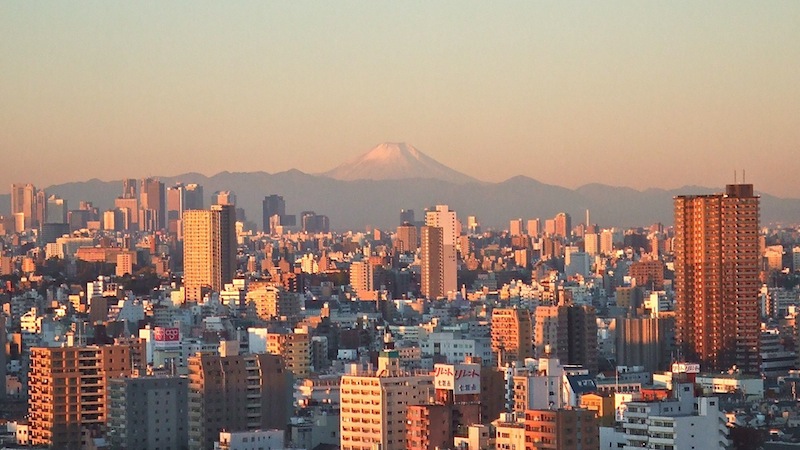
Most place names in Japan are derived from geographical or topographical traits, and one of the most common names in the Kanto area is Fujimi, which indicates that the place has a view of Mount Fuji. The Japanese place a lot of spiritual stock in mountains. Traditionally they were the objects of worship, and Fuji, of course, is practically a religion unto itself. It’s probably no coincidence that “fuji” itself is a homonym for a word that means “live forever.”

Nowadays, any address with the name Fujimi attached is highly valued–if, in fact, it still affords a view of the sacred mountain. Tokyo, in particular, is so built up that, according to Tokyo Shimbun, there are only three locations left in the city named Fujimi from which Mt. Fuji can still be seen from the ground. The most famous of these is in Nishi Nippori, a place called Fujimi-zaka, or Fujimi Slope. In early November and late January, photographers and tourists converge at the top of the slope to wonder at the Fuji Diamond, when the sun happens to set behind the mountain’s summit. This year, rubberneckers almost lost their chance, since the weather was cloudy for two of the three days when the diamond view is possible. As it happens, it may be the last time.

That’s because Sumitomo is building three tower condominiums that will forever block the view of Mt. Fuji from the vantage point of Fujimi-zaka. This almost happened before. Back in 1999, another developer announced a plan to build a tall condo within the neighborhood that threatened the view, and local residents formed a committee to protest construction. Naturally, the developer paid no attention, but as it turned out, the building only blocked a small portion of the foot of the mountain. The new Sumitomo project will definitely block the whole thing, so the committee has asked the mayor of Arakawa Ward to lodge a formal complaint with the developer, which reportedly was quite “annoyed” by the request owing to the fact that the buildings under construction happen to be in Okubo, all the way on the other side of the Yamanote Line. Sumitomo bought the land five years ago and says it has complied with all relevant prefectural and ward regulations in planning the housing project, and the ward in question isn’t Arakawa, it’s Shinjuku.

Where there’s smoke

Last Sunday morning at about 7 o’clock, a fire broke out at the Rose House Higashi apartment building in the Okubo section of Shinjuku, Tokyo. More than half of the two-story structure was destroyed. Four residents died and two remain in critical condition. Of the 26 units in the building, 22 were occupied by 23 residents. That means one unit had two people, which is sort of remarkable since each apartment is only 4.5 tatami mats in size, or about 8 square meters.

Rose House is fifty years old. Each room has a cold water faucet and a gas burner. The toilets are communal. There is no bath, which is characteristic of these kind of wooden apartment buildings. Rents were between ¥51,000 and ¥53,000 a month, which is cheap for Shinjuku but quite expensive for this kind of residence. For ¥10,000 more you can probably find a six-mat apartment not far away with its own private bathroom, but as media have reported 17 of Rose House’s residents were on welfare, and most of them were “very old.” The Shinjuku welfare office told reporters that they did not “recommend” Rose House to any of the people they administer, but it’s common for welfare recipients to “live in the same building.” That’s because their incomes are extremely limited and most landlords will not rent to welfare recipients. As it happens, welfare recipients in Tokyo tend to receive a higher housing allowance than people in other cities in Japan, the maximum being ¥53,000. Rose House apparently catered to welfare cases, which makes sense. Landlords usually can’t demand that much money for such old, cramped apartments, even in Shinjuku, and public housing is usually off-limits to single people; but since welfare recipients don’t have a lot of choices the Rose House landlord could ask them to pay that much. Also, Rose House didn’t demand a guarantor. Even at less than full capacity the place makes more than a million yen a month.

So far the police have not isolated the cause of the fire. Some media initially suspected it had something to do with “old wiring,” since there was a small electrical fire in one of the apartments several months ago, but the Asahi Shimbun has reported that theory has been discounted. Though the building was situated on the edge of a parking lot, Rose House is what is called a saikenchikufuka, a structure that “can’t be rebuilt” because it was erected in the middle of block, thus making it very difficult for firemen to gain access. Nobody will be moving back in, which means the surviving residents now have to find some other hovel to accept them.

Taking shopping arcades seriously

Shotengai in Sanya, Tokyo

Shotengai, or shopping arcades, have been moving toward extinction for several decades now, the victim of increased motorization, new laws favoring large chain retailers, and the economic slump in general. Composed of small, family-run stores that invariably coalesced into merchant associations, shotengai were the social and commercial hearts of communities in both rural towns and huge cities. The death of the shotengai in the countryside has given rise to a new phenomenon called shopping refugees (kaimono nanmin): residents, most of them elderly, who are effectively cut off from retail areas because local family merchants have closed down and they have no easy access (i.e., driver’s licenses, vehicles) to shopping malls. Some local governments and chain retailers are addressing this problem by helping the refugees reach retailers, but there are also communities that refuse to let their shopping arcades fade into memory. Read More

Matsudo as microcosm

Many municipalities in Japan have local natural history museums, and the one in Matsudo, a Chiba Prefecture bedroom community about 45 minutes by train from central Tokyo, is typical even if its summary explanation of purpose may sound inadvertently funny: “From the birth of humanity to the Tokiwadai housing complex.” It’s the juxtaposition of the epic with the plebeian, but the exhibit itself, which does exactly what it claims to do, provided a thorough encapsulation of socioeconomic development in Japan from the standpoint of what can only be described as “the average person.”

As with all natural history museums, Matsudo’s traces the area’s geological makeup and how its proximity to the river that flowed from the north into what is now Tokyo Bay, which shifted greatly over time, determined its economy. However, with no natural resources or development of special technologies that could take root and turn into ongoing regional industries (salt processing and pear growing were successful endeavors, but only for short, isolated periods), Matsudo’s most salient feature was and still is its topography: valleys called “yatsu” etched between plateus called “dai” and lowlands that straddled rivers called “shitaya.” Each was distinct geographically (dai were at least 30 meters above sea level, yatsu 10 meters, and shitaya 2 to 5 meters) and economically. Rice farmers lived in the shitaya, which often flooded during the typhoon season. The houses and, especially, grain storage facilities were built on man-made elevations to keep them dry. They were also built close to one another and in columns that stretched north to south, with the entrances facing south, often in “terrace” formations. The direction was important because the often destructive winds that would seasonally race through the lowlands came from the north and the west. This might explain the Japanese obsession with positioning housing is a southward orientation, regardless of the view such positioning provides. Read More

The tako squat

Otako manager redirects traffic from former site to future location

On the morning of Dec. 16, the famous Otako takoyaki (octopus dumplings) stand in Osaka’s thriving Dotonbori district finally pulled up stakes under pressure from municipal authorities, who were set on removing the stand later that day. The stand had been doing business at that particular location since 1972 and was a certifiable if not necessarilly certified local landmark since it was actually featured in an official tourist brochure for Osaka. However, Otako has always been squatting; that is, using public property without permission. And it might have gone on using the small patch of concrete near the entrance to Tazaimon Bridge in perpetuity if it hadn’t tried to take advantage of an obscure legal principle. Read More

What’s a measly seven centimeters?

Looks straight to me: Umeda Gate Tower

The Umeda Gate Tower, a 21-story office building located near Osaka Station, was completed two years ago, but it was only in the past week that the media has reported that the structure is flawed. Before that, the city of Osaka officially reprimanded the general contractor in charge of construction, Kashima Corp., which has since issued assurances that the building is totally safe.

One of the primary vertical steel pillars on the third floor of the building is apparently 7 centimeters off the plumb line, meaning it is not perfectly perpendicular to the base. An unnamed sub-contractor realized the flaw before work on the floor was completed but did nothing to correct it. The company’s workers also failed to inform Kashima of the defect and then falsified the required documentation for the work. These documents were given to the building owner before safety checks were carred out.

Eventually, one of the men who worked for the sub-contractor revealed the defect on the Internet, which is how Kashima and the city of Osaka first found out about it sometime in the fall. Kashima says it carried out an inspection and concluded that the defect does not in any way compromise the structural integrity of the building. The media, however, did not report the story until Dec. 15, by which time the controversy was mostly over. Most of the stories, in fact, did not even identify the building, and none of them analyzed what a 7-centimeter tilt to a third-story vertical pillar means in terms of safety. We just have to take Kashima’s word.