Move on up

CIMG2287Of the three prefectures adjoining Tokyo, Chiba is by far the cheapest in terms of real estate. It tends to rate on the dowdy end of the desirability index. Kanagawa remains the hippest because of places like Kamakura, Shonan, Yokohama; while Saitama, though often derided in popular culture as a suburban backwater (“Dasaitama”), was developed rather quickly owing to its size and convenient proximity to the capital. In fact, property values in northern Chiba along the Noda and Joban lines are comparable to Saitama’s. It’s when you get farther out on the Keisei and Sotobo/Uchibo lines that the suburbs become sparser and less expensive. Chiba is viewed as the sticks, which is just as well for us because it offers more affordable places within striking distance of where we live now.

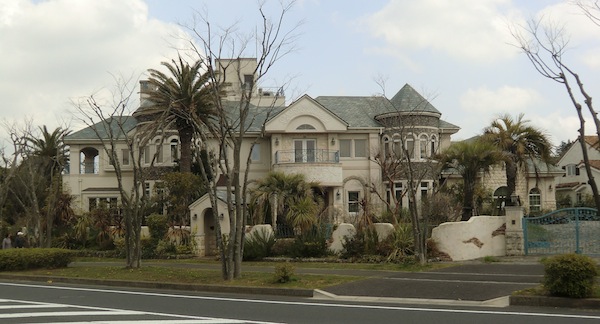
Interestingly, one of the most expensive housing developments in Japan is in a relatively remote corner of Chiba. The Azumigaoka New Town is part of Chiba City’s Midori Ward, but the nearest train station is Toke on JR’s Sotobo Line, which means it’s practically in Ichihara. The exclusivity of portions of the new town development, coupled with the unusually large plots of land contained therein, have earned at least two subdivisions in the area–Prestige and One Hundred Hills–the nickname Chibaley Hills, a takeoff on Beverley Hills. We’ve never seen this neighborhood with our own eyes since, as with the real Beverley Hills, the residents discourage tourists and gawkers by restricting access. When it first opened the development got a lot of media attention, which in turn attracted motorcycle gangs, so now they have a patrol that politely keeps out pedestrians who have no business there. Nevertheless, you can find properties in the area on sale at almost any real estate portal site, and they remain pretty expensive, though certainly not as high as they were when they were first built during the bubble era. What’s considered a super luxury in Japan would be more or less upper middle class in the U.S., essentially backyards big enough to provide privacy, two or more bathrooms, and lots of windows and open floor plans. We even saw one property at a realtor’s site with a swimming pool. Read More

Cheaper than dirt

shiroi4A few weeks ago we learned that a house we had been interested in was sold. We had first seen the house last fall and wrote about it here, and then did some research because the realtor who showed it to us couldn’t answer our questions about the structure and the land. Obviously, other people looking to buy were less apprehensive about the property. Another reason we hesitated for so long was the price. When we first inspected the house we thought ¥15 million was reasonable considering the size, the layout, and the unobstructed view to the south, but then we noticed that in the same general vicinity a developer was selling brand new houses of a comparable size for only ¥16 million, and some were even closer to the train station. Looking at these houses on the web we realized that the reason they were so cheap was because the developer had bought a tract of land in an undeveloped corner of town and just filled it with as many structures as it could. These were not houses ordered by people who first chose a plot and then a model from a list of designs to build on the plot. The developer divided up the tract and went ahead and constructed identical houses on all of the plots, with perhaps minor differences determined by light exposure or shape of the land. By doing it in a mass way, the developer could save money. Though we could tell by just looking at the photos on the web they were not for us, we also thought it would appeal to a lot of potential buyers simply because the houses were brand new, and thus it would be much more difficult for the realtor selling the house we’d been interested in to unload it, but we were wrong.

The existence of such new homes made ¥15 million seem like a lot for the house we had been interested in, so we did a search and found several developments in northern Chiba where brand new homes were being sold at prices below what we had come to think was the average for used homes. Two were in Shiroi on the Hokuso Line, each about 15-20 minutes from the nearest station. In one development they were going for as low as ¥13.7 million and the other as low as ¥14.8 million, which is dirt cheap considering that new homes in the same area with the same floor space and land area, and probably less in terms of fixtures and amenities, were likely going for ¥30-40 in the early 1990s. Of course, comparing anything real estate-wise to the late 80s/early 90s in Japan is a chump’s game, but it does provide a perspective that’s instructive when it comes to making priorities. Read More

The rest of the story

What you see is not what you get

We’ve received two letters in response to our Aug. 2 Home Truths column about renewal fees, both from landlords who obviously want to relate, as Paul Harvey used to put it, the rest of the story. Both letters were sent to the Japan Times, one for the Readers in Council page and the other indirectly to us with a directive that it not be published. Moreover, the RIC letter was published anonymously, so while both of these persons hold strong opinions as to their own situations as property owners neither seems to feel that strong that they might risk exposing themselves to whatever sort of negative reaction landlords can normally expect. This is probably unavoidable. The landlord-tenant relationship is almost by definition an adversarial one; the dynamic fraught with defensiveness. Both landlords basically wanted to show the difficulties of maintaining properties for rental purposes in Japan, and in the process defended the collection of supplemental fees such as reikin (gift money), shikikin (deposits), and koshinryo (rental agreement renewal fees) as essential to their businesses. Read More

Home Truths #2

Caveat emptor

Our latest column in the Japan Times was published today. You can read it here. It’s about the recent Supreme Court decision regarding koshinryo (renewal fees). One small clarification: The photo caption mentions that cheaper rents may mean higher renewal fees and “gift” money. In many cases if the landlord has set the rent lower for the purpose of attracting potential tenants, he/she may also not charge gift money for the same reason. Renewal fees, however, are more hidden because they are usually only mentioned in the fine print, meaning they kick in later, when the tenant has to renew the contract a year or two after moving in. Also, some landlords, especially corporate ones, are making their rental agreements longer, say five years, and then setting the renewal fee a bit higher than average. Another theory associated with renewal fees that we neglected to mention is that some landlords use it to generate higher turnover. Since supplemental fees allow the property owner to make a bit more money in a slumping market, logic says that you make more money if the turnover is higher because more new tenants mean more supplemental fees. This is the same economic logic behind the shaken (regular vehicle inspection), which all car owners have to pay for every two years (or every year, depending on the age of your automobile). When the shaken, which is expensive, comes due, many car owners simply trade their vehicle in for a new one. The first shaken for a new car is three years. The same concept is supposedly used for renewal fees: People will move to a new place because they don’t feel like paying it. The reason we didn’t mention this theory is because we’re not really sure it’s credible. People’s attachment to the place where they live is different from their attachment to their car. If people move because they don’t want to pay the koshinryo it probably means they don’t like the dwelling in the first place.

Sourced

Masako was used as the framing voice in an article by Hiroko Tabuchi in this morning’s New York Times about the Tokyo high-rise market following the quake. You can read it here, though you may have to register first.

Go West

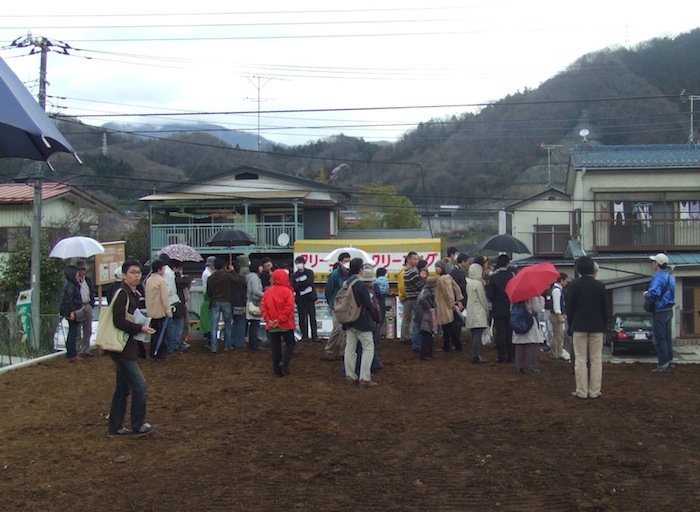
Potential buyers inspect land for sale in Fujino, western Tokyo

Two weeks ago we were at the UR office in Yaesu helping some friends get around the application process and asked the employee about availability. Though there was no ulterior motive behind the question, the woman volunteered that a lot of residents in UR high-rises in the waterfront area were moving out after the earthquake. We were slightly taken aback: Only a semi-public organization like UR would admit to potential renters that people were anxious to leave their properties.

Upon further investigation, we found that the story is a bit more complicated, at least when it comes to buying and selling property. According to various news reports, there has been a notable increase in interest in the Musashino daichi, or plateau, which covers parts of Western Tokyo and Western Saitama Prefecture. This is considered stable land, meaning no risk of liquefaction. The waterfront, of course, is all built on landfill, but there are many other areas located inland that suffered soggy ground after the Mar. 11 earthquake, such as Abiko in Chiba and Kuki in Eastern Saitama, communities that were built on ground that used to be swampland, rice paddies, or even ponds. Usually, you can determine the kind of land an area once was by consulting an old map. If the old name contains words that indicated water, like numa (marsh), then you might want to make sure your foundation is built on piles. In fact, a lot of developers change the names of such places so that people think they were built on solid rock (almost any subdivision with the word oka–hill–is a dead giveaway). Read More

The price you pay

The following is an article I wrote in 2004 for an occasional column that I and several other non-Japanese wrote for the Asahi Evening News about the “expat” experience in Japan. In a way it explains our skittishness about buying property today.

Naive days: The land when it was pure

In the early 90s, my partner and I discussed the possibility of buying a condominium or a house. Both of us had recently become self-employed and our financial situation wasn’t assured, so we talked about buying property as if it would occur sometime in the middle-distant future, meaning not soon enough that we needed to start looking right away.

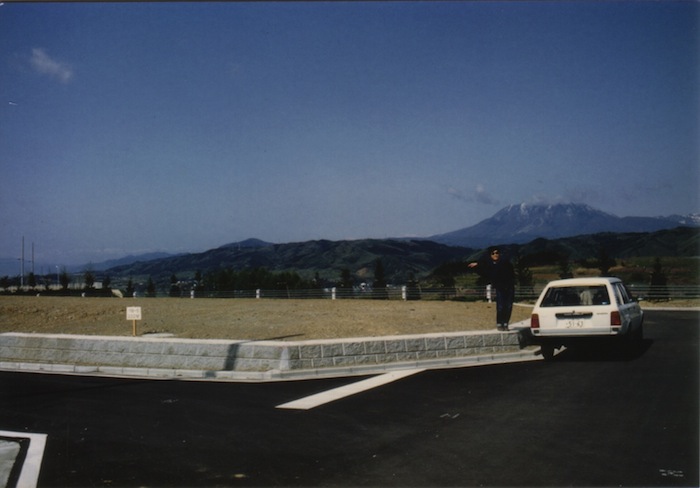
Our friends knew of this vague plan, and once, while visiting a couple we knew in Nagano prefecture, they told us of a housing scheme being promoted by a nearby local government. The city was developing a large piece of land on the top of a hill and offering plots by lottery at below-market prices. The stated aim was to attract new people to the city, which had been losing population over the past decade.

We went to the lottery drawing not thinking that we would participate, but our friends talked my partner into picking a number out of the hamper just for fun. The odds against actually winning were almost ten-to-one. But she did.

Everything suddenly changed. The prospect of buying property had so far been theoretical, but now we had to face the decision head on because we had been given an opportunity.

We returned home and agonized over whether or not we should buy the land. On the plus side, it was very cheap and the lot we had “won” was located on a corner of the hill with an unblocked view of a green valley. On the minus side, we would have to move to Nagano and we would have to build a house, but as we talked these negatives slowly moved over into the positive column. Because of the nature of our work (mostly writing and translating) we didn’t need to live near Tokyo, and having to build our own house meant that we could build the house we wanted. Read More

A tale of two properties

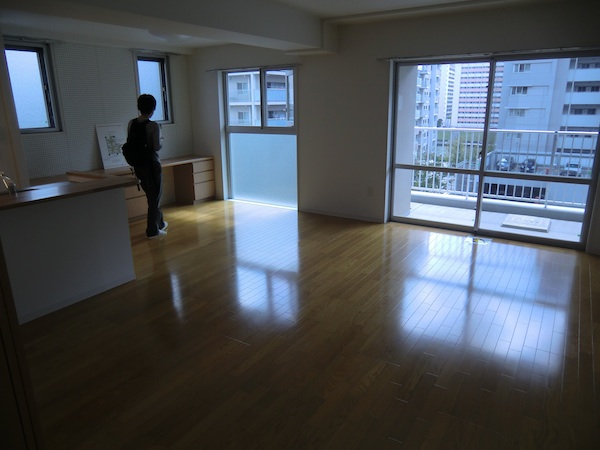
Dark floor, dark room

Across and further down the Sumida River from our apartment is a large condominium complex that has intrigued us ever since we moved here. Legend has it that the late rocker Yutaka Ozaki had just moved into it when he was found not far away in an alleyway one night, dying. It’s a good legend, and like many legends it’s not true. At the time Ozaki was renting a much more commonplace sort of “mansion” in the same neighborhood. But it’s easy to understand why this particular complex has attracted that sort of speculation. Every so often somebody moves out and you see a flier in the mailbox advertising the unit, which tends to fetch a price comparable to new condos even though it was built in 1991. The layouts are more imaginative and seem more livable than those of most condos. Rather than cut a box into rectangles, the designers staggered the position of the rooms along corridors and shaped the building in such a way that every unit looks out on at least two views, meaning there’s more sunlight; or that’s the impression one gets looking at the layout and then at the building’s exterior.

Last week, we finally visited the complex after we saw a flier announcing that two adjacent units on the 14th floor were on sale: a 67-square-meter 2LDK for ¥28 million and a 94-square-meter 3LDK for ¥38 million. Though both of these prices were out of our league we wanted to see what was really there, and were quite shocked at what we found. Read More

Excited about nothing

Sort of exotic

The TBS consumer news variety show Gatchiri Academy is usually pretty thorough about its advice, since it features a panel of economists and financial journalists whose opinions vary widely from one to the other. However, the other night, during a segment about resort condominiums, the information provided was maddeningly incomplete. As described here and here on this blog, resort condos are pretty cheap owing to the simple fact that too many were built and demand isn’t so hot any more. Gatchiri visited several vacation areas, including the Izu Peninsula and the Naeba ski resort in Niigata. The whole point of the segment was to jolt the audience with prices too low to believe. Actually, what was difficult to believe was that people paid so much for these cubbyholes when they were built twenty years ago. In one segment, a talent-reporter, in the company of a local real estate agent, inspected a 60-square meter condo in Izu that originally sold for about ¥25 million, and her jaw dropped when the realtor revealed how it now goes for less than 10. Mandibles literally hit the floor in Naeba, however: one and two-room condos for as low as ¥500,000?! Where do I sign?

That was the general vibe, anyway. What was infuriating was that nobody mentioned the real reason why these places were such bargains. For a split second, each property’s particulars were flashed on the screen, and these particulars may have included the yearly property tax fee you’d have to pay. But I didn’t see or hear any mention of the maintenance (kanri) or common repair (shuzen) fees that a resort condo owner has to pay every month. So when one of the financial writers commented that at such low prices it didn’t really matter whether or not the property continued losing value (which is most certainly would), he was, purposely or not, deceiving viewers who might be considering dropping a mill or two for a nice getaway. Maintenance fees normally run between ¥10,000 and ¥50,000 a month, and repair fees about half that, so the cost of keeping a resort condo could conceivably end up outstripping the value of the property after a few years. That’s fine if you plan to use it often, but the main reason these places are so cheap is that the majority of people don’t have that much free time, something that they realize too late. The financial writer also hinted that, with prices this low, you could just abandon the property without much trouble; but that’s a lie. You still have to pay the fees and the taxes, forever.

Go here to get a better idea of what’s available.

Absentee owners

Last night NHK’s documentary series A to Z covered the phenomenon of abandoned houses. Based on local government statistics, it’s assumed that there are 100,400 unoccupied houses in Tokyo alone, a 40 percent increase since 1998. The number of abandoned homes in Tokyo increases at a rate of about 3,000 a year. NHK limited its coverage to the mostly residential areas of Setagaya and Suginami Wards, finding “at least” 500 houses that looked to be abandoned, of which they isolated 103 for more detailed study.

Study in this case meant talking to neighbors and local officials about the state of these homes, most of which were in severe states of disrepair, as well as finding out who the owners were and why they weren’t living there or keeping the properites up. Understandably, neighbors were quite concerned, not just with the eyesore aspects–some properties were magnets for refuse and overgrown with weeds and vines–but because they were fire hazards. Abandoned homes are often the targets of arsonists.

Ward officials receive complaints from neighbors about abandoned homes on a daily basis, but legally there is little they can do. It’s a Catch-22 situation: They need permission from the owner of a property before they can set foot on it, and in most cases they cannot locate the owner. In some instances, the owner has died and no heirs can be found; or, as in the case of one woman, a painter who died several years ago, her son was eventually located by NHK and said he had had “no connection” with his mother for many years. One owner of a house in Adachi Ward died with a lot of debt, so it’s assumed that his relatives have not come forward to claim the property because they are afraid they will have to assume that debt along with the property.

However, in some cases the neglect is on purpose. Officials know of some cases where the title of a property was taken over by a relative after the death of the owner or was sold to a third party. These new owners are simply waiting for the value of the plots to increase so that they can sell them for profit, but in the meantime they aren’t maintaining the properties. Of course, the houses in almost all these cases are worth zero, but in any of the 23 wards of Tokyo the land on which they stand could be quite valuable. One property in Setagaya that NHK checked was worth ¥200 million, but no one has seen the owner in at least ten years.