For years we have been writing about the future of Japan’s condominiums, which is dire. Though condos continue to sell relatively well in Japan, especially in Tokyo where prices for new ones continue to break records, evidence is ever mounting that the life spans of the buildings themselves are more limited than most people previously thought, if, in fact, they thought of it at all. And while much of this problem is demographic in nature—Japan’s declining population is certainly a factor—the real culprit is everyday economics. The cost of maintaining the buildings so that they will be attractive to future buyers is usually too much for the people who do buy them, and so they aren’t kept up.
Now the Japanese media is finally coming around to this realization in a concerted way, as exemplified by the Japan Times, for which we once wrote a monthly housing column, running a feature about the difficulties being faced by condo owners as their properties slowly fall apart. Soon, they will be abandoned in increasing numbers, just like millions of single-family houses throughout Japan. However, the best coverage of this phenomenon we’ve seen so far was a multi-part series in the Asahi Shimbun about “shukatsu mansion,” with “mansion” being the foreign loan word used for condominiums as promoted by the real estate industry, and “shukatsu” an in-vogue word at the moment representing the increasingly valid idea of the importance of end-of-life planning. In other words, owners of older condominiums are facing the fact that they will be the last owners of their units, because not only will no one want to buy them, but they may not even be inhabitable.
The Asahi refers to these condos as “time bombs,” and while most are forty years old, a few are newer. One article focuses on a 19-unit, 30-year-old building in Kawasaki that’s a 15-minute walk from a station on the Odakyu Line. The design is terrace-style, which was popular in the 1990s and costs more to maintain and repair than conventional apartment buildings. The original buyers carried out large-scale repair work using funds from their saved shuzenhi (repair fee) contributions in the past, and the present owners say they need to do it again. One member of the homeowners association (HOA) told Asahi that they are thinking of “rebuilding” the whole thing, meaning they would tear down the present building and then construct a new one, hopefully with extra units whose sale can offset some of the rebuilding cost for present owners. However, when they hired a consultant to estimate how much such a rebuilding would cost each owner, they were shocked with the answer: ¥47.4 million. The average age of the present owners is somewhere in the 60s, meaning many are living on fixed incomes, which would make it not only impractical to spend that kind of money but impossible. The main problem is the capacity rate, meaning the amount of condo floor area that can be built in relation to the amount of land the building occupies. When the condo was originally built, it took up the maximum capacity allowed, and the local government has not changed regulations since then (many other local governments have done so in recent years in order to attract more developers). So they can’t add new units to a new building unless they reduce the floor area of all the new units.
Another problem is the 15-minute walk to the station, which in today’s market is considered far. It will become increasingly difficult to sell any of the units to someone who still needs to commute to Tokyo, unless they price the units much lower than what it would cost to build them. Consequently, it will be difficult to get a developer involved in the rebuilding, since there wouldn’t be much profit in it for them.
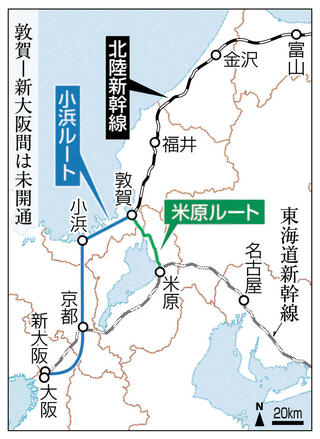
Last spring we wrote about the newly opened extension of the Hokuriku Shinkansen connecting Kanazawa and Tsuruga for Number 1 Shimbun. Eventually, the line will go to Shin-Osaka, but at the time the exact route had yet to be determined. Three possibilities were being discussed, with two of them going through the city of Kyoto.
In December, three priests representing the Kyoto Buddhist Association, which oversees thousands of temples, visited the Kyoto prefectural offices in their ceremonial robes to deliver a petition to Governor Takatoshi Nishiwaki stating the association’s opposition to the ruling coalition’s preference that the Hokuriku route go through Obama in Fukui Prefecture and then on to Kyoto Station via an underground tunnel. According to a feature in the Asahi Shimbun, the Liberal Democratic Party and its coalition partner, Komeito, decided in 2016 that this would be the route and have been trying to finalize the plan ever since. Last August, the land ministry studied the three proposed plans. The priests’ gripe has to do with ground water, which is important to Kyoto’s traditional food and beverage makers, especially the many sake brewers who rely on the prefecture’s famously pure mineral water. The tunnel for the Hokuriku Shinkansen would destroy much of the prefecture’s water source.
Asahi says that when the priests arrived with the petition, Nishiwaki was “about to leave the office,” thus suggesting he was trying to avoid them. The priests told him that they “would not be around when construction of the proposed line is finished,” and so they feel they are responsible to those who will come after them.
But it isn’t just the ground water that is causing locals to question the proposed route. Last August, local officials also calculated a new estimate for the cost of constructing the route from Tsuruga to Osaka, and found that it could be as much as ¥3.9 trillion, which is much more than the last estimate projected in 2017. And if present consumer price index trends continue as they are, the price could increase to ¥5.3 trillion. Both the municipal government and the prefectural government said they don’t know how they could possibly afford that.
Tax season is our least favorite time of the year, and probably yours, too, so we weren’t necessarily inclined to read an article about housing loan income tax deductions that appeared in the Jan. 26 Asahi Shimbun, and not just because we don’t want to be reminded of all the calculations we will have to make and the forms we still have to fill out, but also because we paid off our meager mortgage just a few years ago and so the article has nothing to say to us. But it may have something to say to others.
The article focuses on one particular qualification for a housing loan tax cut, which sounds fairly obvious. You qualify if you bought a residential property to live in and took out a loan to pay for it. The article mentions a realtor who received a phone call from someone who bought a house from them, complaining that they had been refused a tax deduction for their housing loan. As it turned out, the client, who is a salaried employee, had been transferred to another location by his company, and so he decided to rent out the house he bought through the realtor during the indefinite transfer period. The client’s whole family moved with him to his new location. After he submitted the proper form for the housing loan deduction with his tax return, he received a call from the tax office saying that he no longer qualified because he didn’t live in the house for which he took out the loan.
In principle, the deduction covers 0.7 percent of the housing loan balance for a given tax year up to 13 years, a maximum loan amount of ¥50 million, and a maximum tax deduction of ¥4.55 million. The deduction applies to both income tax and local tax, and if the income tax deduction is more than the tax that is actually paid, then the difference is applied to the local tax.
But as the tax office pointed out to the property owner in question, if the person who took out the housing loan is not living in or on the property for which they took out the loan then the deduction does not apply. A tax accountant told the Asahi that the tax office is very strict about this rule since the central government essentially forfeits ¥1 trillion a year in potential tax revenues because of the housing loan tax deduction.
In the case mentioned above, the borrower/owner should have reported rental income after deducting expenses, but apparently many people in the same situation neglect to do that. The client in this case was angry that the realtor did not inform him of this rule when he bought the property, but the realtor didn’t know that the client would be transferred so there was no reason to talk about such things. Nevertheless, there are a number of circumstances under which the housing loan tax deduction does not apply, and realtors should be clear about them. In many cases, homeowners who file for housing loan tax deductions who do not live in the homes themselves are breaking the law. The tax accountant says that in all likelihood, if the tax office finds out that someone is renting out a property that they own without reporting the rental income, the tax office will not only cite the owner for claiming a tax deduction they didn’t qualify for, but will charge a penalty on top of the taxes owed for the unclaimed rental income and the loss of the deduction.
In an article we wrote for the Number 1 Shimbun last year we talked about a new government scheme called Sozoku Tochi Kokko Kizoku Seido, a “system for returning inherited land to the state,” which makes it possible someone who has inherited land they don’t want to transfer title to the central government. We expressed doubt as to whether the scheme would at all be effective in resolving the huge unmanaged land issue in Japan because the conditions for the government accepting the land in question seemed onerous. In order for the land to pass approval for acquisition, the nominal owners would be subject to a screening process that most would not be able to pass.
It’s been more than a year since the plan went into effect, and according to a YouTube interview with the real estate lawyer Tatsuya Arai, who specializes in abandoned properties, the system seems to be working better than expected, even if the number of cases accepted by the government is still pretty small. Arai says that the prognosis for the government scheme “is unexpectedly good,” according to lawyers and notaries he talked to.
The Ministry of Justice (MOJ) released statistics related to the 1,905 applications it had received for the ssystem as of April of 2024. Land registered for agricultural use accounted for the largest number of applications, 721. After that, 698 applications were for residential land, 280 for “forested” land in mountainous areas, and 206 for “others.” The reason residential land and forested land were not represented more, Arai believes, is because the conditions for application made it difficult. Applications must be accompanied by photographs of the property in question showing border markers (kui), which in the case of forested land in remote mountainous areas is difficult—most owners of such land don’t even live close to it and, in some cases, may not even know exactly where it is. In the case of residential land, the property must be completely cleared, meaning any structures that were built on it must be torn down and the land “cleared.” Moreover, many residential lots developed just after the war were not surveyed properly and/or the lots were built in cities where laws were later passed designating road widths and other infrastructure regulations, so the border markers may not be legal. But farmland is relatively easy because it usually contains no structures and the borders are usually easy to discern because owners needed to distinguish their land from their neighbors’.
Of the 1,905 applications received, 248 (107 residential, 57 farm, 6 mountain, 78 others) were approved, which may not sound like a lot, but one has to take into consideration that it requires at least 8 months to screen the applications, according to the MOJ. Then, after the screening, there is another process that must be carried out before the government decides to acquire the land. For Arai, the important aspect is not how many applications have so far been approved, but how many have not been approved, and that number is only 18. That means the approval rate for the applications initially submitted is 93 percent, which is much higher than Arai and his colleagues in the legal professsion thought it would be.
Of course, the main obstacle is, as already mentioned, the set of conditions for the application, and Arai is positive that there are many more than 1,905 people—he estimates the number is in the millions—who want to get rid of the land they have inherited or will inherit. In that regard, he thinks more people should make the effort to apply. In addition, the ministry has not promoted the new scheme very much, so many people who could take advantage of it may not even know about it. But that aspect could also be hiding a less convenient truth, which is that the central government is not really enthusiastic about acquiring land it cannot use easily. He has the feeling that once the number of approvals reaches a certain level, the ministry may tack on new conditions that will make it more difficult for approval. Also, it costs money: ¥14,000 for the application itself and then, once the application is approved and the government decides to acquire the land, a much larger fee to actually execute the transfer of title. He mentions that 212 applications were actually withdrawn during the screening process, which could indicate several things: the applicant found a buyer for the land, or the applicant realized how much it would cost them if the application was approved. But even factoring in these withdrawals, the approval rate is still quite good.
Arai recommends that anyone who wishes to take advantage of the system call the Ministry of Justice and explain their situation. The MOJ will tell them outright if their application even has a chance because they don’t want to waste time either. He says that the ministry received more than 10,000 inquiry calls as of April 2024, so since only 1,905 applications were made, it indicates many of the callers had already been discouraged from applying. That said, if the MOJ thinks you have a case for an application, the chances are good it will be successful. He also adds that the MOJ is “the strictest of all the government ministries,” so make sure the applications are properly filled out. Even an incorrectly written kanji might mean a rejection.
Last spring, the National Association of Realtors in the U.S. announced that it was eliminating its rule on realtor commissions in the wake of settling a suit brought against it by homeseller groups. The main result of the new rules put in place is that commission rates charged to sellers, which formerly hovered around 6 percent, would be done away with. Under that system, the seller often had to pay a commission not only to their own realtor, but to that of the buyer.
Realtor fees are still a normal part of the property transaction in Japan, and also tend to be 6 percent, though in Japan’s case that fee is divided between the buyer and the seller, meaning each side pays their own realtor 3 percent, which is the limit as prescribed by the government. However, on top of this commission realtors charge a flat ¥60,000 per transaction from each party, a fee we’ve never fully understood until we read an article in the Dec. 25 edition of the Asahi Shimbun.
The article covered a new rule that goes into effect this month with regards to information about properties for sale. As background, the article points out that when a property is put on sale, the seller will in all likelihood hire a realtor to manage the sale. The realtor typically sends the information pertaining to the property to the Real Estate Information Network System (REINS), a database that shares such information with member realtors, who can use it to find buyers for the listed properties. However, some realtors do not want to share such information with other realtors, preferring to find potential buyers themselves. In such cases, the REINS listing may say that the sale has been “temporarily suspended.” The reason is obvious. Since it is common for both sides of the transaction in Japan to pay realtor fees, the listing company is hoping to grab the full 6 percent commission allowed by law by being the agent for both the seller and the buyer.
This practice is called ryote torihiki, meaning “charging both parties,” and while it is not illegal, it is clearly a conflict of interest. If the realtor in question represents both sides of the transaction then its incentive will be to keep the price of the property as high as possible in order to maximize its commission. Normally, buyers of properties insist their realtor negotiate the price as low as they can, but in this case the realtor will not do so because it is also representing the seller, who wants to get the highest price possible.
The new regulations require all realtors to register all properties they are representing with REINS, after which they receive a certificate that is passed on to the seller, who can use the QR code on the certificate to check their agent’s REINS page, thus confirming the progress of the sale. As one agent told the Asahi, this move is important because in the past realtors might post false information on the REINS listing in order to discourage other realtors from looking for potential buyers. They would do this by posting an altered floor plan that might show less floor area or otherwise post information that indicated the property was flawed. Meanwhile, the posting realtor would look for buyers on its own with the real information about the property. According to the new rules, any realtor who posts false information would be penalized. The agent who talked to Asahi went on to say that this “exclusionary” practice is one of the reasons why the secondary house market in Japan “doesn’t grow,” since it makes the cost of buying and selling such properties artificially high.
The article was very informative, but while it mentions the ¥60,000 surcharge (+ consumption tax) that realtors regularly attach to the transaction, it doesn’t explain it in detail, so we dug a bit further and came across a real estate blog called Rakumachi that did. What we found was interesting, and a bit surprising.
Apparently, the 3 percent ceiling on commissions is qualified. The 3 percent limit is for properties whose price is above ¥4 million. A realtor can charge up to 5 percent for properties priced at less than ¥2 million, and up to 4 percent for properties priced at less than ¥4 million. Since very few properties in Japan—or, at least, very few properties that a real estate agent will agree to handle—are priced at less than ¥4 million, the higher commission fees would, it seem, never come into play, but the actual procedure is tricky.
Realtors essentially “interpret” these regulations to mean that the first ¥2 million of a sale price extracts a commission of 5 percent, the portion between ¥2 million and ¥4 million extracts 4 percent, and the rest of the price extracts 3 percent. So, in practice, if a property is being sold for ¥20 million, the commission would be ¥100,000 (¥2 million x .05) plus ¥80,000 (¥2 million x .04) plus ¥480,000 (¥16 million x .03), for a total of ¥660,000. If the commission for the entire sale price was set at 3 percent, than the total fee would be ¥600,000. So what realtors do, in order to appear as if they’re applying only the 3 percent commission fee, is charge that fee and then add the surcharge of ¥60,000 to make up the difference. (It always works out to ¥60,000 regardless of the actual price of the house) No one has ever legally challenged this practice, which every real estate agent in Japan employs. As Rakumachi points out, the surcharge is merely a “custom,” and both brokers in a transaction demand it, so if the seller’s agent is also the buyer’s agent, that agent can make even more money. As for the legality, Rakumachi says, “It isn’t clear.”
Just before Christmas, the Asahi Shimbun ran a story in preparation for the first anniversary of the Noto Peninsula earthquake, whose effects still weigh heavily on residents of the area. Demolition work on structures damaged in the quake continues because many of the houses in the areas most affected were already abandoned and thus local authorities couldn’t contact owners easily. The article first focuses on the city of Suzu in Ichikawa Prefecture. The coastal residential zone was badly damaged, and since houses were densely packed and the streets only wide enough for one car to pass through at a time, cleaning up the area has been very difficult.
According to Asahi’s investigation, many of the houses in this area were not only already vacant when the quake hit, some were in such bad condition that they were uninhabitable, mainly because the houses had no value whatsoever. A survey conducted in 2022 found that 1,365 houses in Suzu were abandoned, of which 60 had insurmountable structural problems. The quake caused more than 3,000 houses to collapse, but this number only covers houses that were occupied, and the city has yet to carry out a more extensive survey to comprehend the full story with regard to vacant houses that collapsed or were fully damaged.
The problem for the city is that tearing down a house requires consent from the owner, and if local authorities cannot contact the owner they usually do nothing; but even if they do find the owner, it doesn’t mean that person can be compelled to either renovate the house or demolish it, both of which cost a lot of money.
The situation is even worse in nearby Wajima, where 30 percent of the houses in the “urban” part of the municipality are vacant. Local leaders told Asahi that some of the owners of these houses do occasionally stop by to visit their properties when they come to pay their respect at family graves in the vicinity, which makes these leaders reluctant to tell these owners they have to do something with their properties. “It might be difficult for them to part with the house,” said one official.
Asahi extrapolated these issues to talk about fears regarding the long predicted Nankai Trough or Tokyo earthquakes, which would affect a huge area from the capital all the way to the western edge of the Kansai region. If a quake with the intensity of at least minus 6 on the Japanese scale struck this area, it could be a bigger mess than anticipated, since about 1.45 million houses in the region are vacant wooden structures, a number that increases every year. Asahi’s own research found that about 750,000 of these houses are abandoned, meaning the owners of more than half do not even visit or keep up the property. Even in Tokyo’s 23 wards, where real estate values are the most expensive in Japan, there are 55,000 abandoned wooden houses, the most being in Setagaya Ward (7,500). One Setagaya official said the problem will only get worse because the boomer cohort will soon die out, leaving their children with properties those children likely don’t want to take over.
We’ve written about Yusuke Yoshikawa, a YouTuber who covers what he calls “genkai new towns,” which are difficult to describe, but anyone who has followed our blog for any extended amount of time should be familiar with the concept. Essentially, Yoshikawa seeks out derelict housing developments, mainly in Chiba Prefecture where he lives (and where we live, too). He makes videos of these subdivisions, which contain not only abandoned houses, but plots of land that have never had anything built on them and thus are usually overgrown with vegetation because the people who own them have given up on whatever plans they had for the land. According to Yoshikawa, most of these plots were bought for investment purposes during or shortly after the bubble period of the late 80s and early 90s. His well researched and very funny videos have garnered him enough followers to allow him to make a living off this pastime, and he has recently been in demand as a paid speaker and published a book that is selling well. He’s a self-made success, but not in material terms. As he has pointed out, he himself lives in one of these genkai new towns, somewhere past Narita, because he could no longer afford to live in Tokyo, where he was a cab driver. In a sense, he’s stuck where he is but says he nevertheless can blog from a unique perspective about the state of Japanese real estate. He’s the most honest, clear-headed critic in the field, and he’s totally a layman.
On Dec. 6, Asahi Shimbun ran an interview with Yoshikawa conducted at his home. The interviewer sounds a bit naive about Japan’s property situation, but maybe he’s just taking the role of the average reader. In any case, if we were doing the interviewing (and we hope to someday) we’d have more pointed questions, but this will do for now and, we hope, steer more people to Yoshikawa’s blog.
As the reporter points out in the introduction, Yoshikawa lives on the edge of the Tokyo metropolitan are, meaning a place where you can sense the population dropping off and nature taking over places where people were supposed to be living. He notes “land that was prepared for residences” but which contain “no buildings.” Infrastructure is either non-existent or “in very bad condition.” He hopes these descriptions help the reader gain a better understanding of Yoshikawa’s term, genkai new town, which has entered the vocabulary thanks to the internet. When he meets Yoshikawa at his home in one of these developments, he remarks how lonely it is. The paved streets and retaining walls make it clear that this area was prepared for residences, but there are no people.
Yoshikawa explains that the area was developed “several decades ago” but for the most part very few people built houses on the land they bought. The interviewer mentions very old signs with the names of real estate companies that, presumably, are trying to sell particular plots, and Yoshikawa responds that in most of these cases the seller has given up and doesn’t even come to keep the plot tidy. These developments are what he calls “small scale new towns,” new towns being, in the public’s mind, large residential projects carried out with the help of public entities to develop tracts of land. Most of the more well-known new towns were built in the 60s and 70s, but these small scale new towns were built by developers as subdivisions of land that was no longer being used for agriculture, mainly during the bubble period, when real estate values skyrocketed and commercial entities were convinced that people who couldn’t afford homes in the major cities would flock to the outskirts of suburbia to live. These companies were overzealous and so were the small-time investors who bought plots in the belief that they could sell them later for more money. At some point, however, there were just too many small scale developments being built and the whole endeavor just collapsed.
He goes on to explain how he was living in Tokyo’s Koto Ward in 2017 and having a tough time making ends meet because the cost of living kept rising. Both he and his wife worked, but they had no savings or assets and assumed if they remained in Tokyo they would just be living hand-to-mouth in small rental properties for the rest of their lives. So they looked for a place to buy that they could afford and this derelict property was the closest thing they could find. Though the development has 64 lots, only 7 contain houses.
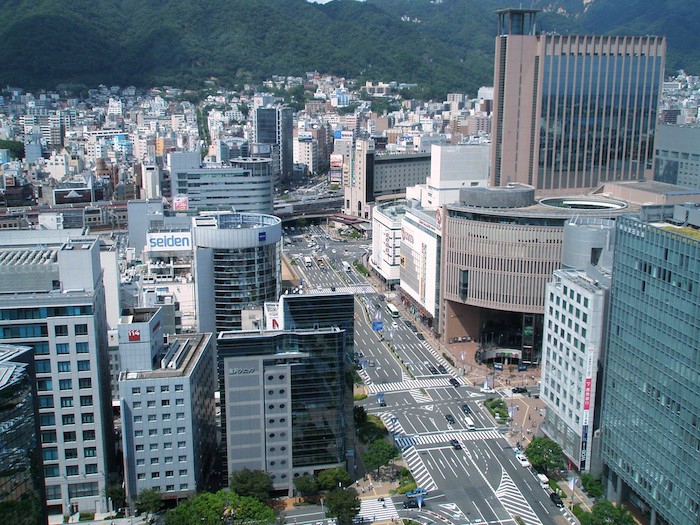
The major residential developer Sumitomo Fudosan will soon complete construction of two high-rise condominiums in the Sannomiya district of Kobe. The pair of 27-story buildings comprise 690 units, with apartments on the upper floors fetching as much as ¥200 million for their panoramic view of Kobe port.
Sales have been very good, and according to a recent article in the Asahi Shimbun it’s not just because of the great view and the vanguard amenities. Word has already gotten out that these two towers will be the last high-rise condos built in Kobe, thus increasing their scarcity value, which means that over time their resale value could go up.
But likely that would only be in the short term. The reason there will not be any more “tower mansions” erected in Kobe is that the city has decided to prohibit new housing construction south of JR Sannomiya Station, which is a commercial district. In addition, the city has restricted the capacity rate of any new residential construction around Sannomiya Station to 400 percent, which means no new tall apartment buildings. Essentially, the municipal government is limiting the amount of new housing that can be built in the city center.
Their reason for this restriction is worth scrutinizing. According to Asahi, many cities in Japan are competing with one another to attract new residents with high-rise condominiums in their respective city centers, the idea being that people want to live near their places of work. Osaka, for example, which is next door to Kobe, is redeveloping the Umeda district north of Osaka Station, a commercial area, and one of the prime features of this redevelopment is high-rise condominiums that the city leaders hope will attract well-to-do working people. The mayor of Kobe has said that this kind of policy doesn’t make any sense when a city’s population is decreasing, as Kobe’s is. When you build new housing while the population is going down, you’re basically creating waste for the future.
As we’ve pointed out in previous posts, the prices of new condos in Tokyo have risen considerably in the past few years owing to the high cost of construction, lowering supply, and an increase in sales to investors, whether Japanese or foreign. A June 20 article in the Asahi Shimbun about the cheap yen includes remarks from realtors who say that new condos in central Tokyo will remain expensive for the near future, with some, in fact, explaining that now they only deal with high-earning double income couples and rich investors.
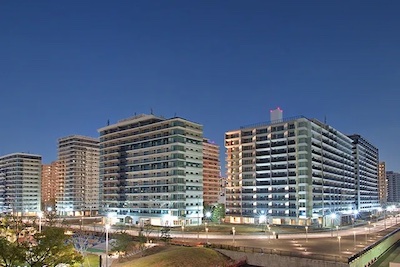
In light of this situation, the news surrounding one large Tokyo condo complex has been instructive. Harumi Flag, which was originally built to be the athletes village for the 2020 Tokyo Olympics, finally started receiving residents in January after renovations to turn the living quarters into condominiums was delayed almost two years by the pandemic. However, according to a June 7 report by NHK, as of the end of May a good portion of the units in the 17 buildings that have been sold so far are empty, which NHK finds strange since the demand for the Harumi Flag condos was quite intense owing mainly to the fact that prices were reasonable compared to other real estate in the area. NHK’s investigation found that many of the units were bought by investors, which shouldn’t sound strange given the current real estate climate in Tokyo, but the Harumi Flag project was initiated by the Tokyo prefectural government for the secondary purpose of eventually selling the residences to people who would live in them, in particular families. That’s supposedly why the initial prices were set lower.
NHK checked the title registrations of 1,089 units of the 2,690 that have been sold so far in the Sun Village part of the complex. Mitsui Fudosan Residential, the company that headed the consortium of 11 developers involved in the project, has been selling the condos in phases, and in the most recent phase there were an average of 71 applications for each unit. There were no limits to how many applications a potential buyer could submit or units they could purchase if their luck was good. Under such circumstances, institutional investors applied for as many units as they could, since they could buy as many units as possible by borrowing money more easily. In fact, NHK discovered that 292 units out of the 1,089 they checked were owned by companies, or one out of four. Sales began in 2019, and four sales phases were carried out in 2021 and 2022, with the largest number of companies registered as owners with the justice ministry following the last of these. However, when NHK checked with the Chuo Ward office it found that there were no resident registrations (juminhyo) listed for 30 percent of the condos, meaning that, technically, no one is living in these condos. In fact, more than half the units sold during the last phase were bought by companies, with many purchasing more than one unit. The investors who own the 292 units in question comprise 147 companies, most of them dealing in real estate and investment. On further investigation, NHK found that only five of these units were being used by their corporate owners as offices. NHK makes a special note in the report that all these corporate owners are Japanese, which they think is surprising considering all the media attention being paid to foreign buyers of Tokyo real estate.
One investment company from Fukuoka, in fact, owns 38 units, and while they wouldn’t talk to NHK, their home page mentions their involvement in Harumi Flag “at an early stage” to “ensure stable returns on investments.” Two other companies did talk to NHK on condition of anonymity. One had 3 units in the complex and owned properties in Tokyo and Yokohama, as well as in the U.S. Their total real estate investments amount to ¥3 billion. A different company owns “more than 4 units” in Harumi Flag, and says they applied for and bought condos during each sales phase. In the beginning, they weren’t sure if the investment was wise, but now they are very happy because they are sure they can sell them for a hefty profit, and that seems to be the case. NHK says that so far hundreds of units have already been resold or are on the market for prices that are from 50 to 100 percent higher than their initial sales price. According to one real estate portal site, a 4LDK, 100-square meter unit in Sun Village that originally sold for ¥106 million is now on sale for ¥238 million.
But the market is still hot, so many of the investor-buyers are not planning on selling for a while and instead are renting out their units. Unfortunately, there are too many units for rent in the complex so few have found tenants, though there are other reasons for the low occupancy rate. Harumi Flag is 20 minutes from the nearest station and all the leases have a limit of two to five years, because the owners may want to sell the units if the price peaks. NHK doesn’t mention the cost of rent, but when we checked portal sites we found one 86-square meter unit asking for ¥420,000 a month and a 65-square meter unit going for ¥280,000 a month.
NHK talked to one couple in their 60s who made 7 attempts to buy a unit in Harumi Flag and failed. Their budget was ¥80 million, which was more than sufficient for a good-sized condo during the initial sales phases but not enough to buy one that is being resold, so they’ve given up, even though several buildings in the complex are still under construction.
We’ve written extensively about Tokyo’s current condo boom without really addressing what it will lead to in the long run. Most commentators seem to expect a burst bubble, like the one that happened in the early 90s following a similar over-valuation of properties in the late 80s. However, there is an important difference in that the current Tokyo bubble is being pumped up by rich people. The average price of a new condo in the capital has exceeded ¥100 million. In the late 80s, the bubble was caused by everyone, since the huge boomer cohort had secured its lifetime employment and banks were willing to lend them money. Even though housing interest rates are low in Japan compared to the bubble era, younger families with average incomes who still insist on buying new condos are finding it difficult to find anything they can afford in the 23 wards, according to local media.
A recent video on the YouTube real estate channel Rakumachi put the present bubble in perspective, especially in terms of what it holds for the future. According to Tomohiro Makino, a “real estate producer” whose career started in the 80s, people who say the Tokyo condo market is “over-heated” need to look at classic supply-and-demand. “Over-heated” suggests that the market will eventually cool, but since this particular bubble is being caused by rich people and institutional or business investors, it isn’t that simple. Scarcity is one of the factors fueling the over-heated prices: the number of new condos on sale in recent years is one-third the number that were on sale in a given year two decades ago. Much of the reason for this scarcity is the high cost of building materials and lack of labor. Building a condominium is much more time- and capital-intensive than it used to be, so developers have scaled down. And with prices so high, buyers trend toward people who benefit from certain financial realities, such as foreign investors who can exploit the historically cheap yen. Even rich elderly Japanese who don’t necessarily need a new place to live are buying high-end condos in Tokyo as hedges against taxes their heirs will have to pay when they die. So they invest their cash in real estate, which can lower the inheritance tax burden by as much as 70 percent. Those who do buy new Tokyo condos for living purposes tend to be so-called power couples—married people whose combined incomes exceed ¥15 million a year.
So the high condo prices are essentially being maintained by a small group of people. Nomura Securities says the number of “very wealthy” households in Japan, meaning they are worth more than ¥500 million each, is around 90,000, for combined assets (not counting debt) of ¥105 trillion. Merely “wealthy” households (¥100-¥500 million) number around 1.4 million with ¥259 trillion in assets; “less wealthy” (¥50-¥100 million) number 3.3 million with ¥258 trillion; upper middle class (¥30-¥50 million) number 7.2 million with ¥332 trillion; and the vast middle class (less than ¥30 million), numbering 42 million, is worth ¥678 trillion. Though the top two tiers account for a bit more than 2 million households, the amount of assets they control is considerable. Much has been made of the global income gap in recent years, and Makino says the top 1 percent in Japan has seen its wealth increase by 80 percent since 2013, when Abenomics. The investment market was flooded with easy money, but average households received no comparable benefit from the policy. Makino says that its effect on real estate has led to the over-heated condo market, putting Tokyo real estate out of the reach of the middle class. Developers don’t even think about this group of consumers, because they know that even if every condo they build is luxury-class, they can still sell them. Consequently, they don’t have to build that many in order to make as much money as they used to make when they sold to everyone. The average price of a new condo in the 23 wards as recently as 2015 was ¥60 million. Last year it was ¥115 million. And due to the lag in construction costs, prices will continue to go up for the near future.
And it’s construction costs that are the main concern for developers, since right now they account for 70 percent of the cost of a condo, the other 30 percent being land. This aspect is very significant, because while land prices vary greatly depending on location, construction costs do not. It costs almost the same to build a condo in the suburbs as it does to build one in the center of Tokyo, so most developers are putting as much of their money and resources as they can into the city. Even mid-sized developers that tend to do all their work in the suburbs are foregoing new construction to invest in new condos in Tokyo by borrowing money to buy them from major developers. Then they quickly resell them to make money. The most prevalent example of this kind of practice in the news right now is the Harumi Flag complex on the waterfront, which was built as the Tokyo 2020 Olympic athletes village and then sold or rented out afterwards. A substantial number of the condos remain empty because they’ve been bought by corporations, including developers, as investments, thus pushing the price of individual units up. According to Makino, some companies have bought from 10 to 20 units in Harumi Flag.
Makino sees this trend continuing as long as interest rates remain low, since most investors don’t use their own money to buy real estate. Once rates start to rise, he says, the market will cool as investors pull out. Now that the era of the “negative interest rate” has ended in Japan, he thinks that such a change is on the horizon, even if many experts believe the Bank of Japan won’t increase interest rates due to the amount of government bonds it has. But the BOJ doesn’t control interest rates. Other factors, including environmental disasters, international politics, even rumors, will always come into play, and once they do “the party will be over,” meaning even foreign investors will bail regardless of the exchange rate. This could prove to be a huge shock to the system. After all, young Japanese adults today know nothing about interest, having been born without any experience of bank deposits earning interest. It’s unrealistic to think that this kind of environment will persist indefinitely, but until it does change it’s also unrealistic to thing that average Japanese people will step in when wealthy investors drop out. It’s just too risky for the average household to buy a condo in Tokyo now or in the near future.
If Makino were to give advice to potential middle class homeowners who want to live in Tokyo, it would be to wait, probably until 2030, by which time he says the “market will surely change.” Not only will prices for condos, used and new, go down, but so likely will rents. And his reasons for thinking so are grounded in an unavoidable truth. Households headed by people over 65 in the Tokyo metropolitan area now number 9 million, with half of those headed by people over 75. That number will steadily increase. After 2025 all the 1.5 million boomers living in the metro area will be over 75, and while lifespans are also increasing, it won’t be long before this cohort starts dying out in record numbers, which means their property will either be left to heirs or abandoned, if it hadn’t already been sold. These people came to the metro area in their youth to work, and they bought homes. But their children, now middle aged, mostly own their own homes, too, and so won’t need their parents’, which means they’ll sell it or do something worse (pretend to ignore it?), but in any case there will be a lot of empty homes on the market. This, as Makino points out, is the heart of the akiya problem, which will only intensify by the end of the decade, throwing the real estate market, including Tokyo’s, into turmoil. Oversupply will become a chronic issue unless the construction industry and the authorities change their tune with regard to building new residences, which is pretty much all they think about now.







 Cat Foreheads & Rabbit Hutches