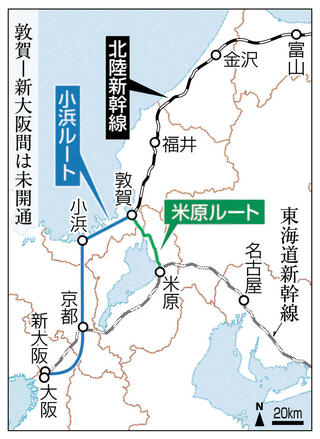
Last spring we wrote about the newly opened extension of the Hokuriku Shinkansen connecting Kanazawa and Tsuruga for Number 1 Shimbun. Eventually, the line will go to Shin-Osaka, but at the time the exact route had yet to be determined. Three possibilities were being discussed, with two of them going through the city of Kyoto.
In December, three priests representing the Kyoto Buddhist Association, which oversees thousands of temples, visited the Kyoto prefectural offices in their ceremonial robes to deliver a petition to Governor Takatoshi Nishiwaki stating the association’s opposition to the ruling coalition’s preference that the Hokuriku route go through Obama in Fukui Prefecture and then on to Kyoto Station via an underground tunnel. According to a feature in the Asahi Shimbun, the Liberal Democratic Party and its coalition partner, Komeito, decided in 2016 that this would be the route and have been trying to finalize the plan ever since. Last August, the land ministry studied the three proposed plans. The priests’ gripe has to do with ground water, which is important to Kyoto’s traditional food and beverage makers, especially the many sake brewers who rely on the prefecture’s famously pure mineral water. The tunnel for the Hokuriku Shinkansen would destroy much of the prefecture’s water source.
Asahi says that when the priests arrived with the petition, Nishiwaki was “about to leave the office,” thus suggesting he was trying to avoid them. The priests told him that they “would not be around when construction of the proposed line is finished,” and so they feel they are responsible to those who will come after them.
But it isn’t just the ground water that is causing locals to question the proposed route. Last August, local officials also calculated a new estimate for the cost of constructing the route from Tsuruga to Osaka, and found that it could be as much as ¥3.9 trillion, which is much more than the last estimate projected in 2017. And if present consumer price index trends continue as they are, the price could increase to ¥5.3 trillion. Both the municipal government and the prefectural government said they don’t know how they could possibly afford that.
The central government has tried to assure them that it will handle the cost, since the Hokuriku extension is a “seibi shinkansen” project, meaning it is effectively owned by the central government. JR West, which would operate the line, only pays rent on facilities after it’s completed. But as far as construction goes, under the seibi shinkansen protocol, the country pays for two-thirds and the rest is covered by the relevant local governments. In 2016 Kyoto city and prefecture approved a route that would go from Obama to Maizuru and then to Kyoto, but that was before it was made aware of the effect such construction would have on Kyoto’s watershed. The problem, according to Asahi, is that the newly elected mayor of Kyoto, Koji Matsui, who formally opposes the shinkansen plan, used to be a cabinet minister in the Hatoyama asministration, and prior to his election as mayor in February 2024, he seemed to be all for the extension going through Kyoto. Now he says the plan needs “more study,” which sounds like bureaucrat-speak for being against it.
LDP lawmakers in Tokyo say they are willing to bear the full cost of construction if it means getting the extension built, but Matsui still seems reluctant, understanding that, regardless of the LDP’s promises, Kyoto in the end will have to bear something. As a former central government bureaucrat he knows how these promises work. For that matter, Nishiwaki is also an ex-central government employee, for the land ministry, no less, which means he is equally reluctant to contradict his old bosses by being openly against the proposal, so Matsui will have to be the leader whose face fronts the opposition. In any event, both Nishiwaki and Matsui went to Tokyo in December to relate their concerns to the government committee that is studying the proposals. Though it’s reduced the number of proposed routes from 3 to 2, the committee still hasn’t made a final decision, which it was supposed to do last year. At this point, there is still no projected opening date for the extension to Shin-Osaka.
 Cat Foreheads & Rabbit Hutches