Dynasty end

Unwanted

In 1941, 22 percent of all dwellings in Japan were owned by the people who inhabited them. By 1948, the portion had swelled to 48 percent in the cities and 67 percent nationally. Even before the war housing was at a premium, but thanks to the wholesale destruction of the Japanese archipelago during the final years of the war, it had become even more dear when the American occupation started. Inflation was rampant, and in order to make sure property prices didn’t spiral out of control a directive was issued in 1946 to freeze land prices and rents. It wasn’t the first time. Similar directives were issued in 1939 and 1940, but they were provisional. The 1946 directive was more open-ended, and the result was that landlords couldn’t raise rents. One of their countermeasures, at least in Tokyo, was to implement the now infamous koshinryo system: Every time the rental agreement expired, the landlord would charge the tenant an extra month or two worth of rent as a renewal fee. (This will be the topic of our next “Home Truths” column in the Japan Times on Tuesday) However, most landlords, unable to pass on maintenance costs, simply sold the properties to their tenants. Moreover, there was no incentive to build new rental properties, so construction companies started building houses for the few people who could actually afford to buy them. Ever since then, there have been more homeowners than renters in Japan.

The home ownership rate first peaked to 71 percent in 1958, then slid down to 64 percent by 1963 and 60 percent by 1968. The main reason is that more people migrated to cities for jobs. They couldn’t afford to buy houses, so more rental properties were built in urban and suburban areas. However, by this point home ownership became a national priority, since it spurred growth. With the population increasing and nuclear families replacing extended families as the household norm it wasn’t difficult for the government to promote home ownership through schems such as the Home Finance Law (1950), which made mortgages affordable; and the Public Housing Law (1955), which set up a government corporation to oversee the building of affordable rental properties in cities so that young families had a stepping stone to home ownership. The main problem is that in order to make home-ownership possible for the new generation of urban workers they had to be made relatively cheaply, since land prices have always been high. In other words, the houses themselves weren’t meant to outlast their mortgages. Read More


Sourced

Masako was used as the framing voice in an article by Hiroko Tabuchi in this morning’s New York Times about the Tokyo high-rise market following the quake. You can read it here, though you may have to register first.

All fall down

In the months after the March 11 earthquake, a condominium management association conducted a survey of the Tohoku region to find out the damage sustained by multi-resident buildings. Almost all those that were built since 1981, when stricter earthquake-proofing codes went into effect, survived with minimal damage, but there were quite a few built before 1981that didn’t do as well. In fact, the survey found that about 60 structures in Sendai alone had been declared zenkai (“completely damaged”; in other words, legally uninhabitable).

The Asahi Shimbun looked at several of these buildings. One, the somewhat optimistically named Sunny Heights Takasago, was built in 1976 and was actually damaged in 1978 during a large earthquake that struck Sendai. However, the damage wasn’t “complete” and repairs were made. The building was not so lucky this time. The condominium is actually two 14-story buildings positioned in an L-shape. During the initital earthquake the two structures knocked against each other, but afterward inspectors declared them yochui–residents should take caution but they could keep living there. But the condos sustained further damage in the aftershock of April 7: window and door frames deformed, cracks appeared on outside corridors, steel beams were exposed. Even worse, the ground itself was “damaged.” Consequently, the properties were condemned. Read More

No parking

It takes two

Yesterday at our sister blog, Yen for Living, we posted an article about big cars that probably needs some clarification. By no means are we fans of big cars and, in fact, we sort of denounced cars in general when we sold ours in 2006. We aren’t necessarily against cars in principle, but the automobile is privileged way too much in Japan and America (we can’t vouch for Europe and the rest of Asia). We simply wanted to comment ironically on what we thought was the strange marketing logic of GM, and also wanted to use this photo of a Hummer that is parked not far from our apartment. The fact that the owner needs to rent two parking spaces says a lot about Japan’s car-ownership situation, though it should be pointed out that these spaces only cost ¥4,000 each. For another look at how parking explains Japan’s car-ownership situation, after the jump is an article we wrote for the Asahi Shimbun in 2004, when we were still car owners ourselves. Read More

The right thing

The blur of memory: After the cleanup in Tokyo

In the last few posts we’ve ragged a bit on UR, specifically their dodgy ties to outside providers like Tokyo Gas and local cable outfits, but that shouldn’t be interpreted as disillusionment. For all its anal bureaucratic culture and general air of mismanagement, Japan’s only national semi-public housing corporation is also the only place in Japan where renters get a fair shake. We found that out when we received the refund for our security deposit a few days ago.

We moved from a UR high-rise in Tokyo to a low-rise UR complex in northern Chiba Prefecture. UR makes it relatively easy to move from one of its buildings to another one. The tenant doesn’t have to go through the screening process again (unless he/she is moving to a decidedly more expensive residence), and the security deposit (shikikin) that was paid for the former apartment is transferred to the new one, with the difference either being made up by the tenant or refunded to him/her. In our case it was the latter. Though the new apartment is the same size as the one we rented in Tokyo, it is almost ¥70,000 cheaper per month. The security deposits for UR typically amount to the equivalent of three months’ rent, which is a bit higher at the moment than security deposits for private rentals, but the important thing to remember about UR is that they don’t charge “gift money” (reikin) or contract renewal fees (koshinryo), and also don’t require guarantors or co-signers. Read More

Gas attack

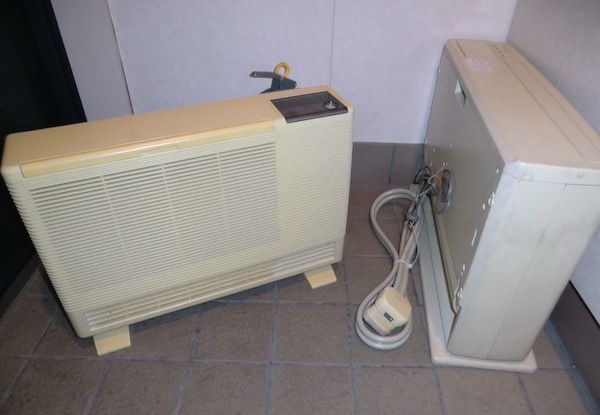
In the previous post we talked about Tokyo Gas’s relationship with the public housing corporation UR and how we were left with no choice but to throw away two perfectly good space heaters because they couldn’t be used in our new UR apartment and there was no system set up to sell or even give them to people who might be moving into our old UR apartment. As it turns out Tokyo Gas has UR tenants coming and going. Out new apartment does not have a stove, though our old one did. This is a facet of rental living in Japan that I had forgotten all about: the total lack of appliances. In the U.S. when you rent an apartment, you almost always get a stove, an oven, a refrigerator, sometimes even a washer/dryer, not to mention central heating. You don’t necessarily get any of those things in Japanese rentals, though, as I mentioned, our last UR apartment did have a stove, and recently some UR apartments have had floor heating or wall heating units built into the rooms. We have gas-powered floor heating in our new apartment in the living room only, but for some reason it’s billed separately from the other gas we use in the apartment, which means it requires a separate contract and, thus, a separate contract signing fee: ¥7,500 just to turn the system on. We were told, however, that if we did use floor heating we would get a “discount” on our total gas bill in any month we used the floor heating. We assume that means floor heating is very expensive. Since there are no gas outlets in our new apartment, we would have to heat the place with electric space heaters or kerosene heaters if we decided not to use the floor heating. In any case, it won’t be cheap. Read More

Wasted

Planned obsolescence

Moving house is a pain in the ass, but it can also be a rush. Basically, you shlep your entire life to a new abode and in the process assess that life in concentrated form. Inevitably, you are forced to pick and choose what you want to keep from it and what you want to discard. Some things you get rid of simply because you want to get rid of them, and some things you get rid of simply because you have to.

Yesterday we threw away two perfectly good heaters because we can’t use them in our new apartment. We also can’t sell tor even give them away, and it’s hard to shake the feeling that it was somehow planned to be this way. The heaters are made and sold by Tokyo Gas. Unlike standard gas heaters, which directly convert “city gas” piped into your home into heat, these draw hot water from your boiler (or, to use the redundant Americanism “hot water heater”). In that way they function in much the same way that baseboard heating does, except for one very significant difference. Baseboard heating is built into a house or apartment, and is generally designed in such a way that it doesn’t get in the way. These water heaters, on the other hand, are stand-alone boxes that do get in the way since they connect to wall outlets via thick hoses. Ideally, Tokyo Gas wants you to buy one for every room in your apartment, and priced at between ¥28,000 and ¥45,000, they can add up to quite an investment. Read More

Go West

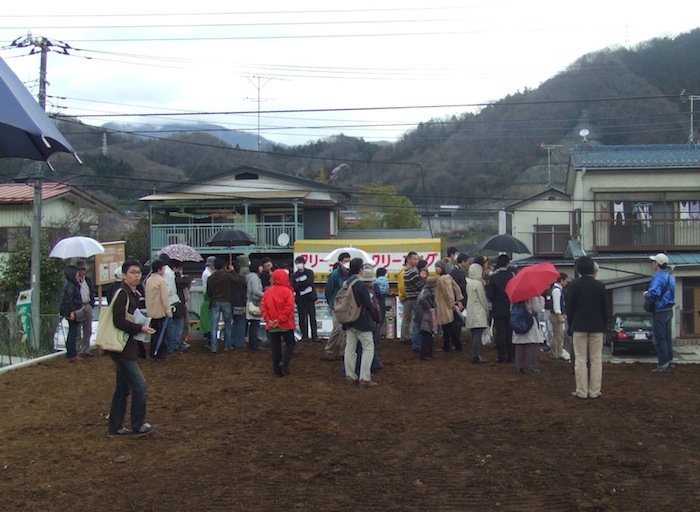
Potential buyers inspect land for sale in Fujino, western Tokyo

Two weeks ago we were at the UR office in Yaesu helping some friends get around the application process and asked the employee about availability. Though there was no ulterior motive behind the question, the woman volunteered that a lot of residents in UR high-rises in the waterfront area were moving out after the earthquake. We were slightly taken aback: Only a semi-public organization like UR would admit to potential renters that people were anxious to leave their properties.

Upon further investigation, we found that the story is a bit more complicated, at least when it comes to buying and selling property. According to various news reports, there has been a notable increase in interest in the Musashino daichi, or plateau, which covers parts of Western Tokyo and Western Saitama Prefecture. This is considered stable land, meaning no risk of liquefaction. The waterfront, of course, is all built on landfill, but there are many other areas located inland that suffered soggy ground after the Mar. 11 earthquake, such as Abiko in Chiba and Kuki in Eastern Saitama, communities that were built on ground that used to be swampland, rice paddies, or even ponds. Usually, you can determine the kind of land an area once was by consulting an old map. If the old name contains words that indicated water, like numa (marsh), then you might want to make sure your foundation is built on piles. In fact, a lot of developers change the names of such places so that people think they were built on solid rock (almost any subdivision with the word oka–hill–is a dead giveaway). Read More

Cheap fix

Here is a housing-related article we wrote for our sister blog at the Japan Times about a recent government study about reserve funds for condo repairs. It relates to a lot of the themes we have covered in this blog.