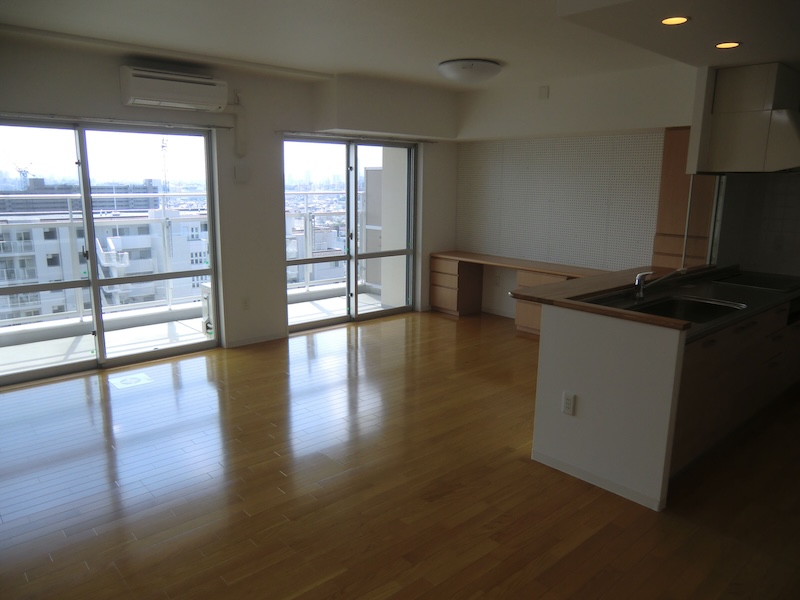
It says something that the big economic buzz word in Trumpworld—affordability—has entered the Japanese lexicon as a katakana term, though it seems to be restricted to real estate in Tokyo, which, as we’ve mentioned so many times, is the only real estate story that the Japanese media cares about. But while everybody knows that prices of residential properites in the capital are skyrocketing, less is said about rents, which are going up even more.
In February, the real estate portal site At Home announced that the average rent in Tokyo’s 23 wards had increased for 21 months in a row, a new record. Moreover, the average rent for a unit for one person, meaning a condo or apartment of 30 square meters or less, had exceeded ¥110,000 a month for the first time. In fact, the exact amount, ¥110,177, marked a 12 percent increase from the previous year, another record. One of the reasons for this massive increase is the replacement of old wooden apartment buildings with concrete ones, with the new units being made smaller so that more of them can be fit into the space the former ones once filled. But larger apartments also saw startling year-to-year increases: two-person units (30-50 square meters) averaged ¥124,378 a month, a 10.7 percent increase; and family units (50 square meters and larger) averaged ¥174,082 a month, an 8.2 percent increase. Tokyo apartments outside the 23 wards went up less, but still went up: ¥87,887 for a two-person unit, an increase of 5.7 percent.
The Tokyo Metropolitan Government anticipated these developments and, according to Asahi Shimbun, will start providing “affordable housing” in the prefecture starting this year. One of the related measures will be to levy a special tax on residential properties that remain vacant, though so far no details or timeline has been announced.
What has been rushed into realization is ¥10 billion in investments from Tokyo in new affordable housing in partnerships with four foundations set up by major real estate companies like Nomura Fudosan. These funds will be used to operate rental housing that on average will be about 20 percent cheaper than current market rates. This year 350 units throughout the city will be made available starting next month. All these units are existing apartments that have been renovated. In principle, Tokyo is not going to build any new housing for the project but rather use existing structures with the help of private partners and investors, who will earn dividends on the returns, though lower than other real estate investments since such investments are pegged as “social contributions.” Tokyo is currently studying a system that could create more rental units by easing capacity rates in order to encourage developers to build more affordable housing. (Though it should be noted that easing capacity rates was the scheme of the Koizumi administration to increase construction, which lead to the boom in high-rise condos.)
One affordable rental property has already opened. Neuvono Kikukawa, operated by Mitsui Real Estate, as a kind of model for the project. It is two buildings in Sumida Ward comprising about 100 units, each about 55 square meters in size. The target is families and all the units were quickly rented out. There is a licensed nursery school on the first floor that is always open.
Tokyo is thus playing catchup with other major world capitals, many of which have had affordable housing schemes for years, though the success of such schemes has been patchy. Rents are rising everywhere in the world at alarming rates: Sydney 3.5 percent in the last year, Mumbai 2.8 percent, New York 2.6 percent. The reasons are numerous but mainly come down to increased urbanization and the globalization of real estate investment. Local governments in France already impose steep taxes on vacant properties.
The main problem in Japan is that both the central and local governments have never really been concerned about rental properties. Since the 1970s, the national policy for housing has been to encourage home ownership by essentially ignoring rental properties and the rights of renters. Tokyo isn’t the only municipality to start doing something about affordable rents. Kyoto has a plan to implement a tax starting in 2030 on second houses and vacant homes in order to spur usage of available properties for rental purposes. Essentially, Kyoto wants the owners of these properties to either live in them or sell them. Kobe is also discussing a similar kind of tax, not just for houses but vacant rooms.
These plans, however, have their skeptics. Tsunehira Furuya, a well known author who has written many books about housing, admits that Tokyo’s plan is “ambitious” but that it will probably do little to rein in rents. One reason is the semi-public housing company UR, which is the biggest landlord in the world. UR is famous for not imposing gift money or renewal fees and not requiring guarantors, policies that make it much easier for people to move in to their properties. However, UR tends to charge about 10 percent more for rent than market rates in a given area so as not to compete with private landlords, thus always keeping rents on average higher than they would normally be.
But the main problem, according to Furuya, is that the government, Tokyo’s included, still can’t look beyond the ownership priority policy, the thinking being that people who own the homes they live in work harder and consume more, thus spurring the economy. However, this rationale is based on social models from 50-60 years ago and does not always jibe with present economic realities, such as the ongoing diminishment of the lifetime employment system. Before the war, 70 percent of Japanese people rented. Now 60 percent own, a result of the authorities pushing the idea after the war that renters should be made to see that they live a “makeshift existence” until they man up and buy a house. That’s why the situation surrounding rental properties has always been bad, unlike in Europe where renters’ rights are protected. This paradox is best represented by relative size. The floor area of owned homes in Japan is not that much different from the floor area of owned homes in North America and Europe, but the average floor area of rental properties in Japan is about half that of rental properties in Europe.
Another problem that’s not unrelated is that the government is averse to doing anything that might upset private landlords. As already mentioned, UR sets its rents higher so as not to compete. That’s why UR’s predecessor, the Public Housing Authority known as Kodan, built rental properties in inconvenient locations so as not to provide competition for private landlords, according to Furuya. Also, genuine public housing, which in Japan is only operated by local governments, is very spare. There is always a long waiting list of low income families trying to get in. Too much public housing would upset the real estate industry. As long as this mindset endures, affordability with regard to rent will always be difficult to achieve.


Hi,
Interesting to see the rents in Tokyo.
Australia has a huge housing shortage and surging rents.
This is a result of huge increase in population from immigration, a failure to build more housing units, and increasing interest rates and costs.
Condos here are surprisingly quite small with many 2 bedroom units having 60 to 80 meters in internal space.
Three bedroom units are scarce in many areas are are often luxury type accommodation.
In comparing those rents in Tokyo to Australia in number terms not adjusted for income they are cheap.
One of those typical two bedroom condos will cost around $750 a week in Brighton or around 330,000 yen a month.
Houses?
Where I live in the suburbs a typical 4 bedroom house will rent for $1000 a week or more or 440,000 yen a month.
LikeLike
Eugh, this is a bad idea, it hasn’t worked anywhere globally (“Affordable housing” biggest practitioners are the places that have the worst affordability, England, California).
I would also totally challenge the idea that Japan doesn’t serve renters, the soft-rent control system they’ve had since the 1950’s, plus the scale of building saw declining prices quality adjusted (i.e. everywhere has showers, aircon etc) and location adjusted (i.e. high share of population lives in big cities). Depreciation/high property taxes/financial repression also mean Japan is probably the OECD country with the least subsidy to homeownership with the possible exception of Switzerland. Its why homeownership has stagnated around 60% despite quality adjusted housing costs being stable/declining over the last generation. Japan is probably the best builder of working class rental housing in the OECD. Japanese social inequality doesn’t come from housing issues but from tax subsidies and rentier industries at the expense of the urban poor.
Japan’s high depreciation rate means that if it gets hit by interest rates or higher import costs, or labour shortages affordability can hiccup quite rapidly. But Yoshida Jiro points out that the current “affordability” worries are very much a Tokyo-special wards centric story that hasn’t really broken out into the suburban prefectures.
That said Japan really should be looking towards building social housing, because the depreciation and aging issues means Japanese settlements need to consolidate and concentrate. But few want to commit even to the modest extent Toyama is. And that’s not just LDP-construction industry pipe, that’s also fundamental denialism of everyone, from the PM to the electorate. And don’t forget the gerrymandered electoral system.
LikeLike