Not what they paid for

In December, the Chiba city office of East Japan Railways (JR East) announced a change in the timetable for the Keiyo Line that would start in March. The Keiyo runs from Tokyo Station parallel to the Tokyo Bay shoreline south to Soga Station in Chiba city. It is the train line that services Tokyo Disneyland and the Makuhari district of Chiba, which is the home of Makuhari Messe, one of the metro area’s biggest exhibition and convention facilities. The reason for the timetable change was the removal of the Commuter Express train, which does not make any stops between Shin Kiba Station in Tokyo and Soga, and which operated twice in the morning and twice in the evening. The Commuter Express would be replaced by local trains, which stop at every station on the line, but several Rapid Express trains would be added during off-peak hours in the daytime. 

According to the transportation-oriented website Impress Watch, the announcement was met with opposition from local governments affected by the Keiyo Line, including Chiba city’s and Chiba Prefecture’s. In addition, the major media covered the matter with an eye as to how the changes would affect commuters, many of whom demanded that JR East reinstate the Commuter Express. As a compromise, the company added two Rapid Express trains to the morning peak and two to the evening peak, which was highly unusual. Once a railway company changes a timetable they almost never change it back, even partially. However, the compromise may not be enough for commuters who rely on the Keiyo Line to get to their jobs in the capital. In fact, many probably bought their homes on the Chiba peninsula because of the Keiyo Commuter Express, which is why many real estate companies and residential housing developers are nervous about the timetable changes. 

JR East told NHK that the number of passengers on the line has decreased by up to 30 percent during peak periods compared to before the pandemic. There are a total of 18 stations on the Keiyo Line, of which 7 are not serviced by the Commuter Express and the Rapid Express. The company thinks that people who live near these stations are inconvenienced by the former express train timetables, and wanted to give them more opportunities to use the line. In addition, local trains have to wait at certain stations along the line for Commuter Express and Rapid Express trains to pass, thus further inconveniencing local train users. Though JR East emphasizes that they’re thinking about local line users, it’s their own bottom line that’s really at issue. Those who use the various express trains to get to work are already locked in as customers, so the strategy of the timetable change is to add passengers by increasing local runs and making them more “efficient” for those passengers. And on paper, at least, the difference in time doesn’t seem that bad. During peak hours, the local train from Soga to Tokyo, and vice versa, takes only 19 more minutes than the Commuter Express. 

Read More

Make mine maglev (5)

Heita Kawakatsu

At the end of March, JR Tokai admitted something that we have been writing about for a number of years, which is that the inaugural Shinagawa-Nagoya leg of the Chuo Shinkansen, more popularly known as the linear motorcar in Japanese and the maglev in English, will not open in 2027 as originally planned. JR Tokai, the railway company in charge of the project (often referred to as JR Central in English), had already submitted a notification to the transport ministry in December saying that the maglev wouldn’t open until “after 2027,” but didn’t announce the revision publicly until March 28. Some reporters and at least one major media outlet, the Nihon Keizai Shimbun (Nikkei), have been suggesting for years that, given the unprecedented scale of the project, there was no way JR Tokai was going to open the line, which will zip passengers between Tokyo and Nagoya in 40 minutes, by 2027.

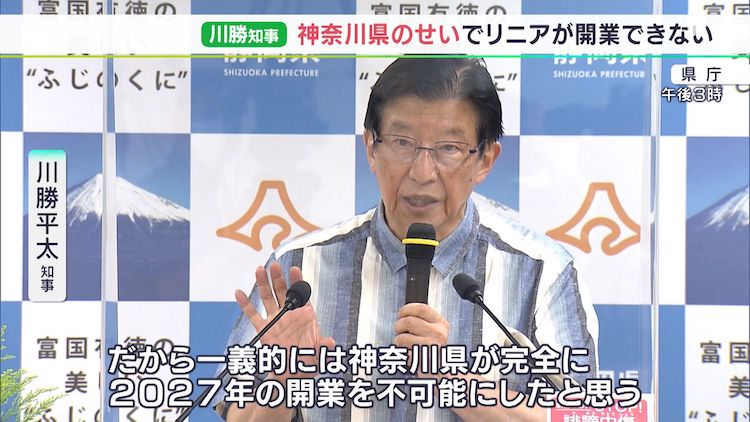
The company was going to have to deliver the bad news eventually and needed a convenient scapegoat. They already had one in the form of Shizuoka Prefecture Governor Heita Kawakatsu, who had been a thorn in the side of the project for more than a decade (though the prefecture’s beef with JR Tokai extends back to before his administration). JR Tokai is now blaming Kawakatsu almost exclusively for the delay. As we’ve explained in the past, the governor, who professes to be in favor of the maglev, had refused to grant the company permission to carry out tunnel construction in his prefecture until it could guarantee that the Oi River, which is in the vicinity of the construction work, would not lose any water as a result. Tens of thousands of residents rely on the river as a water source, and JR Tokai’s own impact study projected that tunnel construction would result in a significant loss. The problem has been a matter of debate between the prefecture and the railway since 2014.

According to Nikkei, the transport ministry called a meeting at the end of March where the water problem was discussed within a framework of environmental conservation related to the maglev construction, and at the start of the meeting JR Tokai President Shunsuke Niwa said that, due to Shizuoka’s intransigence, he could no longer project when the Shinagawa-Nagoya leg would open. Another JR Tokai official explained that the original construction period of 17 years “could not be shortened,” and since it would have taken ten years to complete the line after construction of the Shizuoka section started, even if they did so this year they wouldn’t be able to finish the 8.9 kilometers of tunnel that passes through the prefecture until 2034. This is a big problem for JR Tokai since local governments and businesses located along the maglev line have been carrying out infrastructure construction and redevelopment in anticipation of a 2027 opening, and the delay could cost them money and, more significantly, public trust.

Then, on April 2, Kawakatsu announced he would resign in June, one year before his fourth term is up, for something that had nothing to do with the maglev or JR Tokai. During a speech to welcome new prefectural employees, the governor made a stupid remark belittling vegetable sellers and other occupations. All the media reports on the resignation mentioned that JR Tokai had blamed Kawakatsu for the fact that the maglev wouldn’t open in 2027, and while the ostensible reason for Kawakatsu’s standing down is the remark, he told reporters, perhaps passive-aggressively, that he wanted to remove himself as an obstacle to the tunnel construction.

Read More

Condo, heal thyself

One of the fees that condominium owners have to pay every month is called shuzenhi, which are contributions to a fund that will go toward large-scale repairs of common property in the overall structure, such as exterior walls and some plumbing shared by all the residents. This fee is separate from the management fee, which goes toward operation of the building and more immediate maintenance, including mandatory elevator inspections. Ideally, large-scale repairs should be carried out every dozen years or so, but they usually aren’t owing to difficulty in gaining approval from the needed majority of owners. As a result, many buildings fall into disrepair after several decades, but even when the homeowners get it together and vote for necessary work, there usually isn’t enough money in the fund to cover what has to be done. That’s because developers purposely set the monthly fees for the repair fund low so as to make it easier to sell units when they are first put on the market. We’ve read of cases where homeowners in some condominium buildings had to pay tens of millions of yen each on top of the money they’d contributed to the fund in order to get repair work done. Most condo operations are run by outside management companies, which may or may not be related to the original developers, and one of their tasks is to raise the shuzenhi gradually over the years so that there is enough money for the repairs, but, again, they need to gain the approval of the mandated portion of owners to do it, and that can be hard.

In response to this problem the construction ministry last month assembled a panel of experts to study a system, first implemented in 2022, for local governments to certify whether condo owners associations are operating properly. According to a ministry survey the amount of funds needed for long-term repairs is, on average, 3.6 times the amount collected using the original contribution calculation, but this real amount can go as high as 10 times the originally collected fund. Another survey conducted in 2018 found that 35 percent of condos nationwide have insufficient repair funds, which is likely a low estimate. According to a Feb. 23 article in the Asahi Shimbun, the ministry is trying to come up with better ways to persuade condo owners associations to increase their repair funds by adopting a savings plan based on long-term estimates of exactly how much money will be needed. Usually, when developers set the monthly contributions no such estimates have been made. The amount of the contribution is set arbitrarily based mainly on market considerations. 

The revised plan that the ministry has submitted to the expert panel for study says that the amount needed for long-term repairs should be calculated and then divided into the number of owners and number of months remaining between the start of the fund and the proposed repairs. The ministry recommends that the actual monthly contribution be no less than 60 percent of the estimate and no more than 110 percent. However, if the fee is set at less than what is needed for the eventual repairs, the association can increase it over time by up to 80 percent. This means that if the full monthly contribution for long-term repairs is calculated to be ¥20,000 based on what the cost of repairs will be in the long run, the developer or whoever makes such a decision can set the actual contribution as low as ¥12,000, but then can increase it over time to ¥22,000. 

Such a plan would be included in the management authorization system that local governments use to certify condo owners associations. Certification is based on whether the association has a long-term repair scheme. If the local government grants certification, the association is entitled to borrow money for large-scale repairs at a lower interest rate. 

In a followup report on Feb. 27, the Asahi looked at a condominium in Tokyo’s Adachi Ward that contains 28 units and was built in 2008. Three years ago, the owners association increased the repair savings fund contribution 3.5-fold. The 45-year-old head of the association said that when he took over the position in 2017 he realized that the fund was about ¥20 million short of what it should have contained according to the initial savings plan. The reason for the shortage was that previous association heads did not carry out contribution increases every three years in accordance with the initial plan. The current head invited an expert to talk to other members of the association about what they needed to do, saying that if they didn’t carry out these needed repairs, the building itself would need even more expensive work down the line just to keep it working. Though the owners approved the new contribution plan, it took two years and 8 months to convince them. 

The purpose of the ministry’s certification system is to avoid this kind of delay because increases in contributions would be incorporated into a plan, but as the Adachi example shows, even when such a plan exists it doesn’t mean the owners association will stick to it. The certification system is an incentive, but it is not mandated by law. For that reason, in addition to being eligible for lower interest rates to borrow money for repairs, the panel has suggested that associations who devise a plan and stick to it could have their property taxes lowered. As of the end of February, only 481 condo associations nationwide have been certified. The panel believes that the guidelines for the system should provide more of an incentive if such certification doesn’t have the force of law behind it.

Read More

Too much of not enough

One of the prime purposes of this blog is to explain the paradox of Japan’s housing situation. The country’s residential real estate market is one of the liveliest in the world, and yet most homeowners can’t count on their properties being net assets in the long run. And then there’s those 8.5 million empty residences, which, despite the occasional media story about some foreigner swooping in and turning a derelict kominka into a dream home, will likely remain empty forever without a concerted effort on the part of the central and local goverments to either find a way to make them desirable or get rid of them. 

A recent story that appeared on the financial magazine Toyo Keizai‘s web site reinforces this paradox. The writer, a real estate consultant named Yujin Oki, claims that there is a critical housing shortage in Japan. In a long article dense with statistics he doesn’t even mention the akiya (empty house) situation, probably because his focus is still on urban housing, and most abandoned homes are in the countryside or outlying suburbs (though there are also quite a few in Tokyo). The part of the paradox he does mention is the demographic angle: Japan’s population is declining, which means the available housing stock should be increasing, but it isn’t. He then endeavors to explain why. 

Since 2013, he writes, the price of condominiums in Japan has increased by 70 percent. The main reason is Abenomics, or, more precisely, the monetary easing policy that was a core component of the late Shinzo Abe’s master plan to bring the Japanese economy back to its former glory. The Bank of Japan would print more money and give it to commercial banks at low interest rates. Most of this cash was loaned out to buy land, since it is the most secure investment, and that drove prices up. This always happens with monetary easing. 

However, the situation was complicated by extraneous factors, namely the sudden increase in the price of construction materials and the more gradual decrease in the construction labor pool. Residential developers who borrowed all this available cash were faced with rising construction costs and delays in construction time due to lack of workers, thus driving the price of newly built homes higher. On top of the boost in land prices, new housing was more expensive, especially in places like Tokyo and its surrounding suburbs. Though he doesn’t specify exactly when, Oki says that the number of new condos in the Tokyo metropolitan area going on sale was once 90,000 a year, but this year the number has dropped to only 30,000. That’s why there is a shortage.

As we’ve often pointed out in this blog, almost all the writing about real estate trends focuses on Tokyo, and this article is no exception. Oki does make a point of saying that the shortage he’s talking about is in “places where people want to live,” but doesn’t interrogate that qualification any further. For instance, we can say for a fact that the suburb where we live, an hour from Nihonbashi by train, has seen a lot of new building in the last five years and many young families moving in, but this kind of growth seems to play no part in Oki’s calculations. New homes still seem to be affordable and plentiful for people with average incomes in our neck of the woods.

Read More

Price is right, for the moment

The news that land prices throughout Japan have risen 0.3 percent over last year’s prices was covered extensively by the media last month. Though 0.3 might sound negligible, it’s the first time in 30 years that the change was in the positive direction. Of course, land values in the three major metropolises have always gone up in a net fashion to a certain extent, but prices in what are called “regional areas,” meaning the countryside and smaller urban metropolises far from Tokyo, have either gone down or remained stagnant. The big news is that this increase has happened two years in a row, thus proving it isn’t just a fluke. According to the Asahi Shimbun, four regional capitals led the surge—Sapporo, Sendai, Hiroshima, and Fukuoka. During the pandemic these cities saw land price increases of between 4 and 6 percent, but last year the change was plus 8.1 percent. As it happens, rural land continued to lose value during the pandemic, but on average last year it leveled off: prices in 27 of 38 prefectures surveyed went down as a whole, but the prices in the capitals of 20 of these prefectures either increased or remained the same, further proof that land value may finally be turning the corner, so to speak. 

What this means, according to Asahi, is that people are moving into these regional cities in substantial numbers, thus boosting hiring and education, which in turn spurs redevelopment. So far the most publicized examples of this trend have been the introduction of semiconductor factories into areas where there was previoulsy little industrial development, namely Chitose in Hokkaido and Kikuyo in Kumamoto. In the former, the company Rapidus is building a factory that will open in 2027, employing about 1,000 people. Local realtors told Asahi that individuals and businesses are snatching up property near Chitose Station, the main train hub in the area, which is about 40 minutes from Sapporo. Some realtors claim that there is no more vacant land to be had around Chitose Station, and what is available slightly farther from the station is “very expensive.” By the same token, TSMC, the Taiwan semiconductor maker, plans a factory in Kikuyo, and the news has caused land prices in the area to skyrocket. One reason for the unusual increase is that a lot of people who own land in the area are not selling at the moment, but waiting for land values to increase even more before they put their properties on the market. 

Another reason for regional increases is that retired people are selling their homes and moving into apartments and condominiums in regional cities, thus boosting property values in those cities. One developer told Asahi that in Yamagata City a new 70-unit condominium still under construction is almost sold out and cites the availability of services in the area as the main appeal: a ten-minute walk to Yamagata Station, and within a 5-minute walk 3 hospitals, a full range of public schools and a retail district. Even with prices going up, a unit in the new condo is very affordable, 3LDK for only ¥35 million, including tax. One 88-year-old woman told Asahi that she moved to an apartment in the area after selling her house and since then her life “has become easier because I don’t have to shovel snow.” Asahi notes that land prices in Yamagata Prefecture are still dropping, but prices in Yamagata City have increased for 9 years in a row. 

Read More

Capital gains

As recently as a decade ago there was fairly active discussion in the Japanese government about moving certain central government functions out of Tokyo. The reasons were varied, but it mostly came down to their being too much power concentrated in the capital, be it administrative, economic, or cultural. Besides the most urgent issue of what this concentration means if a major disaster strikes Tokyo, there are the demographic considerations. As the city remains affordable to most workers and the center of government and commerce, the rest of the country is drained of manpower, resources, and capital, since young people still move to Tokyo and its suburbs in large numbers. On the most basic level, the job of moving millions of people twice a day to-and-from their jobs becomes an undertaking of enormous precision, and while Tokyo has managed to do it with miraculous agility, the cost to the country in terms of both money and individual well-being has never been properly gauged. As the pandemic recently proved, it seems most people would prefer working either at home or much closer to home. At the very least, twice daily 90-minute-plus-long commutes on crowded trains take their toll, and the main reason is that they have to work in Tokyo but prefer living in a place where they can own a home without risking their savings and raising a family in a comfortable environment. 

Nevertheless, the idea of moving government functions out of Tokyo as a means of encouraging decentralization has never received anything more than lip service. Some years ago a tourist-related government office was removed to Kanazawa or thereabouts, and there was talk about transferring culture-related bureaus to Kyoto, but Tokyo remains the overwhelming center of the Japanese universe. 

With this in mind, it’s interesting to observe how South Korea has addressed its own decentralization problem. Seoul is also a kind of black hole that sucks resources and people from other areas of the country, attracted by the concentration of corporate, administrative, and educational functions. But the government has actually tried to do something about it, and a recent interview in the Asahi Shimbun with the mayor of Sejong, which is located in the middle of the country, points up the differences in approach between Korea and Japan. In 2012, the central government of Korea designated Sejong, then just a patch of dirt about one hour south of Seoul, as an autonomous district and the future administrative capital of South Korea. Now, some 23 government entities have permanently moved their operations there, which is more than the number that remains in Seoul. In the end, the only ministries that will not move are those involved in foreign affairs and national security. They even plan to build a second presidential office and second parliament building in Sejong. 

The current mayor, Choi Min-ho of the People Power Party, who was elected last year, has been involved in the project since its beginning. Choi is an alumnus of Georgetown but, more significantly, studied local government administration at the University of Tokyo graduate school, thus giving him a unique insight into how the Japanese government’s approach to decentralization compares to Korea’s. As he notes during the interview, the main difference is “the speed of decision-making.” In South Korea, politicians have more power in this regard than do bureaucrats. The opposite is true in Japan, he says, where all matters are discussed thoroughly by civil servants and thus take a long time to reach any kind of realization. “And once a decision is made in Korea,” he says, “we take action.”

Of course, such a process has its own demerits in that decisions made in haste require ongoing repairs and improvements. He presents as an example the transfer of personnel along with the offices in which they work. “We had to think about housing them and their families, and if they already owned homes in Seoul, it might be difficult for them to sell them and move here. Some may decide not to move, preferring to commute, and then the problem is transportation.”

Though these problems were formidable, in time they became workable. A massive construction project to build collective housing was approved and carried out, and the government built a high-speed train between Seoul and Sejong that takes 50 minutes one-way. 

Read More

Occupy Kyoto

(Kyoto Shimbun)

Last week, the Kyoto city assembly passed a regulation to introduce a special tax on unoccupied properties or underutlized second homes for the purpose of opening up the used housing market. Kyoto is experiencing an acute housing shortage that is pushing up prices and, as a result, making the city unaffordable for young families, who are moving out to the surburbs. Before the regulation goes into effect it has to be approved by the internal affairs ministry, and when it does it will be the first such local tax system that targets vacant properties, or akiya, as they’ve come to be called.

The regulation, which wouldn’t be implemented until 2026, targets three categories of empty properties according to appraised value: properties that are less than ¥7 million, those between ¥7 million and ¥9 million, and those that are more than ¥9 million. Each category would entail a different rate of taxation, and if the appraised value is actually less than ¥1 million, no extra tax is imposed for the first five years after the new regulation goes into effect. There are probably very few, if any, properties worth less than ¥1 million in Kyoto, since the appraised value would be for both the structure and the land together. Unoccupied properties includes non-rental condominiums and apartments that are empty. Excluded from the new tax are “historically significant structures,” such as Kyoto’s famous machiya row houses; as well as properties used exclusively for business purposes, rental properties, and empty houses and apartments that the owner plans to put on sale. 

According to the Nippon Keizai Shimbun, during the press conference to announce the new tax, the mayor said that the purpose is not to raise revenue, but rather to “improve civic life and stimulate urban renewal.” Apparently, the idea for the tax originated in a proposal for a kind of vacation home property tax, but experts who studied the proposal told the city that it would be better if Kyoto’s large number of unoccupied properties, including vacation homes that seemingly no one was using, were either made available for others to occupy or torn down and replaced by new homes. 

In effect, the tax would be levied on any property deemed to be unoccupied or vacant. The special tax would increase the property tax on such a property by about 50 percent, the idea being that owners who didn’t live there or rent them out would be thus encouraged to either sell them or destroy them and build something new or sell the land. Empty land, it should be noted, is taxed at an even higher rate, as much as six times as land which contains a structure, whether vacant or not. It should also be noted that properties that are categorized as residences but which are being used only for storage are not exempt from the tax; as well as properties that are only occupied a few times a year—though exactly how few isn’t clear from media reports so far.

Read More

Honeymoon in the danchi

The administration of Prime Minister Fumio Kishida is determined to increase the birth rate—last year it fell below 800,000, 10 years earlier than expected—by any means necessary, even going so far as to suggest raising the consumption tax in order to fund programs that would encourage young people to marry and procreate, which sounds not only desperate but eminently wrong-headed. Another head-scratcher is the proposal to forgive student loans to either spouse or both spouses in a marriage when they produce a child, an idea that opposition lawmakers have found risible for a variety of reasons.

Koichi Hagiuda, the ruling Liberal Democratic Party’s policy chief, has another idea: Give young couples, regardless of income, priority to enter low-rent public housing. Tokyo Shimbun reports that Hagiuda made the suggestion at a party meeting in Saitama, saying that the first order of business for newleyweds is finding a place to live. The thing is, the central government doesn’t manage housing for the general public. Public housing in Japan is only maintained at the prefectural and municipal levels, so the government would have to get them to agree to the proposal. 

The party’s secretary-general, Toshimitsu Motegi, elaborated on the idea by saying that the usual upper income limitations would have to be waived for the proposal to work. He also said that initial estimates indicate such a program would cost about ¥150 billion, most of which would be spent on renovations of public housing. On January 30, Hagiuda explained in the Diet that the current income qualification for public housing applicants—household monthly income should not exceed ¥158,000—would have to be changed for newlyweds, but in any case he said it shouldn’t be a problem since there are 200,000 vacant public housing units nationwide.

Read More

Make Mine Maglev (4)

Shizuoka Governor Heita Kawakatsu predicts the Chuo Shinkansen won’t be ready by 2027. (TBS)

Our ongoing coverage of the Chuo Shinkansen, vernacularly known as the “linear motor car,” and usually referred to in English as the “maglev project,” continues apace even if construction itself doesn’t. This week, we found three distinct media stories about the maglev, and while they can be related to one another due to the way they describe obstacles toward completion of the Tokyo-to-Nagoya leg of the railway, they deserve to be addressed separately.

The first story, reported by the Mainichi Shimbun on Nov. 12, takes place in the town of Mitake in Gifu Prefecture. In 2016, two areas within the town had been selected as candidate landfill sites for receiving excavated soil and rock resulting from maglev tunnel construction. However, any formal announcement about the selection had been postponed after problems arose about the “impact” of the decision. Apparently, a portion of the candidate sites included a wetlands area that has been recognized by the environmental ministry as a vital habitat for a rare species of flora. Such designations do not automatically prohibit “development activities,” but those who carry out the operations regarding development are “required” to consider conservation efforts to protect precious resources. JR Tokai, the company building the maglev, has said it would transplant any rare species of plant in the area. 

On Nov. 10, Mitake held its fourth public forum with “experts” and representatives of JR Tokai. Residents expressed alarm, since it was the first time they were alerted to the fact that the landfill project would contaminate a valuable wetlands area, a fact that was actually revealed by reporter Hiroaki Izawa in a scoop for the weekly magazine Sunday Mainichi after he confirmed the environmental ministry’s designation of the rare species. Afterwards, the town’s mayor tried to explain why no announcement had been made previously, even though the environmental ministry’s designation had also been made in 2016. He said that he wasn’t sure what JR Tokai was planning to do at the time and so put off the announcement. After the company pledged to transplant the endangered plant species he became more positive about the landfill project. 

Though the environmental ministry applauded the dialogue between Mitake and JR Tokai, they didn’t address another problem, which was pointed out by a different media outlet, namely that the excavated soil and rock would contain natural heavy metals, which are toxic to living things, including humans. Consequently, the soil would have to be extensively processed before being dumped into the landfill. 

Read More

New Shinkansen comes up short

While we’re in the mood to talk about high speed express trains, we should discuss the West Kyushu Shinkansen, which opened for business on Sept. 23. Its most notorious feature as far as the media is concerned is that it’s the shortest Shinkansen line, at least for the time being: 66 kilometers long, connecting Takeo Onsen and Nagasaki stations in as little at 23 minutes, having replaced the Kamome limited express train. In fact, the new Shinkansen, which will run 44 round trips a day, has appropriated the Kamome name, probably to make locals feel more familiar with something they likely didn’t see much need for; or, at least, not in its present form.

JR Kyushu, which operates the new train, makes a big deal in its advertising of the fact that the Kamome Shinkansen will reduce the journey from Hakata in Fukuoka, the main Kyushu hub, to Nagasaki by 30 minutes. However, the new line does not connect directly to the main Kyushu Shinkansen line. It’s actually completely independent and self-contained, meaning that it only exists between Takeo Onsen and Nagasaki. To get from Takeo Onsen to Hakata, you transfer at Takeo Onsen to the Relay Kamome, which is not a Shinkansen and doesn’t have a connection to the main Kyushu Shinkansen line either. In order for the new Shinkansen to connect directly to the Kyushu Shinkansen line, a new route would have to be made from Takeo Onsen to Shin Tosu station on the Kyushu Line, a distance of about 50 kilometers, and while JR Kyushu has said that it wants to someday build such a line, there are no plans at present to do so. That’s because Saga Prefecture, through which the connecting line would pass, doesn’t want to pay for any more construction. 

Why it doesn’t want to pay for something that would seem to add value to its infrastructure is an interesting, complicated story. Though JR Kyushu, like all JR group companies, is privately owned, it can’t really operate without considerable assistance from the central government, which guarantees the huge amounts of money necessary for constructing Shinkansen lines. The West Kyushu line cost ¥620 billion to construct, which was 20 percent more than the initial estimate. Much of that had to be covered by the central government and Nagasaki and Saga Prefectures.

Read More