The burden of expectations (3)

What we're trying to avoid

What we’re trying to avoid

We went to Tsukuba on a Friday, and the following Monday the woman from SBI Mortgage called and said we had cleared the preliminary screening. She had already given us a checklist of the documents we would need to submit for the final screening and so we started to collect them. It’s a time-consuming process because many documents are required and you have to go to different government offices to get them. The woman had already photocopied our drivers licenses, national health cards, and three years worth of tax returns. Now we had to get real proof of our worth, so to speak. The easiest to obtain was proof of residence (juminhyo) from the local city office. The checklist still had gaikokujin toroku shomeisho, meaning proof of an alien registration card, but the Foreign Ministry had phased out registration cards last year. We could also pick up inkan shomeisho, meaning proof of registered seals, at city hall. In bureaucracy-obsessed Japan, seals remain the looniest relic, since anyone could go to the store and buy one with another person’s name on it and use it in that person’s stead. Signatures are still not commonly used for purposes of witness and certification, though they’re obviously more individual. In order to somehow safeguard the seal as a means of certification you are supposed to register yours at your local government office, and then when called upon by a party with whom you are drawing up a contract you bring that party “proof” from the local government office that the seal you are using is kosher, though I have no idea how counterpart parties check this evidence unless they’re experts in wood-block printing.

A bit more difficult to secure was proof of our income for the last two years. The copies of our joint tax return were used for the preliminary screening but for the next phase they needed actual documents from both the national and local tax bureaus where we lived, which meant taking a trip to Narita as well as a trip into Tokyo, since we lived in Arakawa Ward for the first six months of 2011. In Narita we could also go to the local branch office of the Justice Ministry to obtain records on the land we were planning to buy–history of ownership as well as the official registered survey map of the plot, or, in our case, plots, since the land we were buying was actually two adjoining lots, one about 200 square meters and the other a mere 20 square meters. This smaller plot would prove to be a hassle, but more on that in a later post. On Tuesday we took a trip to Narita to get the documents we could. Read More

Home Truths, August 2013

CIMG2664Here’s this month’s Home Truths column in the Japan Times, which is about the Chiba New Town development project, where we happen to live. To clarify something that may not be apparent in the article, it’s a very nice place to live. As pointed out, the people who reside here enjoy a mix of urban convenience and unspoiled nature, though one of the points we tried to make is that if the New Town scheme had gone ahead as originally planned, it might have been more congested and less attractive, but it was never going to happen that way because of the area and the way it was developed. As it is, the urban sectors have plenty of well laid-out parks, the roads are all lined with wide sidewalks and bicycle lanes (which few people use since everyone drives), there are plenty of retail outlets offering a wide variety of very cheap merchandise, and just minutes’ walk from any station in the NT area you are in deep countryside: rice paddies surrounded by well-kept forests. And while the Hokuso Line is expensive, it is extremely convenient to both central Tokyo (one hour to Nihohbashi without transfer) and Narita Airport (20 minutes), and, probably because it is expensive, it’s never crowded.

Based on a rough survey of the land being developed now for residential homes, lots of approximately 200 square meters will be going for ¥10-15 million, or about ¥50,000 per square meter. So far, tracts being prepared are located 10 to 25 minutes by foot from Inzai Makinohara Station. We haven’t seen too much land being prepared near other stations. When the project started in the 70s, condominiums were promoted, and there are still some large condo complexes near the various stations in the NT area that have vacant units. One, called Doors near Inzai Makinohara Station (five minutes), is only about half filled. Apartments were first put on sale more than two years ago, and since then the developer has decreased the price at least twice, which probably upsets people who already bought. You can get a brand new condo of 70 square meters for only ¥19 million, but if you go a little farther from the station you can probably have a house built for less than ¥10 million more than that. UR, who will be selling most of these plots to real estate and housing companies, will want to get as much money as possible in order to pay down its debt, but with so much being developed at one time and demand unknown, it’s likely that those prices will come down in a short period of time. Chiba, of course, is the cheapest place to live in the Tokyo metropolitan area, and since its population decreases every year, it will become even cheaper just for that reason. Though the New Town has been a failure in terms of what a New Town is supposed to accomplish fiscally, Chiba New Town is a reasonably priced, attractive alternative to its counterparts in other places in the Kanto area. And now that we think about it, maybe that’s the reason Inzai was selected as the most comfortable city in Japan.

Move on up

CIMG2287Of the three prefectures adjoining Tokyo, Chiba is by far the cheapest in terms of real estate. It tends to rate on the dowdy end of the desirability index. Kanagawa remains the hippest because of places like Kamakura, Shonan, Yokohama; while Saitama, though often derided in popular culture as a suburban backwater (“Dasaitama”), was developed rather quickly owing to its size and convenient proximity to the capital. In fact, property values in northern Chiba along the Noda and Joban lines are comparable to Saitama’s. It’s when you get farther out on the Keisei and Sotobo/Uchibo lines that the suburbs become sparser and less expensive. Chiba is viewed as the sticks, which is just as well for us because it offers more affordable places within striking distance of where we live now.

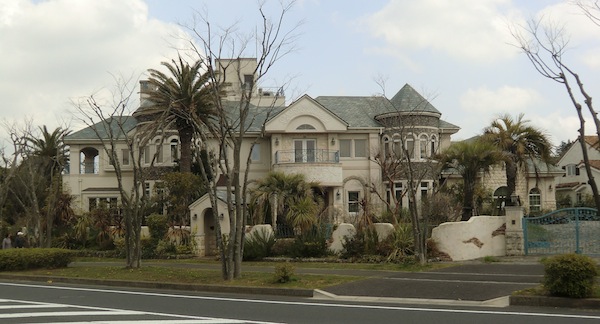
Interestingly, one of the most expensive housing developments in Japan is in a relatively remote corner of Chiba. The Azumigaoka New Town is part of Chiba City’s Midori Ward, but the nearest train station is Toke on JR’s Sotobo Line, which means it’s practically in Ichihara. The exclusivity of portions of the new town development, coupled with the unusually large plots of land contained therein, have earned at least two subdivisions in the area–Prestige and One Hundred Hills–the nickname Chibaley Hills, a takeoff on Beverley Hills. We’ve never seen this neighborhood with our own eyes since, as with the real Beverley Hills, the residents discourage tourists and gawkers by restricting access. When it first opened the development got a lot of media attention, which in turn attracted motorcycle gangs, so now they have a patrol that politely keeps out pedestrians who have no business there. Nevertheless, you can find properties in the area on sale at almost any real estate portal site, and they remain pretty expensive, though certainly not as high as they were when they were first built during the bubble era. What’s considered a super luxury in Japan would be more or less upper middle class in the U.S., essentially backyards big enough to provide privacy, two or more bathrooms, and lots of windows and open floor plans. We even saw one property at a realtor’s site with a swimming pool. Read More

Something to think about (2)

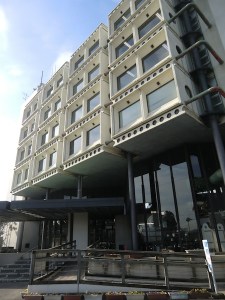
Sakura city office

Sakura city office

In the weeks since we visited the house in Usui we have, indeed, thought a lot about it, and our interest has blown hot and cold. Though we like the layout and the unblocked view to the south, we’re still not sold on the location. Keisei Usui Station is 20-25 minutes away on foot, and the train takes about an hour and fifteen minutes to get to central Tokyo. It’s considerably cheaper than the Hokuso Line, which we use now, and there are more trains per hour, but the Hokuso Line gets directly to the heart of Tokyo in about an hour and is never very crowded, even during rush hour. And it only takes us about 7 minutes to get from our front door to the platform. Of course, the train isn’t a monumental consideration since neither of us goes into Tokyo more than twice a week. Then there’s Usui itself, which as a bedroom town is older than Inzai and experienced the kind of suburban sprawl that plagued most Tokyo bedroom towns developed in the 60s and 70s, while Inzai was better planned and has more parks and open spaces. That said, Inzai is also somewhat antiseptic and lacks the kind of character older Japanese communities offer. Usui was incorporated into the larger city of Sakura some years ago and Sakura is one of the great castle towns of the Kanto region. Parts of it are quite beautiful and well-preserved, it’s just that those parts are not in Usui.

Read More

This land is UR land

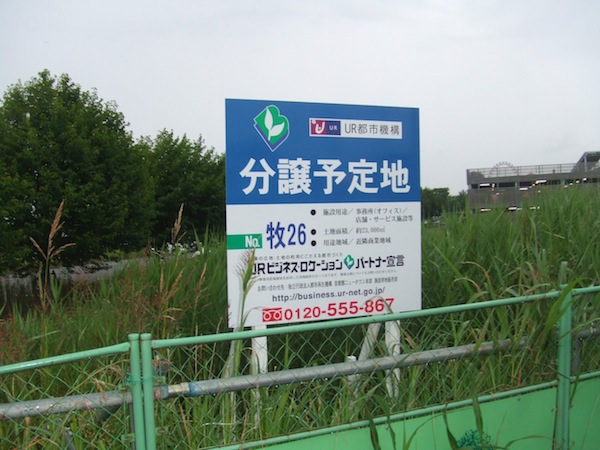
Tract of UR-owned land near Inzai Makinohara station on the Hokuso Line

The Asahi Shimbun recently reported that the government finished auditing its accounts for fiscal 2011. The board that conducted the investigation found 513 separate cases of “waste” comprising ¥529.16 billion, the largest amount since records have been compiled. In the wake of media reports that have government organs inappropriately using tax money earmarked for reconstruction of the disaster-hit Tohoku region, it is natural to assume that this waste would be doubly scrutinized, but we won’t hold our breath. One of the areas that will probably invite less concern is assets held by dokuritsu gyosei hojin–independent administrative agencies–that remain unused. In 2010, the cabinet issued a directive that such assets should be returned to the government, but apparently that’s not happening as the auditors found lots of unused assets lying around–literally, in many cases, since the assets that seem to be the most problematic are real estate-related. The National Hospital Organization, for instance, owns 217,000 square meters of land valued at ¥6.7 billion that remains undeveloped and with no plans for development. According to the cabinet directive this land should be handed over to the national government.

Another independent administrative agency with lots of unused assets is Toshi Saisei Kiko, more popularly known as UR (Urban Renaissance), the semi-public housing corporation that the government would like to make completely private because it’s such a sinkhole for money. Since UR’s business is the sale, development, and management of real estate, its unused asset problem is also a business problem, and the auditors found that the company controlled 223 hectares of land valued at ¥89.7 billion that was unused, which many not sound like much, but apparently the audit board was only talking about assets that were supposed to be “processed” during FY2011. As almost everyone knows, UR has lots and lots of land that remains undeveloped, and since all of UR’s debts are covered by the government the auditors insist that UR can cover at least some of its deficits by liquidating land assets. Read More

Space invaders

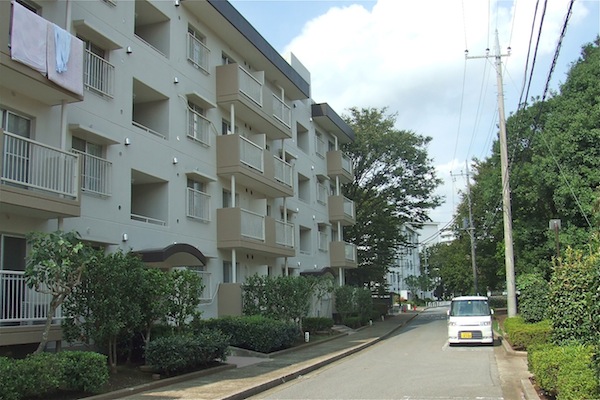
A few weeks ago we went to an old kodan not far from where we live to inspect an apartment that was on sale. We had never had dealings with this particular real estate company before, and we arrived early to check out the general environment, which was better than it is for most kodan. This one was built in the mid-80s and while the buildings themselves were as dull and utilitarian-looking as any other, the landscaping was impressive: lots of clean, well-maintained mini-parks separating the buildings, which were situated at angles that took advantage of the sunlight. We strolled over to the apartment building where we were to meet the agent and just so happened to run into an agent for a different company setting up a sign outside the same building for an open house. We knew this woman well, having met her numerous times when we inspected other properties in the vicinity. She was open and knowledgeable and knew exactly what we were looking for. It was always a pleasure to talk to her because she didn’t put on the usual salesperson front.

She told us that the apartment she was showing had been badly damaged in a fire. The owners had insurance, which covered the renovations. In fact, they apparently used the opportunity to gut the whole place and completely redo it. It wasn’t clear if the owners had been planning to move beforehand or made the decision after the fire (which is understandable–it might have been difficult for them to face their neighbors after almost burning down the building), but in any case the 70-square meter apartment was being sold for about ¥8 million. We told the agent we’d drop in after we inspected the other place. Read More

Unsafe as houses

Ever since the March 2011 earthquake, Tokyo has been reassessing its disaster preparedness policies with mixed results. Though the residents of the city have definitely become more knowledgeable about their vulnerability and what needs to be done to save as many lives as possible in the event of a major quake, not much, in fact, has been done, owing mainly to the usual issues involving private property versus public responsibility. Tens of thousands of old wooden houses, packed tightly together in some neighborhoods, are basically kindling for the inevitable conflagrations that will start after an earthquake hits. Since the local government doesn’t feel it can force these people to move or rebuild their houses (which would, in accordance with zoning laws that have gone into effect since they were originally built, force them to construct smaller abodes then they already occupy) their dire prediction falls on deaf ears. Libertarians and individuals with fond feelings about Tokyo’s uniquely quaint neighborhoods condemn any sort of regulatory move that would change the character of those neighborhoods, but it’s clear that these neighborhoods, as well as the people who live in them, won’t survive a big quake. They didn’t survive the 1923 quake, and the situation isn’t really that much different.

The same seems to go for condominiums and apartments, though in a different way. Late last year, the Tokyo government sent out questionnaires to building management companies and condo owner associations to determine the status of quake-proofing for collective housing in the city. Owner-occupied and rental combined, Tokyo has some 132,600 multi-resident buildings, 24,000 of which were built before 1981 when stricter quake-proofing standards went into effect. About 52,000 questionnaires were sent out, and one-tenth were completed and returned. Of these, only 11 percent said that their buildings have been inspected for structural integrity–17 percent for condos and 6 percent for rental apartments. Another 8 percent said they “planned to carry out inspections,” while 9 percent plan to “discuss the matter.” Sixty-three percent responded that they have no plans to do anything. Among the buildings that did carry out inspections, 60 percent were told that they needed “further reinforcements,” but only 4 percent have actually carried out any reinforcement work. Read More

Tall order

Kimiko Uehara (Tokyo Shimbun)

More than a decade ago, we were following the situation in Kunitachi, Tokyo. A developer, Meiwa Jisho, wanted to build an 18-story condominium in the city and was being opposed by locals. As is often the case with public contretemps that go to court, we lost the thread and our attention fixed on something else. The case was initially interesting because it seemed like a good and rare example of locals standing up to a developer in a concerted, effective fashion. It’s not unusual for residents to protest buildings going up in their midst, but normally such protests are so parochial in impact and fruitless in purpose–involving anything from protection of “right to sunlight” to keeping out “undesirable” elements, like single women working in the so-called water trade–that, by themselves, they offer little that would help us understand the housing situation. The Kunitachi affair was different, and while we were interested in it we thought the residents might actually have a chance to prevail.

The outcome turned out to be more complicated. A recent article in Tokyo Shimbun profiled 63-year-old Kimiko Uehara, the one-time mayor of Kunitachi who was instrumental in bringing the suit against Meiwa. She has been out of politics for years now but is still involved in the Meiwa affair, except that now she is the target of a lawsuit–prosecuted by her fellow Kunitachians. Read More

We’re the top

What we’re talking about: Palm Springs in Inzai!

Earlier this week the Sankei-affiliated web magazine Zakzak published this year’s results of business journal Toyo Keizai’s annual survey of “urban power,” meaning the most livable cities in Japan. Toyo has been doing the survey since 1993 in conjunction with the publication of a periodical data book that compiles statistics about local economies. The survey uses “14 types of information” released by a number of government organs, including the Ministry of Economy, Trade and Industry, comprising five criteria for satisfactory urban living: safety, convenience, comfort, affluence, and housing standards. The survey covered 787 cities and the 23 wards of Tokyo, and this year the municipality that came out on top was Inzai in Chiba Prefecture, which just happens to be where we live.

Our reaction was pleasant surprise mixed with doubt, and as we read the Zakzak article it became clear what Toyo Keizai’s priorities are with regard to a satisfactory living situation. Inzai ranked #3 in the nation in the convenience category because of its retail accessibility. There are lots of discount stores that are easy to reach and with plenty of free parking. People of a certain aesthetic disposition will, of course, find this aspect of Inzai life somewhat off-putting. The retail outlets in question line route 464, which runs parallel to the Hokuso train line through three stations. Many of these outlets are gathered into rather sterile shopping malls. The article also quotes a 35-year-old resident as praising the “large choice of restaurants” along the main road, though such effusiveness should be qualified by the information that almost all these restaurants belong to national chains. For sure, if there’s one thing that characterizes Inzai’s abundance of commercial choice it’s the almost total lack of distinction. There’s nothing here that’s any different from other suburban commercial districts in Japan except maybe more of it; or less, since you’d be hard pressed to find anything that could be described as “typically Japanese.” If anything, the retail tone is strikingly American. Read More