Reform or die

Change is gonna come: Old kitchen with new (cheap) cabinets

As we’ve pointed out ad nauseum on this blog, it’s becoming more and more difficult to sell older homes and apartments. Obviously, owners who want to unload their properties have to do something to make them more attractive than the next seller’s, which is one of the reasons for the “reform boom.” Though remodeling and home improvement has always been an important factor in the housing market, it’s no longer a matter of added value. It’s considered almost a necessity, given how bad most of the product is and how competitive the market has become.

During our inspections of older properties we’ve seen many that had undergone “reform” for the sake of boosting the sale potential. In most cases, the work done was purely cosmetic–new wallpaper, maybe new cabinets in the kitchen. (New tatami and fusuma are standard in all housing transactions and don’t really count as reform) Some go a little farther by replacing the flooring and putting in a new bathtub, but in almost all the instances where we inspected a reformed property the changes didn’t really amount to anything that made us want that property any more. Though the physical condition of the place is certainly important, the location, layout, environment, and general “image” of the house are, taken together, probably more important. More significantly, a house that has been remodeled just for the sake of improving its chances of being sold is, by definition, discouraging. As a potential owner, we would want to make those changes ourselves, so buying a home that’s already been remodeled in a half-hearted way based on generic tastes seems like a waste, especially if the price has been jacked up to absorb the difference.

As an example, we inspected a twenty-year-old kodan several months ago with an asking price of ¥11.6 million. It was large and sunny, and the layout was sensible. Though the apartment had not been remodeled, the asking price included “reform” that involved new walls and new floors and which would be carried out after the contract was signed. We told the salesperson that we would prefer to do the remodeling ourselves, in which case how much cheaper would the price be? She called us back that night and told us: ¥11 million. That means, theoretically, they were going to spend ¥600,000 on new walls and new floors. Based on what we’ve learned about reform, replacing walls and floors in an apartment that size would have probably cost much more, so it’s likely the remodeling would have been perfunctory at best.

In 2010, the land ministry surveyed people who had sold or were trying to sell their homes. Of those who sold their homes and had carried out home improvements in order to increase the value or simply make them more desirable, 73 percent said they sold their properties for more money than they originally asked for prior to the reform. However, the average boost in price these improvements provided was ¥1.66 million, though the average amount of money spent on said reform was ¥3.13 million. So in actuality, these homeowners lost money, since they paid more for the improvements than they received in added value. Of course, a more pertinent question is: Did the reform actually make it easier for them to sell the house? Our feeling is that they probably would have been able to sell the house anyway without the reform, but that the real estate company talked them into carrying out improvements to make it easier to do so, and then brokered a deal with a remodeling company. (We’ve seen homes that were remodeled for sale only five years after they were built!) It’s a common practice, and one that doesn’t always work. There’s one real estate company called Mount that has hundreds of properties on its website, many of which have been reformed. We know, because we’ve visited a number of them. Most were undesirable because of location and general design; the reform, which was half-assed to begin with, made no difference. And many of those houses still remain vacant after a year on the market.
Make mine menshin

The Asahi Shimbun reports that more and more companies are interested in fortifying their buildings with so-called menshin technology. Menshin involves placing shock absorbers in the foundations to mitigate the vibration accompanying earthquakes. Quite a bit of media attention was directed at the 18-story Sendai MT Building, which not only survived the March 11 earthquake in the largest city of the affected area, but made it through with minimal shaking, according to people who were in the building at the time. Sendaki MT Building is a commercial building run by Mori Trust, and it acted as a kind of makeshift refugee center for office workers who couldn’t get home the night of March 11. Though there were aftershocks all through the night, most people in the building said they didn’t feel them as much as they did in their own office buildings. After the quake, the building’s occupancy rate increased 20 percent and is now almost completely filled.

And it wasn’t just high-rises. The two-story distribution center for Suzuden Logistics in Matsudo is menshin-equipped. None of the goods stored in the building were damaged at all. Another menshin building is the Aizu Central Hospital in Aizu Wakamatsu, Fukushima Prefecture. Though it also underwent 5-plus shaking, the building suffered no damage and regular treatment continued normally. No in-patients had to be moved out or transferred.

The Asahi reports that, while menshin features add between 10 to 20 percent to the cost of construction, major contractors have seen inquiries into the system triple since March 11, and just as many are for factories and warehouses as they are for office buildings.

All fall down

In the months after the March 11 earthquake, a condominium management association conducted a survey of the Tohoku region to find out the damage sustained by multi-resident buildings. Almost all those that were built since 1981, when stricter earthquake-proofing codes went into effect, survived with minimal damage, but there were quite a few built before 1981that didn’t do as well. In fact, the survey found that about 60 structures in Sendai alone had been declared zenkai (“completely damaged”; in other words, legally uninhabitable).

The Asahi Shimbun looked at several of these buildings. One, the somewhat optimistically named Sunny Heights Takasago, was built in 1976 and was actually damaged in 1978 during a large earthquake that struck Sendai. However, the damage wasn’t “complete” and repairs were made. The building was not so lucky this time. The condominium is actually two 14-story buildings positioned in an L-shape. During the initital earthquake the two structures knocked against each other, but afterward inspectors declared them yochui–residents should take caution but they could keep living there. But the condos sustained further damage in the aftershock of April 7: window and door frames deformed, cracks appeared on outside corridors, steel beams were exposed. Even worse, the ground itself was “damaged.” Consequently, the properties were condemned. Read More

Go West

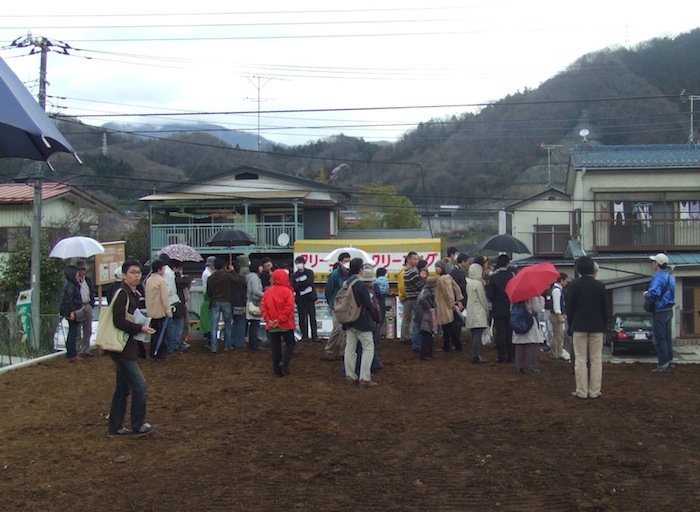
Potential buyers inspect land for sale in Fujino, western Tokyo

Two weeks ago we were at the UR office in Yaesu helping some friends get around the application process and asked the employee about availability. Though there was no ulterior motive behind the question, the woman volunteered that a lot of residents in UR high-rises in the waterfront area were moving out after the earthquake. We were slightly taken aback: Only a semi-public organization like UR would admit to potential renters that people were anxious to leave their properties.

Upon further investigation, we found that the story is a bit more complicated, at least when it comes to buying and selling property. According to various news reports, there has been a notable increase in interest in the Musashino daichi, or plateau, which covers parts of Western Tokyo and Western Saitama Prefecture. This is considered stable land, meaning no risk of liquefaction. The waterfront, of course, is all built on landfill, but there are many other areas located inland that suffered soggy ground after the Mar. 11 earthquake, such as Abiko in Chiba and Kuki in Eastern Saitama, communities that were built on ground that used to be swampland, rice paddies, or even ponds. Usually, you can determine the kind of land an area once was by consulting an old map. If the old name contains words that indicated water, like numa (marsh), then you might want to make sure your foundation is built on piles. In fact, a lot of developers change the names of such places so that people think they were built on solid rock (almost any subdivision with the word oka–hill–is a dead giveaway). Read More

Getting what you pay for

Room with a view, sort of

Last weekend we traveled up to Nikko to look at properties. Along the way, we could see the damage caused by the earthquake that hit southern Tochigi Prefecture the day before, mostly in the form of blue tarp hastily stretched across roofs where kawara tiles had broken loose. Kawara tends to be used in more traditional houses and is considered to have better weather-proofing and climate control properties than regular shingles. However, they are notoriously difficult to apply and easily come loose during earthquakes. Roofers throughout the Kanto and Tohoku regions are raking it in right now.

Nikko is one of Japan’s most historically significant places and a UNESCO World Heritage site. It was combined with several other neighboring towns and villages some years ago, and the area we visited is in the residential district to the south of the famous temples. In that regard, it isn’t significantly different from your average suburban residential area–meaning it’s cramped and nondescript–though the surrounding mountains and abundant pockets of wooded areas and terraced farmlands give it some character. The first place we visited, in fact, was in a development originally subdivided for besso (second homes). We got off at Tobu Shimo Goshiro station, which was small enough to not have a ticket wicket (we were on the honor system and only required to drop our tickets into an unattended box), and walked for 25 minutes through rolling hills and past the old cedar-lined Nikko Kaido to the subdivision, which didn’t really look like a subdivision when you approach it from the main road. Situated in a grove, it did look like a besso community, meaning the homes were varied in style, shape, and size. The property we were looking at was in the middle, next to a golf course, and the real estate agent from a Shinagawa-based company called Mount, who was going to show us all the properties, was already there getting the place ready for our inspection. Read More

High anxiety

You can’t get there from here

Since the earthquake of Mar. 11, I have been extra sensitive to stories of people living in Tokyo high-rises and have expected to see more dispatches like the one I wrote above. Interestingly, they’ve been few and far between, and mostly dwell on how well these high-rises performed during the earthquake. I said as much in my blog post, but that’s not the most salient observation I took away from the experience and I doubt if others who live in tall buildings did as well. Then, last week Asahi Shimbun printed an article relating the experiences of two koso mansion owners. Unfortunately, since then the story is gone from the Asahi.com site, either locked behind a pay wall or taken off completely. I doubt the latter, but M. says she read a few tweets from people who thought Asahi might have been pressured by developers or real estate companies, who are big advertisers. That seems a fairly conspiratorial take on the matter, but one thing’s for sure: New high-rise luxury condos have been one of the few reliable success stories in the Tokyo real estate market in the past few years.

In the article, a 32-year-old full-time housewife was in her 55th floor apartment in Chuo Ward when the quake struck. She ducked under a table. The swaying lasted for a full five minutes. Terrified, she remained under the table during the subsequent aftershocks while she tried to call her husband, a doctor, and the day care center where her two children were. (M.: “She’s a full-time housewife. Why are her two kids in day care?”) She couldn’t get through to either. Read More

Big One

A view to die for

I certainly don’t believe any of that “divine retribution” crap, which happens to unify the philosophies of right wing broadcaster Glenn Beck and Tokyo governor Shintaro Ishihara; but I can appreciate a cosmic joke. The massive earthquake that hit northeast Japan on Mar. 11 came right in the middle of moving season. The Japanese fiscal year, not to mention the school year, begins April 1 or thereabouts, and traditionally many people move house during the month of March, because of job transfers, university admission, or they just like to do what everybody else is doing. Consequently, there were a few trucks outside our 38-story building the weekend after the quake, carrying furniture for folks who were moving in. Fortunately, the freight elevator was operational again by the morning of the 12th, but what did those new arrivals think standing in their new apartment while it swayed back and forth during one of the many aftershocks?

Who knows? Maybe they were in a high-rise before, but in any case the quake helped test a theory, at least partially: Would all these earthquake-proofed structures actually withstand a massive quake? Of course, the epicenter of the one we experienced was a hundred kilometers off the coast of Iwate Prefecture, but according to reports, no buildings collapsed in Sendai, the nearest large city to the quake and one with its own share of skyscrapers. So the technology seems to work, and while it certainly saves lives and property, it doesn’t solve a more intractable problem: Once you’ve been in a large earthquake in a high rise, you don’t want to be in another one. Read More

Insulate it

Polystyrene

Recently, there was a conversation on Twitter about insulation, which outside of Hokkaido has only caught on recently in Japan. I’ve heard more than once that Japanese homes are built for summer, but older, traditional Japanese houses did a fair job of conserving heat, since most were designed with roka (hallways) around the perimeter of the house, which meant there was a space between the walls of the inner rooms and the exterior walls and windows. But since the war and even before, Japanese houses have become boxier in order to accommodate smaller parcels of land near large cities so that middle class families could afford them. Since insulation per se wasn’t an integral consideration of traditional homes, no one really thought to incorporate it in the new style. People just bought more kerosene. Read More

Cookie cutter architecture 1

Due to zoning rules and the general cost of land, there are some oddly shaped buildings in Tokyo and other major Japanese cities. Triangular plots yield wedge-forms (cutely referred to as tongari, or “pointed”). The taper on this four-story residence in Tokyo’s Arakawa Ward is too gentle to qualify as a wedge, but at its widest it’s only about two meters.