The enduring stigma of renting

In April, the government decided to extend its subsidy for temporary emergency housing in the Tohoku region by one year. Originally, they allowed for two years, so that means people who are currently approved to live in temporary (kasetsu) housing can remain where they are until at least April 2014. Most of the media coverage of this issue centers on the new housing that was built specifically for the refugees of the March 11 disaster, but in truth most of the units being used for this purpose are existing houses and apartments that the government is leasing from their owners. According to Tokyo Shimbun, in Miyagi Prefecture alone, there are 26,000 minashi–units being rented from landlords–units in use and 21,500 specially built units.

Not everybody was pleased when the government announced the extension. A group of people who own the land on which some of the temporary housing was built expressed concern that they wouldn’t be able to sell their land for another year, and are worried that the government could continue extending the period of habitation indefinitely, which is what happened in Kobe after the Great Hanshin Earthquake. Another dissatisfied group is an association made up of Miyagi realtors and landlords. One would think that landlords would be happy with the extension, since it guarantees income for another year, and probably at inflated rates since the government is paying. However, one Sendai realtor told Tokyo Shimbun that many of the refugees who are living in these minashi units are not homeowners who lost their houses but rather people who were renting apartments or houses that were destroyed or damaged. The realtor says that local governments assigned these renters to minashi dwellings “without properly checking their situations,” meaning, presumably, that the temporary housing program does not discriminate but it should, since there is a difference between renters and owners. Some “adjustment” (merihari) should have been made before the government decided to extend the program another year. Exactly what “adjustment” means in this case isn’t spelled out, but the only natural conclusion is that the renters should be evicted. Read More

The landlord’s an idol

This week the tabloid press is obsessed with Tomoko Nakajima, half of the comedy duo Othello. According to the scandal weekly Flash, Nakajima hasn’t paid rent on two apartments in Shibuya–one her residence, the other an office–since last August and is now being sued by the owners of the two properties, which together cost ¥1.1 million a month to rent. Nakajima hasn’t worked since April when she took sick leave, but show biz reporters are saying that she came under the spell of a “fortune teller.” Nakajima allowed the woman to move in with her and she has been directing Nakajima’s life ever since, presumably squeezing her for cash. The comedian’s parents and management company say they have not been able to contact her for months, but also assume that once Nakajima runs out of money the woman will lose interest and move out.

The story wouldn’t have normally interested us until we heard that the apartment Nakajima rents as a residence at ¥650,000 a month is owned by Masahiro Motoki, who starred in the Oscar-winning film “Departures” (“Okuribito”). We dug a little deeper and learned that Motoki is not the person who is suing Nakajima for back rent. The suit is being carried out by the guarantee company that manages the apartment. This is a common investment scheme. Guarantee companies broker deals between apartment sellers and buyers, convincing the potential landlords to purchase the property and leave all management to the guarantee company, which looks for tenants, sets rent rates, and acts as guarantor in exchange for a sizable fee that is paid by the tenant. Nakajima’s unit is 122 square meters, which partially explains why her rent is so high. Other factors include the location, Shibuya, and the fact that the building houses a number of other celebrity-owned units that we presume are also managed by guarantee companies, thus setting up an interesting show biz pecking order. Motoki, a former Johnny’s idol who made a successful transition to legitimate acting, can invest in properties that are then rented out to other show biz people who are successful but not successful enough to buy their own luxury condos. (We’re not entirely sure if Motoki didn’t live in the apartment at some time in the past, but at any rate he did hire the guarantee company) In fact, we would think that one of the advantages a star like Motoki would derive from such a business arrangement would be keeping his name out of the press if a lawsuit erupted with a tenant. How does it look for a former idol to be suing a civilian, or even a current comedian for that matter? Maybe it means nothing. In our research we found a number of celebrities who have made similar investments, including another comedy duo, Kyain. Othello is popular, but not as popular as Kyain. Are they popular enough to afford ¥1.1 million a month in rent? At the moment, apparently not.

Home Truths #3

Here’s this month’s Home Truths column in the Japan Times, about UR housing. The article is mainly a how-to piece and doesn’t really get into the details of what the buildings and apartments themselves are like. We’ve written about UR a lot in this blog, as well as in our sister blog Yen for Living, since we’ve been living in UR units since 2000. Below are links to some of these posts that provide more specific information.

Security deposits / Tour of Nouvelle Akabanedai / Amenities / Tour of UR Ogikubo / Matsudo public housing / Japanese needed? / Low-income housing / Tour of Heart Island Shinden / ‘kudokushi’ savings / Tour of East Core Hikifune

The rest of the story

What you see is not what you get

We’ve received two letters in response to our Aug. 2 Home Truths column about renewal fees, both from landlords who obviously want to relate, as Paul Harvey used to put it, the rest of the story. Both letters were sent to the Japan Times, one for the Readers in Council page and the other indirectly to us with a directive that it not be published. Moreover, the RIC letter was published anonymously, so while both of these persons hold strong opinions as to their own situations as property owners neither seems to feel that strong that they might risk exposing themselves to whatever sort of negative reaction landlords can normally expect. This is probably unavoidable. The landlord-tenant relationship is almost by definition an adversarial one; the dynamic fraught with defensiveness. Both landlords basically wanted to show the difficulties of maintaining properties for rental purposes in Japan, and in the process defended the collection of supplemental fees such as reikin (gift money), shikikin (deposits), and koshinryo (rental agreement renewal fees) as essential to their businesses. Read More

Home Truths #2

Caveat emptor

Our latest column in the Japan Times was published today. You can read it here. It’s about the recent Supreme Court decision regarding koshinryo (renewal fees). One small clarification: The photo caption mentions that cheaper rents may mean higher renewal fees and “gift” money. In many cases if the landlord has set the rent lower for the purpose of attracting potential tenants, he/she may also not charge gift money for the same reason. Renewal fees, however, are more hidden because they are usually only mentioned in the fine print, meaning they kick in later, when the tenant has to renew the contract a year or two after moving in. Also, some landlords, especially corporate ones, are making their rental agreements longer, say five years, and then setting the renewal fee a bit higher than average. Another theory associated with renewal fees that we neglected to mention is that some landlords use it to generate higher turnover. Since supplemental fees allow the property owner to make a bit more money in a slumping market, logic says that you make more money if the turnover is higher because more new tenants mean more supplemental fees. This is the same economic logic behind the shaken (regular vehicle inspection), which all car owners have to pay for every two years (or every year, depending on the age of your automobile). When the shaken, which is expensive, comes due, many car owners simply trade their vehicle in for a new one. The first shaken for a new car is three years. The same concept is supposedly used for renewal fees: People will move to a new place because they don’t feel like paying it. The reason we didn’t mention this theory is because we’re not really sure it’s credible. People’s attachment to the place where they live is different from their attachment to their car. If people move because they don’t want to pay the koshinryo it probably means they don’t like the dwelling in the first place.

The right thing

The blur of memory: After the cleanup in Tokyo

In the last few posts we’ve ragged a bit on UR, specifically their dodgy ties to outside providers like Tokyo Gas and local cable outfits, but that shouldn’t be interpreted as disillusionment. For all its anal bureaucratic culture and general air of mismanagement, Japan’s only national semi-public housing corporation is also the only place in Japan where renters get a fair shake. We found that out when we received the refund for our security deposit a few days ago.

We moved from a UR high-rise in Tokyo to a low-rise UR complex in northern Chiba Prefecture. UR makes it relatively easy to move from one of its buildings to another one. The tenant doesn’t have to go through the screening process again (unless he/she is moving to a decidedly more expensive residence), and the security deposit (shikikin) that was paid for the former apartment is transferred to the new one, with the difference either being made up by the tenant or refunded to him/her. In our case it was the latter. Though the new apartment is the same size as the one we rented in Tokyo, it is almost ¥70,000 cheaper per month. The security deposits for UR typically amount to the equivalent of three months’ rent, which is a bit higher at the moment than security deposits for private rentals, but the important thing to remember about UR is that they don’t charge “gift money” (reikin) or contract renewal fees (koshinryo), and also don’t require guarantors or co-signers. Read More

Gas attack

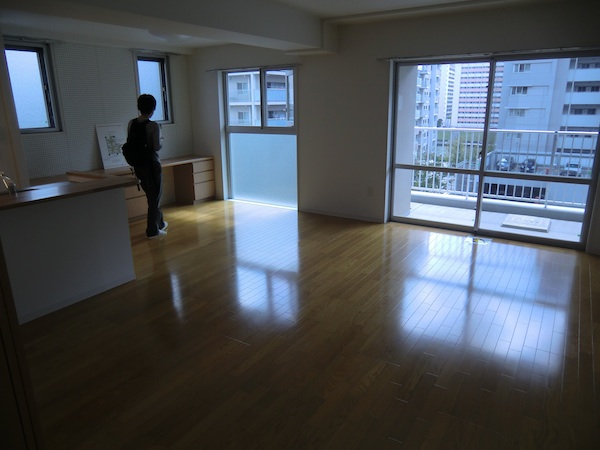
In the previous post we talked about Tokyo Gas’s relationship with the public housing corporation UR and how we were left with no choice but to throw away two perfectly good space heaters because they couldn’t be used in our new UR apartment and there was no system set up to sell or even give them to people who might be moving into our old UR apartment. As it turns out Tokyo Gas has UR tenants coming and going. Out new apartment does not have a stove, though our old one did. This is a facet of rental living in Japan that I had forgotten all about: the total lack of appliances. In the U.S. when you rent an apartment, you almost always get a stove, an oven, a refrigerator, sometimes even a washer/dryer, not to mention central heating. You don’t necessarily get any of those things in Japanese rentals, though, as I mentioned, our last UR apartment did have a stove, and recently some UR apartments have had floor heating or wall heating units built into the rooms. We have gas-powered floor heating in our new apartment in the living room only, but for some reason it’s billed separately from the other gas we use in the apartment, which means it requires a separate contract and, thus, a separate contract signing fee: ¥7,500 just to turn the system on. We were told, however, that if we did use floor heating we would get a “discount” on our total gas bill in any month we used the floor heating. We assume that means floor heating is very expensive. Since there are no gas outlets in our new apartment, we would have to heat the place with electric space heaters or kerosene heaters if we decided not to use the floor heating. In any case, it won’t be cheap. Read More

Wasted

Planned obsolescence

Moving house is a pain in the ass, but it can also be a rush. Basically, you shlep your entire life to a new abode and in the process assess that life in concentrated form. Inevitably, you are forced to pick and choose what you want to keep from it and what you want to discard. Some things you get rid of simply because you want to get rid of them, and some things you get rid of simply because you have to.

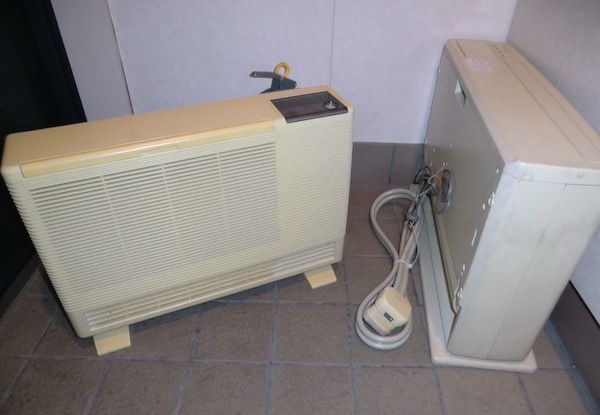
Yesterday we threw away two perfectly good heaters because we can’t use them in our new apartment. We also can’t sell tor even give them away, and it’s hard to shake the feeling that it was somehow planned to be this way. The heaters are made and sold by Tokyo Gas. Unlike standard gas heaters, which directly convert “city gas” piped into your home into heat, these draw hot water from your boiler (or, to use the redundant Americanism “hot water heater”). In that way they function in much the same way that baseboard heating does, except for one very significant difference. Baseboard heating is built into a house or apartment, and is generally designed in such a way that it doesn’t get in the way. These water heaters, on the other hand, are stand-alone boxes that do get in the way since they connect to wall outlets via thick hoses. Ideally, Tokyo Gas wants you to buy one for every room in your apartment, and priced at between ¥28,000 and ¥45,000, they can add up to quite an investment. Read More

The “custom” myth

Today we wrote a letter to the Japan Times about an article they printed last week about rentals for foreigners. Here it is:

In the May 15 article “Housing glut opens door to foreign tenants” Takahide Ezoe of the Shinjuku Japanese Language Institute states that “Japanese…know that you don’t usually get the amount of deposit back” when they move out of a rental property, and thus potential foreign renters have to be made to understand this point since, According to Ezoe, “to foreigners, a deposit is something that will be returned fully.”

In principle, the purpose of a security deposit, or shikikin, is to provide reserve funds in the event that the tenant is delinquent with his or her rent. However, many landlords consider it money that can be used after the tenant moves out for repairs and maintenance. In most developed countries, landlords are legally responsible for normal wear-and-tear on a rental property, not the tenant. Foreigners who have not caused any unusual damage to their residences should by all rights expect to receive their security deposits in full when they leave, as should Japanese tenants. In fact, many Japanese have sued landlords to recover their security deposits and won.

As the article points out, potential renters should read their contracts. If they don’t understand the security deposit issue then they should have it clarified by the landlord or agent. When they move out and do not receive their deposits back, they should confront the landlord and demand an explanation. Many landlords use security deposits, key money (reikin), and contract renewal fees as tools to gouge tenants, whose rights in these matters are not clearly defined by Japanese law. To call these conditions “customs,” which is what realtors tend to do, is to obfuscate their questionable legality. They are certainly unethical.