Something to think about (1)

As mentioned elsewhere in this blog and others, we live on what has been described as the most expensive train line in Japan. It’s also one of the most convenient–if you’re traveling into Tokyo or to Narita Airport. If you’re trying to get somewhere in the local vicinity that isn’t directly on the line, however, it’s not convenient at all. For instance, a few weeks ago we wanted to inspect a property in Sakura, a fairly large city in northern Chiba, which happens to be serviced by two train lines. As the crow flies, Sakura is directly southeast of where we live, and by car probably would take about a half hour to reach, but we don’t own a car. By train it would take more than an hour, though, as well as a considerable monetary investment, because we would have to go into Narita first and then transfer to another line, and while the line we live on does go to the airport, it doesn’t actually stop in Narita city, which is where the connections are.

So we did what we usually do: rode bicycles to the property. Pedaling from Inzai to Sakura gives you a perspective you wouldn’t otherwise have if you drove or took the train. Inzai is still “developing,” as it were, and has been carefully planned; or, at least, more carefully planned than other cities in Chiba. The roads are wide and straight. Sidewalks provide ample bicycle lanes. Subdivisions do not encroach awkwardly on farmland or abundant tracts of forest–the satoyama dynamic holds for the most part. The commercial areas are well contained and laid out in a relatively efficient fashion. As you pass from Inzai to Sakura, these features slowly give way to the more common Japanese suburban clutter. The roads become narrower and sidewalks eventually disappear altogether. Houses and commercial buildings appear on top of one another. Main thoroughfares take forever to get where they’re going and if you really want to get there in a reasonable amount of time you have to constantly stop and check a map. Japan, as someone once told me, was custom made for GPS. Read More

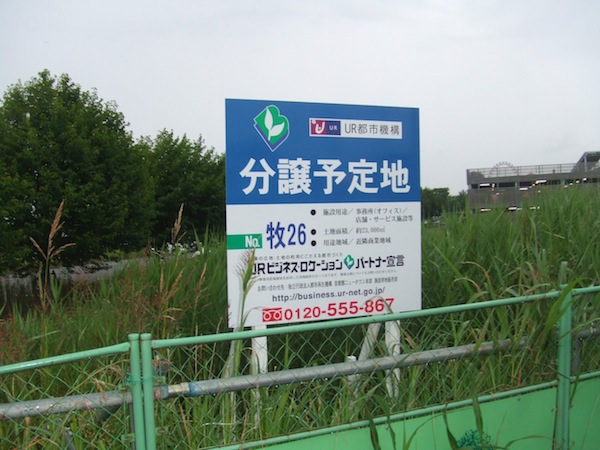
This land is UR land

Tract of UR-owned land near Inzai Makinohara station on the Hokuso Line

The Asahi Shimbun recently reported that the government finished auditing its accounts for fiscal 2011. The board that conducted the investigation found 513 separate cases of “waste” comprising ¥529.16 billion, the largest amount since records have been compiled. In the wake of media reports that have government organs inappropriately using tax money earmarked for reconstruction of the disaster-hit Tohoku region, it is natural to assume that this waste would be doubly scrutinized, but we won’t hold our breath. One of the areas that will probably invite less concern is assets held by dokuritsu gyosei hojin–independent administrative agencies–that remain unused. In 2010, the cabinet issued a directive that such assets should be returned to the government, but apparently that’s not happening as the auditors found lots of unused assets lying around–literally, in many cases, since the assets that seem to be the most problematic are real estate-related. The National Hospital Organization, for instance, owns 217,000 square meters of land valued at ¥6.7 billion that remains undeveloped and with no plans for development. According to the cabinet directive this land should be handed over to the national government.

Another independent administrative agency with lots of unused assets is Toshi Saisei Kiko, more popularly known as UR (Urban Renaissance), the semi-public housing corporation that the government would like to make completely private because it’s such a sinkhole for money. Since UR’s business is the sale, development, and management of real estate, its unused asset problem is also a business problem, and the auditors found that the company controlled 223 hectares of land valued at ¥89.7 billion that was unused, which many not sound like much, but apparently the audit board was only talking about assets that were supposed to be “processed” during FY2011. As almost everyone knows, UR has lots and lots of land that remains undeveloped, and since all of UR’s debts are covered by the government the auditors insist that UR can cover at least some of its deficits by liquidating land assets. Read More

Space invaders

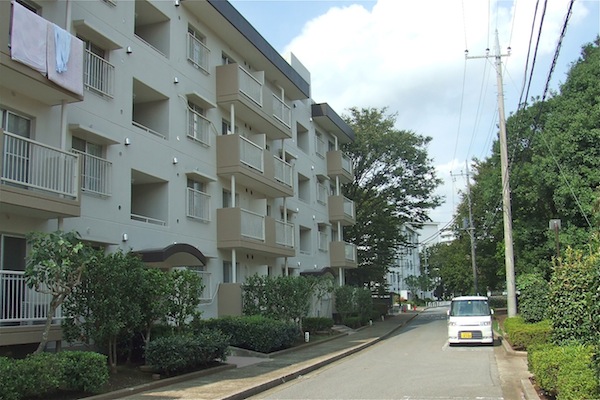
A few weeks ago we went to an old kodan not far from where we live to inspect an apartment that was on sale. We had never had dealings with this particular real estate company before, and we arrived early to check out the general environment, which was better than it is for most kodan. This one was built in the mid-80s and while the buildings themselves were as dull and utilitarian-looking as any other, the landscaping was impressive: lots of clean, well-maintained mini-parks separating the buildings, which were situated at angles that took advantage of the sunlight. We strolled over to the apartment building where we were to meet the agent and just so happened to run into an agent for a different company setting up a sign outside the same building for an open house. We knew this woman well, having met her numerous times when we inspected other properties in the vicinity. She was open and knowledgeable and knew exactly what we were looking for. It was always a pleasure to talk to her because she didn’t put on the usual salesperson front.

She told us that the apartment she was showing had been badly damaged in a fire. The owners had insurance, which covered the renovations. In fact, they apparently used the opportunity to gut the whole place and completely redo it. It wasn’t clear if the owners had been planning to move beforehand or made the decision after the fire (which is understandable–it might have been difficult for them to face their neighbors after almost burning down the building), but in any case the 70-square meter apartment was being sold for about ¥8 million. We told the agent we’d drop in after we inspected the other place. Read More

Unsafe as houses

Ever since the March 2011 earthquake, Tokyo has been reassessing its disaster preparedness policies with mixed results. Though the residents of the city have definitely become more knowledgeable about their vulnerability and what needs to be done to save as many lives as possible in the event of a major quake, not much, in fact, has been done, owing mainly to the usual issues involving private property versus public responsibility. Tens of thousands of old wooden houses, packed tightly together in some neighborhoods, are basically kindling for the inevitable conflagrations that will start after an earthquake hits. Since the local government doesn’t feel it can force these people to move or rebuild their houses (which would, in accordance with zoning laws that have gone into effect since they were originally built, force them to construct smaller abodes then they already occupy) their dire prediction falls on deaf ears. Libertarians and individuals with fond feelings about Tokyo’s uniquely quaint neighborhoods condemn any sort of regulatory move that would change the character of those neighborhoods, but it’s clear that these neighborhoods, as well as the people who live in them, won’t survive a big quake. They didn’t survive the 1923 quake, and the situation isn’t really that much different.

The same seems to go for condominiums and apartments, though in a different way. Late last year, the Tokyo government sent out questionnaires to building management companies and condo owner associations to determine the status of quake-proofing for collective housing in the city. Owner-occupied and rental combined, Tokyo has some 132,600 multi-resident buildings, 24,000 of which were built before 1981 when stricter quake-proofing standards went into effect. About 52,000 questionnaires were sent out, and one-tenth were completed and returned. Of these, only 11 percent said that their buildings have been inspected for structural integrity–17 percent for condos and 6 percent for rental apartments. Another 8 percent said they “planned to carry out inspections,” while 9 percent plan to “discuss the matter.” Sixty-three percent responded that they have no plans to do anything. Among the buildings that did carry out inspections, 60 percent were told that they needed “further reinforcements,” but only 4 percent have actually carried out any reinforcement work. Read More

Not quite

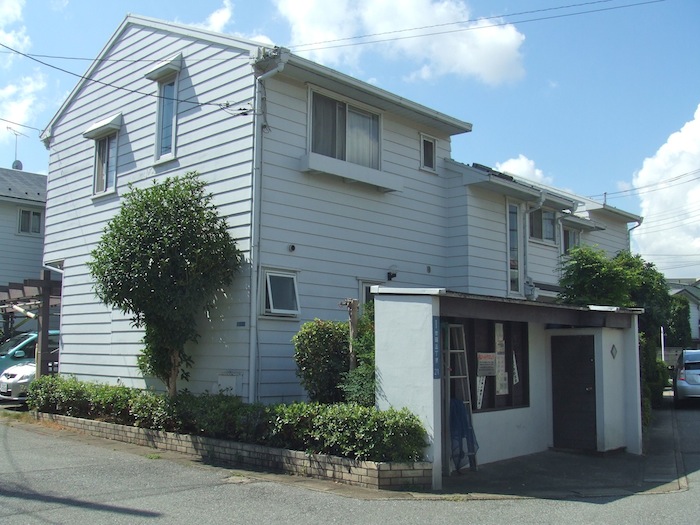
We’ve always been interested in town houses and are still thinking of dedicating a Japan Times column to them. Town houses were briefly popular in the late 70s and early 80s. Japan has always had an indigenous town house, called nagaya or machiya depending on which part of the country you’re in, but the structures called “town houses” in English (sometimes “terrace houses”) were more like their Western cognates: two-story structures with walls adjoining their neighbors. In urban environments town houses offer more effective utilization of land than normal detached houses while providing a similar level of creature comfort. However, once land prices skyrocketed in the mid-80s town houses were considered economically inefficient, even in the suburbs, which is where you normally found them anyway. Everybody started building condos with boxy floor plans in order to get as much cash out of a block of air as possible. Every so often we come across an old town house on sale and check it out, but because of their relative scarcity they tend to be overpriced. Of course, “overpriced” is all a matter of perception. Because town houses are relatively unusual, owners think that makes them more valuable, but they’re still old and always need a lot of work, as much as a detached house of the same vintage does if it hasn’t been renovated (and usually they haven’t been). A few weeks ago, as a matter of fact, we were amused to see a listing in which town houses were qualified as being “popular.” They aren’t, at least not in the general definition of the word. They are simply “rare,” which means it’s assumed some people will pay a bit more to have one. Read More

Get on it

Small item in the Tokyo Shimbun reported that on Sept. 8 the land ministry announced a policy to “step forward” in developing a system to provide potential homeowners with information about earthquake-proofing and renovation histories of used properties put on the market. As it stands, real estate agents who list homes for sale include information about price, layout, size, age, and location, but usually not much else unless you ask, and even then they are sometimes reluctant about things like quake-proofing since they don’t want to be responsible for such information. As far as renovations go, if the work was done recently in order to improve the value of a property, then, of course, the realtor will mention it, but if the work was done in the past there’s not much reason to if the cosmetic benefits are negligible.

The purpose of the land ministry policy is to expand the housing market to include more used homes. In 2008, only 13.5 percent of all homes sold in Japan were used, while the portion (in 2009) of same in the U.S. was 90.3 percent and in the UK 85.8 percent. The ministry thinks that if consumers had “more confidence” in used properties they would buy more. Typically, the ministry doesn’t have any concrete measures in mind to accomplish this confidence-building, but in the next budget they plan to ask for ¥50 million for “study,” meaning, presumably, looking into ways to help realtors include this information in their listings. Would they actually pass a law making it mandatory for realtors to tell potential buyers if a property was quake-proofed? That would be quite an undertaking since a lot of homeowners don’t even know the extent of the quake-proofing on their structures, or if there is any at all. All homes and condos constructed after 1980 are supposed to have been built to quake-proof standards, but given lead times on construction the standard probably didn’t become a full standard until the mid-80s. In any case, no one has done a proper study to find out how strictly the standards were carried out. One problem the ministry will have to consider when it spends its measly 50 million is what potential buyers can do to find out about quake-proofing. If a realtor doesn’t have that information and a buyer wants to know, who is going to pay for the inspection? For a single-family home a quake-proofing inspection can cost hundreds of thousands of yen; for a condominium building, a cool million. It’s easy to see why realtors, and the sellers they represent, want to avoid the subject, but the ministry doesn’t have that luxury. They say they want to stimulate the used housing market, but if there’s no reliable and reasonably priced system of assessing something as basic as quake-proofing then maybe the market isn’t even worth it.

Field diary: Izu

Last week we were on the Tokaido Shinkansen early in the morning and ran into a friend we hadn’t seen in years. He asked us if we were still living in Tokyo and we said we weren’t, that we had moved a little over a year ago mainly due to the earthquake. He then asked us what we were doing on the bullet train and we said we were on our way to Atami on the Izu Peninsula to look at some properties we might be interested in buying. He gave us a funny look. “That would seem to be the worst place to live if you’re afraid of earthquakes.” True. Just the day before the Cabinet Office Disaster Council updated its projections for a major earthquake in the Nankai Trough, and Shizuoka Prefecture was deemed the worst in terms of possible casualties, though, technically, most of those casualties would be in the western part of the prefecture, not Izu. In any case, we weren’t completely serious about buying a place on the peninsula. Having been frustrated in our search so far for a home-sweet-home we could afford, we were entertaining the idea of keeping our rental and buying a very cheap old fixer-upper in a place with cooler summers. If our income situation worsened and we had to give up renting, then we would at least have a roof over our heads, and if things continued as they have been (notice we don’t actually think they’ll get better) then we’d have a weekend/summer place. There are plenty of old dumps in the highlands of Tochigi and Nagano, or in the wilds of Chiba, that can be had for under ¥7 million, though they’d require another ¥3-5 million to make them livable. And during our search we noticed there were quite a few such places in Izu, too, mainly besso (second homes), which we had avoided so far. Second homes tend to be built in specially designated besso developments managed by companies that charge yearly fees, some of which are pretty high. Also, besso tend to be impractical for year-round living, but since we weren’t necessarily going to be living in one year-round we thought we’d see what was available. And Izu is, as they say, the “Riviera of Japan.” Read More

Overexposed

One of our main bugbears with used houses is the obsession with a southern exposure. Though we perfectly understand the rationale–Japan is in the northern hemisphere and thus a southern facade provides more natural heating in the wintertime–we can’t fathom the insistence of builders and designers that all rooms in a house will face south and all “utilities,” meaning bathrooms and kitchen, will be located on the north side of the structure. Given the normally small plots of land in Japan, this results in a kind of domino distribution: all houses in a development “face” south, which inevitably means facing the “north” side of your neighbor. When we’ve asked builders about orienting a house toward the west or even north in order to take advantage of some attractive natural feature of the land, we’re invariably met with consternation and concern. It’s entirely possible, they say, but inadvisable. Some things just aren’t done.

Our reasons for shunning southern exposures are mostly aesthetic, but a recent article in the Tokyo Shimbun suggests that maybe southern exposures are not economical or even healthy. The University of Tokyo Engineering Department built an experimental house on the roof of one of its buildings to study the effect of direct sunlight on interior environments. Like almost all modern Japanese housing, the part of the building facing south had large plate glass windows so as to allow more light in. On sunny winter days when the exterior temperature was 10 degrees C, the interior temperature was as much as 35 degrees C, which is actually bad for the people who live there. In essence, the large windows make it difficult to control the interior temperature, which means the home owner may actually use more energy. According to the professor in charge of the project, it depends on the type of glass that is used, but in most houses the windows allow visible and near infrared light to pass into the house, where it is reflected off of the floor in the form of far infrared light, warming the room. Far infrared light cannot pass back out the window and thus more heat is trapped in the room. Direct sunlight contains a great deal of energy. Moreover, at night, when temperatures drop even further and there is no sunlight, more heat escapes from the house because of these big windows. Read More

Home Truths, Aug. 2012

Here is this month’s Home Truths column in the Japan Times, about pets. Though we have two cats ourselves, and basically believe that anyone who has a pet should be able to live where they want, we’re not entirely comfortable with the increasingly open acceptance of pets in collective residences. As we suggest several times, it’s a two-way street. Tenants and condo owners who do not demonstrate sufficient understanding of what it means to have an animal companion should not have them, though we’re not sure how that point can be driven home in a way that doesn’t discriminate against people who do demonstrate responsibility and understanding. Is it right to keep large dogs in small apartments? Should all dog owners who live in collective housing be obliged to train their pets? Should cats be confined indoors or allowed to roam free, and if the latter is allowed, should they be required to be spayed/neutered? Rules are unavoidable, but education is essential.