
Field diary: Izu
 Last week we were on the Tokaido Shinkansen early in the morning and ran into a friend we hadn’t seen in years. He asked us if we were still living in Tokyo and we said we weren’t, that we had moved a little over a year ago mainly due to the earthquake. He then asked us what we were doing on the bullet train and we said we were on our way to Atami on the Izu Peninsula to look at some properties we might be interested in buying. He gave us a funny look. “That would seem to be the worst place to live if you’re afraid of earthquakes.” True. Just the day before the Cabinet Office Disaster Council updated its projections for a major earthquake in the Nankai Trough, and Shizuoka Prefecture was deemed the worst in terms of possible casualties, though, technically, most of those casualties would be in the western part of the prefecture, not Izu. In any case, we weren’t completely serious about buying a place on the peninsula. Having been frustrated in our search so far for a home-sweet-home we could afford, we were entertaining the idea of keeping our rental and buying a very cheap old fixer-upper in a place with cooler summers. If our income situation worsened and we had to give up renting, then we would at least have a roof over our heads, and if things continued as they have been (notice we don’t actually think they’ll get better) then we’d have a weekend/summer place. There are plenty of old dumps in the highlands of Tochigi and Nagano, or in the wilds of Chiba, that can be had for under ¥7 million, though they’d require another ¥3-5 million to make them livable. And during our search we noticed there were quite a few such places in Izu, too, mainly besso (second homes), which we had avoided so far. Second homes tend to be built in specially designated besso developments managed by companies that charge yearly fees, some of which are pretty high. Also, besso tend to be impractical for year-round living, but since we weren’t necessarily going to be living in one year-round we thought we’d see what was available. And Izu is, as they say, the “Riviera of Japan.” Read More
Overexposed
 One of our main bugbears with used houses is the obsession with a southern exposure. Though we perfectly understand the rationale–Japan is in the northern hemisphere and thus a southern facade provides more natural heating in the wintertime–we can’t fathom the insistence of builders and designers that all rooms in a house will face south and all “utilities,” meaning bathrooms and kitchen, will be located on the north side of the structure. Given the normally small plots of land in Japan, this results in a kind of domino distribution: all houses in a development “face” south, which inevitably means facing the “north” side of your neighbor. When we’ve asked builders about orienting a house toward the west or even north in order to take advantage of some attractive natural feature of the land, we’re invariably met with consternation and concern. It’s entirely possible, they say, but inadvisable. Some things just aren’t done.
Our reasons for shunning southern exposures are mostly aesthetic, but a recent article in the Tokyo Shimbun suggests that maybe southern exposures are not economical or even healthy. The University of Tokyo Engineering Department built an experimental house on the roof of one of its buildings to study the effect of direct sunlight on interior environments. Like almost all modern Japanese housing, the part of the building facing south had large plate glass windows so as to allow more light in. On sunny winter days when the exterior temperature was 10 degrees C, the interior temperature was as much as 35 degrees C, which is actually bad for the people who live there. In essence, the large windows make it difficult to control the interior temperature, which means the home owner may actually use more energy. According to the professor in charge of the project, it depends on the type of glass that is used, but in most houses the windows allow visible and near infrared light to pass into the house, where it is reflected off of the floor in the form of far infrared light, warming the room. Far infrared light cannot pass back out the window and thus more heat is trapped in the room. Direct sunlight contains a great deal of energy. Moreover, at night, when temperatures drop even further and there is no sunlight, more heat escapes from the house because of these big windows. Read More
Home Truths, Aug. 2012
 Here is this month’s Home Truths column in the Japan Times, about pets. Though we have two cats ourselves, and basically believe that anyone who has a pet should be able to live where they want, we’re not entirely comfortable with the increasingly open acceptance of pets in collective residences. As we suggest several times, it’s a two-way street. Tenants and condo owners who do not demonstrate sufficient understanding of what it means to have an animal companion should not have them, though we’re not sure how that point can be driven home in a way that doesn’t discriminate against people who do demonstrate responsibility and understanding. Is it right to keep large dogs in small apartments? Should all dog owners who live in collective housing be obliged to train their pets? Should cats be confined indoors or allowed to roam free, and if the latter is allowed, should they be required to be spayed/neutered? Rules are unavoidable, but education is essential.
Tall order

Kimiko Uehara (Tokyo Shimbun)
More than a decade ago, we were following the situation in Kunitachi, Tokyo. A developer, Meiwa Jisho, wanted to build an 18-story condominium in the city and was being opposed by locals. As is often the case with public contretemps that go to court, we lost the thread and our attention fixed on something else. The case was initially interesting because it seemed like a good and rare example of locals standing up to a developer in a concerted, effective fashion. It’s not unusual for residents to protest buildings going up in their midst, but normally such protests are so parochial in impact and fruitless in purpose–involving anything from protection of “right to sunlight” to keeping out “undesirable” elements, like single women working in the so-called water trade–that, by themselves, they offer little that would help us understand the housing situation. The Kunitachi affair was different, and while we were interested in it we thought the residents might actually have a chance to prevail.
The outcome turned out to be more complicated. A recent article in Tokyo Shimbun profiled 63-year-old Kimiko Uehara, the one-time mayor of Kunitachi who was instrumental in bringing the suit against Meiwa. She has been out of politics for years now but is still involved in the Meiwa affair, except that now she is the target of a lawsuit–prosecuted by her fellow Kunitachians. Read More
Field diary: Onjuku 2
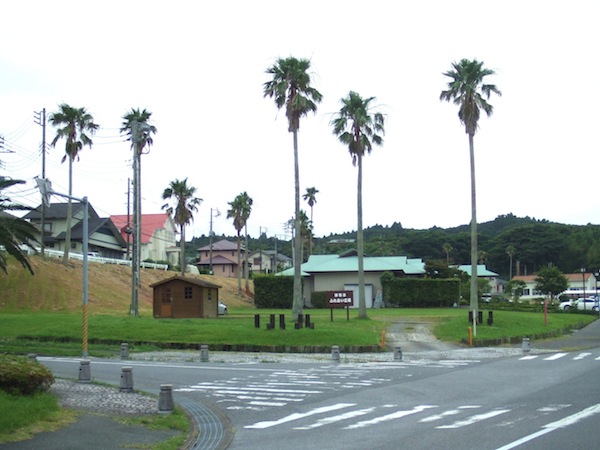
The entrance to Green Town. Note non-indigenous palm trees.
The last time we inspected some homes in Onjuku, a coastal town in southeastern Chiba famous for its surfing, we went fairly deep into the interior and were disappointed with the quality of the product, which was uniformly cheap, in all definitions of the word. This time we inspected three houses in a large housing development unimaginatively called Green Town. It sits on a hill west of the main train station and overlooks the ocean, which means it has a clear advantage over the rest of the town in this post-311 world: no fear of being swamped by a tsunami. The most popular portion of Onjuku is adjacent to the crescent of beach, which, for what it’s worth, is much cleaner and prettier than any part of Shonan I’ve seen. “Downtown” Onjuku is filled with funky little eateries, surf shops that double as outdoor bars, and lots of tall resort condos that have aged quickly–and badly–thanks to the salt-laden sea breezes. It’s a very attractive place, but it’s also very low and a tidal wave even half the size of the ones that flattened Tohoku would reduce it to sodden rubble rather easily. The reason we kept coming back to Onjuku is the climate. In the summer, it’s on average about 5 degrees cooler than Tokyo. We don’t like air conditioning and one of our priorities is a place where we don’t need it.
Green Town is also at least partially a weekend or summer community, though it’s laid out as a typical cramped Japanese housing development, albeit with more attention paid to the “green” component it promises. The developer is Seibu, and there are altogether about 1,500 lots, one thousand of which have houses on them. Half of these are owned by year-round residents, and thus the normal sterile atmosphere of modern Japanese housing developments is checked by a certain ramshackle quality. Some of the buildings are quite fine–and large–while others are modest and makeshift-looking. But while the stylistic tone is pleasingly varied, the overall feel is almost ominous. The day we visited was a weekday and summer vacation hadn’t begun in earnest yet, but the neighborhoods we visited were quite deserted. The only human activity was workers cutting grass or delivering LPG cannisters (despite the upscale appearance of the area, they don’t have gas lines). The real estate agent who guided us said most of the population was older, not because young people were moving out, but because only older people were moving in. (It’s not a town for commuters–Tokyo is an hour and 30 minutes away by super express) Apparently, older people don’t like to leave their homes in the daytime. Read More
Semi-detached
 Though we still look at condos, it’s mostly for academic purposes. We have nothing against condos aesthetically or practically, but collective living automatically brings with it certain restrictions that we don’t really want to buy into. That may sound strange coming from people who still rent, but the responsibilities inherent in owning a property are more pronounced when the property is collective. For one thing, the condominiums we tend to like in terms of layout and design are actually those that were built by the housing authority, now called UR, and most of those still don’t allow pets. (We plan to cover the pet problem in more detail in a later article.) This small but significant restriction is indicative of the condo experience: people who own are understandably more caught up in the collective enterprise and thus pay closer attention to their neighbors. Renters are relatively forgiving, maybe because they tend to think they won’t be staying here forever. Owners have more of a stake and thus there are more rules and the rules are enforced. We’re not against rules, but it seems less stressful to own a house, where you can pretty much do whatever you want, than a condo, where you may not be sure what you can do until you move in. Read More
We’re the top

What we’re talking about: Palm Springs in Inzai!
Earlier this week the Sankei-affiliated web magazine Zakzak published this year’s results of business journal Toyo Keizai’s annual survey of “urban power,” meaning the most livable cities in Japan. Toyo has been doing the survey since 1993 in conjunction with the publication of a periodical data book that compiles statistics about local economies. The survey uses “14 types of information” released by a number of government organs, including the Ministry of Economy, Trade and Industry, comprising five criteria for satisfactory urban living: safety, convenience, comfort, affluence, and housing standards. The survey covered 787 cities and the 23 wards of Tokyo, and this year the municipality that came out on top was Inzai in Chiba Prefecture, which just happens to be where we live.
Our reaction was pleasant surprise mixed with doubt, and as we read the Zakzak article it became clear what Toyo Keizai’s priorities are with regard to a satisfactory living situation. Inzai ranked #3 in the nation in the convenience category because of its retail accessibility. There are lots of discount stores that are easy to reach and with plenty of free parking. People of a certain aesthetic disposition will, of course, find this aspect of Inzai life somewhat off-putting. The retail outlets in question line route 464, which runs parallel to the Hokuso train line through three stations. Many of these outlets are gathered into rather sterile shopping malls. The article also quotes a 35-year-old resident as praising the “large choice of restaurants” along the main road, though such effusiveness should be qualified by the information that almost all these restaurants belong to national chains. For sure, if there’s one thing that characterizes Inzai’s abundance of commercial choice it’s the almost total lack of distinction. There’s nothing here that’s any different from other suburban commercial districts in Japan except maybe more of it; or less, since you’d be hard pressed to find anything that could be described as “typically Japanese.” If anything, the retail tone is strikingly American. Read More
Nailed

Extendable grid panel used as coat rack
In the most recent newsletter published our landlord, the semi-public housing corporation UR, and deposited in our mailbox there’s a specious “conversation” between a theoretical apartment renter and a theoretical apartment owner about the respective advantages of each mode of living. Discounting the whole economic side of the issue, the most obvious distinction is that owners can “freely change and remodel their apartment and replace or install amenities.” The renter counters by saying it may be nice to change your apartment the way you want, but what a pain in the neck! You have to hire someone to do the work and then move out while the work is being done. And, in any case, you can’t actually change the size of an apartment the way you can a house; whereas with some rentals, (s)he argues, the landlord will gladly remodel the unit to the tenant’s specification before the latter moves in. What’s perplexing about this line of thinking is that, while it may be true in “some” cases, as the speaker says, it isn’t true in the case of UR rentals. You have to take it the way you see it. The only part of the renter’s argument that holds water is that renters have more freedom to choose, meaning once they move in they can always move out and find something more suitable or desirable. Owners don’t have that freedom; or, they do, but it depends on how easily they can sell their property and how much of their initial investment they get back, and those points are hardly guaranteed in Japan.
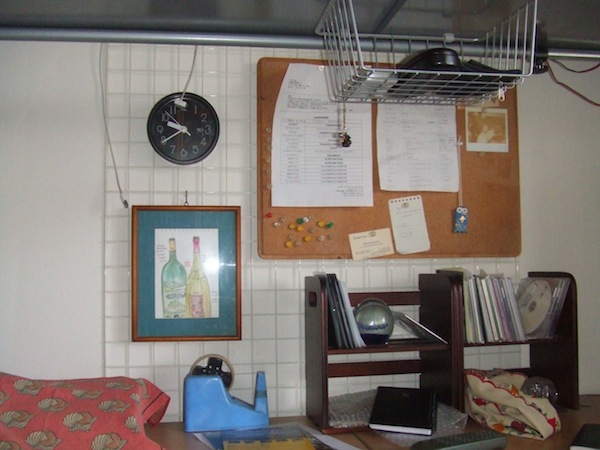
Stand-alone grid panel for office use
Still, remodeling needs to be addressed. In UR apartments, as with most rental units, tenants are very limited with regard to how they can decorate, since almost all rental agreements include a term that says the tenant must leave the apartment in the exact same state as he or she found it. And while usually contracts don’t specifically say you can’t make holes in the wall, that is how most people interpret it. In any case, we’ve heard of people having had money taken out of their security deposit because of holes in the wall–but then, private landlords will find any excuse to keep that money. Read More
Too late?
 Last Friday, several media reported that the land ministry released a new white paper on land and property usage based on research carried out last year. The conclusion of the study is hardly earth-shaking to anyone who reads this blog, but it’s nevertheless noteworthy. The paper says that the market for older homes and commercial properties should be expanded by maximizing their value through renovation and rebuilding. Though the Cabinet Office’s recognition that Japan is overwhelmed by superannuated, deteriorating structures is a step in the right direction, it’s difficult to understand if anything can be done about the problem as long as policies for promoting new building continues as it is.
According to the government’s findings, more than 30 percent of office buildings in Japan are at least 30 years old, meaning they were constructed before current earthquake-proof standards were implemented. Consequently, 90 percent of “real estate investors” are not interested in these buildings. The paper recommends that they be quake-proofed in order to “increase the stock of good quality” structures. It also advocates promoting energy efficiency so as to make the buildings more desirable. Such renovation will “increase the value of real estate” in general by reducing running costs. The government also concluded that as a result of last year’s major earthquake people’s “thinking about real estate” has changed: they are now more aware of “land quality.”
None of the news reports we’ve read have indicated what the government will do, if anything, to follow up on the findings of the white paper. Tax breaks for people who fix up older properties? That might work but seems unlikely given the government’s current craze for tax increases. The construction industry will certainly welcome any renovation boom sparked by tax cuts but it isn’t going to be happy if such renovation comes at the expense of new building, which is where the money is. Increasing property values in that way has never really been in the government’s interest.
 Cat Foreheads & Rabbit Hutches