Marginal living

We’ve written about Yusuke Yoshikawa, a YouTuber who covers what he calls “genkai new towns,” which are difficult to describe, but anyone who has followed our blog for any extended amount of time should be familiar with the concept. Essentially, Yoshikawa seeks out derelict housing developments, mainly in Chiba Prefecture where he lives (and where we live, too). He makes videos of these subdivisions, which contain not only abandoned houses, but plots of land that have never had anything built on them and thus are usually overgrown with vegetation because the people who own them have given up on whatever plans they had for the land. According to Yoshikawa, most of these plots were bought for investment purposes during or shortly after the bubble period of the late 80s and early 90s. His well researched and very funny videos have garnered him enough followers to allow him to make a living off this pastime, and he has recently been in demand as a paid speaker and published a book that is selling well. He’s a self-made success, but not in material terms. As he has pointed out, he himself lives in one of these genkai new towns, somewhere past Narita, because he could no longer afford to live in Tokyo, where he was a cab driver. In a sense, he’s stuck where he is but says he nevertheless can blog from a unique perspective about the state of Japanese real estate. He’s the most honest, clear-headed critic in the field, and he’s totally a layman. 

On Dec. 6, Asahi Shimbun ran an interview with Yoshikawa conducted at his home. The interviewer sounds a bit naive about Japan’s property situation, but maybe he’s just taking the role of the average reader. In any case, if we were doing the interviewing (and we hope to someday) we’d have more pointed questions, but this will do for now and, we hope, steer more people to Yoshikawa’s blog.

As the reporter points out in the introduction, Yoshikawa lives on the edge of the Tokyo metropolitan are, meaning a place where you can sense the population dropping off and nature taking over places where people were supposed to be living. He notes “land that was prepared for residences” but which contain “no buildings.” Infrastructure is either non-existent or “in very bad condition.” He hopes these descriptions help the reader gain a better understanding of Yoshikawa’s term, genkai new town, which has entered the vocabulary thanks to the internet. When he meets Yoshikawa at his home in one of these developments, he remarks how lonely it is. The paved streets and retaining walls make it clear that this area was prepared for residences, but there are no people. 

Yoshikawa explains that the area was developed “several decades ago” but for the most part very few people built houses on the land they bought. The interviewer mentions very old signs with the names of real estate companies that, presumably, are trying to sell particular plots, and Yoshikawa responds that in most of these cases the seller has given up and doesn’t even come to keep the plot tidy. These developments are what he calls “small scale new towns,” new towns being, in the public’s mind, large residential projects carried out with the help of public entities to develop tracts of land. Most of the more well-known new towns were built in the 60s and 70s, but these small scale new towns were built by developers as subdivisions of land that was no longer being used for agriculture, mainly during the bubble period, when real estate values skyrocketed and commercial entities were convinced that people who couldn’t afford homes in the major cities would flock to the outskirts of suburbia to live. These companies were overzealous and so were the small-time investors who bought plots in the belief that they could sell them later for more money. At some point, however, there were just too many small scale developments being built and the whole endeavor just collapsed. 

He goes on to explain how he was living in Tokyo’s Koto Ward in 2017 and having a tough time making ends meet because the cost of living kept rising. Both he and his wife worked, but they had no savings or assets and assumed if they remained in Tokyo they would just be living hand-to-mouth in small rental properties for the rest of their lives. So they looked for a place to buy that they could afford and this derelict property was the closest thing they could find. Though the development has 64 lots, only 7 contain houses.

Read More

Redevelop this

More high-rise condominium shenanigans. On Nov. 17, Tokyo Shimbun reported on 118 redevelopment projects being carried out with the help of local governments that don’t necessarily benefit people who live in the localities but nevertheless are contributing to the projects through local taxes. The article is based on a Kyodo News survey of local governments that found 90 percent of these entities paid or will pay a total of ¥1.0543 trillion in subsidies to developers and/or construction companies that are working on these projects. 

Regional cities rely more on public funds than do large regional capitals, and four of the projects surveyed apparently received more than half their total funding from tax revenues. What makes the situation concerning is that 66 of these projects comprising 19 prefectures are centered on tower condominiums, which by definition are sold to upper income people, mainly as investments. Moreover, Kyodo found through the inspection of publicly available documents that there has been “no real long-term planning” attached to these urban redevelopment projects, meaning they are simply enterprises carried out by developers who want to sell condos in the short term. Local residents will receive no ascertainable benefits from these projects, though they are helping to pay for them. Kyodo calculated that as of the end of fiscal 2023, the 118 projects were costing a total of ¥8.52 trillion to build, with 12.4 percent of the cost of 104 of the projects coming from local governments, which would come to ¥1.0543 in subsidies. 

Some projects received more public subsidies than others. A tower condo construction project at the North Exit 1 of Fuji Station in Fuji, Shizuoka Prefecture received 57.7 percent of its funds from public moneys; the Machikata-cho 1 project in Numazu, Shizuoka Prefecture received 56.9 percent of its funding from the local government; and the Yokote Station East Exit 2 project in Yokote, Akita Prefecture received 53.3 percent of its funding from tax revenues.

Tomorrow never knows

There’s a certain information lag that comes with media reporting on larger social phenomena. The whole akiya/vacant housing issue has become big news in Japan over the last decade, but it was a fact of Japanese life well before that. This blog, in fact, which began in 2009, was initially conceived as a means of explaining our belief that Japan would eventually have to face a surplus of housing due to its policy of building and selling new homes without any regard for existing and future housing stock. Akiya had been on the increase well before the media started paying attention, and just now the press is beginning to report on other effects of oversupply, but in the context of the demographic crisis, meaning depopulation. 

A recent story in Gendai Business covered a bestseller by Masashi Kawai called Mirai no Nenpyo (Chronology of the Future), which puts into perspective how depopulation will affect the economy with respect to four fields: housing, medical care, local government, and public safety. In terms of housing, Kawai says the main immediate effect will be that houses will become difficult to sell, a situation that is already quite apparent in certain rural suburban areas of Japan. However, Kawai is not just talking about existing or used housing, which has been difficult to sell for a while now, but also new housing. That’s because the prime demographic for new house sales, people in their 30s with families, is shrinking in size so significantly. Statistics can be misleading. Overall, land value has increased in Japan, as well as the demand for new housing, but these two circumstances have been spurred by seniors with money to burn. They buy expensive condominiums in city centers as a means of reducing the inheritance tax burden for their heirs; or these high-end properties are being bought as investments because the buyers believe that real estate is the most stable place to park their money. Consequently, the market as a whole seems primed for growth, but it’s lopsided. 

Tomorrow will bring what could be termed the 30-30-30 problem: In 30 years the number of people in their 30s—the prime demographic for new house sales—will have shrunk 30 percent compared to right now. This cohort is already marrying later in life than their parents did, which means if they do buy a home it might not be until they are in their 40s or even later. Right now, the common time frame for housing loans is 30 years, but as the home-buying layer of the population ages, the terms for most mortgages may shorten to 20-25 years, which means the people seeking these loans will likely be faced with higher interest rates and thus be looking for less expensive housing.

Read More

Tall order, too

Sannomiya area of Kobe

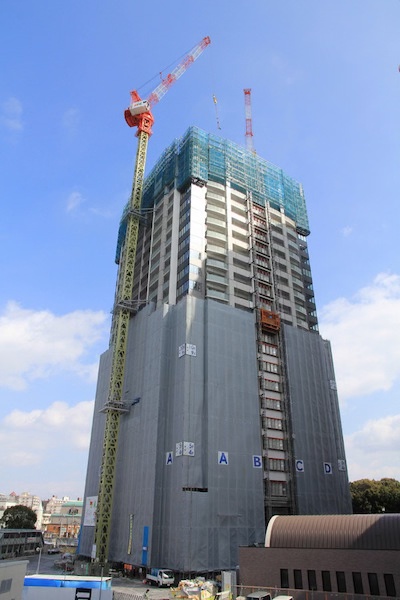
The major residential developer Sumitomo Fudosan will soon complete construction of two high-rise condominiums in the Sannomiya district of Kobe. The pair of 27-story buildings comprise 690 units, with apartments on the upper floors fetching as much as ¥200 million for their panoramic view of Kobe port. 

Sales have been very good, and according to a recent article in the Asahi Shimbun it’s not just because of the great view and the vanguard amenities. Word has already gotten out that these two towers will be the last high-rise condos built in Kobe, thus increasing their scarcity value, which means that over time their resale value could go up.

But likely that would only be in the short term. The reason there will not be any more “tower mansions” erected in Kobe is that the city has decided to prohibit new housing construction south of JR Sannomiya Station, which is a commercial district. In addition, the city has restricted the capacity rate of any new residential construction around Sannomiya Station to 400 percent, which means no new tall apartment buildings. Essentially, the municipal government is limiting the amount of new housing that can be built in the city center.

Their reason for this restriction is worth scrutinizing. According to Asahi, many cities in Japan are competing with one another to attract new residents with high-rise condominiums in their respective city centers, the idea being that people want to live near their places of work. Osaka, for example, which is next door to Kobe, is redeveloping the Umeda district north of Osaka Station, a commercial area, and one of the prime features of this redevelopment is high-rise condominiums that the city leaders hope will attract well-to-do working people. The mayor of Kobe has said that this kind of policy doesn’t make any sense when a city’s population is decreasing, as Kobe’s is. When you build new housing while the population is going down, you’re basically creating waste for the future. 

Read More

Harumi Flag unfurls

As we’ve pointed out in previous posts, the prices of new condos in Tokyo have risen considerably in the past few years owing to the high cost of construction, lowering supply, and an increase in sales to investors, whether Japanese or foreign. A June 20 article in the Asahi Shimbun about the cheap yen includes remarks from realtors who say that new condos in central Tokyo will remain expensive for the near future, with some, in fact, explaining that now they only deal with high-earning double income couples and rich investors. 

In light of this situation, the news surrounding one large Tokyo condo complex has been instructive. Harumi Flag, which was originally built to be the athletes village for the 2020 Tokyo Olympics, finally started receiving residents in January after renovations to turn the living quarters into condominiums was delayed almost two years by the pandemic. However, according to a June 7 report by NHK, as of the end of May a good portion of the units in the 17 buildings that have been sold so far are empty, which NHK finds strange since the demand for the Harumi Flag condos was quite intense owing mainly to the fact that prices were reasonable compared to other real estate in the area. NHK’s investigation found that many of the units were bought by investors, which shouldn’t sound strange given the current real estate climate in Tokyo, but the Harumi Flag project was initiated by the Tokyo prefectural government for the secondary purpose of eventually selling the residences to people who would live in them, in particular families. That’s supposedly why the initial prices were set lower.

NHK checked the title registrations of 1,089 units of the 2,690 that have been sold so far in the Sun Village part of the complex. Mitsui Fudosan Residential, the company that headed the consortium of 11 developers involved in the project, has been selling the condos in phases, and in the most recent phase there were an average of 71 applications for each unit. There were no limits to how many applications a potential buyer could submit or units they could purchase if their luck was good. Under such circumstances, institutional investors applied for as many units as they could, since they could buy as many units as possible by borrowing money more easily. In fact, NHK discovered that 292 units out of the 1,089 they checked were owned by companies, or one out of four. Sales began in 2019, and four sales phases were carried out in 2021 and 2022, with the largest number of companies registered as owners with the justice ministry following the last of these. However, when NHK checked with the Chuo Ward office it found that there were no resident registrations (juminhyo) listed for 30 percent of the condos, meaning that, technically, no one is living in these condos. In fact, more than half the units sold during the last phase were bought by companies, with many purchasing more than one unit. The investors who own the 292 units in question comprise 147 companies, most of them dealing in real estate and investment. On further investigation, NHK found that only five of these units were being used by their corporate owners as offices. NHK makes a special note in the report that all these corporate owners are Japanese, which they think is surprising considering all the media attention being paid to foreign buyers of Tokyo real estate. 

One investment company from Fukuoka, in fact, owns 38 units, and while they wouldn’t talk to NHK, their home page mentions their involvement in Harumi Flag “at an early stage” to “ensure stable returns on investments.” Two other companies did talk to NHK on condition of anonymity. One had 3 units in the complex and owned properties in Tokyo and Yokohama, as well as in the U.S. Their total real estate investments amount to ¥3 billion. A different company owns “more than 4 units” in Harumi Flag, and says they applied for and bought condos during each sales phase. In the beginning, they weren’t sure if the investment was wise, but now they are very happy because they are sure they can sell them for a hefty profit, and that seems to be the case. NHK says that so far hundreds of units have already been resold or are on the market for prices that are from 50 to 100 percent higher than their initial sales price. According to one real estate portal site, a 4LDK, 100-square meter unit in Sun Village that originally sold for ¥106 million is now on sale for ¥238 million. 

But the market is still hot, so many of the investor-buyers are not planning on selling for a while and instead are renting out their units. Unfortunately, there are too many units for rent in the complex so few have found tenants, though there are other reasons for the low occupancy rate. Harumi Flag is 20 minutes from the nearest station and all the leases have a limit of two to five years, because the owners may want to sell the units if the price peaks. NHK doesn’t mention the cost of rent, but when we checked portal sites we found one 86-square meter unit asking for ¥420,000 a month and a 65-square meter unit going for ¥280,000 a month.

NHK talked to one couple in their 60s who made 7 attempts to buy a unit in Harumi Flag and failed. Their budget was ¥80 million, which was more than sufficient for a good-sized condo during the initial sales phases but not enough to buy one that is being resold, so they’ve given up, even though several buildings in the complex are still under construction.

Read More

Future shock

We’ve written extensively about Tokyo’s current condo boom without really addressing what it will lead to in the long run. Most commentators seem to expect a burst bubble, like the one that happened in the early 90s following a similar over-valuation of properties in the late 80s. However, there is an important difference in that the current Tokyo bubble is being pumped up by rich people. The average price of a new condo in the capital has exceeded ¥100 million. In the late 80s, the bubble was caused by everyone, since the huge boomer cohort had secured its lifetime employment and banks were willing to lend them money. Even though housing interest rates are low in Japan compared to the bubble era, younger families with average incomes who still insist on buying new condos are finding it difficult to find anything they can afford in the 23 wards, according to local media.

A recent video on the YouTube real estate channel Rakumachi put the present bubble in perspective, especially in terms of what it holds for the future. According to Tomohiro Makino, a “real estate producer” whose career started in the 80s, people who say the Tokyo condo market is “over-heated” need to look at classic supply-and-demand. “Over-heated” suggests that the market will eventually cool, but since this particular bubble is being caused by rich people and institutional or business investors, it isn’t that simple. Scarcity is one of the factors fueling the over-heated prices: the number of new condos on sale in recent years is one-third the number that were on sale in a given year two decades ago. Much of the reason for this scarcity is the high cost of building materials and lack of labor. Building a condominium is much more time- and capital-intensive than it used to be, so developers have scaled down. And with prices so high, buyers trend toward people who benefit from certain financial realities, such as foreign investors who can exploit the historically cheap yen. Even rich elderly Japanese who don’t necessarily need a new place to live are buying high-end condos in Tokyo as hedges against taxes their heirs will have to pay when they die. So they invest their cash in real estate, which can lower the inheritance tax burden by as much as 70 percent. Those who do buy new Tokyo condos for living purposes tend to be so-called power couples—married people whose combined incomes exceed ¥15 million a year. 

So the high condo prices are essentially being maintained by a small group of people. Nomura Securities says the number of “very wealthy” households in Japan, meaning they are worth more than ¥500 million each, is around 90,000, for combined assets (not counting debt) of ¥105 trillion. Merely “wealthy” households (¥100-¥500 million) number around 1.4 million with ¥259 trillion in assets; “less wealthy” (¥50-¥100 million) number 3.3 million with ¥258 trillion; upper middle class (¥30-¥50 million) number 7.2 million with ¥332 trillion; and the vast middle class (less than ¥30 million), numbering 42 million, is worth ¥678 trillion. Though the top two tiers account for a bit more than 2 million households, the amount of assets they control is considerable. Much has been made of the global income gap in recent years, and Makino says the top 1 percent in Japan has seen its wealth increase by 80 percent since 2013, when Abenomics. The investment market was flooded with easy money, but average households received no comparable benefit from the policy. Makino says that its effect on real estate has led to the over-heated condo market, putting Tokyo real estate out of the reach of the middle class. Developers don’t even think about this group of consumers, because they know that even if every condo they build is luxury-class, they can still sell them. Consequently, they don’t have to build that many in order to make as much money as they used to make when they sold to everyone. The average price of a new condo in the 23 wards as recently as 2015 was ¥60 million. Last year it was ¥115 million. And due to the lag in construction costs, prices will continue to go up for the near future. 

And it’s construction costs that are the main concern for developers, since right now they account for 70 percent of the cost of a condo, the other 30 percent being land. This aspect is very significant, because while land prices vary greatly depending on location, construction costs do not. It costs almost the same to build a condo in the suburbs as it does to build one in the center of Tokyo, so most developers are putting as much of their money and resources as they can into the city. Even mid-sized developers that tend to do all their work in the suburbs are foregoing new construction to invest in new condos in Tokyo by borrowing money to buy them from major developers. Then they quickly resell them to make money. The most prevalent example of this kind of practice in the news right now is the Harumi Flag complex on the waterfront, which was built as the Tokyo 2020 Olympic athletes village and then sold or rented out afterwards. A substantial number of the condos remain empty because they’ve been bought by corporations, including developers, as investments, thus pushing the price of individual units up. According to Makino, some companies have bought from 10 to 20 units in Harumi Flag.

Makino sees this trend continuing as long as interest rates remain low, since most investors don’t use their own money to buy real estate. Once rates start to rise, he says, the market will cool as investors pull out. Now that the era of the “negative interest rate” has ended in Japan, he thinks that such a change is on the horizon, even if many experts believe the Bank of Japan won’t increase interest rates due to the amount of government bonds it has. But the BOJ doesn’t control interest rates. Other factors, including environmental disasters, international politics, even rumors, will always come into play, and once they do “the party will be over,” meaning even foreign investors will bail regardless of the exchange rate. This could prove to be a huge shock to the system. After all, young Japanese adults today know nothing about interest, having been born without any experience of bank deposits earning interest. It’s unrealistic to think that this kind of environment will persist indefinitely, but until it does change it’s also unrealistic to thing that average Japanese people will step in when wealthy investors drop out. It’s just too risky for the average household to buy a condo in Tokyo now or in the near future.

If Makino were to give advice to potential middle class homeowners who want to live in Tokyo, it would be to wait, probably until 2030, by which time he says the “market will surely change.” Not only will prices for condos, used and new, go down, but so likely will rents. And his reasons for thinking so are grounded in an unavoidable truth. Households headed by people over 65 in the Tokyo metropolitan area now number 9 million, with half of those headed by people over 75. That number will steadily increase. After 2025 all the 1.5 million boomers living in the metro area will be over 75, and while lifespans are also increasing, it won’t be long before this cohort starts dying out in record numbers, which means their property will either be left to heirs or abandoned, if it hadn’t already been sold. These people came to the metro area in their youth to work, and they bought homes. But their children, now middle aged, mostly own their own homes, too, and so won’t need their parents’, which means they’ll sell it or do something worse (pretend to ignore it?), but in any case there will be a lot of empty homes on the market. This, as Makino points out, is the heart of the akiya problem, which will only intensify by the end of the decade, throwing the real estate market, including Tokyo’s, into turmoil. Oversupply will become a chronic issue unless the construction industry and the authorities change their tune with regard to building new residences, which is pretty much all they think about now. 

Read More

Counter intuitive

Is it or isn’t it?

Last week the Ministry of Internal Affairs and Communications (MIC) finally released its latest survey of the Japanese housing situation. We say “finally” because the survey is conducted every five years and the last one came out in 2018, so we’d been waiting for it since last fall. The big news is that the number of vacant houses, or akiya, has grown to more than 9 million, or 13 percent of all homes in Japan, a statistic that’s earned headlines all over the world, though the last time the survey was published the number was already way over 8 million, so it’s not as if it’s a surprise. Still, given the global housing situation vis-a-vis inflation and other economic pressures, it’s a mighty powerful indicator of something that few people have explained satisfactorily. We think we know the reason, and we’ve discussed it for years on this blog, but that’s not our concern today. What we want to talk about is the real mystery surrounding the survey, which is how it’s conducted.

For the most part, nobody questions the MIC’s methodology, but given the sheer scale of the akiya situation, one would naturally wonder how the field staff who carry out the survey could possibly count every single vacant home. And, of course, they can’t, so they use the common statistical technique known as extrapolation, which means inferring the unknown based on the known. Specifically, it means taking a scientifically derived sample of a population and then using those results to draw a conclusion about the larger picture. So the real question is: How do they choose a sample?

In 2016, the real estate investment website, Rakumachi, published an article about how the akiya survey was conducted based on questions it had submitted to the MIC. The first point was how the ministry defined a vacant home, and, as it turns out, it has five categories, which are:

1. “Second homes,” meaning vacation properties that are used only on weekends and/or holidays; no year-round occupancy.

2. “Other” second homes, such as residences that are used only for work purposes and occasional overnight stays.

3. Vacant properties that are for rent, regardless of age.

4. Vacant properties that are listed for sale, new or used.

5. “All others,” including homes owned by people who are not occupying them at the time due to work transfers or extended hospital stays, homes that are being “prepared for demolition or rebuilding,” and homes that are vacant but to which none of the above criteria apply.

We assume that “abandoned homes” (hochi akiya) are included in category 5, and in the latest survey they total 4 million, which is quite substantial. Nevertheless, it also means that most of the residences described in the survey are still in use to some extent, so the term “vacant” needs to be qualified.

When Rakumachi asks how the akiya statistic is estimated, the MIC gives a fairly detailed answer. A vacant home is defined as a residence that is not occupied “on a daily basis,” and an evaluation is reached without necessarily interacting with the owners of the residences in question. The field surveyors “make an effort” to talk to the owner/titleholder of a property several times. But mainly they inspect the exterior of the property and question neighbors or, if the property is collective housing, like an apartment building or a condominium, they try to talk to the manager. They collect all this information for a sample of a given area and, using other information specific to the locality, extrapolate. The MIC stresses that collective housing is more difficult for different reasons, the most obvious one being that field surveyors usually cannot enter the building to interact with residents. 

So already there is guesswork involved in compiling the information that will form the basis for the akiya statistic. In January 2021, Nikkei Business ran a story that questioned this methodology with the headline, “Is the 10 percent vacancy rate in Tokyo true?” Nikkei ran off the most recent vacancy statistics: 8.49 million akiya out of a total of 62.4 million residential units in Japan; more than 800,000 vacant properties in Tokyo out of a housing stock of 7.67 million. The reporter, Takeshi So, wondered about these statistics because he rarely sees what he would describe as an akiya, be it a single-family house or an apartment, in Tokyo. (For what it’s worth, we’ve seen quite a few, but we are sensitive to that sort of thing.) And when So looked carefully at the MIC’s methodology he was struck by one thing, namely the discrepancies between the MIC’s numbers and those reported by local governments. 

Read More

Not what they paid for

In December, the Chiba city office of East Japan Railways (JR East) announced a change in the timetable for the Keiyo Line that would start in March. The Keiyo runs from Tokyo Station parallel to the Tokyo Bay shoreline south to Soga Station in Chiba city. It is the train line that services Tokyo Disneyland and the Makuhari district of Chiba, which is the home of Makuhari Messe, one of the metro area’s biggest exhibition and convention facilities. The reason for the timetable change was the removal of the Commuter Express train, which does not make any stops between Shin Kiba Station in Tokyo and Soga, and which operated twice in the morning and twice in the evening. The Commuter Express would be replaced by local trains, which stop at every station on the line, but several Rapid Express trains would be added during off-peak hours in the daytime. 

According to the transportation-oriented website Impress Watch, the announcement was met with opposition from local governments affected by the Keiyo Line, including Chiba city’s and Chiba Prefecture’s. In addition, the major media covered the matter with an eye as to how the changes would affect commuters, many of whom demanded that JR East reinstate the Commuter Express. As a compromise, the company added two Rapid Express trains to the morning peak and two to the evening peak, which was highly unusual. Once a railway company changes a timetable they almost never change it back, even partially. However, the compromise may not be enough for commuters who rely on the Keiyo Line to get to their jobs in the capital. In fact, many probably bought their homes on the Chiba peninsula because of the Keiyo Commuter Express, which is why many real estate companies and residential housing developers are nervous about the timetable changes. 

JR East told NHK that the number of passengers on the line has decreased by up to 30 percent during peak periods compared to before the pandemic. There are a total of 18 stations on the Keiyo Line, of which 7 are not serviced by the Commuter Express and the Rapid Express. The company thinks that people who live near these stations are inconvenienced by the former express train timetables, and wanted to give them more opportunities to use the line. In addition, local trains have to wait at certain stations along the line for Commuter Express and Rapid Express trains to pass, thus further inconveniencing local train users. Though JR East emphasizes that they’re thinking about local line users, it’s their own bottom line that’s really at issue. Those who use the various express trains to get to work are already locked in as customers, so the strategy of the timetable change is to add passengers by increasing local runs and making them more “efficient” for those passengers. And on paper, at least, the difference in time doesn’t seem that bad. During peak hours, the local train from Soga to Tokyo, and vice versa, takes only 19 more minutes than the Commuter Express. 

Read More

Make mine maglev (5)

Heita Kawakatsu

At the end of March, JR Tokai admitted something that we have been writing about for a number of years, which is that the inaugural Shinagawa-Nagoya leg of the Chuo Shinkansen, more popularly known as the linear motorcar in Japanese and the maglev in English, will not open in 2027 as originally planned. JR Tokai, the railway company in charge of the project (often referred to as JR Central in English), had already submitted a notification to the transport ministry in December saying that the maglev wouldn’t open until “after 2027,” but didn’t announce the revision publicly until March 28. Some reporters and at least one major media outlet, the Nihon Keizai Shimbun (Nikkei), have been suggesting for years that, given the unprecedented scale of the project, there was no way JR Tokai was going to open the line, which will zip passengers between Tokyo and Nagoya in 40 minutes, by 2027.

The company was going to have to deliver the bad news eventually and needed a convenient scapegoat. They already had one in the form of Shizuoka Prefecture Governor Heita Kawakatsu, who had been a thorn in the side of the project for more than a decade (though the prefecture’s beef with JR Tokai extends back to before his administration). JR Tokai is now blaming Kawakatsu almost exclusively for the delay. As we’ve explained in the past, the governor, who professes to be in favor of the maglev, had refused to grant the company permission to carry out tunnel construction in his prefecture until it could guarantee that the Oi River, which is in the vicinity of the construction work, would not lose any water as a result. Tens of thousands of residents rely on the river as a water source, and JR Tokai’s own impact study projected that tunnel construction would result in a significant loss. The problem has been a matter of debate between the prefecture and the railway since 2014.

According to Nikkei, the transport ministry called a meeting at the end of March where the water problem was discussed within a framework of environmental conservation related to the maglev construction, and at the start of the meeting JR Tokai President Shunsuke Niwa said that, due to Shizuoka’s intransigence, he could no longer project when the Shinagawa-Nagoya leg would open. Another JR Tokai official explained that the original construction period of 17 years “could not be shortened,” and since it would have taken ten years to complete the line after construction of the Shizuoka section started, even if they did so this year they wouldn’t be able to finish the 8.9 kilometers of tunnel that passes through the prefecture until 2034. This is a big problem for JR Tokai since local governments and businesses located along the maglev line have been carrying out infrastructure construction and redevelopment in anticipation of a 2027 opening, and the delay could cost them money and, more significantly, public trust.

Then, on April 2, Kawakatsu announced he would resign in June, one year before his fourth term is up, for something that had nothing to do with the maglev or JR Tokai. During a speech to welcome new prefectural employees, the governor made a stupid remark belittling vegetable sellers and other occupations. All the media reports on the resignation mentioned that JR Tokai had blamed Kawakatsu for the fact that the maglev wouldn’t open in 2027, and while the ostensible reason for Kawakatsu’s standing down is the remark, he told reporters, perhaps passive-aggressively, that he wanted to remove himself as an obstacle to the tunnel construction.

Read More