Field Diary: Onjuku-Kamifuse

Type: One-story house; slate roof; wooden frame; siding exterior
Age: 14 years
Land: 165 square meters
Floor area: 76.6 square meters
Distance from nearest station (Onjuku on the Sotobo Line): 3.8 km
Price: ¥7.9 million

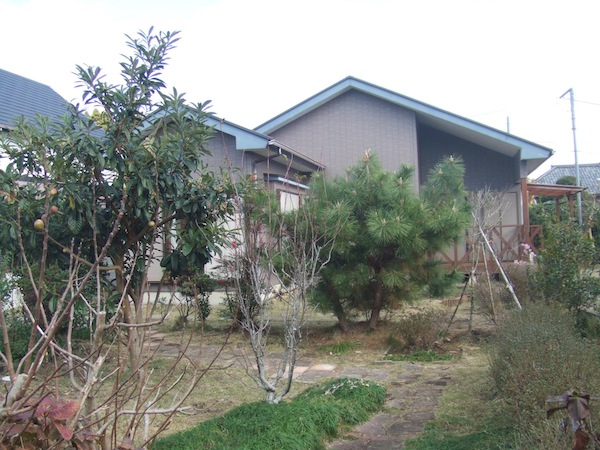
Unlike the previous property we inspected in the coastal town of Onjuku, Chiba Prefecture, this one was firmly embedded in a subdivision, albeit a sparsely occupied subdivision. Slammed up against a dense forest, the sad-looking little gray house had no southern exposure to speak of, and so was situated perpendicularly to the road, offering the vacant lots to the west and east its only views. The fact that the house is 14 years old and nobody has snatched up these lots in the meantime probably means they never will, what with other, more elaborate and better planned subdivisions going up elsewhere in the town–and closer to the station.

We couldn’t imagine anyone buying this house, which, aside from being dark, was mold-infested and falling apart. Given the low price, one might think it could be fixed up, but up close the structure, at least, seemed hopeless. The design was out of whack: The toilet on the west side? The agent was polite and helpful but obviously understood the property’s unsellability and didn’t even bother taking our data the way he’s supposed to. There would be no follow-up. We all agreed, however, that it was nice to see somebody install double-glazed windows.

Field diary: Onjuku-Jikkoku

Type: One-story house; slate roof; wooden frame; siding exterior
Age: 12 years
Land: 404 square meters
Floor area: 78.3 square meters
Distance from nearest station (Onjuku on the Sotobo Line): 3.9 km (6 min. by car)
Price: ¥10 million

Situated on the edge of a huge rice field, the land that comes with this property is probably its most attractive feature, providing a sizable front yard, which the previous residents tried to make into a combination vegetable/Japanese garden. Considering how overgrown and tacky it’s become–not to mention the fact that the original asking price was ¥11 million–no one has obviously lived there for a while. The agent told us that the house was originally connected to its almost identical neighbor to the west. At some point the corridor that bound them was torn down, leaving a mysterious windowless storeroom off the bathroom as its only evidence of prior existence.

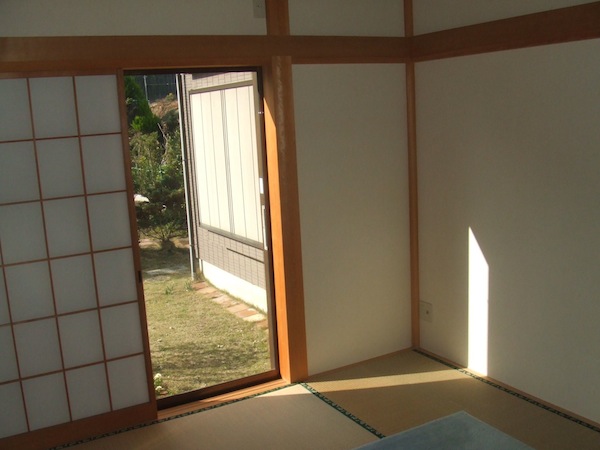
The layout was reasonable: two Japanese rooms situated in staggered parallel, both looking south; an open living/dining area perpendicularly positioned to the kitchen, which is large and airy. Despite the efficient use of space the rooms are darker than we like, owning mainly to the low ceilings and small windows. Also, a small wooden deck was built outside of the double sliding doors on the east side of the living room, facing the farmhouse next door, which is uncomfortably close. The agent said that someone still lives there though we couldn’t see any signs of recent life. It was the model of a derelict fire trap and would make any venture out on to the deck for purposes of enjoying the sunrise or whatever depressing.

Verdict: House would need at least 3 million more to make is livable, and the land size alone, not to mention the distance from transportation, couldn’t justify the price.

Dying to get in

Who died here?

Further on the subject of the property values of places where people died, which was started in the comments section of the previous post, there was actually a book titled “Tokyo Laundering” published last year about a fictional occupation: people who are hired by landlords or realtors to live for one month in houses or apartments where people just died. By having somebody occupy the place legally, the owner can rent or sell the property at its listed value rather than the cut-rate price that most owners are compelled to advertise for such a property since, according to law, they have to tell prospective buyers/renters that a person died there. If someone lives there for a month, they’re no longer obliged to reveal that information. It’s such a clever subterfuge, we’re surprised no one has actually put it into practice.

As far as we know, the only outfit that openly advertises such properties is UR, which lists rental apartments where people have died for something like half the normal price for up to two years. Supposedly, within their system 300 units become vacant each year because someone died. We’ve also heard of realtors soliciting doctors, people in the funeral business, and foreigners for such properties since such people usually aren’t grossed out by the idea of someone having died in the place they just moved into. There’s also a website that lists properties where “incidents” occurred, and though they detail the incident that took place (with the help of inadvertently humorous illustrations) and even show you the location on a map, you’ll need to do a bit of detective work to find out about renting or buying, since all they give as contact is the name of the realtor or owner. It’s a great site, however, for those into ghoulish walking tours.

And lastly, some insurance companies offer coverage to landlords for apartment deaths. If a tenant dies in one of their properties, they can receive up to ¥1 million, which should cover the money lost as a result of an extended vacancy or decreased rent.

A riddle

The house pictured above is on a major road in the city of Inzai, Chiba Prefecture. It was built in 2004 on a 446.28-square-meter plot of land. The floor area of the house itself is 82.29 square meters. It is less than one minute from a bus station. The bus ride from that station to Inzai Makinohara station on the Hokuso train line is 13 minutes (from Inzai Makinohara to Nihombashi is a little less than an hour). Since the land is relatively large, there are none of the usual privacy problems one gets in Japanese housing developments, and the lack of buildings in the surrounding area means the house gets a lot of sunshine from three different directions.

According to Inzai city records, the average price of a single-family home in this particular area of the city is ¥24 million. This house is now on sale for ¥15 million. It has been on sale for more than three months, which is why we went to see what it looked like. With the conditions we mentioned above, this should be a steal, but for some reason no one seems to want it. Of course, normally in Japan, a house that’s older than 20 years, unless it’s in the middle of a major city, has no value. This one isn’t that old, and though it’s hardly impressive in terms of design or style, it still seems to be in good shape. Moreover, the land, which is on a major thoroughfare, should be worth quite a bit (if Inzai’s assessment protocols can be considered accurate).

But even if the property’s continued vacancy seems a mystery, it’s not a place that we ourselves would ever want to own, and maybe that feeling, more than the logic of the economics, says something.

Whose view?

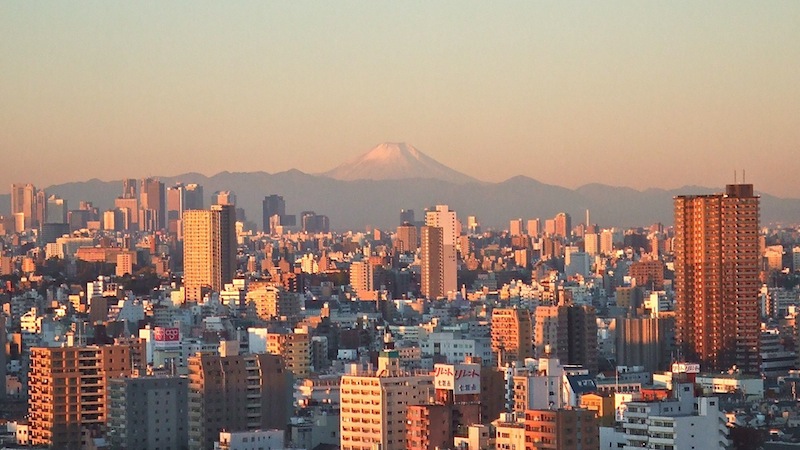
Most place names in Japan are derived from geographical or topographical traits, and one of the most common names in the Kanto area is Fujimi, which indicates that the place has a view of Mount Fuji. The Japanese place a lot of spiritual stock in mountains. Traditionally they were the objects of worship, and Fuji, of course, is practically a religion unto itself. It’s probably no coincidence that “fuji” itself is a homonym for a word that means “live forever.”

Nowadays, any address with the name Fujimi attached is highly valued–if, in fact, it still affords a view of the sacred mountain. Tokyo, in particular, is so built up that, according to Tokyo Shimbun, there are only three locations left in the city named Fujimi from which Mt. Fuji can still be seen from the ground. The most famous of these is in Nishi Nippori, a place called Fujimi-zaka, or Fujimi Slope. In early November and late January, photographers and tourists converge at the top of the slope to wonder at the Fuji Diamond, when the sun happens to set behind the mountain’s summit. This year, rubberneckers almost lost their chance, since the weather was cloudy for two of the three days when the diamond view is possible. As it happens, it may be the last time.

That’s because Sumitomo is building three tower condominiums that will forever block the view of Mt. Fuji from the vantage point of Fujimi-zaka. This almost happened before. Back in 1999, another developer announced a plan to build a tall condo within the neighborhood that threatened the view, and local residents formed a committee to protest construction. Naturally, the developer paid no attention, but as it turned out, the building only blocked a small portion of the foot of the mountain. The new Sumitomo project will definitely block the whole thing, so the committee has asked the mayor of Arakawa Ward to lodge a formal complaint with the developer, which reportedly was quite “annoyed” by the request owing to the fact that the buildings under construction happen to be in Okubo, all the way on the other side of the Yamanote Line. Sumitomo bought the land five years ago and says it has complied with all relevant prefectural and ward regulations in planning the housing project, and the ward in question isn’t Arakawa, it’s Shinjuku.

Where there’s smoke

Last Sunday morning at about 7 o’clock, a fire broke out at the Rose House Higashi apartment building in the Okubo section of Shinjuku, Tokyo. More than half of the two-story structure was destroyed. Four residents died and two remain in critical condition. Of the 26 units in the building, 22 were occupied by 23 residents. That means one unit had two people, which is sort of remarkable since each apartment is only 4.5 tatami mats in size, or about 8 square meters.

Rose House is fifty years old. Each room has a cold water faucet and a gas burner. The toilets are communal. There is no bath, which is characteristic of these kind of wooden apartment buildings. Rents were between ¥51,000 and ¥53,000 a month, which is cheap for Shinjuku but quite expensive for this kind of residence. For ¥10,000 more you can probably find a six-mat apartment not far away with its own private bathroom, but as media have reported 17 of Rose House’s residents were on welfare, and most of them were “very old.” The Shinjuku welfare office told reporters that they did not “recommend” Rose House to any of the people they administer, but it’s common for welfare recipients to “live in the same building.” That’s because their incomes are extremely limited and most landlords will not rent to welfare recipients. As it happens, welfare recipients in Tokyo tend to receive a higher housing allowance than people in other cities in Japan, the maximum being ¥53,000. Rose House apparently catered to welfare cases, which makes sense. Landlords usually can’t demand that much money for such old, cramped apartments, even in Shinjuku, and public housing is usually off-limits to single people; but since welfare recipients don’t have a lot of choices the Rose House landlord could ask them to pay that much. Also, Rose House didn’t demand a guarantor. Even at less than full capacity the place makes more than a million yen a month.

So far the police have not isolated the cause of the fire. Some media initially suspected it had something to do with “old wiring,” since there was a small electrical fire in one of the apartments several months ago, but the Asahi Shimbun has reported that theory has been discounted. Though the building was situated on the edge of a parking lot, Rose House is what is called a saikenchikufuka, a structure that “can’t be rebuilt” because it was erected in the middle of block, thus making it very difficult for firemen to gain access. Nobody will be moving back in, which means the surviving residents now have to find some other hovel to accept them.

Now on sale

It’s fairly well-known that Japanese people like new things, and if their budget allows they prefer buying a brand new house or condo rather than one that’s already been lived in. Half of the almost six million condominiums in Japan were built within the last 15 years, and reportedly the pace of construction is slowing due to the ongoing recession. According to statistics recently released by Reins Tower (East Japan Real Estate), sales of older condos also went down over the past year. Sales contracts were concluded for 1,943 used condos in August in the Tokyo Metropolitan area. That’s a 6 percent drop from the same month last year. However, the 920 sales in Tokyo alone represented a 0.9 percent increase over last year. The suburbs were a bit different, with Chiba seeing a 6.8 percent drop and Kanagawa a whopping 14.1 percent decline.

But that isn’t the whole story. While sales on the whole have gone down slightly, the average prices of the condos sold have gone up, as much as 4.6 percent in Saitama, for instance. What this would seem to indicate is that more newer used condos are being sold, since condominiums lose their value with time on a pretty consistent basis. In Tokyo, the trend is more localized. Sales of used condos in the three central wards (Chiyoda, Chuo, Minato) decreased by 15.4 percent, while those in the eastern portion of the city increased by 8.6 percent. Condos in the center of the capital are, of course, much more expensive that those in the eastern part, even though prices in central Tokyo have dropped 6 percent while those in eastern Tokyo declined only 1.4 percent (for comparison’s sake, prices in the western wards dropped the most, 8.2 percent, while those in the southwest–Meguro, Shinagawa, Ota–lost only 0.6 percent).

All indications point to a buyers market for used condos, which is hardly surprising. The stock is increasing. For the entire Tokyo metropolitan area, the available stock of used condos is 52 percent higher than it was last year, and in central Tokyo it’s gone up by 25 percent (all Tokyo by 35 percent). What this means is that it’s becoming more difficult to sell older condos, even in those areas like central Tokyo where it used to be considered easy to do so.

Does ownership = entitlement?

Damages: Worse for some

There was a very interesting letter in today’s Tokyo Shimbun. A 51-year-old company executive from Kodaira, Tokyo, wrote that he recently visited his sales department in Sendai, and one of the employees told him that the residents of the condominium where he lived until the earthquake of Mar. 11 all received “charity donations,” presumably from the Red Cross, totaling ¥450 million, or ¥3 million for each of 150 households. Since the building was declared “zenkai,” or uninhabitable due to the extent of the damage, all the condo owners have had to move. Obviously, thought the executive, ¥3 million is not enough money to replace their apartments.

But what really bothered the letter writer was that he soon learned that other, presumably less deserving victims of the disaster also received donated funds. Another “acquaintance” was given ¥2.5 million. His apartment was also condemned, but it was a rental. The executive said that the person hardly needed that much money, because all he required was “maybe ¥200-300,000 to move to a new rental apartment.” Even more outrageous was the intelligence that someone who lived in a public apartment (koei, meaning that the amount of rent is pegged to the tenant’s income) also received “a lot of money” from the fund. The executive couldn’t understand why, since all that person had to do was “move to another public apartment.” In the end, the letter writer said, “I have doubts that this donated money was spent meaningfully on victims who really needed it, and a lot of people I know in Sendai feel the same way.”

Most of those people are probably home owners themselves, and the letter brings up a matter that has simmered under the surface of disaster coverage for months now: Do home owners deserve more help than other people? Obviously, they think so, but one of the basic tenets of “ownership” is that the thing owned is the owner’s responsibility. He has dominion over that thing and no one can take that away from him. This belief forms the sacred core of capitalism and free enterprise: You can do anything you want with your property, and the unavoidable corollary is that you and only you are responsible for what happens to it.

But ever since the disaster home owners in the affected areas have demanded that the authorities (including TEPCO) help them rebuild, and not just with loans, but with direct payments. In response to the Great Hanshin Earthquake, the government passed the Disaster Relief Act, which provided funds for people affected by natural disasters. Owners of homes assessed to be zenkai can receive up to ¥3 million toward rebuilding. Many homeowners say this is not enough, and there is even a plan for the government to buy up private land along the coast that has become uninhabitable due to changes in the shoreline.

The magnitude of the disaster has, however, obscured an important point. Japan is a capitalist democracy, so why should the government give any free money to home owners? By using tax money to help them, even people who don’t own homes pay to help replace lost private property. This concept violates the spirit of “ownership” and certainly constitutes what libertarians would call a moral hazard.

We don’t necessarily support this view. The lives of people in the stricken areas have been destroyed, and we believe it is a social obligation for all of us to help them get back on their feet, whether through the agency of the government or through charitable concerns like the Red Cross. However, the man who wrote the letter to the Tokyo Shimbun has his priorities twisted. Why is a home owner–who tacitly accepts the risk attendant to ownership–eligible for greater charitable assistance (on top of the money he/she will receive from the government) than is someone who rents? Because he has “lost more”? Perhaps, but loss is an unavoidable component of ownership, so why should a renter be penalized for risking less? It’s a class distinction; no more, no less.

Shift that burden

Professor Yosuke Hirayama of Kobe University, probably Japan’s foremost scholar on the subject of housing and social policy, was the subject of a fairly long interview in the Asahi Shimbun recently, and though everything he said has been discussed at length in this blog, his explanation of what’s wrong with Japan’s official housing policy deserves to be summarized, especially in light of the current worldwide movement to close the income gap. For sure, Hirayama’s belief that government must shift its policy away from home ownership may raise the hackles of free market advocates and libertarians since it basically takes for granted the idea that housing is such a basic need for all members of society that the authorities need to be involved. What’s notable is that his ideas are based on classic, some might say prosaic economic principles; but in any case it was government that created the problem in the first place.

In a nutshell, Hirayama says that Japan’s long-time housing policy, which is based on promoting home ownership, has hit a wall, and that the government should shift this policy to promoting rentals. He begins by citing the disaster in the Tohoku region, where home ownership is even higher than the national average and where a good portion of these homeowners are elderly people who live alone. They are already in debt, and to encourage them to build new houses is simply to push them further into debt. Instead, the government should promote the construction of more rental housing and offer subsidies to renters. He mentions that he himself lived through the Great Hanshin Earthquake of 1995, and at the time was renting. Compared to homeowners, he survived the situation without as much emotional or financial trouble, because all he had to do was move. Of course, earthquakes are unpredictable, and by themselves can not be used to argue against home ownership (though he also points out that seismologists predict a better than even chance of a major earthquake hitting a large populated area in Kanto or Tokai in the next 30 years). The point is that renting has its advantages, a notion that has no traction in Japan. Read More