The single life

Statistics recently released by the Health, Labor and Welfare Ministry show that the number of single parents is on the increase, and has been since 2006. This makes sense since the divorce rate is also rising, but what’s makes the statistics noteworthy is that more and more single mothers are women who have either never been married or were married but gave birth after their marriage ended.

Right now, the ministry estimates there are about 1,520,000 households in Japan headed by single monthers, and about 200,000 headed by single fathers. Though the statistics are a bit old, the Ministry of Internal Affairs conducted surveys of “never-married” single mothers in 2000 and 2005, and between those two years the number of single mothers between the ages of 15 and 49 increased by 39 percent. However, when you break this number down by age groups, you find that the biggest increases are among women over 30: 57 percent for 30-34; 45 percent for 35-39; and 56 percent for 40-44. In terms of real numbers these increases don’t represent very much since the portion of children born out of wedlock in Japan is only about 1 percent. Read More

Yuzawa’s last resorts

Yuzawa-machi

In 1987, at the height of the so-called bubble era, when land and stock prices were on a bender, the Diet passed the Law for the Development of Comprehensive Resort Areas, whose idea was to make the development of leisure facilities a national project. Developers and local governments were given financial incentives, and property laws were relaxed so that more holiday-oriented projects could be carried out. One of the outcomes of the law was the invention of the “resort mansion,” condominium complexes that were built in outlying areas where city folk could spend their vacations. Read More

Beware the realtor

Future dream home or heartache?

According to the land ministry, in 2009 60,000 properties were put on the auction block due to failure to meet mortgage payments. That’s a 30 percent increase over the number of auctions in 2008. Meanwhile, 800,000 new homes, including condos, were built in 2009.

The Asahi Shimbun yesterday ran a story about two such delinquencies that happened to neighbors in a town in Chiba. Both of the houses involved were built in 2001 in a small, cramped development of six buildings about 10 minutes walk from the nearest train station, which the article declines to identify. Three of the houses have changed ownership since they were first sold.

One of them is a two-story, 130-square-meter house that still looks relatively new. It was originally bought by a dump truck driver, who is now 61, for ¥22 million, which is a fairly reasonable price for a house that size which is 90 minutes from the center of Tokyo. Read More

Interest drops

Think you can afford it now?

For the first time in seven years the long-term interest rate in Japan dropped below 1 percent, which should be good news for people in the housing and construction business, not to mention potential homeowners. The reason is less encouraging. Because the US economy continues to be sluggish, more people are purchasing Japanese government bonds and yen.

Consequently, the government will reduce the interest rate for Flat 35 housing loans starting in August, which are government-supported mortgages for between 21 and 35 years. Depending on how many years your mortgage is for, the interest rate will be from 2.3 to 3.2 percent, which compares to about 4.6 percent in the U.S. right now.

Though this development will certainly spur home purchases, it would be better if savings interest rates weren’t so low and salaries were rising. As it is, a lot of people just don’t have enough faith in the future to sink everything they have into a house or condominium.

Down by the river

Feeling blue

In summer there are fireworks festivals everywhere throughout Japan. One of the most popular is the one over the Sumida River in Tokyo. Every year about 1 million people show up.  This year it’s taking place on July 31st.  During the second week of July the authorities start to install fences along the river banks.  The fences are to protect the spectators and prevent water accidents. In order to install the fences the people who erect blue tents (homeless poeple) on the terraces or along the paths have to leave and remove their tents. That means that during the festival the homeless people who live in these tents have to move somewhere else temporarily. In March 2010, the authorities said that there are 13,000 homeless people in Japan. That’s a decrease of 12,000 since 2003, when they counted the homeless for the first time. Both Sumida and Taito Wards counted 720 homeless people in their jurisdictions, and about 70 percent of them live along the Sumida River. They have nowhere else to go, but people who live nearby tend to complain.

Cookie cutter architecture 1

Due to zoning rules and the general cost of land, there are some oddly shaped buildings in Tokyo and other major Japanese cities. Triangular plots yield wedge-forms (cutely referred to as tongari, or “pointed”). The taper on this four-story residence in Tokyo’s Arakawa Ward is too gentle to qualify as a wedge, but at its widest it’s only about two meters.

New depressing stats

The forecast is not fair

The government recently released new figures related to household income. As of June 2009 there were approximately 48 million households in Japan, each with an average 2.62 members. The average income per household was ¥5.475 million, which is ¥87,000 lower than the average in 2007. Household income in Japan peaked in 1994 at ¥6.642 million.

In terms of an aging society, there were 9.623 million households whose members were either all over 65 or a mix of over 65 and under 18. The average income of these households in 2008 was ¥2.98 million. Overall, 61.5 percent of the households earned below the average income, and 19.4 percent of these earned less than ¥2 million. About 58% of the respondents of a related survey said that “life is difficult,” the first time since 1986 that that answer represented the majority of Japanese. Read More

Ghostbuster apartments

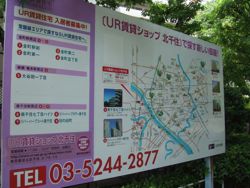
One of the inevitable consequences of a rapidly aging society is that people who die alone in their homes become more of a conspicuous phenomenon. There’s a word for it in Japanese–kodokushi–which is usually used when someone dies and no one discovers the body right away. As Japan became a more atomized society following the economic growth period of the 60s and 70s, more and more old people have been living in urban apartments by themselves, cut off from their communities and even from relatives. Isolated neighborhood groups often form patrols that keep an eye on elderly people living alone, checking up on them regularly to make sure they’re all right. One firm that works with UR, the nation’s public housing corporation, helps older tenants who find it difficult to move about. For ¥500 a month they take out their garbage for them, a service that doubles as a kind of patrol for obvious reasons. Read More

Tree huggers

In Japan, any property you buy will likely not increase in value over time. Structures themselves, whether houses or condominiums, lose value as a matter of course because that’s the way the government and the housing industry planned it. And since the end of the bubble economy of the late 80s, even land prices have dropped and continue to do so, thus contributing to the cycle of deflation that keeps the economy in the doldrums.

The only exception to this trend is Tokyo, and the media has lately been reporting on how healthy the condo market is in the capital, but according to AERA it’s only specific areas of Tokyo, and not necessarily the ones you might expect. For instance, the “3A area” of Aoyama, Azabu and Akasaka–expensive locations favored by well-to-do expats–has been losing value steadily since the so-called Lehman Shock because of decreasing demand for rental property. Read More

The “custom” myth

Today we wrote a letter to the Japan Times about an article they printed last week about rentals for foreigners. Here it is:

In the May 15 article “Housing glut opens door to foreign tenants” Takahide Ezoe of the Shinjuku Japanese Language Institute states that “Japanese…know that you don’t usually get the amount of deposit back” when they move out of a rental property, and thus potential foreign renters have to be made to understand this point since, According to Ezoe, “to foreigners, a deposit is something that will be returned fully.”

In principle, the purpose of a security deposit, or shikikin, is to provide reserve funds in the event that the tenant is delinquent with his or her rent. However, many landlords consider it money that can be used after the tenant moves out for repairs and maintenance. In most developed countries, landlords are legally responsible for normal wear-and-tear on a rental property, not the tenant. Foreigners who have not caused any unusual damage to their residences should by all rights expect to receive their security deposits in full when they leave, as should Japanese tenants. In fact, many Japanese have sued landlords to recover their security deposits and won.

As the article points out, potential renters should read their contracts. If they don’t understand the security deposit issue then they should have it clarified by the landlord or agent. When they move out and do not receive their deposits back, they should confront the landlord and demand an explanation. Many landlords use security deposits, key money (reikin), and contract renewal fees as tools to gouge tenants, whose rights in these matters are not clearly defined by Japanese law. To call these conditions “customs,” which is what realtors tend to do, is to obfuscate their questionable legality. They are certainly unethical.