Marginal living

We’ve written about Yusuke Yoshikawa, a YouTuber who covers what he calls “genkai new towns,” which are difficult to describe, but anyone who has followed our blog for any extended amount of time should be familiar with the concept. Essentially, Yoshikawa seeks out derelict housing developments, mainly in Chiba Prefecture where he lives (and where we live, too). He makes videos of these subdivisions, which contain not only abandoned houses, but plots of land that have never had anything built on them and thus are usually overgrown with vegetation because the people who own them have given up on whatever plans they had for the land. According to Yoshikawa, most of these plots were bought for investment purposes during or shortly after the bubble period of the late 80s and early 90s. His well researched and very funny videos have garnered him enough followers to allow him to make a living off this pastime, and he has recently been in demand as a paid speaker and published a book that is selling well. He’s a self-made success, but not in material terms. As he has pointed out, he himself lives in one of these genkai new towns, somewhere past Narita, because he could no longer afford to live in Tokyo, where he was a cab driver. In a sense, he’s stuck where he is but says he nevertheless can blog from a unique perspective about the state of Japanese real estate. He’s the most honest, clear-headed critic in the field, and he’s totally a layman. 

On Dec. 6, Asahi Shimbun ran an interview with Yoshikawa conducted at his home. The interviewer sounds a bit naive about Japan’s property situation, but maybe he’s just taking the role of the average reader. In any case, if we were doing the interviewing (and we hope to someday) we’d have more pointed questions, but this will do for now and, we hope, steer more people to Yoshikawa’s blog.

As the reporter points out in the introduction, Yoshikawa lives on the edge of the Tokyo metropolitan are, meaning a place where you can sense the population dropping off and nature taking over places where people were supposed to be living. He notes “land that was prepared for residences” but which contain “no buildings.” Infrastructure is either non-existent or “in very bad condition.” He hopes these descriptions help the reader gain a better understanding of Yoshikawa’s term, genkai new town, which has entered the vocabulary thanks to the internet. When he meets Yoshikawa at his home in one of these developments, he remarks how lonely it is. The paved streets and retaining walls make it clear that this area was prepared for residences, but there are no people. 

Yoshikawa explains that the area was developed “several decades ago” but for the most part very few people built houses on the land they bought. The interviewer mentions very old signs with the names of real estate companies that, presumably, are trying to sell particular plots, and Yoshikawa responds that in most of these cases the seller has given up and doesn’t even come to keep the plot tidy. These developments are what he calls “small scale new towns,” new towns being, in the public’s mind, large residential projects carried out with the help of public entities to develop tracts of land. Most of the more well-known new towns were built in the 60s and 70s, but these small scale new towns were built by developers as subdivisions of land that was no longer being used for agriculture, mainly during the bubble period, when real estate values skyrocketed and commercial entities were convinced that people who couldn’t afford homes in the major cities would flock to the outskirts of suburbia to live. These companies were overzealous and so were the small-time investors who bought plots in the belief that they could sell them later for more money. At some point, however, there were just too many small scale developments being built and the whole endeavor just collapsed. 

He goes on to explain how he was living in Tokyo’s Koto Ward in 2017 and having a tough time making ends meet because the cost of living kept rising. Both he and his wife worked, but they had no savings or assets and assumed if they remained in Tokyo they would just be living hand-to-mouth in small rental properties for the rest of their lives. So they looked for a place to buy that they could afford and this derelict property was the closest thing they could find. Though the development has 64 lots, only 7 contain houses.

Read More

Dead houses

In the last year, we’ve seen a lot of headlines on social media about how you can buy a house in Japan for a song. The usual figure quoted is about $500 US, which makes us think that all these articles spring from one source that’s likely American. We haven’t bothered tracing the articles to one source, though we read a few of them and they all say basically the same thing: local governments throughout Japan are promoting the acquisition of abandoned houses in order to get people to move into their regions and lift the tax base. In some cases, they are even giving houses away, but in any situation these structures will need a lot of work before they are at all habitable. We’ve written extensively about the problem of akiya and since you get what you pay for it follows that the lower the price the more work that will need to be done. The worst akiya, it must be said, are not even on the market, meaning they were literally abandoned by the owner for any number of reasons—either because they moved out and couldn’t be bothered to try and sell it, or they did try to sell it with no success, or they simply disappeared in order to avoid having to pay property taxes, which, in all probability, were very low to begin with. Or they died—with or without an heir. There are a lot of akiya whose owners are dead, meaning they never transferred the title to anyone, and though heirs are still legally responsible in Japan they can be difficult to contact if they don’t want to be found. Those houses are probably unihabitable since they’ve been left to rot, and the local government doesn’t want to spend the money to have them demolished.

There are more than 8 million akiya and, not counting dedicated rental units, many are not livable and fewer are even sellable due to other factors such as location. So when you read an article about somebody who bought a house for nothing and fixed it up into a nice place it’s not just an exception to the rule, but almost an anomaly. Anytime a foreign person buys an old farmhouse or kominka and turns it into a monument to traditional Japanese craftsmanship they’re bound to get it featured in the news, but, again, it’s exceedingly rare. Most people prefer new homes, and because government policy has always privileged new house construction, potential buyers can always find something they can afford that’s new; and in many cases it will even be cheaper than an older house that requires extensive renovation, which describes a substantial number of old houses that are on sale. 

The reason these articles about cheap houses have proliferated in the past year is mainly the pandemic, which, for a while, cut into new home construction. People are moving out of the cities because they can now work from home, so used houses starting selling well, but, again, a lot still aren’t selling. We know of several houses in our general vicinity that are in good condition but they’ve been on the market for months, some even years. There are just too many cheap old houses that people want to sell and not enough buyers. Of course, much of it has to do with Japan’s decreasing population, but mainly it has to do with oversupply. When construction resumes apace, those old houses will become even more difficult to sell. 

More to the point, people who do sell their homes almost never make back what they paid for them. The exception is certain areas of big cities, but even in those cases it isn’t guaranteed, and then the seller will be even less likely to see a profit, especially when you factor in the interest they paid on their loan. (You’re more likely to make a small profit if you bought an old condo in a popular area of Tokyo and resell it later.) At this point, we think most Japanese people know this, despite all the talk about “maintaining property values” at all cost. We certainly know it. Almost as soon as we moved into our new house in 2014 the assessed value dropped by almost two-thirds—and that’s for property tax purposes, which tends to be higher than market assessed value. (Assessed value for land is a different matter) So we know we will never be able to make money on this house, which is one of the reasons why we had it built the way we wanted—meaning few other people would probably want it. But the problem as we get older is: What can we do with it when we reach the age where we can no longer live here? There’s a very good chance we won’t even be able to sell it. Since we don’t have children, there’s no one to inherit it. We’ve already brought up the possibility with some younger relatives that any of them can have it for free, and while they sound interested, we’re not sure if the idea of taking on a property is something they have the wherewithal to carry out. We’ve even thought of donating it to some organization, but that might run into problems with neighbors who find out about it beforehand. 

Read More

The now and future isolated

A superannuated New Town

Around the time the central government finally decided to declare a state of emergency to get people to stay indoors and help halt the spread of the coronavirus, we wondered if anyone would mention our pet peeve—tower condominiums—as an ideal residential accommodation for self-isolating individuals in Tokyo. The problem with living in a metropolis during an epidemic is that most people reside in collective housing, which makes it more difficult to not come into contact with others if you decide to emerge from your apartment. Consequently, the closer you are to the ground, the more insistent the urge to get some fresh air. High-rise apartment buildings make it that much more difficult to leave one’s home, since it requires getting into an elevator, which is the worst environment in a pandemic—cramped and unventilated—in order to come and go. So in a sense people who live in high-rises are already isolated to a certain degree, since, in our own experience as tower dwellers, such residents require more energy and initiative just to get out the door.

Novelist Jin Mayama doesn’t make this exact point in his essay for Asahi Shimbun that appeared April 18, but he comes close. He acknowledges that families will be trapped inside together for an indefinite period of time and hints that people in high-rises will be more stressed out owing to the cramped conditions. However, he sees this as a kind of opportunity, not so much for the residents, who are mostly stuck with their lot, especially if they bought their apartment, but rather for the rest of us who don’t live in high-rises. The epidemic puts the future of tower condominiums in a new light, or, maybe it would be better to say, a new shade.

Mayama predicts that the lot of tower condos will be strikingly similar to that of New Towns right now, which is that the latter have essentially become “slums.” Most of Mayama’s explanation mirrors what we’ve talked about at length in this blog, but it’s worth going through again for the sake of clarity. Collective housing is still a fairly recent trend in Japan, since it wasn’t anywhere near the norm, even in cities, before World War II. To him, the idea of collective housing as a social trend really took off in 1955, when the central housing authority started planning New Towns, which were based on a British idea but, physically, resembled Soviet apartment blocks. The New Towns were broadly covered by the media as being futuristic and progressive, and were instrumental in creating what was called “new families,” which, to Westerners, were basically nuclear families. Extended families, which had always been the norm and ideal in Japan, didn’t fit the new housing plan. Moreover, the New Towns epitomized the government’s drive to create a “100 million-strong middle class.” Read More

This land is UR land

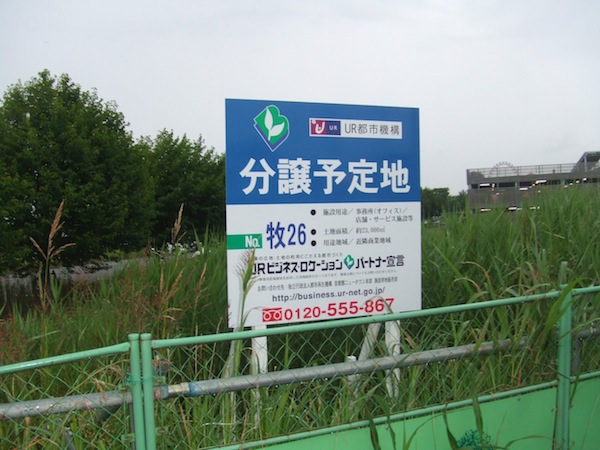
Tract of UR-owned land near Inzai Makinohara station on the Hokuso Line

The Asahi Shimbun recently reported that the government finished auditing its accounts for fiscal 2011. The board that conducted the investigation found 513 separate cases of “waste” comprising ¥529.16 billion, the largest amount since records have been compiled. In the wake of media reports that have government organs inappropriately using tax money earmarked for reconstruction of the disaster-hit Tohoku region, it is natural to assume that this waste would be doubly scrutinized, but we won’t hold our breath. One of the areas that will probably invite less concern is assets held by dokuritsu gyosei hojin–independent administrative agencies–that remain unused. In 2010, the cabinet issued a directive that such assets should be returned to the government, but apparently that’s not happening as the auditors found lots of unused assets lying around–literally, in many cases, since the assets that seem to be the most problematic are real estate-related. The National Hospital Organization, for instance, owns 217,000 square meters of land valued at ¥6.7 billion that remains undeveloped and with no plans for development. According to the cabinet directive this land should be handed over to the national government.

Another independent administrative agency with lots of unused assets is Toshi Saisei Kiko, more popularly known as UR (Urban Renaissance), the semi-public housing corporation that the government would like to make completely private because it’s such a sinkhole for money. Since UR’s business is the sale, development, and management of real estate, its unused asset problem is also a business problem, and the auditors found that the company controlled 223 hectares of land valued at ¥89.7 billion that was unused, which many not sound like much, but apparently the audit board was only talking about assets that were supposed to be “processed” during FY2011. As almost everyone knows, UR has lots and lots of land that remains undeveloped, and since all of UR’s debts are covered by the government the auditors insist that UR can cover at least some of its deficits by liquidating land assets. Read More

We’re the top

What we’re talking about: Palm Springs in Inzai!

Earlier this week the Sankei-affiliated web magazine Zakzak published this year’s results of business journal Toyo Keizai’s annual survey of “urban power,” meaning the most livable cities in Japan. Toyo has been doing the survey since 1993 in conjunction with the publication of a periodical data book that compiles statistics about local economies. The survey uses “14 types of information” released by a number of government organs, including the Ministry of Economy, Trade and Industry, comprising five criteria for satisfactory urban living: safety, convenience, comfort, affluence, and housing standards. The survey covered 787 cities and the 23 wards of Tokyo, and this year the municipality that came out on top was Inzai in Chiba Prefecture, which just happens to be where we live.

Our reaction was pleasant surprise mixed with doubt, and as we read the Zakzak article it became clear what Toyo Keizai’s priorities are with regard to a satisfactory living situation. Inzai ranked #3 in the nation in the convenience category because of its retail accessibility. There are lots of discount stores that are easy to reach and with plenty of free parking. People of a certain aesthetic disposition will, of course, find this aspect of Inzai life somewhat off-putting. The retail outlets in question line route 464, which runs parallel to the Hokuso train line through three stations. Many of these outlets are gathered into rather sterile shopping malls. The article also quotes a 35-year-old resident as praising the “large choice of restaurants” along the main road, though such effusiveness should be qualified by the information that almost all these restaurants belong to national chains. For sure, if there’s one thing that characterizes Inzai’s abundance of commercial choice it’s the almost total lack of distinction. There’s nothing here that’s any different from other suburban commercial districts in Japan except maybe more of it; or less, since you’d be hard pressed to find anything that could be described as “typically Japanese.” If anything, the retail tone is strikingly American. Read More

Field diary: Yukarigaoka

Monorail at rest

Centrally planned communities have been around in Japan since the 60s with the advent of the “new town” movement, based on the similarly named British social housing policy. The idea is that housing and commerce are engineered to work together. Theoreticians of the Jane Jacobs school of organic urban environments may look down on the concept because of its artificiality: everything is supposed to work because it’s been programmed carefully beforehand. The new towns we’ve looked at in Japan are predictably old-fashioned, like snapshots of the 60s and 70s but ones that evoke no feelings of warm nostalgia except for so-called kodan otaku (public housing freaks). They just look old, mainly because most of the people living in them are old, but also because they are simply superannuated. Though the term “public housing” needs to be qualified in the case of new towns, for the most part the architecture and design of the communities were carried out by public or semi-public entities, and today the buildings and neighborhoods still have a utilitarian quality that many people find quaint at best, ugly at worst. It all depends on what’s been done with the residences in the meantime.

Yukarigaoka, a community in the north-central Chiba city of Sakura, isn’t stricly speaking a “new town,” but it was extensively planned. The difference is that the planning was done by a private company, Yamaman, which started out as a fabric wholesaler in Osaka in 1951. They moved their headquarters to Tokyo in 1965 and for the next ten years became a full-scale real estate developer for residential communities. Their first large-scale project was in Yokosuka, a project that was historically notable for being the first Japanese address written in katakana. They started the Yukarigaoka project in 1971, and even after the initial development phase was completed, have stayed on for the expansion, which continues today. The first sale of single-family homes was in 1979, the first condominium in 1982, the same year they opened a monorail that circled the project and connected to the Keisei Honsen train line. In fact, they convinced Keisei to build a new station just for the community called Yukarigaoka. Naturally, the company had to work closely with the Sakura municipal government in order to purchase land for development, but they also built the area as a community with a future. According to one of the company’s real estate agents, Yukarigaoka is the only similarly sized project in Japan completely overseen by a private company. Because it’s built on a hilly plateau with lots of farmland, the usual expanses of cramped housing developments are broken up by huge swaths of green forests and fields. (Though public parks are relatively scarce.) It has its own “downtown” with a major city hotel and department store complex. There’s even a university with one of the most attractive campuses we’ve ever seen. Read More