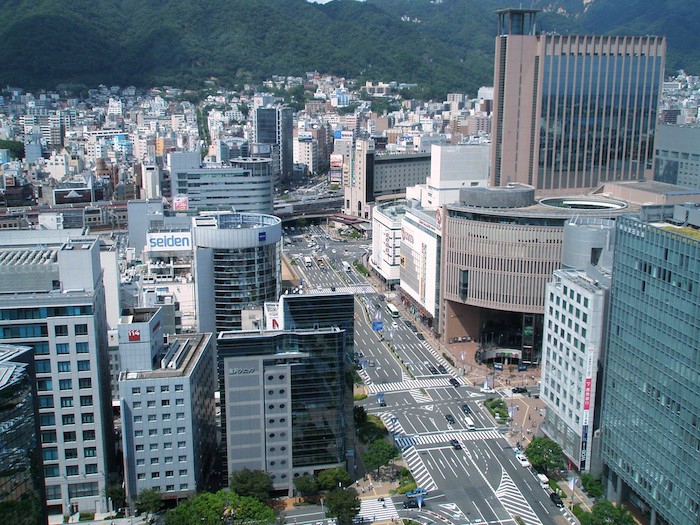
The major residential developer Sumitomo Fudosan will soon complete construction of two high-rise condominiums in the Sannomiya district of Kobe. The pair of 27-story buildings comprise 690 units, with apartments on the upper floors fetching as much as ¥200 million for their panoramic view of Kobe port.
Sales have been very good, and according to a recent article in the Asahi Shimbun it’s not just because of the great view and the vanguard amenities. Word has already gotten out that these two towers will be the last high-rise condos built in Kobe, thus increasing their scarcity value, which means that over time their resale value could go up.
But likely that would only be in the short term. The reason there will not be any more “tower mansions” erected in Kobe is that the city has decided to prohibit new housing construction south of JR Sannomiya Station, which is a commercial district. In addition, the city has restricted the capacity rate of any new residential construction around Sannomiya Station to 400 percent, which means no new tall apartment buildings. Essentially, the municipal government is limiting the amount of new housing that can be built in the city center.
Their reason for this restriction is worth scrutinizing. According to Asahi, many cities in Japan are competing with one another to attract new residents with high-rise condominiums in their respective city centers, the idea being that people want to live near their places of work. Osaka, for example, which is next door to Kobe, is redeveloping the Umeda district north of Osaka Station, a commercial area, and one of the prime features of this redevelopment is high-rise condominiums that the city leaders hope will attract well-to-do working people. The mayor of Kobe has said that this kind of policy doesn’t make any sense when a city’s population is decreasing, as Kobe’s is. When you build new housing while the population is going down, you’re basically creating waste for the future.
As we’ve pointed out in this blog before, new tower condos sell very well, regardless of price, and retain a certain level of their value in the short term, but over the long term they can become burdensome. One reason is the higher cost of maintenance and large-scale repair work for high-rises, which often require considerable investment down the road on top of the condo owner’s monthly repair fee. Another reason is the somewhat shaky situation surrounding building management associations, which require steady input from resident-owners. As the population of a city decreases, invariably the value of even once coveted tower condos also decreases. That means fewer residents in the long run, thus making it more difficult to maintain such massive structures. In decades to come, there is a good possibility that these buildings will become derelict, and the cost of demolishing them would be enormous.
Kobe realizes this, and has acknowledged the truth that its population, which peaked in 2011, is never going to grow again. The only two major cities in Japan that have a steeper drop in resident numbers are Fukuoka and Kawasaki. As of October 2023, the population of Kobe was less than 1.5 million. For cities to maintain some kind of tax base they need a constant influx of working people between the ages of 15 and 64, and Kobe estimates that particular layer of its population will decrease 20 percent by 2040.
And it’s not just the prospect of aging tower condos. Kobe questions the whole rationale behind attracting new residents to the city center. When you do that, the city center’s full-time population become denser, which spurs the depopulation of areas outside the city center, including suburbs. As a consequence, it becomes more costly and difficult to maintain traffic infrastructure for the city as a whole. Ideally, the commercial assets of a city should be in the city center, and residences should be outside of it.
Kobe isn’t the fitst city to come to this conclusion. Yokohama has already implemented a policy to limit housing in its city center by prohibiting the construction of high-rise condos that don’t contain business functions while easing height regulations for so-called complex facilities.
Asahi says that Kobe and Yokohama are the only local governments in Japan that are doing this. Almost all other major cities are encouraging the construction of high-rise condos in their city centers. When Asahi contacted an Osaka public employee involved in city planning, they said that there is no need to restrict the residential sector. Asked about the possibility of superannuated towers in the future, the person implied it’s too far off to worry about. And, in a way, they may have a point. Last year, Osaka’s population increased by 16,000, the biggest increase for a municipality in Japan. At the same time, Kobe knows that Osaka’s gain is their loss. With population throughout Japan dropping steadily, anyone who adds people is by definition taking them away from somewhere else. This year, 43 tower condos will open in Japan, more than half of them in Tokyo and Osaka. Only 9 prefectures in Japan do not have any.
There are, of course, other ways to attract new residents. Another neighbor of Kobe, the city of Akashi, has been drawing young families with its progressive child support policy. Younger residents are the most desirable because they maintain the tax base for a longer period of time, and so Akashi can offer better social services. But that means other places are not going to attract enough young people, which leads to a negative asset spiral. That’s why the mayor of Kobe told Asahi that Japan’s cities should work together to come up with a way of addressing depopulation and how it affects public services. He mentions that Kobe has 21 universities and junior colleges, but that once students graduate, they tend to find work outside of the city. Last year, 30,000 people aged 20-29 moved into Kobe, but the same number also moved out, and so that age group cannot make up for the 9,100 resident deficit when you factor in births and deaths.
A Kobe University professor told the newspaper that Kobe should aspire to be a model medium-sized city that can share its administrative know-how with other similarly-scaled cities in Japan, because these cities are facing a crisis over the next 15 years as their populations age rapidly. They will need more robust medical services and digital resources. Kobe, he said, is already attempting to tackle these issues, but the city leadership knows it can’t do it as an island. It needs to work with other cities in a unified manner.
 Cat Foreheads & Rabbit Hutches
Kobe resident here. Another stated reason for the restriction on new residences in Sannomiya is the lack of primary schools in the area.
The nearest school to the towers you mentioned is more than 2km away and uphill, meaning the kids will take about 30 minutes to get to school in the morning. They will have to cross the national route #2 highway in peak hour traffic before traversing the city’s business and nighttime entertainment districts.
On top of that, the mayor is allergic to doing anything that might benefit families, so there is no chance of a new school or transport facilities being provided for the kiddies.
LikeLike
Hi! It’s been a few months. Hope all is okay
LikeLike