Kyoto says hold on

Two of the proposed routes

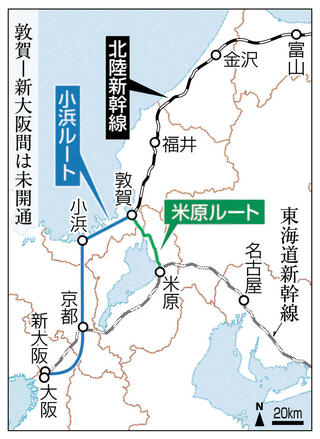
Last spring we wrote about the newly opened extension of the Hokuriku Shinkansen connecting Kanazawa and Tsuruga for Number 1 Shimbun. Eventually, the line will go to Shin-Osaka, but at the time the exact route had yet to be determined. Three possibilities were being discussed, with two of them going through the city of Kyoto. 

In December, three priests representing the Kyoto Buddhist Association, which oversees thousands of temples, visited the Kyoto prefectural offices in their ceremonial robes to deliver a petition to Governor Takatoshi Nishiwaki stating the association’s opposition to the ruling coalition’s preference that the Hokuriku route go through Obama in Fukui Prefecture and then on to Kyoto Station via an underground tunnel. According to a feature in the Asahi Shimbun, the Liberal Democratic Party and its coalition partner, Komeito, decided in 2016 that this would be the route and have been trying to finalize the plan ever since. Last August, the land ministry studied the three proposed plans. The priests’ gripe has to do with ground water, which is important to Kyoto’s traditional food and beverage makers, especially the many sake brewers who rely on the prefecture’s famously pure mineral water. The tunnel for the Hokuriku Shinkansen would destroy much of the prefecture’s water source. 

Asahi says that when the priests arrived with the petition, Nishiwaki was “about to leave the office,” thus suggesting he was trying to avoid them. The priests told him that they “would not be around when construction of the proposed line is finished,” and so they feel they are responsible to those who will come after them. 

But it isn’t just the ground water that is causing locals to question the proposed route. Last August, local officials also calculated a new estimate for the cost of constructing the route from Tsuruga to Osaka, and found that it could be as much as ¥3.9 trillion, which is much more than the last estimate projected in 2017. And if present consumer price index trends continue as they are, the price could increase to ¥5.3 trillion. Both the municipal government and the prefectural government said they don’t know how they could possibly afford that. 

Read More

Do you qualify?

Tax season is our least favorite time of the year, and probably yours, too, so we weren’t necessarily inclined to read an article about housing loan income tax deductions that appeared in the Jan. 26 Asahi Shimbun, and not just because we don’t want to be reminded of all the calculations we will have to make and the forms we still have to fill out, but also because we paid off our meager mortgage just a few years ago and so the article has nothing to say to us. But it may have something to say to others.

The article focuses on one particular qualification for a housing loan tax cut, which sounds fairly obvious. You qualify if you bought a residential property to live in and took out a loan to pay for it. The article mentions a realtor who received a phone call from someone who bought a house from them, complaining that they had been refused a tax deduction for their housing loan. As it turned out, the client, who is a salaried employee, had been transferred to another location by his company, and so he decided to rent out the house he bought through the realtor during the indefinite transfer period. The client’s whole family moved with him to his new location. After he submitted the proper form for the housing loan deduction with his tax return, he received a call from the tax office saying that he no longer qualified because he didn’t live in the house for which he took out the loan.

In principle, the deduction covers 0.7 percent of the housing loan balance for a given tax year up to 13 years, a maximum loan amount of ¥50 million, and a maximum tax deduction of ¥4.55 million. The deduction applies to both income tax and local tax, and if the income tax deduction is more than the tax that is actually paid, then the difference is applied to the local tax. 

But as the tax office pointed out to the property owner in question, if the person who took out the housing loan is not living in or on the property for which they took out the loan then the deduction does not apply. A tax accountant told the Asahi that the tax office is very strict about this rule since the central government essentially forfeits ¥1 trillion a year in potential tax revenues because of the housing loan tax deduction. 

In the case mentioned above, the borrower/owner should have reported rental income after deducting expenses, but apparently many people in the same situation neglect to do that. The client in this case was angry that the realtor did not inform him of this rule when he bought the property, but the realtor didn’t know that the client would be transferred so there was no reason to talk about such things. Nevertheless, there are a number of circumstances under which the housing loan tax deduction does not apply, and realtors should be clear about them. In many cases, homeowners who file for housing loan tax deductions who do not live in the homes themselves are breaking the law. The tax accountant says that in all likelihood, if the tax office finds out that someone is renting out a property that they own without reporting the rental income, the tax office will not only cite the owner for claiming a tax deduction they didn’t qualify for, but will charge a penalty on top of the taxes owed for the unclaimed rental income and the loss of the deduction. 

Read More