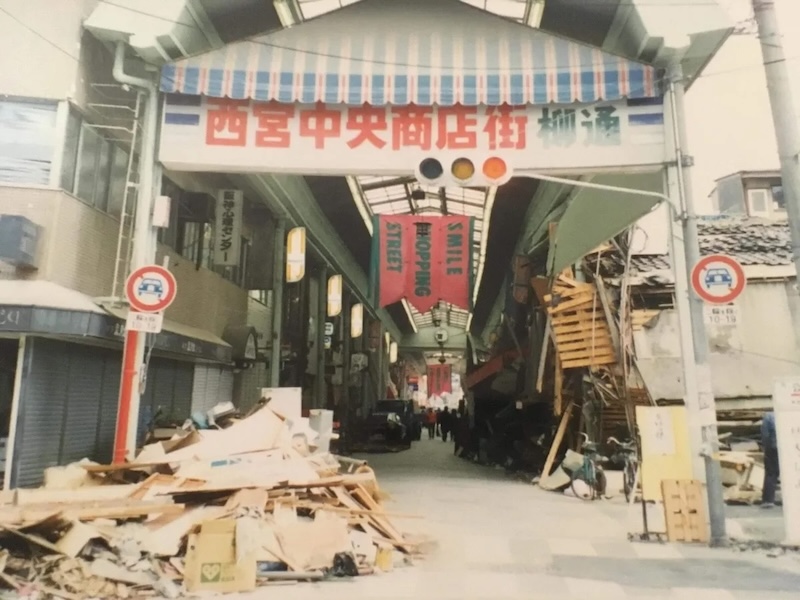
January 17 marked the 31st anniversary of the Hanshin Awaji Earthquake that killed more than 6,000 people and destroyed about 250,000 homes. Every year around this date, various media run stories about the quake and its survivors. Asahi Shimbun on Jan. 16 decided to cover a woman in her 60s from Nishinomiya who survived the quake with her family. However, her house didn’t make it. She and her husband hauled away the wreckage and then built another house on the land where it stood and which they own. Consequently, they were responsible for two mortgages, one for the house that was destroyed and hadn’t been paid off, and one for the new house. Thirty years later they are still paying off both.
Their story isn’t unusual, and isn’t limited to people who lived in the area affected by the Hanshin Awaji Earthquake. Many who lost homes in the Great East Japan Earthquake and Tsunami of March 11, 2011, are also paying off two mortgages. It’s very likely that victims of the quake that hit the Noto Peninsula two years ago are going through something similar; or that they will go through something similar. Several hundred people are still living in temporary housing.
Asahi says the Nishinomiya woman and her husband bought their first home in 1985. Previously they were renting an apartment in the city, but when the woman became pregnant with her second child they decided they needed a bigger place and bought a used house for ¥18 million, taking out a 20-year mortgage to pay for it. Sometime later, the woman gave birth to a third child, their first daughter.
Following the quake in 1995, the authorities classified the house as being uninhabitable, and so the family had to move back into rental housing outside of Nishinomiya. At the time there was no public support system for people who had lost their homes in a disaster to rebuild. Instead, they relied on private charities that collected money from donors all over Japan. Each household affected by the Hanshin quake received about ¥400,000 from the fund. In 1995 only 3 percent of homeowners in Hyogo Prefecture had earthquake insurance. The woman in question did not, so ¥400,000 was all the money they could receive toward a new home.
Eventually, she and her husband built a new house on their land for ¥25 million, for which they took out a new 35-year loan. With ¥10 million still owed for their previous home, their debt was now ¥35 million.
The woman worked in a beauty salon, making an average of ¥80,000 a month, while her husband’s salary was about ¥200,000 a month. Each month’s loan payment was ¥100,000, so they were constantly struggling to make ends meet. To complicate matters further, the woman gave birth to her fourth child, a boy, in 2000.
All four children have now left home, but the loan is still there. The balance is more than ¥5 million, which means the couple still has at least 5 more years of payments. Making their situation even more precarious, the woman is now taking care of her elderly parents full-time, which means her husband will have to put off retirement until he’s 73 at the earliest, they calculate.
In principle, the central government does not automatically assist people whose lives are disrupted by disasters. The concept of self-reliance (jiko sekinin) rules. In 2005, Hyogo Prefecture set up a kind of mutual aid system to address such disasters. If at least half of one’s home is seriously damaged by a disaster and the owner decides to rebuild it or buy a new home, they can receive a subsidy of up to ¥6 million after paying ¥5,000 a year into the mutual aid fund.
As of March 2025, the number of subscribers stood at 166,000 and the accumulated funds amounted to ¥14.3 billion. As some experts have pointed out, if another disaster as big as the Hanshin Awaji Earthquake struck the region, this money will not cover all the damage for subscribers that would result, which means the prefecture would have to compensate for the shortfall, depending on their assessment of the damage. In 2024, a Hyogo prefectural assembly member who once worked for the Ministry of the Interior in the disaster prevention division said he didn’t think the mutual aid program was sustainable in its present form.
So the prefecture discussed what to do with the program, dubbed Phoenix, especially in the event of the predicted Nankai Trough earthquake, which could be even stronger than the Hanshin Awaji Earthquake. If such a disaster happened, the amount of money Phoenix would need to distribute would reach ¥143 billion. However, in December the assembly passed a bill to revise Phoenix by actually decreasing the handouts to each subscriber in the event of a major disaster. As one expert told Asahi, Phoenix cannot be effective for rebuilding as long as the subscription rate remains below 10 percent. As with any insurance system, there is a level of participation needed before the system is viable, and the government has not made the case strongly enough for homeowners to join. The greater the temporal distance from the Hanshin Awaji Earthquake the less urgently people feel the need to participate.
Due to the jiko sekinin principle, the central government is against the idea of using public funds to rebuild private property in the wake of a disaster, but the victims of Hanshin were quite adamant that they couldn’t recover on their own, so the government came up with its own mutual aid system, which was tested in 2011 with the Great East Japan Earthquake. Funds that had been collected nationwide were paid out to victims, with the government itself matching those funds. Altogether 207,000 households received a total of ¥383 billion, or a little less than ¥2 million on average per household, which was hardly enough to alleviate the pain, especially for people who had lost everything.
As already pointed out, the predicted Nankai Trough quake would affect more people more seriously—an estimated 2.35 million homes destroyed comprising ¥8.4 trillion in losses—so the government has increased its own contribution to the fund, but it still wouldn’t be enough.
Of course, there is also commercial disaster insurance, but companies are also limited to what they can pay out. Despite the number of major earthquakes that have hit Japan in the past 30 years, the subscription rate for commercial earthquake insurance is still very low, mainly because the benefits aren’t that much. Normally, homeowners have an option to take out quake insurance as part of their fire insurance, which is mandated by lenders, but the payouts can be nominal at best. For instance, the fire insurance we have for our 90-square meter house pays out a maximum of ¥23 million for house and property in the case of a fire, but only a maximum of ¥3.4 million in the case of an earthquake that makes our house uninhabitable. Our yearly premium for both is ¥16,484. Of course, the homeowner can choose a more expensive plan that pays out more, but the quake benefits will always be limited.
Which means if you lose your house in a quake and you still have a mortgage on it you will still owe at least some money on it before you rebuild. Ironically, if the person who signs the loan dies in the quake, the mortgage is wiped out due to the mandatory death insurance policy for the loan signatory that the lending institution requires. Come quake or high water, banks are going to get their money.
 Cat Foreheads & Rabbit Hutches
Another interesting article.
The insurance premium for your house seems to be very cheap compared to what we pay on our house in Australia.
We live in a flood free zone with the chance of a big earthquake being close to zero.
No cyclone danger and we’re are not in a bushfire zone either.
So in other words we live in a pretty safe area as far as natural disasters are concerned.
So moving on to insurance costs for our house. The premiums have skyrocketed over the recent pay and we pay around A$2500 a year or 250,000 yen.
In addition to that the state government slugs us with another couple of hundred dollars levy when we pay our real estate taxes for “Essential Services” or the fire levy.
LikeLike
if my memory of weather events in Australia serves me , major damage is not just limited to designated disaster prone areas. There are hail storms that destroy things over entire neighbourhoods and the ever popular fallen trees that do significant damage to the buildings they fall on. I suspect the insurance companies collect the disaster statistics and calculate accordingly. That Australia is in many ways a more collective society then Japan show how little accuracy there is in national steriotypes.
LikeLike
I think the premiums are high for two reasons:
Even though we are low risk we pay high premiums because we are paying for floods and bushfires in other parts of Australia and the insurance companies are recouping their experiences and
Everything in Australia is expensive because they can charge more. It’s called the Australian tax.
And by the way there are no large trees around our house so they can’t fall on is and in over 30 years we’ve never experienced a hail storm.
LikeLike
Lovely Writing.
Have you considered purchasing a decent policy? You have opted for the bare-bones.
Decent policies tend to payout 50% of the housing cost if the structure is considered a write-off.
LikeLike
While I really feel for the family and their finances cited in the Asahi Shimbun article, I am also puzzled about their approach to life. They were raising 4 kids and paying off a mortgage (assuming the second mortgage is literally not their fault even in this earthquake-prone country) on a meager monthly income. Is that 自己責任? Taking on a large mortgage without earthquake and fire insurance is irresponsible. It’s akin to driving your new car, purchased with a large loan, without car insurance.
Your discussion about insurance is an important one.
LikeLike