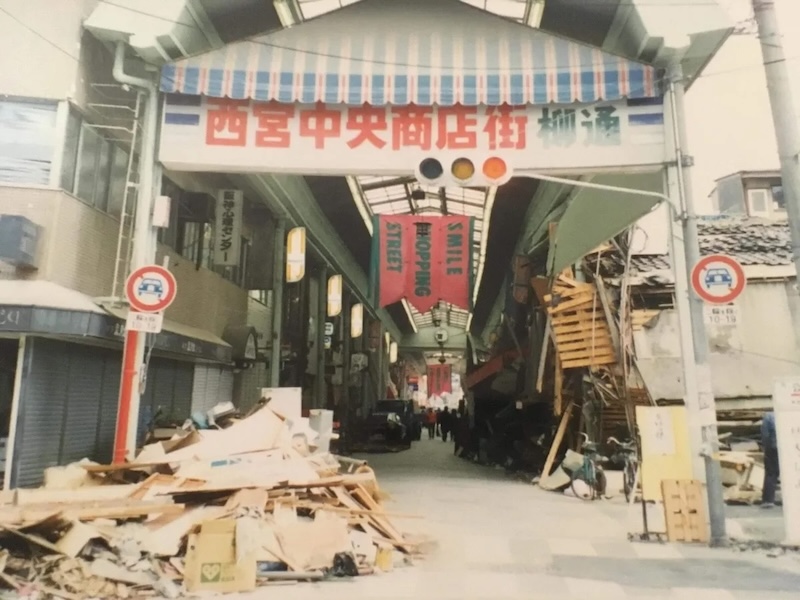
January 17 marked the 31st anniversary of the Hanshin Awaji Earthquake that killed more than 6,000 people and destroyed about 250,000 homes. Every year around this date, various media run stories about the quake and its survivors. Asahi Shimbun on Jan. 16 decided to cover a woman in her 60s from Nishinomiya who survived the quake with her family. However, her house didn’t make it. She and her husband hauled away the wreckage and then built another house on the land where it stood and which they own. Consequently, they were responsible for two mortgages, one for the house that was destroyed and hadn’t been paid off, and one for the new house. Thirty years later they are still paying off both.
Their story isn’t unusual, and isn’t limited to people who lived in the area affected by the Hanshin Awaji Earthquake. Many who lost homes in the Great East Japan Earthquake and Tsunami of March 11, 2011, are also paying off two mortgages. It’s very likely that victims of the quake that hit the Noto Peninsula two years ago are going through something similar; or that they will go through something similar. Several hundred people are still living in temporary housing.
Asahi says the Nishinomiya woman and her husband bought their first home in 1985. Previously they were renting an apartment in the city, but when the woman became pregnant with her second child they decided they needed a bigger place and bought a used house for ¥18 million, taking out a 20-year mortgage to pay for it. Sometime later, the woman gave birth to a third child, their first daughter.
Following the quake in 1995, the authorities classified the house as being uninhabitable, and so the family had to move back into rental housing outside of Nishinomiya. At the time there was no public support system for people who had lost their homes in a disaster to rebuild. Instead, they relied on private charities that collected money from donors all over Japan. Each household affected by the Hanshin quake received about ¥400,000 from the fund. In 1995 only 3 percent of homeowners in Hyogo Prefecture had earthquake insurance. The woman in question did not, so ¥400,000 was all the money they could receive toward a new home.
Eventually, she and her husband built a new house on their land for ¥25 million, for which they took out a new 35-year loan. With ¥10 million still owed for their previous home, their debt was now ¥35 million.
The woman worked in a beauty salon, making an average of ¥80,000 a month, while her husband’s salary was about ¥200,000 a month. Each month’s loan payment was ¥100,000, so they were constantly struggling to make ends meet. To complicate matters further, the woman gave birth to her fourth child, a boy, in 2000.
All four children have now left home, but the loan is still there. The balance is more than ¥5 million, which means the couple still has at least 5 more years of payments. Making their situation even more precarious, the woman is now taking care of her elderly parents full-time, which means her husband will have to put off retirement until he’s 73 at the earliest, they calculate.
Japan has one of the most extensive and sophisticated sewerage systems in the world. As of 2021, slightly more than 80 percent of the population was served by sewerage systems, an impressive statistic considering that less than 10 percent of the population had access to sewerage in 1960. This increase in coverage is just another indication of how quickly and completely Japan rebuilt and improved its infrastructure after World War II.
A recent article in Asahi Shimbun, however, reported that this trend may be reversing. According to surveys conducted by the Ministry of Land, Infrastructure, Transport and Tourism, one-third of local governments in Japan have cancelled their plans to extend their sewerage systems to new and existing residential development. Instead, household waste will be processed by on-site septic tanks.
The reason is obvious: Japan’s population is dropping, and the cost of building and maintaining sewerage systems depends greatly on population density. With fewer people living in a given area, the construction of the new sewerage comprising pipes and treatment facilities cannot be paid off in the long run.
It’s necessary to note that one-third of local governments does not mean one-third of the population. The local governments of large cities represent much larger populations than local governments of smaller cities and rural areas, and it’s mostly in the suburbs and the countryside where these governments are reviewing and cancelling their sewerage construction plans. But what’s perhaps most significant about the Asahi report is its assertion that some local governments will actually backslide on sewerage, meaning that they will replace existing sewerage systems with individual jokaso (septic tanks).
Urban-style sewerage systems collect household waste water and night soil in one central location and then treat it before releasing the filtered water back into the environment. Septic tanks, including so-called multipurpose tanks that process waste from toilets and sinks/baths separately, use on-site filters and bacteria before releasing the filtered water as runoff into the ground or rivers. Sewerage is obviously more cost-intensive because it requires long stretches of pipepines and the purchase of land where those pipes are buried. Septic tanks, including those shared by communities, are on-site, meaning they are completely contained within the property of the user.
The Asahi says that in the 1990s many local governments drew up plans for constructing new sewerage systems based on the assumption that the population would continue to increase. Reality quickly put a damper on those plans. The land ministry found that as of 2014 throughout Japan, local governments had fallen short of their stated plans to extend sewerage systems to their communities by 625,000 hectares, meaning that 625,000 hectares of land that were slated to receive sewerage infrastructure by 2014 had not undergone any construction, or about 34 percent. In fact, as of 2019, 158,000 hectares of land that were initially supposed to receive new sewerage systems instead had those systems replaced with septic tanks. And between 2019 and 2025, at least 80,000 hectares of land slated for sewerage were changed to septic tanks. For the record, the prefectures who altered their plans the most were Chiba (29,646 hectares), Ibaraki (26,726), and Fukushima (15,869).
Moreover, some local governments actually stopped using existing sewerage systems due to their inability to keep up with maintenance and improvement costs. There just weren’t enough customers any more. The article uses the example of Sanmu in eastern Chiba Prefecture, which had devised plans for new sewerage in 1995 when it was still designated as a town before consolidating with neighboring municipalities to become a city. In 1995, the population was still on the rise, but by 2015 it was decreasing, so the city revised its plans when it realized that even if it carried out the construction according to plan, it would only cover 7 percent of the city’s total population. Projections said that the city would have to spend ¥1.3 billion over the next 40 years on maintenance of this new construction. There was no way that fees from such a small number of households could pay for it, so the plan was cancelled. Around the same time, 9 other local governments in Chiba cancelled their sewerage construction plans. At present, there are 18 municipalities in the prefecture that still do not have any sewerage systems and obviously never will, regardless of whether they once made plans to construct them.
It should be noted that the central government subsidizes sewerage construction, and the land ministry itself, having taken note of the population decrease, has encouraged local governments to abandon their sewerage construction plans in favor of septic tanks. This past summer alone, 97 local governments told the ministry that they would change their plans in accordance with the ministry’s request. A representative of the general affairs ministry in charge of public waterworks told the Asahi that this change in policy of the government was mainly implemented in the face of looming infrastructure repairs, which will cost a lot of money in coming years. It would be better if local governments with older sewerage systems that are no longer financially feasible replace them with septic tanks.
One of the reasons we are reporting this news is that we use a multi-purpose septic tank, even though neighborhoods less than half a kilometer from our home are all hooked up to the city sewerage system. When we had our house built in 2013, we learned that the city had no plans to extend sewerage to our area, though we haven’t been able to find out if there were any plans in the past to extend sewerage to our area.
Still, we wanted to compare the cost per household between sewerage and septic by comparing bills we received when we were renting an apartment in the more urban portion of our city in the past and the bills we receive for maintaining our septic tank now. When we were in the city we (two people) paid a little more than ¥3,000 every two months for both water and sewerage, or about ¥18,000 a year. That was in 2013. Now we pay about ¥15,000 a year for a worker to inspect our septic tank as required by local law every three months. Since we also do not have access to municipal waterworks, we use well water, for which we pay nothing, so in a sense the septic tank is more expensive than sewerage, but that doesn’t take into account initial costs. We had to, of course, sink a septic tank and dig a well, but our local government, at the time, subsidized the cost of the septic tank since infrastructure wasn’t available in our (literal) neck of the woods; and while we had to pay several hundred thousand yen to dig a well, if we had access to the local waterworks we would have had to pay an initial cost of about ¥300,000 just to have it turned on, so to speak. In the end, the difference wasn’t that much, and in the long run, we’re probably paying less, though, we have to admit, well water around here isn’t that great.
Just before Christmas, the Asahi Shimbun ran a story in preparation for the first anniversary of the Noto Peninsula earthquake, whose effects still weigh heavily on residents of the area. Demolition work on structures damaged in the quake continues because many of the houses in the areas most affected were already abandoned and thus local authorities couldn’t contact owners easily. The article first focuses on the city of Suzu in Ichikawa Prefecture. The coastal residential zone was badly damaged, and since houses were densely packed and the streets only wide enough for one car to pass through at a time, cleaning up the area has been very difficult.
According to Asahi’s investigation, many of the houses in this area were not only already vacant when the quake hit, some were in such bad condition that they were uninhabitable, mainly because the houses had no value whatsoever. A survey conducted in 2022 found that 1,365 houses in Suzu were abandoned, of which 60 had insurmountable structural problems. The quake caused more than 3,000 houses to collapse, but this number only covers houses that were occupied, and the city has yet to carry out a more extensive survey to comprehend the full story with regard to vacant houses that collapsed or were fully damaged.
The problem for the city is that tearing down a house requires consent from the owner, and if local authorities cannot contact the owner they usually do nothing; but even if they do find the owner, it doesn’t mean that person can be compelled to either renovate the house or demolish it, both of which cost a lot of money.
The situation is even worse in nearby Wajima, where 30 percent of the houses in the “urban” part of the municipality are vacant. Local leaders told Asahi that some of the owners of these houses do occasionally stop by to visit their properties when they come to pay their respect at family graves in the vicinity, which makes these leaders reluctant to tell these owners they have to do something with their properties. “It might be difficult for them to part with the house,” said one official.
Asahi extrapolated these issues to talk about fears regarding the long predicted Nankai Trough or Tokyo earthquakes, which would affect a huge area from the capital all the way to the western edge of the Kansai region. If a quake with the intensity of at least minus 6 on the Japanese scale struck this area, it could be a bigger mess than anticipated, since about 1.45 million houses in the region are vacant wooden structures, a number that increases every year. Asahi’s own research found that about 750,000 of these houses are abandoned, meaning the owners of more than half do not even visit or keep up the property. Even in Tokyo’s 23 wards, where real estate values are the most expensive in Japan, there are 55,000 abandoned wooden houses, the most being in Setagaya Ward (7,500). One Setagaya official said the problem will only get worse because the boomer cohort will soon die out, leaving their children with properties those children likely don’t want to take over.
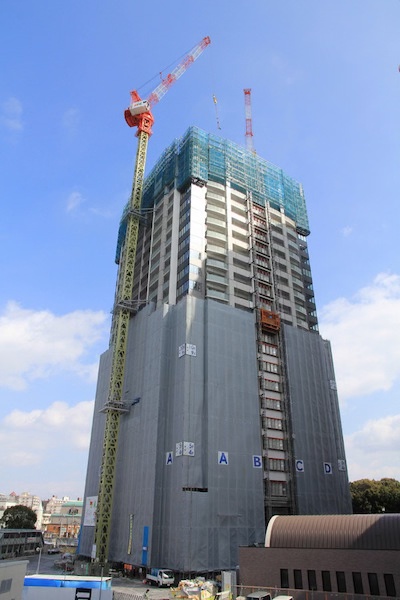
More high-rise condominium shenanigans. On Nov. 17, Tokyo Shimbun reported on 118 redevelopment projects being carried out with the help of local governments that don’t necessarily benefit people who live in the localities but nevertheless are contributing to the projects through local taxes. The article is based on a Kyodo News survey of local governments that found 90 percent of these entities paid or will pay a total of ¥1.0543 trillion in subsidies to developers and/or construction companies that are working on these projects.
Regional cities rely more on public funds than do large regional capitals, and four of the projects surveyed apparently received more than half their total funding from tax revenues. What makes the situation concerning is that 66 of these projects comprising 19 prefectures are centered on tower condominiums, which by definition are sold to upper income people, mainly as investments. Moreover, Kyodo found through the inspection of publicly available documents that there has been “no real long-term planning” attached to these urban redevelopment projects, meaning they are simply enterprises carried out by developers who want to sell condos in the short term. Local residents will receive no ascertainable benefits from these projects, though they are helping to pay for them. Kyodo calculated that as of the end of fiscal 2023, the 118 projects were costing a total of ¥8.52 trillion to build, with 12.4 percent of the cost of 104 of the projects coming from local governments, which would come to ¥1.0543 in subsidies.
Some projects received more public subsidies than others. A tower condo construction project at the North Exit 1 of Fuji Station in Fuji, Shizuoka Prefecture received 57.7 percent of its funds from public moneys; the Machikata-cho 1 project in Numazu, Shizuoka Prefecture received 56.9 percent of its funding from the local government; and the Yokote Station East Exit 2 project in Yokote, Akita Prefecture received 53.3 percent of its funding from tax revenues.
As we’ve pointed out in previous posts, the prices of new condos in Tokyo have risen considerably in the past few years owing to the high cost of construction, lowering supply, and an increase in sales to investors, whether Japanese or foreign. A June 20 article in the Asahi Shimbun about the cheap yen includes remarks from realtors who say that new condos in central Tokyo will remain expensive for the near future, with some, in fact, explaining that now they only deal with high-earning double income couples and rich investors.
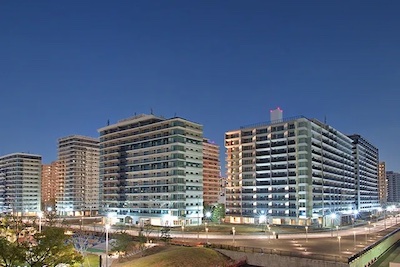
In light of this situation, the news surrounding one large Tokyo condo complex has been instructive. Harumi Flag, which was originally built to be the athletes village for the 2020 Tokyo Olympics, finally started receiving residents in January after renovations to turn the living quarters into condominiums was delayed almost two years by the pandemic. However, according to a June 7 report by NHK, as of the end of May a good portion of the units in the 17 buildings that have been sold so far are empty, which NHK finds strange since the demand for the Harumi Flag condos was quite intense owing mainly to the fact that prices were reasonable compared to other real estate in the area. NHK’s investigation found that many of the units were bought by investors, which shouldn’t sound strange given the current real estate climate in Tokyo, but the Harumi Flag project was initiated by the Tokyo prefectural government for the secondary purpose of eventually selling the residences to people who would live in them, in particular families. That’s supposedly why the initial prices were set lower.
NHK checked the title registrations of 1,089 units of the 2,690 that have been sold so far in the Sun Village part of the complex. Mitsui Fudosan Residential, the company that headed the consortium of 11 developers involved in the project, has been selling the condos in phases, and in the most recent phase there were an average of 71 applications for each unit. There were no limits to how many applications a potential buyer could submit or units they could purchase if their luck was good. Under such circumstances, institutional investors applied for as many units as they could, since they could buy as many units as possible by borrowing money more easily. In fact, NHK discovered that 292 units out of the 1,089 they checked were owned by companies, or one out of four. Sales began in 2019, and four sales phases were carried out in 2021 and 2022, with the largest number of companies registered as owners with the justice ministry following the last of these. However, when NHK checked with the Chuo Ward office it found that there were no resident registrations (juminhyo) listed for 30 percent of the condos, meaning that, technically, no one is living in these condos. In fact, more than half the units sold during the last phase were bought by companies, with many purchasing more than one unit. The investors who own the 292 units in question comprise 147 companies, most of them dealing in real estate and investment. On further investigation, NHK found that only five of these units were being used by their corporate owners as offices. NHK makes a special note in the report that all these corporate owners are Japanese, which they think is surprising considering all the media attention being paid to foreign buyers of Tokyo real estate.
One investment company from Fukuoka, in fact, owns 38 units, and while they wouldn’t talk to NHK, their home page mentions their involvement in Harumi Flag “at an early stage” to “ensure stable returns on investments.” Two other companies did talk to NHK on condition of anonymity. One had 3 units in the complex and owned properties in Tokyo and Yokohama, as well as in the U.S. Their total real estate investments amount to ¥3 billion. A different company owns “more than 4 units” in Harumi Flag, and says they applied for and bought condos during each sales phase. In the beginning, they weren’t sure if the investment was wise, but now they are very happy because they are sure they can sell them for a hefty profit, and that seems to be the case. NHK says that so far hundreds of units have already been resold or are on the market for prices that are from 50 to 100 percent higher than their initial sales price. According to one real estate portal site, a 4LDK, 100-square meter unit in Sun Village that originally sold for ¥106 million is now on sale for ¥238 million.
But the market is still hot, so many of the investor-buyers are not planning on selling for a while and instead are renting out their units. Unfortunately, there are too many units for rent in the complex so few have found tenants, though there are other reasons for the low occupancy rate. Harumi Flag is 20 minutes from the nearest station and all the leases have a limit of two to five years, because the owners may want to sell the units if the price peaks. NHK doesn’t mention the cost of rent, but when we checked portal sites we found one 86-square meter unit asking for ¥420,000 a month and a 65-square meter unit going for ¥280,000 a month.
NHK talked to one couple in their 60s who made 7 attempts to buy a unit in Harumi Flag and failed. Their budget was ¥80 million, which was more than sufficient for a good-sized condo during the initial sales phases but not enough to buy one that is being resold, so they’ve given up, even though several buildings in the complex are still under construction.
At the end of March, JR Tokai admitted something that we have been writing about for a number of years, which is that the inaugural Shinagawa-Nagoya leg of the Chuo Shinkansen, more popularly known as the linear motorcar in Japanese and the maglev in English, will not open in 2027 as originally planned. JR Tokai, the railway company in charge of the project (often referred to as JR Central in English), had already submitted a notification to the transport ministry in December saying that the maglev wouldn’t open until “after 2027,” but didn’t announce the revision publicly until March 28. Some reporters and at least one major media outlet, the Nihon Keizai Shimbun (Nikkei), have been suggesting for years that, given the unprecedented scale of the project, there was no way JR Tokai was going to open the line, which will zip passengers between Tokyo and Nagoya in 40 minutes, by 2027.
The company was going to have to deliver the bad news eventually and needed a convenient scapegoat. They already had one in the form of Shizuoka Prefecture Governor Heita Kawakatsu, who had been a thorn in the side of the project for more than a decade (though the prefecture’s beef with JR Tokai extends back to before his administration). JR Tokai is now blaming Kawakatsu almost exclusively for the delay. As we’ve explained in the past, the governor, who professes to be in favor of the maglev, had refused to grant the company permission to carry out tunnel construction in his prefecture until it could guarantee that the Oi River, which is in the vicinity of the construction work, would not lose any water as a result. Tens of thousands of residents rely on the river as a water source, and JR Tokai’s own impact study projected that tunnel construction would result in a significant loss. The problem has been a matter of debate between the prefecture and the railway since 2014.
According to Nikkei, the transport ministry called a meeting at the end of March where the water problem was discussed within a framework of environmental conservation related to the maglev construction, and at the start of the meeting JR Tokai President Shunsuke Niwa said that, due to Shizuoka’s intransigence, he could no longer project when the Shinagawa-Nagoya leg would open. Another JR Tokai official explained that the original construction period of 17 years “could not be shortened,” and since it would have taken ten years to complete the line after construction of the Shizuoka section started, even if they did so this year they wouldn’t be able to finish the 8.9 kilometers of tunnel that passes through the prefecture until 2034. This is a big problem for JR Tokai since local governments and businesses located along the maglev line have been carrying out infrastructure construction and redevelopment in anticipation of a 2027 opening, and the delay could cost them money and, more significantly, public trust.
Then, on April 2, Kawakatsu announced he would resign in June, one year before his fourth term is up, for something that had nothing to do with the maglev or JR Tokai. During a speech to welcome new prefectural employees, the governor made a stupid remark belittling vegetable sellers and other occupations. All the media reports on the resignation mentioned that JR Tokai had blamed Kawakatsu for the fact that the maglev wouldn’t open in 2027, and while the ostensible reason for Kawakatsu’s standing down is the remark, he told reporters, perhaps passive-aggressively, that he wanted to remove himself as an obstacle to the tunnel construction.
One of the fees that condominium owners have to pay every month is called shuzenhi, which are contributions to a fund that will go toward large-scale repairs of common property in the overall structure, such as exterior walls and some plumbing shared by all the residents. This fee is separate from the management fee, which goes toward operation of the building and more immediate maintenance, including mandatory elevator inspections. Ideally, large-scale repairs should be carried out every dozen years or so, but they usually aren’t owing to difficulty in gaining approval from the needed majority of owners. As a result, many buildings fall into disrepair after several decades, but even when the homeowners get it together and vote for necessary work, there usually isn’t enough money in the fund to cover what has to be done. That’s because developers purposely set the monthly fees for the repair fund low so as to make it easier to sell units when they are first put on the market. We’ve read of cases where homeowners in some condominium buildings had to pay tens of millions of yen each on top of the money they’d contributed to the fund in order to get repair work done. Most condo operations are run by outside management companies, which may or may not be related to the original developers, and one of their tasks is to raise the shuzenhi gradually over the years so that there is enough money for the repairs, but, again, they need to gain the approval of the mandated portion of owners to do it, and that can be hard.
In response to this problem the construction ministry last month assembled a panel of experts to study a system, first implemented in 2022, for local governments to certify whether condo owners associations are operating properly. According to a ministry survey the amount of funds needed for long-term repairs is, on average, 3.6 times the amount collected using the original contribution calculation, but this real amount can go as high as 10 times the originally collected fund. Another survey conducted in 2018 found that 35 percent of condos nationwide have insufficient repair funds, which is likely a low estimate. According to a Feb. 23 article in the Asahi Shimbun, the ministry is trying to come up with better ways to persuade condo owners associations to increase their repair funds by adopting a savings plan based on long-term estimates of exactly how much money will be needed. Usually, when developers set the monthly contributions no such estimates have been made. The amount of the contribution is set arbitrarily based mainly on market considerations.
The revised plan that the ministry has submitted to the expert panel for study says that the amount needed for long-term repairs should be calculated and then divided into the number of owners and number of months remaining between the start of the fund and the proposed repairs. The ministry recommends that the actual monthly contribution be no less than 60 percent of the estimate and no more than 110 percent. However, if the fee is set at less than what is needed for the eventual repairs, the association can increase it over time by up to 80 percent. This means that if the full monthly contribution for long-term repairs is calculated to be ¥20,000 based on what the cost of repairs will be in the long run, the developer or whoever makes such a decision can set the actual contribution as low as ¥12,000, but then can increase it over time to ¥22,000.
Such a plan would be included in the management authorization system that local governments use to certify condo owners associations. Certification is based on whether the association has a long-term repair scheme. If the local government grants certification, the association is entitled to borrow money for large-scale repairs at a lower interest rate.
In a followup report on Feb. 27, the Asahi looked at a condominium in Tokyo’s Adachi Ward that contains 28 units and was built in 2008. Three years ago, the owners association increased the repair savings fund contribution 3.5-fold. The 45-year-old head of the association said that when he took over the position in 2017 he realized that the fund was about ¥20 million short of what it should have contained according to the initial savings plan. The reason for the shortage was that previous association heads did not carry out contribution increases every three years in accordance with the initial plan. The current head invited an expert to talk to other members of the association about what they needed to do, saying that if they didn’t carry out these needed repairs, the building itself would need even more expensive work down the line just to keep it working. Though the owners approved the new contribution plan, it took two years and 8 months to convince them.
The purpose of the ministry’s certification system is to avoid this kind of delay because increases in contributions would be incorporated into a plan, but as the Adachi example shows, even when such a plan exists it doesn’t mean the owners association will stick to it. The certification system is an incentive, but it is not mandated by law. For that reason, in addition to being eligible for lower interest rates to borrow money for repairs, the panel has suggested that associations who devise a plan and stick to it could have their property taxes lowered. As of the end of February, only 481 condo associations nationwide have been certified. The panel believes that the guidelines for the system should provide more of an incentive if such certification doesn’t have the force of law behind it.
We use storage heaters in the winter, and they do a good job of keeping our two-story house uniformly warm, but the technology was partially based on the idea of off-peak electricity, meaning the ceramic bricks inside the storage units are heated in the middle of the night when electricity is cheaper and we’re asleep. Unfortunately, when our utility raised rates more than a year ago it also did away with off-peak discounts and last winter our electricity bills almost doubled. This year it’s been a bit better owing to government intervention, but anyone who lives in Japan, especially if they grew up in Europe or North America, understands how poorly Japanese homes retain heat. For one thing, central heating is not common in Japan, which means each room needs to have its own heat source, be it electric, gas, or kerosene. But the main reason for Japan’s cold houses is poor insulation due to lack of proper design standards that are mandatory in other countries. Even China and South Korea have strict insulation standards they adopted to address energy conservation needs and lower carbon emission targets.
Japan does have standards for insulation, and they were last upgraded in 1999. At the time, these standards were called “next generation energy conservation protocols,” but, in truth, they aren’t even mandatory, thus making Japan unique in that regard among G7 countries. They are simply guidelines, and while most builders adhere to them, the fact that the authorities don’t force them to indicates a curious lack of will that is difficult to explain, but a recent article in Shukan Playboy News made an attempt by comparing Japan’s insulation standards to those of Germany, which has the strictest in the world.
An engineering professor tells the magazine that maintaining a certain temperature for 100 square meters of interior floor area in a house built to Japanese insulation standards requires seven times as much kerosene as maintaining the same temperature for the same floor area in a house built to German standards. And that’s using the 1999 standards, which only apply to 10 percent of all homes in Japan as of 2023. About 70 percent of Japanese homes were built using insulation standards implemented in 1980, which, of course, are less stringent than the ones implemented in 1999. Then there are still homes standing that have no insulation at all.
That’s why Japanese houses are “naturally” cold, says the engineer, a situation that is actually illegal in many other countries. In the UK, for instance, a landlord is prohibited from renting out a residence if the uniform interior temperature falls below 18C. Also, in many countries landlords cover utilities, so it’s in their interest to maintain high energy efficiency. In Japan, it’s up to the tenant.
So why doesn’t Japan have stricter insulation standards? One reason is the commonly held prejudice that Japan is a hot country, so traditionally homes were built to maximize ventilation for hot, humid summers. Because of the draftiness of old Japanese homes, heating in the winter was done on a room-to-room basis. Nowadays, few Japanese live in traditionally styled houses, but the idea of cooling or heating individual rooms still holds, only now people use stand-alone heating units and wall-mounted air conditioners.
According to news reports, the extreme heat we’ve had to put up with this summer is going to be a normal thing from now on. For a while it seemed as if Japan was going to be spared the worst of it, but that isn’t the case any more and forecasters are saying we’ll be sizzling until early October. The authorities warn people, especially the elderly, to use their air conditioners whenever necessary because heat stroke can creep up on you, even when you’re indoors and out of the sun. According to the land ministry, 89 percent of Japanese homes have air conditioners, but that portion drops along with income. Of households that earn less than ¥3 million a year, 84 percent have AC.
There’s one demographic, however, that lacks AC almost altogether, and mainly for systematic reasons: people who live in public housing. An August 1 report in the Asahi Shimbun told of a 43-year-old woman who lives with her three children in a 3DK apartment run by the Tokyo Metropolitan Government for low income families. The rent and management fees for the apartment come to about ¥30,000 a month, which is half what the woman paid for a private rental apartment before she moved into the prefectural building 3 years ago. At the time, the apartment did not have an air conditioner, so she bought one for ¥70,000, including installation, at a discount appliance shop. Her apartment is situated on the corner of the 6th floor and gets a lot of sun, so nights can still be intolerable due to poor air circulation. The woman and her 13-year-old daughter share a six-mat room, leaving her two sons, one 19 years old, the other 17 years old, with a room each to themselves, but in the summer they all sleep in the same room because that’s the only one with AC, which isn’t strong enough to cool the whole apartment. Consequently, the sleeping arrangements in the summer are close and uncomfortable. During the day, they place electric fans strategically throughout the hallways to distribute the cool air, but it doesn’t work very well. The woman would like to buy a second AC, but there’s no place to put it. Her room is next to the veranda, so the fan unit can be placed there, but there are no other places in the apartment where a second AC could be installed. The building, which is 40 years old, was not designed with AC in mind. The electrical current in each apartment is set at 20 amperes, though it can be increased to 30, which still would not be enough. If the AC is on, she has to be careful not to use too many other appliances, otherwise the circuit breaker will trip. And, of course, her electric bills are high. Public housing is notorious for having bad insulation, and her salary as a caregiver is only ¥220,000 a month. Besides, if and when she leaves the apartment, she is required to leave it as she found it, which means she will have to remove the AC and take it with her.
There are 2.16 million public housing units in Japan, all run by local governments. The central government requires that all have kitchens, flush toilets, wash rooms, and bath rooms. AC is not required. The land ministry says that 60 percent of public housing units are more than 30 years old and 60 percent contain a head-of-household over 60. The Tokyo Metro government only provides 260,000 units (individual wards may run their own low-income public housing), 79,000 of which were built before 1970. None of the public housing in Tokyo comes with AC, though newer buildings have features that make it possible to install AC units. When Asahi contacted the relevant prefectural authorities, they said that older buildings are regularly renovated but not in terms of improving insulation or making it possible to install AC units. One staff member said, “We formulate design policies in terms of cost effectiveness.”
A professor of environmental engineering told Asahi that all public housing in Japan is concrete-based and poorly insulated compared to wooden buildings. That means that temperatures don’t drop appreciably at night. Even if a unit in such a building has AC, it’s possible that the interiors will remain above 30 degrees. This is particularly worrisome for elderly tenants, who are more susceptible to heat stroke. Top floors are particularly dangerous since rooms sit right under the roof. According to medical statistics, about half the people who suffer from heat stroke and live on the first floor of a collective housing facility end up hospitalized while 90 percent of heat stroke patients from top floors are hospitalized.
Another professor who studies low income households says that even when they have AC installed, elderly people in public housing often don’t use it because of the electricity costs. He cited statistics showing that most of the people hospitalized in Tokyo for heat stroke were old people who simply did not turn on their AC, especially this summer after electrical utilities nationwide raised prices considerably. He has demanded for years that local governments not only improve insulation in public housing, but that they install air conditioners in all apartments, because the problem of heat stroke among lower income people is only going to get worse from now on.
Here’s another chapter from our unpublished book about housing in Japan based on our own experience of buying/building a home. This one is about keeping up properties.
One of the most popular sub-genres of reality TV is the home improvement show. In 2002, Japan’s Fuji TV launched one called “Before/After,” where superannuated, usually cramped properties were magically transformed into marvels of modern design. The producers hit on a fool-proof hook for the show that they exploited successfully week after week, year after year, without seeming redundant.
People with properties they wanted to fix up would contact the producers, who sift through the candidates, looking for the most broken-down or unusual cases. The best sequences highlight houses that would seem impervious to improvement due to their state of disrepair or local environment. A surefire hit is always the hovel located in one of Tokyo’s warren-like residential areas, usually dating from just after the war, when neighborhoods were constructed on the fly, and which require not just ingenious design skills to improve, but superhuman feats of logistics, since there usually isn’t any room to get heavy machinery to the property owing to narrow alleyways. The architects are lone wolves who waive their design fees and charge only for materials and labor. The recipients of their largesse come up with a ceiling amount they will pay, thus adding another layer of challenge to the architect’s task. The family is then sequestered off-site while the work is done and documented in detail by a film crew. The residents are not allowed to view the property until the “reform” is complete. The climax is dramatic, with the family entering the sparkling new house with tears streaming down their faces and the anodyne voice of the female narrator showing us the stark differences achieved by the architect.
“Before/After” sparked a boom in home improvement TV shows but not in home improvement–or, at least, not to the extent that it made a difference in the marketability of older homes. One of the main problems with remodeling in Japan is lack of regulation and oversight. The vast majority of homeowners can’t afford the kind of architects featured on “Before/After,” but anyone can start a home improvement company. In the past, the biggest complaint with regard to remodeling was fraud, characterized by operations that over-billed elderly people for poor work. Eventually, the complaints became more general owing to greater demand by homeowners who decided it was cheaper to renovate their present houses than it was to buy new ones, even if that wasn’t necessarily the case. In 2011, the Center for Housing Renovation and Dispute Settlement Support addressed more than 4,500 claims, mainly in Tokyo. In most cases there were no contracts, design plans, or even written estimates. If a particular job costs less than ¥5 million, according to the law, the company that carries it out doesn’t have to be registered as a construction firm, though remodeling companies are supposed to be insured for shoddy work. Also, the work doesn’t need to be inspected by the relevant authorities unless “it affects the integrity of the structure.” Some years ago a Nagoya woman whose condo became virtually unlivable after a reform company replaced her floors and windows couldn’t sue because there was no contract. The National Consumer Affairs Center of Japan handled more than 13,000 reform-related complaints in 2011, or twice as many as in 2010. Since there were no regulations, the center urged homeowners who were going ahead with remodeling to record all conversations. The Japan Bar Association in April 2011 urged the construction ministry to pass new laws to cover the industry, no matter how small the company.
When it comes to home improvement, experts recommend hiring designers who understand the engineering aspects of a remodeling project and can subcontract the various jobs to tradespeople. Such projects, however, can run into the tens of millions of yen, which is why comprehensive discount remodeling companies have sprung up, offering total renovations for much less. Many are associated with major retail home improvement centers, and are thus deemed to be reliable. They cut costs by buying materials in bulk, which usually means limited choices for the consumer. As with anything, you get what you pay for.
But most homeowners in Japan don’t renovate in any substantial way, because they’re not conditioned to think of their properties as an investment. And until very recently, there were no government incentives to improve properties. The idea that one’s house, as opposed to the land it sits on, accrues or even retains value over time isn’t widespread in Japan, so as long as people can put up with the wear and tear, they let their houses slide. So the question becomes: Do the houses not retain value because people don’t keep them up? Or do they not keep them up because they believe their houses don’t retain their value? In any case, the majority of used houses, especially those built before, say, 1990, are virtually junk.



 Cat Foreheads & Rabbit Hutches