Dancing to architecture

Kazumi Arai

Kazumi Arai

When we first met the realtor who was selling the land we were interested in at the actual lot, he brought with him a rough visual of the sort of house that could be built on it, along with a mock loan repayment scheme to show how cheap the monthly payments could be. At that point we hadn’t talked about our financial situation or what sort of house we wanted to build, and if we were impressed by the agent’s proactive salesmanship we were also leery of what it might lead to. Of course he wanted a sale on the land, but at ¥5.3 million his company wasn’t going to make a whole lot of money on the deal. What they wanted was also to build our house for us, and help us secure a mortgage. They were basically acting as developers, and had purchased this tract of land (relatively cheaply, because it was still being “adjusted for urban zoning”) with the idea that they could broker deals for houses and make even more money. Later, we would find out that of the five houses already constructed in the subdivision, only one had been built through the realtor. What impressed us about their offer wasn’t the forward thinking but rather the price. The agent said they could build us a house for ¥300,000 per tsubo (3.3 square meters) of floor area. In our mind we estimated that we wouldn’t need more than 30 tsubo, which means they could build us a house for ¥9 million, which was well within our budget. So while we didn’t say we would work with his company, we didn’t say we wouldn’t either.

We were still interested in using a housing company headquartered in Ibaraki called A-1, which we wrote about here in early 2012. Last winter, in fact, after we abandoned our plans to buy a used house or condo and renovate it, we rented a car and drove to their offices near Kasumigaura and interviewed the company president. Kazumi Arai comes across as more of a business philosopher than a businessman, someone with a vision who has assembled a staff that can realize his vision in a practical way. (Later, we learned that Arai has an architect’s license) The explanation he gave us of his company was almost identical to the one he gave to The Japan Times, which is where we first learned about A-1, and, frankly, it was the philosophy that attracted us. Arai’s position is that owning a house should not be an impossible dream, but because of the cost of land in Japan and the way the housing industry is structured, the average person looks upon it as an almost insurmountable financial undertaking. He believes people pay way too much for homes. A-1 keeps costs down in a variety of ways, mainly by cutting promotional budgets. The company does not advertise. It does not build model homes. Also, it is mainly a design company. It offers several basic floor plans that range in price from ¥9 to ¥11 million, and the customer then tells the architect what he/she wants. The architect amends the basic design accordingly, which means A-1 makes money on the design aspects, but it also helps the customer save money on materials. For instance, most major home builders’ designs have lots of rooms and walls, which add to the cost of a house, but A-1 points out that hallways are often unnecessary, and if the layout is carefully considered fewer walls can be built without any loss of privacy. In addition, their workers are trained in a variety of skills to save on labor costs. For each job, a builder usually has to hire someone skilled in that particular trade, be it plumbing, dry wall, whatever. A-1 tries to hire as few people as possible. Read More

Move on up

CIMG2287Of the three prefectures adjoining Tokyo, Chiba is by far the cheapest in terms of real estate. It tends to rate on the dowdy end of the desirability index. Kanagawa remains the hippest because of places like Kamakura, Shonan, Yokohama; while Saitama, though often derided in popular culture as a suburban backwater (“Dasaitama”), was developed rather quickly owing to its size and convenient proximity to the capital. In fact, property values in northern Chiba along the Noda and Joban lines are comparable to Saitama’s. It’s when you get farther out on the Keisei and Sotobo/Uchibo lines that the suburbs become sparser and less expensive. Chiba is viewed as the sticks, which is just as well for us because it offers more affordable places within striking distance of where we live now.

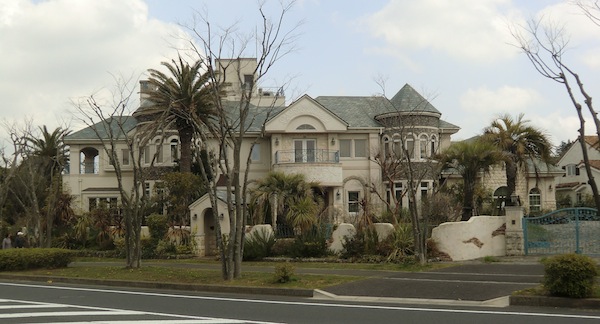
Interestingly, one of the most expensive housing developments in Japan is in a relatively remote corner of Chiba. The Azumigaoka New Town is part of Chiba City’s Midori Ward, but the nearest train station is Toke on JR’s Sotobo Line, which means it’s practically in Ichihara. The exclusivity of portions of the new town development, coupled with the unusually large plots of land contained therein, have earned at least two subdivisions in the area–Prestige and One Hundred Hills–the nickname Chibaley Hills, a takeoff on Beverley Hills. We’ve never seen this neighborhood with our own eyes since, as with the real Beverley Hills, the residents discourage tourists and gawkers by restricting access. When it first opened the development got a lot of media attention, which in turn attracted motorcycle gangs, so now they have a patrol that politely keeps out pedestrians who have no business there. Nevertheless, you can find properties in the area on sale at almost any real estate portal site, and they remain pretty expensive, though certainly not as high as they were when they were first built during the bubble era. What’s considered a super luxury in Japan would be more or less upper middle class in the U.S., essentially backyards big enough to provide privacy, two or more bathrooms, and lots of windows and open floor plans. We even saw one property at a realtor’s site with a swimming pool. Read More

Stand-up routine

showerLast week we were looking at a new house that had recently been completed. The owner allowed the builder to show the property to the public as a model prior to his moving in. The builder represents a new trend in housing that is quickly catching on, and for good reason. They offer a number of standard designs that can be constructed cheaply using kits and materials bought in bulk, and the purchaser can customize the designs in various ways with options and slight floor plan changes. The basic structures range from a mere ¥9 million to about ¥13 million, not including land, of course. The builder also deals in land sales, but only insofar as a means of selling new homes. They look for stray plots for people like us who are looking to build their own home but haven’t found land yet. It’s the reverse of the usual process. Since the house is the main sales point, the company doesn’t charge a fee when brokering a land deal.

For us, however, the visit was purely for research purposes. The house was well-made but the basic design and overall aesthetic was dully conventional: boxy rooms, white walls, nondescript fixtures. Of course, the buyer could pay more and make the improvements he liked, which is the whole point, but given what there was to begin with we weren’t inspired. Moreover, the company seemed to limit its land selection to cramped housing developments, specifically orphan lots that hadn’t been sold after a particular development had been opened for sale.

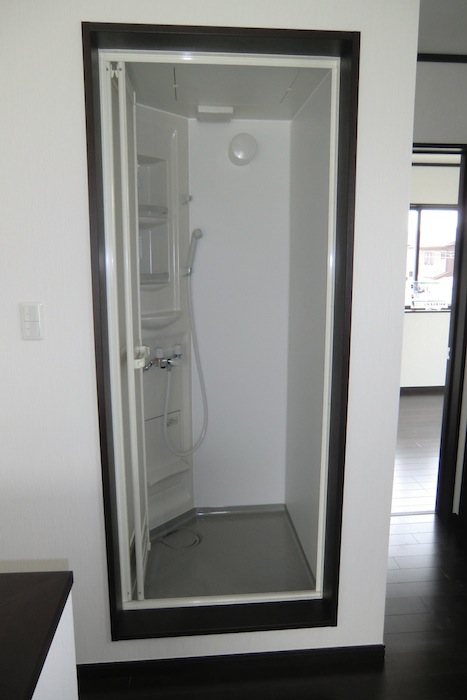
In fact, the visit wouldn’t be worth mentioning if not for one feature that stood out so prominently it seemed to define the house. The owner, whom the agent told us was a “foreigner,” had exercised his design option by installing a separate shower stall on the second floor, in addition to the usual unit bath on the first floor. Stand-alone showers aren’t very common in Japan, certainly not as common as they are in the U.S. or Europe, but you do occasionally see them. What made this one odd was that it was built off the second floor hallway. It was designed almost like a closet: there was a folding door, beyond which was a capsule-style unit shower. There was no space for changing clothes, you just stepped directly from the hallway into the shower. There was also a toilet on the second floor, but as is the Japanese custom it had its own separate room, and was down the hall from the shower. The second floor also had two bedrooms. Japanese houses usually don’t provide a distinctive “master bedroom” in the sense of a room with its own attached bathroom, but the larger bedroom in this house had a huge walk-in closet that was positioned adjacent to the shower stall but didn’t connect to it.

We asked the agent why the owner didn’t put the shower stall in the bedroom or made an entrance to the shower from the walk-in closet. She said that they had another customer who did just that, but such a design change was very expensive and didn’t fit within the overall budget of the person who ordered this house; which is a reasonable explanation but all we could imagine is family members and weekend guests dripping water everywhere as they walked naked around the house (there was a third bedroom on the first floor) after taking a shower. The agent, noting our bemusement, remarked, “Yes, it is strange, isn’t it?”

Highrises revisited

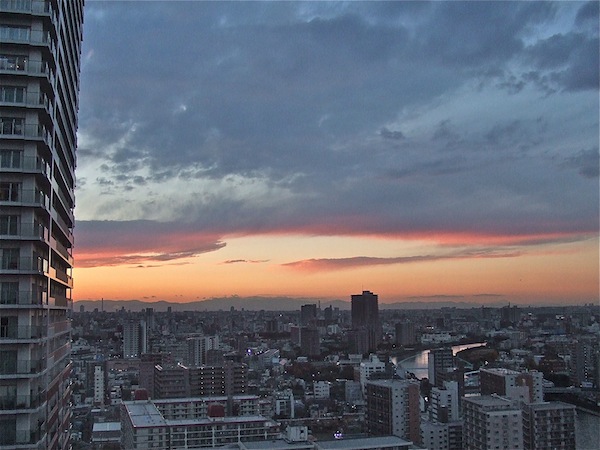
DSCF1857Though we miss living in Tokyo, especially shitamachi, we don’t really miss the highrise kodan where we spent eleven years. Until the earthquake our main complaint was the mostly insular nature of highrise life, the feeling that it was always difficult to get in and out, but during those weeks after the temblor it became a nerve-wracking experience, even as we became convinced that the structure was safe. We wrote a number of posts here about that experience and even one related column for the Japan Times (though it seems to have been taken off the JT site). For a while the media and the market seemed to concur with us that highrises may not be a wise option for a city that could be hit with its own big earthquake at any time, but eventually fears subsided and highrise condos started selling again; quite well, in fact, so we assumed our fears were just our own and didn’t extend to the general population. Even Tsutomu Yamashita, a housing journalist who is unusually frank about these sorts of matters, has come around and said that investing in a highrise Tokyo condo is a good idea since they’ve become even safer since the quake.

A recent article in Aera, however, has confirmed our initial sentiments. Opening with a frightening “what-if” scenario describing a 7.3 magnitude quake happening under the capital, the feature makes the case that even though these highrises will not collapse, life will essentially be impossible in them indefinitely. The most immediate concern, and the one that made the biggest impression on us in the aftermath of the 311 quake, whose epicenter was hundreds of kilometers away, was the loss of elevators, which shut down automatically when a building shakes. According to law, they can only be turned on by a certified technician, which means even when the shaking stops residents will have to wait for that technician to show up, and he may be inspecting other highrises. This problem multiplies with the intensity of the jolt. And if the quake is strong enough to knock out electricity, then the elevator problem is exacerbated. Under such circumstances, the residents on higher floors become like “people stranded on the top of a mountain in bad weather.” The idea of walking down and then up emergency stairways to run errands or whatever is just impractical, and virtually impossible for the elderly, the handicapped, and pregnant women. Most highrises have emergency generators, but these are for contingencies and thus only have enough power for maybe two hours. So if the elevators are out due to loss of power, that means the stairways are also dark. And even if the building structure is sound, some elements, such as doorframes, could be compromised, making it difficult to get out of an apartment. All highrises have emrgency ladders connecting verandas for use during fires, but it will be very difficult to use them to get all the way to the ground. The Tokyo metropolitan government has said that in the event of a major quake their estimate is that it will take at least a week to recover electrical power. Also, highrise residents will likely be lower down on the list of people receiving attention during rescue operations because of the difficulty for crews to access higher floors. Emergency services will first attend to victims they can reach more easily. Read More

Cheaper than dirt

shiroi4A few weeks ago we learned that a house we had been interested in was sold. We had first seen the house last fall and wrote about it here, and then did some research because the realtor who showed it to us couldn’t answer our questions about the structure and the land. Obviously, other people looking to buy were less apprehensive about the property. Another reason we hesitated for so long was the price. When we first inspected the house we thought ¥15 million was reasonable considering the size, the layout, and the unobstructed view to the south, but then we noticed that in the same general vicinity a developer was selling brand new houses of a comparable size for only ¥16 million, and some were even closer to the train station. Looking at these houses on the web we realized that the reason they were so cheap was because the developer had bought a tract of land in an undeveloped corner of town and just filled it with as many structures as it could. These were not houses ordered by people who first chose a plot and then a model from a list of designs to build on the plot. The developer divided up the tract and went ahead and constructed identical houses on all of the plots, with perhaps minor differences determined by light exposure or shape of the land. By doing it in a mass way, the developer could save money. Though we could tell by just looking at the photos on the web they were not for us, we also thought it would appeal to a lot of potential buyers simply because the houses were brand new, and thus it would be much more difficult for the realtor selling the house we’d been interested in to unload it, but we were wrong.

The existence of such new homes made ¥15 million seem like a lot for the house we had been interested in, so we did a search and found several developments in northern Chiba where brand new homes were being sold at prices below what we had come to think was the average for used homes. Two were in Shiroi on the Hokuso Line, each about 15-20 minutes from the nearest station. In one development they were going for as low as ¥13.7 million and the other as low as ¥14.8 million, which is dirt cheap considering that new homes in the same area with the same floor space and land area, and probably less in terms of fixtures and amenities, were likely going for ¥30-40 in the early 1990s. Of course, comparing anything real estate-wise to the late 80s/early 90s in Japan is a chump’s game, but it does provide a perspective that’s instructive when it comes to making priorities. Read More

Damn shed

For sale? No thanks

For sale? No thanks

As we’ve looked at properties over the years we’ve invariably absorbed certain truths that don’t require statistics to verify. One of these is that Japanese single family homes are very large in proportion to the amount of land they occupy. I’m sure someone has done a study using ratios of land to floor area, and I’m also sure that Japan is probably high on the list of countries where the rate is the smallest. This situation, of course, explains the cramping not only in suburbs but in rural neighborhoods that undergo residential development. Another certain truth that may be more difficult to prove is that Japanese have more stuff in relation to the amount of storage space available. The clutter of residential subdivisions is mirrored by the clutter inside individual homes, but more to the point it is characterized by one particular item that almost every property features: the tool shed.

In Japanese they’re called monooki, which literally means a place to put things. Sheds are hardly unique to Japan, but because of the aforementioned cramped conditions they are unavoidable, ubiquitous eyesores. Most are grey and metallic, which is bad enough, but because land is such a premium and people who build houses naturally want at much interior space as they can get, sheds take up a great deal of whatever exterior space is left over. We have seen so many properties that looked OK, and then we looked out a window and–BAM!–there’s a shed blocking whatever vista that window might look out upon. And it doesn’t always belong to the property we’re checking. Once we were inspecting a house in Nishi Shiroi in a very well-tended residential neighborhood. The kitchen had a nice corner window that looked out on the leafy walkway that separated the rows of houses, but the scene was totally destroyed because the neighbor had erected a shed on the edge of his property that interfered with the view. Obviously, anyone who bought this house would have to contend with that big, grey box and we mentioned this to the realtor, and he pointed out, quite naturally, that there was nothing anyone could do about it since the shed was on someone else’s property. This seemed strange to us, because there are lots of local property laws that regulate what sort of windows you must install to protect privacy and how much sunlight you have a right to and where the driveway should be positioned so as not to bother neighbors, but there seems to be no law regulating the placement of monooki.

So we’ve concluded that it’s us, not everyone else, because sheds are so common it must mean people actually like them. (They need them to store tools? Most people don’t have gardens big enough to justify that many tools) Last week, we rode past a relatively new housing development with near-identical houses lined up in neat rows, and every one had an identical grey shed positioned in the exact same spot on the property, as if it were a standard fixture they were proud of. There is a house not far from where we live with what should be a pleasant southern exposure except that there is not one but two large sheds situated in front of what we assume is the living room sliding doors. The only reason we can think of for this unbelievably bad choice is that there is a public road to the south of the house and the occupants don’t want passers-by to look in their living room window. We understand their desire for greater privacy, but that’s why curtains were invented.

Something to think about (1)

As mentioned elsewhere in this blog and others, we live on what has been described as the most expensive train line in Japan. It’s also one of the most convenient–if you’re traveling into Tokyo or to Narita Airport. If you’re trying to get somewhere in the local vicinity that isn’t directly on the line, however, it’s not convenient at all. For instance, a few weeks ago we wanted to inspect a property in Sakura, a fairly large city in northern Chiba, which happens to be serviced by two train lines. As the crow flies, Sakura is directly southeast of where we live, and by car probably would take about a half hour to reach, but we don’t own a car. By train it would take more than an hour, though, as well as a considerable monetary investment, because we would have to go into Narita first and then transfer to another line, and while the line we live on does go to the airport, it doesn’t actually stop in Narita city, which is where the connections are.

So we did what we usually do: rode bicycles to the property. Pedaling from Inzai to Sakura gives you a perspective you wouldn’t otherwise have if you drove or took the train. Inzai is still “developing,” as it were, and has been carefully planned; or, at least, more carefully planned than other cities in Chiba. The roads are wide and straight. Sidewalks provide ample bicycle lanes. Subdivisions do not encroach awkwardly on farmland or abundant tracts of forest–the satoyama dynamic holds for the most part. The commercial areas are well contained and laid out in a relatively efficient fashion. As you pass from Inzai to Sakura, these features slowly give way to the more common Japanese suburban clutter. The roads become narrower and sidewalks eventually disappear altogether. Houses and commercial buildings appear on top of one another. Main thoroughfares take forever to get where they’re going and if you really want to get there in a reasonable amount of time you have to constantly stop and check a map. Japan, as someone once told me, was custom made for GPS. Read More

Unsafe as houses

Ever since the March 2011 earthquake, Tokyo has been reassessing its disaster preparedness policies with mixed results. Though the residents of the city have definitely become more knowledgeable about their vulnerability and what needs to be done to save as many lives as possible in the event of a major quake, not much, in fact, has been done, owing mainly to the usual issues involving private property versus public responsibility. Tens of thousands of old wooden houses, packed tightly together in some neighborhoods, are basically kindling for the inevitable conflagrations that will start after an earthquake hits. Since the local government doesn’t feel it can force these people to move or rebuild their houses (which would, in accordance with zoning laws that have gone into effect since they were originally built, force them to construct smaller abodes then they already occupy) their dire prediction falls on deaf ears. Libertarians and individuals with fond feelings about Tokyo’s uniquely quaint neighborhoods condemn any sort of regulatory move that would change the character of those neighborhoods, but it’s clear that these neighborhoods, as well as the people who live in them, won’t survive a big quake. They didn’t survive the 1923 quake, and the situation isn’t really that much different.

The same seems to go for condominiums and apartments, though in a different way. Late last year, the Tokyo government sent out questionnaires to building management companies and condo owner associations to determine the status of quake-proofing for collective housing in the city. Owner-occupied and rental combined, Tokyo has some 132,600 multi-resident buildings, 24,000 of which were built before 1981 when stricter quake-proofing standards went into effect. About 52,000 questionnaires were sent out, and one-tenth were completed and returned. Of these, only 11 percent said that their buildings have been inspected for structural integrity–17 percent for condos and 6 percent for rental apartments. Another 8 percent said they “planned to carry out inspections,” while 9 percent plan to “discuss the matter.” Sixty-three percent responded that they have no plans to do anything. Among the buildings that did carry out inspections, 60 percent were told that they needed “further reinforcements,” but only 4 percent have actually carried out any reinforcement work. Read More