The current income tax deduction on housing loans will expire at the end of this year, but, as in the past, it will probably be renewed in some form. The tax deduction was first implemented in 1972 and has been revised repeatedly ever since. The current deduction, revised in 2022, cut the rate from 1.0 to 0.7 percent of the balance of the loan in a given year for up to 13 years. Originally, the deduction was 1 percent of the entire price of the house for up to 3 years, and has fluctuated rather liberally over time, depending on how desperately the government wanted to use home sales as an economic stimulus measure.
That’s why the reason the deduction will likely be renewed again isn’t just that it’s become an expected feature of home ownership. On April 21, the welfare ministry announced the results of a survey of people who bought homes between 2022 and 2025. Twenty-one percent of the 8,400 respondents said that if there had been no tax deduction on housing loans they wouldn’t have purchased a home. Kyodo says that this survey will be used to decide on whether to extend the deduction after this year, with the implication that it will be. Among respondents, only 20 percent said that the housing loan tax deduction had “no influence” over their decision to buy a home.
Higher income buyers have lost something over time. Currently, anyone making more than ¥20 million a year is ineligible for the deduction, though the ceiling used to be ¥30 million. The carryover has also been decreased. If the amount of the tax deduction turns out to be more than the income tax owed the government, the excess can be applied to local taxes, but only up to ¥97,500. The maximum used to be ¥136,500.
The housing loan tax deduction has always been controversial, and not just in Japan, because it’s basically discriminatory. Why should people who can afford to buy a home get a special break on their taxes? The ostensible reason is to promote home ownership, which is generally assumed to be a good thing for society, but it ignores the situation of renters. Landlords in Japan do not get a deduction when they buy property because it only applies to people who purchase a home they will live in, but landlords undoubtedly pass the cost of all the taxes they pay on to their tenants, so landlords always have a means of handling tax issues. They don’t need a deduction. The only purpose of the deduction for homeowners is to encourage sales, which helps the real estate and construction industries, not to mention the banks that provide the housing loans.
We’ve written extensively about Tokyo’s current condo boom without really addressing what it will lead to in the long run. Most commentators seem to expect a burst bubble, like the one that happened in the early 90s following a similar over-valuation of properties in the late 80s. However, there is an important difference in that the current Tokyo bubble is being pumped up by rich people. The average price of a new condo in the capital has exceeded ¥100 million. In the late 80s, the bubble was caused by everyone, since the huge boomer cohort had secured its lifetime employment and banks were willing to lend them money. Even though housing interest rates are low in Japan compared to the bubble era, younger families with average incomes who still insist on buying new condos are finding it difficult to find anything they can afford in the 23 wards, according to local media.
A recent video on the YouTube real estate channel Rakumachi put the present bubble in perspective, especially in terms of what it holds for the future. According to Tomohiro Makino, a “real estate producer” whose career started in the 80s, people who say the Tokyo condo market is “over-heated” need to look at classic supply-and-demand. “Over-heated” suggests that the market will eventually cool, but since this particular bubble is being caused by rich people and institutional or business investors, it isn’t that simple. Scarcity is one of the factors fueling the over-heated prices: the number of new condos on sale in recent years is one-third the number that were on sale in a given year two decades ago. Much of the reason for this scarcity is the high cost of building materials and lack of labor. Building a condominium is much more time- and capital-intensive than it used to be, so developers have scaled down. And with prices so high, buyers trend toward people who benefit from certain financial realities, such as foreign investors who can exploit the historically cheap yen. Even rich elderly Japanese who don’t necessarily need a new place to live are buying high-end condos in Tokyo as hedges against taxes their heirs will have to pay when they die. So they invest their cash in real estate, which can lower the inheritance tax burden by as much as 70 percent. Those who do buy new Tokyo condos for living purposes tend to be so-called power couples—married people whose combined incomes exceed ¥15 million a year.
So the high condo prices are essentially being maintained by a small group of people. Nomura Securities says the number of “very wealthy” households in Japan, meaning they are worth more than ¥500 million each, is around 90,000, for combined assets (not counting debt) of ¥105 trillion. Merely “wealthy” households (¥100-¥500 million) number around 1.4 million with ¥259 trillion in assets; “less wealthy” (¥50-¥100 million) number 3.3 million with ¥258 trillion; upper middle class (¥30-¥50 million) number 7.2 million with ¥332 trillion; and the vast middle class (less than ¥30 million), numbering 42 million, is worth ¥678 trillion. Though the top two tiers account for a bit more than 2 million households, the amount of assets they control is considerable. Much has been made of the global income gap in recent years, and Makino says the top 1 percent in Japan has seen its wealth increase by 80 percent since 2013, when Abenomics. The investment market was flooded with easy money, but average households received no comparable benefit from the policy. Makino says that its effect on real estate has led to the over-heated condo market, putting Tokyo real estate out of the reach of the middle class. Developers don’t even think about this group of consumers, because they know that even if every condo they build is luxury-class, they can still sell them. Consequently, they don’t have to build that many in order to make as much money as they used to make when they sold to everyone. The average price of a new condo in the 23 wards as recently as 2015 was ¥60 million. Last year it was ¥115 million. And due to the lag in construction costs, prices will continue to go up for the near future.
And it’s construction costs that are the main concern for developers, since right now they account for 70 percent of the cost of a condo, the other 30 percent being land. This aspect is very significant, because while land prices vary greatly depending on location, construction costs do not. It costs almost the same to build a condo in the suburbs as it does to build one in the center of Tokyo, so most developers are putting as much of their money and resources as they can into the city. Even mid-sized developers that tend to do all their work in the suburbs are foregoing new construction to invest in new condos in Tokyo by borrowing money to buy them from major developers. Then they quickly resell them to make money. The most prevalent example of this kind of practice in the news right now is the Harumi Flag complex on the waterfront, which was built as the Tokyo 2020 Olympic athletes village and then sold or rented out afterwards. A substantial number of the condos remain empty because they’ve been bought by corporations, including developers, as investments, thus pushing the price of individual units up. According to Makino, some companies have bought from 10 to 20 units in Harumi Flag.
Makino sees this trend continuing as long as interest rates remain low, since most investors don’t use their own money to buy real estate. Once rates start to rise, he says, the market will cool as investors pull out. Now that the era of the “negative interest rate” has ended in Japan, he thinks that such a change is on the horizon, even if many experts believe the Bank of Japan won’t increase interest rates due to the amount of government bonds it has. But the BOJ doesn’t control interest rates. Other factors, including environmental disasters, international politics, even rumors, will always come into play, and once they do “the party will be over,” meaning even foreign investors will bail regardless of the exchange rate. This could prove to be a huge shock to the system. After all, young Japanese adults today know nothing about interest, having been born without any experience of bank deposits earning interest. It’s unrealistic to think that this kind of environment will persist indefinitely, but until it does change it’s also unrealistic to thing that average Japanese people will step in when wealthy investors drop out. It’s just too risky for the average household to buy a condo in Tokyo now or in the near future.
If Makino were to give advice to potential middle class homeowners who want to live in Tokyo, it would be to wait, probably until 2030, by which time he says the “market will surely change.” Not only will prices for condos, used and new, go down, but so likely will rents. And his reasons for thinking so are grounded in an unavoidable truth. Households headed by people over 65 in the Tokyo metropolitan area now number 9 million, with half of those headed by people over 75. That number will steadily increase. After 2025 all the 1.5 million boomers living in the metro area will be over 75, and while lifespans are also increasing, it won’t be long before this cohort starts dying out in record numbers, which means their property will either be left to heirs or abandoned, if it hadn’t already been sold. These people came to the metro area in their youth to work, and they bought homes. But their children, now middle aged, mostly own their own homes, too, and so won’t need their parents’, which means they’ll sell it or do something worse (pretend to ignore it?), but in any case there will be a lot of empty homes on the market. This, as Makino points out, is the heart of the akiya problem, which will only intensify by the end of the decade, throwing the real estate market, including Tokyo’s, into turmoil. Oversupply will become a chronic issue unless the construction industry and the authorities change their tune with regard to building new residences, which is pretty much all they think about now.
Here’s another chapter from our unpublished book about housing in Japan based on our own experience of buying/building a home. This one is about keeping up properties.
One of the most popular sub-genres of reality TV is the home improvement show. In 2002, Japan’s Fuji TV launched one called “Before/After,” where superannuated, usually cramped properties were magically transformed into marvels of modern design. The producers hit on a fool-proof hook for the show that they exploited successfully week after week, year after year, without seeming redundant.
People with properties they wanted to fix up would contact the producers, who sift through the candidates, looking for the most broken-down or unusual cases. The best sequences highlight houses that would seem impervious to improvement due to their state of disrepair or local environment. A surefire hit is always the hovel located in one of Tokyo’s warren-like residential areas, usually dating from just after the war, when neighborhoods were constructed on the fly, and which require not just ingenious design skills to improve, but superhuman feats of logistics, since there usually isn’t any room to get heavy machinery to the property owing to narrow alleyways. The architects are lone wolves who waive their design fees and charge only for materials and labor. The recipients of their largesse come up with a ceiling amount they will pay, thus adding another layer of challenge to the architect’s task. The family is then sequestered off-site while the work is done and documented in detail by a film crew. The residents are not allowed to view the property until the “reform” is complete. The climax is dramatic, with the family entering the sparkling new house with tears streaming down their faces and the anodyne voice of the female narrator showing us the stark differences achieved by the architect.
“Before/After” sparked a boom in home improvement TV shows but not in home improvement–or, at least, not to the extent that it made a difference in the marketability of older homes. One of the main problems with remodeling in Japan is lack of regulation and oversight. The vast majority of homeowners can’t afford the kind of architects featured on “Before/After,” but anyone can start a home improvement company. In the past, the biggest complaint with regard to remodeling was fraud, characterized by operations that over-billed elderly people for poor work. Eventually, the complaints became more general owing to greater demand by homeowners who decided it was cheaper to renovate their present houses than it was to buy new ones, even if that wasn’t necessarily the case. In 2011, the Center for Housing Renovation and Dispute Settlement Support addressed more than 4,500 claims, mainly in Tokyo. In most cases there were no contracts, design plans, or even written estimates. If a particular job costs less than ¥5 million, according to the law, the company that carries it out doesn’t have to be registered as a construction firm, though remodeling companies are supposed to be insured for shoddy work. Also, the work doesn’t need to be inspected by the relevant authorities unless “it affects the integrity of the structure.” Some years ago a Nagoya woman whose condo became virtually unlivable after a reform company replaced her floors and windows couldn’t sue because there was no contract. The National Consumer Affairs Center of Japan handled more than 13,000 reform-related complaints in 2011, or twice as many as in 2010. Since there were no regulations, the center urged homeowners who were going ahead with remodeling to record all conversations. The Japan Bar Association in April 2011 urged the construction ministry to pass new laws to cover the industry, no matter how small the company.
When it comes to home improvement, experts recommend hiring designers who understand the engineering aspects of a remodeling project and can subcontract the various jobs to tradespeople. Such projects, however, can run into the tens of millions of yen, which is why comprehensive discount remodeling companies have sprung up, offering total renovations for much less. Many are associated with major retail home improvement centers, and are thus deemed to be reliable. They cut costs by buying materials in bulk, which usually means limited choices for the consumer. As with anything, you get what you pay for.
But most homeowners in Japan don’t renovate in any substantial way, because they’re not conditioned to think of their properties as an investment. And until very recently, there were no government incentives to improve properties. The idea that one’s house, as opposed to the land it sits on, accrues or even retains value over time isn’t widespread in Japan, so as long as people can put up with the wear and tear, they let their houses slide. So the question becomes: Do the houses not retain value because people don’t keep them up? Or do they not keep them up because they believe their houses don’t retain their value? In any case, the majority of used houses, especially those built before, say, 1990, are virtually junk.
Here is another draft chapter from our unpublished book about our house-hunting adventure. This one is about second homes and so-called resort mansions.
Second-home inspecting in Nikko
One late summer morning in 2012 we were on the Tokaido Shinkansen super express and ran into a friend we hadn’t seen in years. He asked us if we were still living in Tokyo and we said we had moved some time ago because of the earthquake. He then asked what we were doing on the bullet train and we said we were on our way to Atami on the Izu Peninsula to look at some properties we might be interested in buying. He gave us a funny look. “That would seem to be the worst place to live if you’re afraid of earthquakes.”
True. Just the day before Japan’s Cabinet Office Disaster Council had updated its projections for a major earthquake occurring in the Nankai Trough, the deep indentation in the sea bed off the Pacific coast, and Shizuoka Prefecture, which contains Izu, was deemed the worst location in terms of projected casualties, though, technically, most of those casualties would be in the western part of the prefecture, not Izu. In any case, we weren’t completely serious about buying a place there. Having been frustrated in our search for a home we could afford, we were entertaining the idea of keeping our rental and buying a cheap old fixer-upper in a location with cooler summers. If our income situation worsened and we had to give up renting, then we would at least have a roof over our heads, and if things continued as they had been then we’d have a weekend/summer place. There are plenty of old dumps in the highlands of Tochigi and Nagano, or in the wilds of Chiba that can be had for under ¥7 million, though they’d require another ¥3-5 million to make livable. And during our search we noticed there were quite a few such places in Izu, too, mainly besso (separate homes), which we had avoided so far. Second homes tend to be built in specially designated developments managed by companies that charge yearly fees. Also, besso are usually impractical for year-round living, but since we weren’t necessarily going to be living in one year-round we thought we’d see what was available. And Izu is, as they say, the “Riviera of Japan.” More to the point, it’s cooler in the summer.
In the last year, we’ve seen a lot of headlines on social media about how you can buy a house in Japan for a song. The usual figure quoted is about $500 US, which makes us think that all these articles spring from one source that’s likely American. We haven’t bothered tracing the articles to one source, though we read a few of them and they all say basically the same thing: local governments throughout Japan are promoting the acquisition of abandoned houses in order to get people to move into their regions and lift the tax base. In some cases, they are even giving houses away, but in any situation these structures will need a lot of work before they are at all habitable. We’ve written extensively about the problem of akiya and since you get what you pay for it follows that the lower the price the more work that will need to be done. The worst akiya, it must be said, are not even on the market, meaning they were literally abandoned by the owner for any number of reasons—either because they moved out and couldn’t be bothered to try and sell it, or they did try to sell it with no success, or they simply disappeared in order to avoid having to pay property taxes, which, in all probability, were very low to begin with. Or they died—with or without an heir. There are a lot of akiya whose owners are dead, meaning they never transferred the title to anyone, and though heirs are still legally responsible in Japan they can be difficult to contact if they don’t want to be found. Those houses are probably unihabitable since they’ve been left to rot, and the local government doesn’t want to spend the money to have them demolished.
There are more than 8 million akiya and, not counting dedicated rental units, many are not livable and fewer are even sellable due to other factors such as location. So when you read an article about somebody who bought a house for nothing and fixed it up into a nice place it’s not just an exception to the rule, but almost an anomaly. Anytime a foreign person buys an old farmhouse or kominka and turns it into a monument to traditional Japanese craftsmanship they’re bound to get it featured in the news, but, again, it’s exceedingly rare. Most people prefer new homes, and because government policy has always privileged new house construction, potential buyers can always find something they can afford that’s new; and in many cases it will even be cheaper than an older house that requires extensive renovation, which describes a substantial number of old houses that are on sale.
The reason these articles about cheap houses have proliferated in the past year is mainly the pandemic, which, for a while, cut into new home construction. People are moving out of the cities because they can now work from home, so used houses starting selling well, but, again, a lot still aren’t selling. We know of several houses in our general vicinity that are in good condition but they’ve been on the market for months, some even years. There are just too many cheap old houses that people want to sell and not enough buyers. Of course, much of it has to do with Japan’s decreasing population, but mainly it has to do with oversupply. When construction resumes apace, those old houses will become even more difficult to sell.
More to the point, people who do sell their homes almost never make back what they paid for them. The exception is certain areas of big cities, but even in those cases it isn’t guaranteed, and then the seller will be even less likely to see a profit, especially when you factor in the interest they paid on their loan. (You’re more likely to make a small profit if you bought an old condo in a popular area of Tokyo and resell it later.) At this point, we think most Japanese people know this, despite all the talk about “maintaining property values” at all cost. We certainly know it. Almost as soon as we moved into our new house in 2014 the assessed value dropped by almost two-thirds—and that’s for property tax purposes, which tends to be higher than market assessed value. (Assessed value for land is a different matter) So we know we will never be able to make money on this house, which is one of the reasons why we had it built the way we wanted—meaning few other people would probably want it. But the problem as we get older is: What can we do with it when we reach the age where we can no longer live here? There’s a very good chance we won’t even be able to sell it. Since we don’t have children, there’s no one to inherit it. We’ve already brought up the possibility with some younger relatives that any of them can have it for free, and while they sound interested, we’re not sure if the idea of taking on a property is something they have the wherewithal to carry out. We’ve even thought of donating it to some organization, but that might run into problems with neighbors who find out about it beforehand.
Once you embark on a certain course of action, even if the motivation is basically speculative, matters often progress of their own accord. Though we hadn’t yet secured the plot of land we liked, the fact that for a month it was ours for the taking made us feel strangely possessive of it. It is only a ten-minute bike ride from our apartment, and in the weeks after our visit to A-1 we would drop by just to have a look at it and imagine what a house might look like sitting on it. Sometimes we would address a pressing consideration, such as: What is the Internet capability in this leafy corner of the city? It was a real consideration since our work depends on online access, and one day we asked the carpenter next door, who just happened to be outside puttering around, what sort of access he had. He didn’t, and didn’t seem to know anything about it since he didn’t need the Internet for his work and wasn’t a technophile. While we admired his resistance to the irresistible pull of modern life we also felt slightly taken aback. Were we thinking of moving into the Ozarks?
Later, we met another neighbor who assured us that optical fiber connections were available in the area, but the seed had already been planted. What about the water we’d be consuming from the well we’d have to dig? The carpenter said it tasted terrible and that he only used it for washing, while the other neighbor thought it tasted better than the city water he used to drink. We knew there was no accounting for taste, but that’s quite a gap in perception. The realtor said something about the depth of the wells: that the carpenter’s was shallow and the other neighbor’s much deeper, but that information only made us more confused and obligated to do even more research into the matter. In other words, coming to a decision about the land was going to be even more complicated than we’d thought. Read More
Having lost interest in the land in Makinosato, we felt as if we’d retreated to square one. There was still that lot near Shimosa-Manzaki station, but besides being really cheap it didn’t offer anything we could get excited about. Our disinterest was rooted in the same feeling that made it easy to drop the Makinosato plan: We didn’t really want to live in a subdivision, though we also understood that if we wanted to remain in this particular stretch of Chiba Prefecture and weren’t going to pay more than ¥5 million, the only lots we could afford were in subdivisions. This feeling turned to something like despair when several large tracts of land close to our train station were suddenly opened for development. As mentioned elsewhere in this blog, we live in what is called Chiba New Town, which stretches across parts of three cities in northern Chiba Prefecture. As a housing and commercial project developed by the government housing authority in the 1960s and 70s, management eventually fell to the authority’s semi-private successor, UR, which was stuck with a lot of land that was never developed because Chiba New Town didn’t attract residents and businesses in the numbers the government originally envisioned. But the government has also given UR a deadline to get out of the land development business and that deadline is next March. So suddenly, all these overgrown fields bordering the Hokuso Line are being bulldozed and subdivided, and several weeks ago housing companies and real estate agents started advertising the plots, which start at about ¥11 million for 200 square meters. So even though there will be hundreds of plots made available soon in subdivisions we would probably prefer not living in, we at least have to double our land purchase budget in order to buy one.
So after a short respite we resumed our seemingly endless Internet search, checking portal sites for anything–land, condos, used houses–that might offer us something appealing. In terms of land, we increased the budget to see what was available. Portal sites have series of buttons you check to narrow the search, and land prices are normally tiered in multiples of ¥5 million. In the past we’d input the very smallest amount, but now we broadened the search to ¥10 million in the areas we were interested in. There was a lot more available, obviously, and since we’ve been at this thing a while we’ve become better at rejecting properties without looking too closely at them. Read More
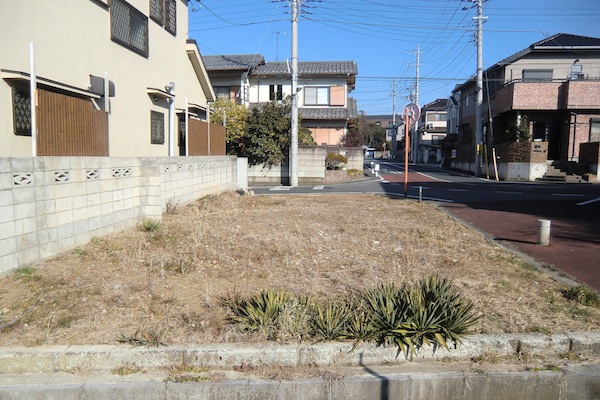
For a short time we were very interested in a small piece of land in Abiko along the Narita line near Kohoku Station. It was in a tightly packed subdivision called Nakabyo surrounded by older neighborhoods whose winding streets and oddly shaped plots of land indicated it had once been an agricultural community. Nakabyo itself was not as distinctive. It was a typical subdivision of the late 80s, with large houses in varying degrees of disrepair situated on lots that were a little too small for them. The community was laid out on a gentle, long slope that ascended south to north, so that houses positioned on the north sides of the parallel streets had a slight advantage over the ones positioned on the south sides, whose own southern exposures were quite close to their southern neighbors. The land that interested us was at the bottom of the slope and positioned on the south side of a street but its own southern exposure faced a large park. Moreover it was on the corner of an intersection, meaning streets bordered the land to the east and the north, not buildings. Only to the west was there another house.
And it was cheap–¥4.3 million. In fact, the realtor implied that we could probably get it down to an even ¥4 million if we paid cash. Apparently, the owner was desperate to unload it, and we wondered why it was so difficult to do so. Abiko is quite popular owing to the many train lines that run through it and the fact that Ueno is a little more than 30 minutes away by express. This was not in central Abiko, but it was close enough. Moreover, the clear prospect on three sides, including a park to the south, made it one of the few truly attractive lots we’d found in a conventional subdivision. The only reason we could see for its relative unpopularity was its size, slightly less than 100 square meters. Since the occupancy rate was 50 percent and the capacity rate 100, it still meant you could build a two-story house of up to 100 square meters, but because the shape of the land was slightly trapezoidal, the orientation of the house was limited. Read More
Several months ago we looked at house in Sakura, Chiba Prefecture that was built in the early 90s. It was on the side of a fairly steep hill and commanded a view of Inba Marsh to the northeast; or, at least, that was what the info at various real estate portal sites implied. The place had already been on the market for almost six months, and when we noticed that the price had been cut for the second time we thought we might take a look at it. Originally, it was about ¥18 million and now it was ¥13 million.
The owners were still living there, but the agent said it would be no problem to look at it. Inspecting properties where people still live isn’t much fun and usually not very helpful. Though you can get some idea of the functionality of a place by seeing how people live in it, those people’s mode of living is always very different from our own, so there’s nothing to gain from it. We have to imagine ourselves in this place without all their stuff.
This particular house was even worse than we could imagine, since the photos on the web didn’t include interior shots. The residents didn’t even bother to clean up and we walked through bedrooms (they have two kids) with laundry thrown on the floor and a kitchen so cramped and cluttered there didn’t seem to be anywhere to stand. Even the “view” that the portal site had publicized turned out to be nothing. The only vista was from one of the bedrooms. It was impossible to tell how much work the place would need since it was difficult to see the floors and walls.
We promptly crossed it off our list and would have forgotten about it completely but it remained on the market and thus on all the portal sites we checked regularly. Last week we noticed that the owner had decreased the price again, this time to ¥8.9 million, which is quite a drop. That means the asking price is now about half what it was when it first went on sale. The agent let on that the family couldn’t move until they sold this house, but if that’s the case they are going to have to do something more than just keep cutting the price. Maybe the house is unsellable anyway, but in this market, which is filling up with older homes all the time, a low price isn’t enough. This particular house isn’t that close to the station. Would a better “presentation” help? It couldn’t hurt, but in any case it’s hard to imagine that there is a buyer out there who would want to buy such a place.







 Cat Foreheads & Rabbit Hutches