Move on up

CIMG2287Of the three prefectures adjoining Tokyo, Chiba is by far the cheapest in terms of real estate. It tends to rate on the dowdy end of the desirability index. Kanagawa remains the hippest because of places like Kamakura, Shonan, Yokohama; while Saitama, though often derided in popular culture as a suburban backwater (“Dasaitama”), was developed rather quickly owing to its size and convenient proximity to the capital. In fact, property values in northern Chiba along the Noda and Joban lines are comparable to Saitama’s. It’s when you get farther out on the Keisei and Sotobo/Uchibo lines that the suburbs become sparser and less expensive. Chiba is viewed as the sticks, which is just as well for us because it offers more affordable places within striking distance of where we live now.

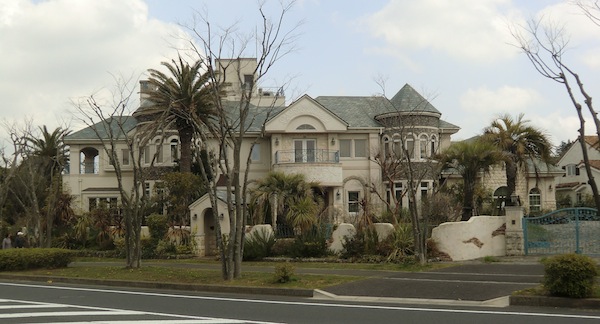
Interestingly, one of the most expensive housing developments in Japan is in a relatively remote corner of Chiba. The Azumigaoka New Town is part of Chiba City’s Midori Ward, but the nearest train station is Toke on JR’s Sotobo Line, which means it’s practically in Ichihara. The exclusivity of portions of the new town development, coupled with the unusually large plots of land contained therein, have earned at least two subdivisions in the area–Prestige and One Hundred Hills–the nickname Chibaley Hills, a takeoff on Beverley Hills. We’ve never seen this neighborhood with our own eyes since, as with the real Beverley Hills, the residents discourage tourists and gawkers by restricting access. When it first opened the development got a lot of media attention, which in turn attracted motorcycle gangs, so now they have a patrol that politely keeps out pedestrians who have no business there. Nevertheless, you can find properties in the area on sale at almost any real estate portal site, and they remain pretty expensive, though certainly not as high as they were when they were first built during the bubble era. What’s considered a super luxury in Japan would be more or less upper middle class in the U.S., essentially backyards big enough to provide privacy, two or more bathrooms, and lots of windows and open floor plans. We even saw one property at a realtor’s site with a swimming pool. Read More

Cheaper than dirt

shiroi4A few weeks ago we learned that a house we had been interested in was sold. We had first seen the house last fall and wrote about it here, and then did some research because the realtor who showed it to us couldn’t answer our questions about the structure and the land. Obviously, other people looking to buy were less apprehensive about the property. Another reason we hesitated for so long was the price. When we first inspected the house we thought ¥15 million was reasonable considering the size, the layout, and the unobstructed view to the south, but then we noticed that in the same general vicinity a developer was selling brand new houses of a comparable size for only ¥16 million, and some were even closer to the train station. Looking at these houses on the web we realized that the reason they were so cheap was because the developer had bought a tract of land in an undeveloped corner of town and just filled it with as many structures as it could. These were not houses ordered by people who first chose a plot and then a model from a list of designs to build on the plot. The developer divided up the tract and went ahead and constructed identical houses on all of the plots, with perhaps minor differences determined by light exposure or shape of the land. By doing it in a mass way, the developer could save money. Though we could tell by just looking at the photos on the web they were not for us, we also thought it would appeal to a lot of potential buyers simply because the houses were brand new, and thus it would be much more difficult for the realtor selling the house we’d been interested in to unload it, but we were wrong.

The existence of such new homes made ¥15 million seem like a lot for the house we had been interested in, so we did a search and found several developments in northern Chiba where brand new homes were being sold at prices below what we had come to think was the average for used homes. Two were in Shiroi on the Hokuso Line, each about 15-20 minutes from the nearest station. In one development they were going for as low as ¥13.7 million and the other as low as ¥14.8 million, which is dirt cheap considering that new homes in the same area with the same floor space and land area, and probably less in terms of fixtures and amenities, were likely going for ¥30-40 in the early 1990s. Of course, comparing anything real estate-wise to the late 80s/early 90s in Japan is a chump’s game, but it does provide a perspective that’s instructive when it comes to making priorities. Read More

Back to the land

CIMG1953During the New Years break our house-hunting ambitions flagged a bit, and we started reassessing our priorities: What would happen if we went back to zero? In other words, we thought carefully about building our own house. The last time we did that, almost 20 years ago, we got burned, more because of our own ignorance than due to any concerted effort on the part of the real estate and construction industries. But we know more now and feel that we should at least explore the idea. For instance, we like the small houses built by A1 and they’re pretty cheap, so we could talk to them about our needs and what they can do to satisfy them. But first we would need to find a piece of land.

Though land prices have fallen since the bubble period, it’s still pretty expensive anywhere within, say, two hours of Tokyo. We’re not commuters so we don’t need to be on a main train line, but we do need to be on some train line. We started our search at the bottom, in two areas not that far from where we live and which we’ve come to know through our house-hunting inspections in the past year-and-a-half: northern Chiba along the Narita line, and south of where we live now, along the Keisei Hon-sen through Sakura. As it turned out there were more than a few very cheap properties that were still large enough for our purposes. By cheap, we’re talking ¥5 million or less, and for that price you definitely have to give up something. In some cases, the plot isn’t properly developed, meaning it may not have sewage or gas lines extended into the property itself. Also, cheap plots tend to be holdouts in sub-divisions that are already mostly filled, meaning no one wants them but the developer is desperate. The lot might be stuck in a dark corner of the neighborhood or have problems with access, which isn’t a concern for us because we don’t have a car, but sunlight is one of our priorities. Then there’s the state of the lot itself. Some appear to require a great deal of “preparation” before they could have a house constructed on them, and we have no idea how much that would cost. Read More

Something to think about (2)

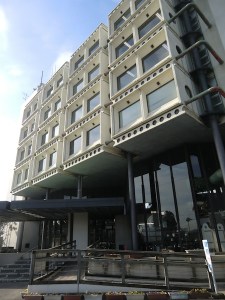
Sakura city office

Sakura city office

In the weeks since we visited the house in Usui we have, indeed, thought a lot about it, and our interest has blown hot and cold. Though we like the layout and the unblocked view to the south, we’re still not sold on the location. Keisei Usui Station is 20-25 minutes away on foot, and the train takes about an hour and fifteen minutes to get to central Tokyo. It’s considerably cheaper than the Hokuso Line, which we use now, and there are more trains per hour, but the Hokuso Line gets directly to the heart of Tokyo in about an hour and is never very crowded, even during rush hour. And it only takes us about 7 minutes to get from our front door to the platform. Of course, the train isn’t a monumental consideration since neither of us goes into Tokyo more than twice a week. Then there’s Usui itself, which as a bedroom town is older than Inzai and experienced the kind of suburban sprawl that plagued most Tokyo bedroom towns developed in the 60s and 70s, while Inzai was better planned and has more parks and open spaces. That said, Inzai is also somewhat antiseptic and lacks the kind of character older Japanese communities offer. Usui was incorporated into the larger city of Sakura some years ago and Sakura is one of the great castle towns of the Kanto region. Parts of it are quite beautiful and well-preserved, it’s just that those parts are not in Usui.

Read More

Something to think about (1)

As mentioned elsewhere in this blog and others, we live on what has been described as the most expensive train line in Japan. It’s also one of the most convenient–if you’re traveling into Tokyo or to Narita Airport. If you’re trying to get somewhere in the local vicinity that isn’t directly on the line, however, it’s not convenient at all. For instance, a few weeks ago we wanted to inspect a property in Sakura, a fairly large city in northern Chiba, which happens to be serviced by two train lines. As the crow flies, Sakura is directly southeast of where we live, and by car probably would take about a half hour to reach, but we don’t own a car. By train it would take more than an hour, though, as well as a considerable monetary investment, because we would have to go into Narita first and then transfer to another line, and while the line we live on does go to the airport, it doesn’t actually stop in Narita city, which is where the connections are.

So we did what we usually do: rode bicycles to the property. Pedaling from Inzai to Sakura gives you a perspective you wouldn’t otherwise have if you drove or took the train. Inzai is still “developing,” as it were, and has been carefully planned; or, at least, more carefully planned than other cities in Chiba. The roads are wide and straight. Sidewalks provide ample bicycle lanes. Subdivisions do not encroach awkwardly on farmland or abundant tracts of forest–the satoyama dynamic holds for the most part. The commercial areas are well contained and laid out in a relatively efficient fashion. As you pass from Inzai to Sakura, these features slowly give way to the more common Japanese suburban clutter. The roads become narrower and sidewalks eventually disappear altogether. Houses and commercial buildings appear on top of one another. Main thoroughfares take forever to get where they’re going and if you really want to get there in a reasonable amount of time you have to constantly stop and check a map. Japan, as someone once told me, was custom made for GPS. Read More

Space invaders

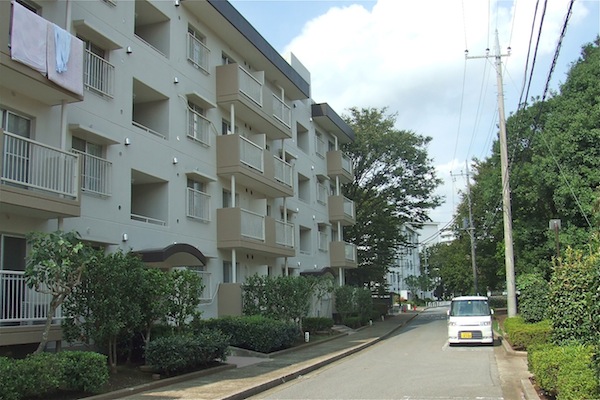
A few weeks ago we went to an old kodan not far from where we live to inspect an apartment that was on sale. We had never had dealings with this particular real estate company before, and we arrived early to check out the general environment, which was better than it is for most kodan. This one was built in the mid-80s and while the buildings themselves were as dull and utilitarian-looking as any other, the landscaping was impressive: lots of clean, well-maintained mini-parks separating the buildings, which were situated at angles that took advantage of the sunlight. We strolled over to the apartment building where we were to meet the agent and just so happened to run into an agent for a different company setting up a sign outside the same building for an open house. We knew this woman well, having met her numerous times when we inspected other properties in the vicinity. She was open and knowledgeable and knew exactly what we were looking for. It was always a pleasure to talk to her because she didn’t put on the usual salesperson front.

She told us that the apartment she was showing had been badly damaged in a fire. The owners had insurance, which covered the renovations. In fact, they apparently used the opportunity to gut the whole place and completely redo it. It wasn’t clear if the owners had been planning to move beforehand or made the decision after the fire (which is understandable–it might have been difficult for them to face their neighbors after almost burning down the building), but in any case the 70-square meter apartment was being sold for about ¥8 million. We told the agent we’d drop in after we inspected the other place. Read More

Not quite

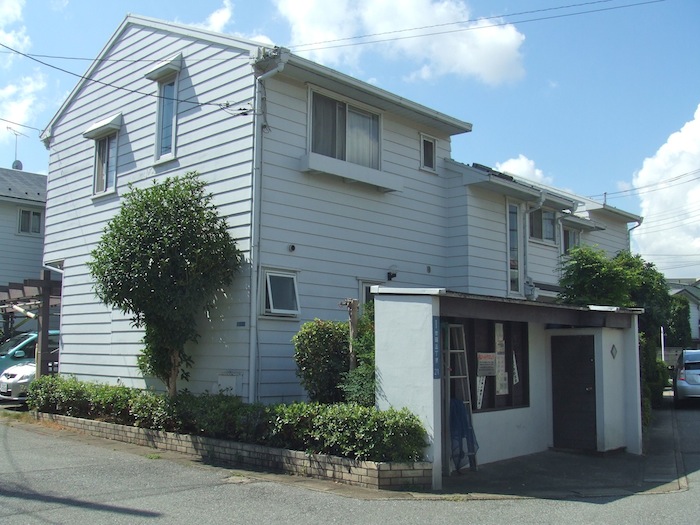
We’ve always been interested in town houses and are still thinking of dedicating a Japan Times column to them. Town houses were briefly popular in the late 70s and early 80s. Japan has always had an indigenous town house, called nagaya or machiya depending on which part of the country you’re in, but the structures called “town houses” in English (sometimes “terrace houses”) were more like their Western cognates: two-story structures with walls adjoining their neighbors. In urban environments town houses offer more effective utilization of land than normal detached houses while providing a similar level of creature comfort. However, once land prices skyrocketed in the mid-80s town houses were considered economically inefficient, even in the suburbs, which is where you normally found them anyway. Everybody started building condos with boxy floor plans in order to get as much cash out of a block of air as possible. Every so often we come across an old town house on sale and check it out, but because of their relative scarcity they tend to be overpriced. Of course, “overpriced” is all a matter of perception. Because town houses are relatively unusual, owners think that makes them more valuable, but they’re still old and always need a lot of work, as much as a detached house of the same vintage does if it hasn’t been renovated (and usually they haven’t been). A few weeks ago, as a matter of fact, we were amused to see a listing in which town houses were qualified as being “popular.” They aren’t, at least not in the general definition of the word. They are simply “rare,” which means it’s assumed some people will pay a bit more to have one. Read More

Field diary: Izu

Last week we were on the Tokaido Shinkansen early in the morning and ran into a friend we hadn’t seen in years. He asked us if we were still living in Tokyo and we said we weren’t, that we had moved a little over a year ago mainly due to the earthquake. He then asked us what we were doing on the bullet train and we said we were on our way to Atami on the Izu Peninsula to look at some properties we might be interested in buying. He gave us a funny look. “That would seem to be the worst place to live if you’re afraid of earthquakes.” True. Just the day before the Cabinet Office Disaster Council updated its projections for a major earthquake in the Nankai Trough, and Shizuoka Prefecture was deemed the worst in terms of possible casualties, though, technically, most of those casualties would be in the western part of the prefecture, not Izu. In any case, we weren’t completely serious about buying a place on the peninsula. Having been frustrated in our search so far for a home-sweet-home we could afford, we were entertaining the idea of keeping our rental and buying a very cheap old fixer-upper in a place with cooler summers. If our income situation worsened and we had to give up renting, then we would at least have a roof over our heads, and if things continued as they have been (notice we don’t actually think they’ll get better) then we’d have a weekend/summer place. There are plenty of old dumps in the highlands of Tochigi and Nagano, or in the wilds of Chiba, that can be had for under ¥7 million, though they’d require another ¥3-5 million to make them livable. And during our search we noticed there were quite a few such places in Izu, too, mainly besso (second homes), which we had avoided so far. Second homes tend to be built in specially designated besso developments managed by companies that charge yearly fees, some of which are pretty high. Also, besso tend to be impractical for year-round living, but since we weren’t necessarily going to be living in one year-round we thought we’d see what was available. And Izu is, as they say, the “Riviera of Japan.” Read More

Field diary: Onjuku 2

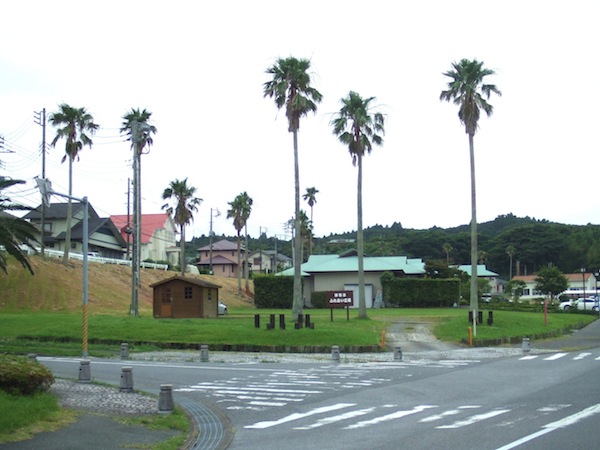
The entrance to Green Town. Note non-indigenous palm trees.

The last time we inspected some homes in Onjuku, a coastal town in southeastern Chiba famous for its surfing, we went fairly deep into the interior and were disappointed with the quality of the product, which was uniformly cheap, in all definitions of the word. This time we inspected three houses in a large housing development unimaginatively called Green Town. It sits on a hill west of the main train station and overlooks the ocean, which means it has a clear advantage over the rest of the town in this post-311 world: no fear of being swamped by a tsunami. The most popular portion of Onjuku is adjacent to the crescent of beach, which, for what it’s worth, is much cleaner and prettier than any part of Shonan I’ve seen. “Downtown” Onjuku is filled with funky little eateries, surf shops that double as outdoor bars, and lots of tall resort condos that have aged quickly–and badly–thanks to the salt-laden sea breezes. It’s a very attractive place, but it’s also very low and a tidal wave even half the size of the ones that flattened Tohoku would reduce it to sodden rubble rather easily. The reason we kept coming back to Onjuku is the climate. In the summer, it’s on average about 5 degrees cooler than Tokyo. We don’t like air conditioning and one of our priorities is a place where we don’t need it.

Green Town is also at least partially a weekend or summer community, though it’s laid out as a typical cramped Japanese housing development, albeit with more attention paid to the “green” component it promises. The developer is Seibu, and there are altogether about 1,500 lots, one thousand of which have houses on them. Half of these are owned by year-round residents, and thus the normal sterile atmosphere of modern Japanese housing developments is checked by a certain ramshackle quality. Some of the buildings are quite fine–and large–while others are modest and makeshift-looking. But while the stylistic tone is pleasingly varied, the overall feel is almost ominous. The day we visited was a weekday and summer vacation hadn’t begun in earnest yet, but the neighborhoods we visited were quite deserted. The only human activity was workers cutting grass or delivering LPG cannisters (despite the upscale appearance of the area, they don’t have gas lines). The real estate agent who guided us said most of the population was older, not because young people were moving out, but because only older people were moving in. (It’s not a town for commuters–Tokyo is an hour and 30 minutes away by super express) Apparently, older people don’t like to leave their homes in the daytime. Read More

Semi-detached

Though we still look at condos, it’s mostly for academic purposes. We have nothing against condos aesthetically or practically, but collective living automatically brings with it certain restrictions that we don’t really want to buy into. That may sound strange coming from people who still rent, but the responsibilities inherent in owning a property are more pronounced when the property is collective. For one thing, the condominiums we tend to like in terms of layout and design are actually those that were built by the housing authority, now called UR, and most of those still don’t allow pets. (We plan to cover the pet problem in more detail in a later article.) This small but significant restriction is indicative of the condo experience: people who own are understandably more caught up in the collective enterprise and thus pay closer attention to their neighbors. Renters are relatively forgiving, maybe because they tend to think they won’t be staying here forever. Owners have more of a stake and thus there are more rules and the rules are enforced. We’re not against rules, but it seems less stressful to own a house, where you can pretty much do whatever you want, than a condo, where you may not be sure what you can do until you move in. Read More