Inzai as the future of Japan

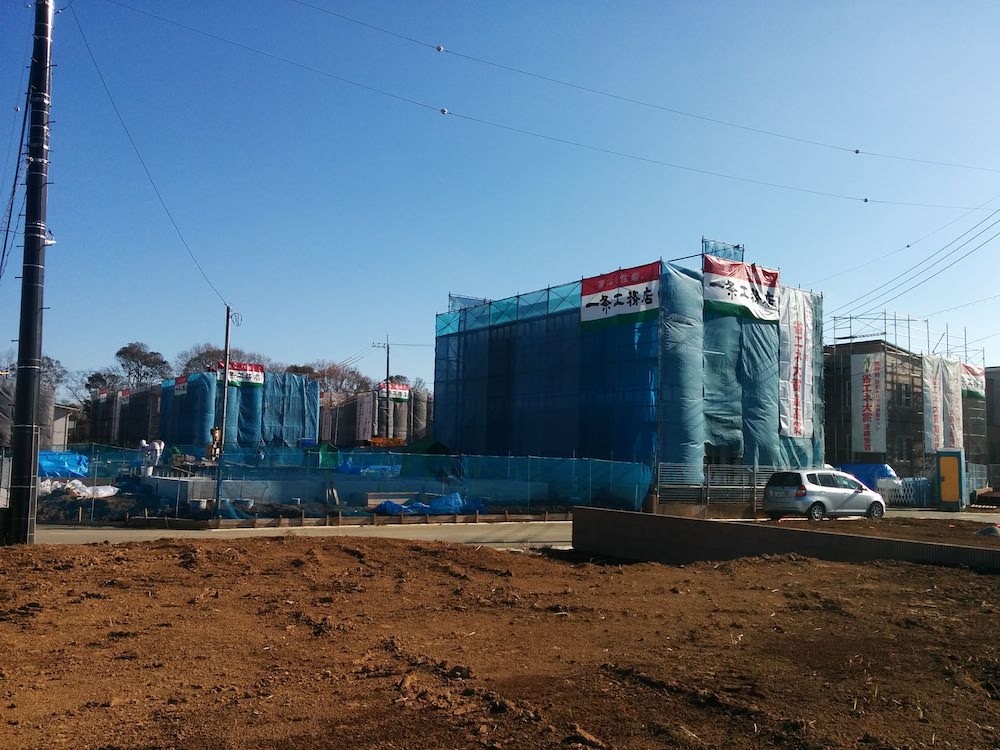
New housing going up in the Inzai portion of Chiba New Town

It was a little odd to open the Japan Times this morning and find a feature about the city we live in, Inzai; odd in the sense that for as long as we’ve lived here whenever we tell people our address, in almost every case they’ve never heard of Inzai, which is the city just to the west of Narita in Chiba Prefecture. The article, written by Elaine Lies of Reuters, uses Inzai as a model for future growth in Japan, which is seeing its population shrink and age. For this purpose, the article compares Inzai’s situation with that of its neighbor to the south, Sakura, which is aging much more rapidly. The reason for Inzai’s good fortune is what Reuters sees as its aggressively pro-growth outlook. Inzai is one of the three cities that are part of the Chiba New Town development project, while Sakura is a typical suburban bedroom community that was developed in the 70s-80s during the lead-up to the Japanese bubble period. Though it includes some neighborhoods, like Yurigaoka, which was planned around an offshoot of the Keisei Main Line, that continue to attract young families, for the most part Sakura is made up of isolated housing subdivisions that no one is really interested in any more, probably because most of them are far from train lines. Inzai, on the other hand—or, at least, the part of Inzai that Reuters was covering—is built along the Hokuso Line, which also happens to follow Route 464, a major road that goes from the edge of Tokyo almost to Narita airport. In fact, the first item in the article that raised any eyebrows on our part was the factoid that says Inzai is 40 minutes from the airport. Actually, if you take the Airport Access train from either of Inzai’s two express stops, it’s only about 20 minutes, so we suspect the reporter got her information from someone who drives to Narita. As of now, 464 doesn’t reach as far as the airport. After it gets to the town of Sakae, you have to take back roads to get there.

And in a sense, this ironic lack of ready automobile access to the area’s most prominent feature is what makes Inzai less progressive than the article makes it out to be. Interestingly, Lies does not mention one feature of Inzai that the local government plays up constantly—that it has been named multiple times as Japan’s most livable city by the business magazine Toyo Keizai. The reasons have to do with things like affluence, green spaces, and convenience. Inzai’s tax base, as Lies implies, is quite sturdy owing mainly to the fact that new housing developments are booming along the 464 corridor. After we moved here in 2011, much of the land that had been put aside for the Chiba New Town project was opened up for development by UR, the semi-public housing corporation that managed the land. Because the land had been held for so long in the hopes that it would someday regain the value it had at the end of the 1980s (it never did), and UR was losing money in the process, the central government had for years been pressuring the corporation to liquidate it, and finally gave them a deadline. So they mostly sold it to developers and housing companies at prices far below those they’d paid, and all at the same time. The most valuable properties in the New Town area, those immediately adjacent to 464 and the Hokuso Line, were originally slated for commercial development, either for retail businesses or office buildings, and while Inzai did manage to attract a fair amount of commercial interests, it wasn’t nearly as much as Reuters seems to think. There are at least three shopping malls within 15-minute bike rides from our home and two of them are only half-occupied, despite the huge amount of residential development taking place. And as far as office buildings go, most were built two decades ago around the Chiba New Town Chuo Station. For the most part they are data centers for banks and other major financial institutions. Inzai is built on bedrock, so in the event of a major earthquake the records of these companies should be safe. As far as new commercial facilities go, the only things we’ve noticed is more logistics centers, which take advantage of Inzai’s proximity to Narita Airport. Read More

Kill Your (Vacation) Landlord

Judging from the amount of coverage it’s received from the domestic and foreign press, Airbnb’s decision to remove 80 percent of the properties from its Japanese listings is a big deal. That wouldn’t be surprising except that previously the Japanese press, at least, didn’t seem overly interested in the house-share service. What makes it news is mainly timing. On June 15, the new Minpaku Law, which regulates the short-time rental of private property, goes into effect, right before the vacation and tourist season starts. Apparently, Airbnb, nervous about a government crackdown, decided not to take any chances and dropped listings of properties that couldn’t prove they had already received permission to operate under the new law. That means people who had made reservations at these properties in the past are out of luck unless their owners can somehow get a license to operate by the time the visitor is scheduled to occupy the room or home. Some people are blaming Airbnb itself for, presumably, not being prepared for this sort of outcome, which has been apparent at least since the beginning of the year. Whether the visitors who made reservations have gotten the message isn’t clear, but it’s likely that, come next month when they show up in Japan after having spent money on air fare and other vacation-related expenses, they may find themselves locked out of the place they thought they would be staying at. One can imagine scores of foreigners wandering the streets of Tokyo and sleeping under bridges. Thank God it’s a safe country.

Seriously, though, the Minpaku Law, regardless of how poorly it was conceived and written, was inevitable, and its purport with regard to Airbnb is hardly limited to Japan. What makes it momentous, and, in the long run, perhaps prescient, is that it adds a layer of national intent to locally enacted rules that weren’t being enforced very strongly before. In other words, Airbnb didn’t take local regulations at face value until the central government said they supported them through the law. Ostensibly, the reason for the stricter definitions is public order–protecting communities where property owners rent out rooms to strangers. Less obviously, the Minpaku Law supports the powerful hotel and innkeepers industry, which has been calling for the banning of peer-to-peer short-term rentals. And even less apparently, but no less potently, the law favors another powerful lobby, the real estate industry, which can use the law to corner whatever market is left of short-term vacation rentals, since many of the rules call for oversight by corporate entities, or, at least, entities that act like corporations.

The Minpaku Law essentially covers two types of properties. The first type is a property that has applied for and received the proper permits, meaning they comply with the hotel law. From the outside, they may look like a regular private residence, but inside they adhere to fire regulations and there is someone who manages the property on site. Minshuku, capsule hotels, and guest houses fall into this category. The second type are properties that heretofore fell into the so-called gray zone, rooms that did not comply to the hotel law but weren’t really breaking any laws–until now. Though fire laws and other related safety regulations will presumably be more strictly enforced for these properties, the main difficulty will be stricter enforcement of zoning laws, which are locally enacted. The main blanket, national rule is the one that says minpaku can only rent out rooms for a maximum of 180 days out of the year. Also, if the property is in a condominium, the owners association must be apprised of the existence of a minpaku and approve of it in writing, which may end up being the most difficult condition to satisfy, even when localities don’t prohibit minpaku from residential zones. Read More

Pity the landlord

cimg3718

These are the kinds of apartments subleasing companies build.

We’ve already talked about the sublease racket. The term has a special meaning in Japan that’s related to a specific real estate scheme designed to sell apartment buildings to people with extra money. Construction companies build small apartment buildings on unused land for the owners of that land and then manage the property for them through a sublease arrangement that requires them to pay a guaranteed “rent” every month. The logic is simple. The property owners have to pay higher taxes on land that is empty and so they build an apartment building for purposes of reducing those taxes and providing income. The construction company then does all the work of finding tenants and managing the property.

As we’ve mentioned in past posts about this scheme, it heavily favors the construction company, which gets out of its obligation for guaranteed payments to the landlord through various small print loopholes. The construction company, which usually has a real estate subsidiary, is only really interested in building, and understands that as Japan’s population declines it is going to be more and more difficult to find enough tenants to make even small apartment buildings profitable. Consequently, they make sure there is something in the management contract that allows them to get out of the deal if things go south, and invariably they do. Read More

Last resorts redux

file_6_18_1Several times on this blog we’ve written about the collapsed market for resort condominiums, which are conveniently called “rizoman” (for “resort mansions”) in Japanese. The majority of these apartments were built during the asset-inflated bubble period of the late 80s and the hangover from that period in the early 90s. Many, but not all, were attendant to the ski boom, and after the bubble burst and people’s interest in skiing deflated, more and more of these condos were abandoned by their owners, the result being thousands of empty units in vacation areas throughout Japan. More importantly, however, it also meant huge losses in property taxes for local governments and the deterioration of condo complexes that were no longer collecting management fees from absent owners, most of whom lived in major cities. These specific circumstances led to an unusual phenomenon. The units themselves dropped dramatically in price on the resale market and could be had for a song (or even a verse), but they could hardly be sold because even if the market price was only a million yen or cheaper, whoever bought them would also have to cover the back taxes owed, not to mention the unpaid management fees, and together these two debts could run into milions and millions of yen.

At the end of last month, Asahi Shimbun ran a series of articles about a turnaround in Yuzawa, Niigata Prefecture, which is the closest town to one of Japan’s most famous ski and hot spring resorts. (It’s also where the Fuji Rock Festival is held in July.) Yuzawa has been for years the poster child for the crippled rizoman market, a place that saw a huge amount of construction in the late 80s/early 90s and which later stood as a symbol of pointless extravagance. According to a realtor quoted in one article, there are some 15,000 empty condo units in Yuzawa, accounting for 20 percent of all the empty resort condos in Japan. During the bubble period, when these units were new, they were so popular they could be sold at auction, and many went for as much at ¥100 million. Now, many are going for less than ¥500,000, depending on the size. Management fees, however, are still high owing to the fact that many buildings have large communal baths, swimming pools, recreation rooms, and exercise facilities. Read More

Suburban blight, Japanese-style

img_20161223_114702In our latest housing column for the Japan Times we talk about a new book by Chie Nozawa that explains in simple, clear terms why more and more abandoned homes, both houses and condos, will litter the landscape in coming years. She gives a lot of good examples of the kind of city planning, or, more precisely, lack of city planning, that has given rise to over-production of housing even as the population in general is shrinking and homes are left vacant.

Last week, she published an article in Gendai Business that summarizes and elaborates on the book. (Gendai is published by Kodansha, which also published her book) Her main thesis is that housing is “no longer” a financial asset, though we would probably argue that it never really has been. She points out that by 2033 one out of every three homes in Japan will be vacant, and that if nothing is done–either through demolition or some program to make more effective use of existing housing–there will be 21.5 million vacant homes in Japan. She give two reasons based on the fact that the huge boomer generation will be dying out in large numbers: 1) the homes the boomers have inherited from their own parents will be empty; 2) the homes the boomers built themselves will be empty because their own children built their own homes and thus have no reason to take those homes over. It seems almost redundant for her to mention that these homes, unless they are located in major cities on desirable land, have no value whatsoever. The homes that boomers now live in are old, and so their heirs cannot possibly move in or sell or rent them without extensive renovations, which is not liely to happen given the nature of the housing market, which is all about new things, as we pointed out in our column.

img_20161223_114841Thus, these properties have “negative value,” meaning regardless of whether the heirs tear them down or improve them, they will have to spend money that they will never see again because it will become increasingly difficult to sell or otherwise liquidate these properties, most of which are in the suburbs. And the more there are, the worse this problem gets.

This vacant house problem brings about what Nozawa calls the “sponge phenomenon.” In English parlance we might refer to it as the Swiss cheese effect: The suburbs of major cities, and even the cities themselves, become pocked with holes of vacancies that further erode surrounding property values and scare off younger potential homeowners, who gravitate instead to the nearest brand new ultra-cheap, ultra-cramped subdivision. Nozawa gives examples of regional capitals where this effect is already in full swing: 20.8 percent of the homes in Kofu, Yamanashi Prefecture, are vacant.

img_20161223_114030Vacant housing comes in four types: rental housing that is presently uninhabited, vacant houses on sale, secondary housing (vacation homes, etc.) that is unoccupied almost all of the time, and abandoned housing, meaning not for rent or sale, merely empty. Nozawa provides statistics showing that of these four type, the last, abandoned housing, is increasing at the fastest rate. She also shows the direct relationship between the amount of new housing being built in a town or city, and that locality’s portion of vacant housing. In most cases the more building that’s happening, the higher the number of vacant homes. A few enterprising spirits are trying to address this problem. One local real estate company in Higashi Matsuyama, about 50 kilomters north of Tokyo, is actively buying up small lots in these sponge-like neighborhoods and combining adjacent ones to make larger lots that can accommodate larger houses, but in order to do that effectively the realtor has to locate the owners of land that in many cases has been abandoned for a long time, and often that means negotiating with more than one reluctant heir.

It’s not a problem that is going away any time soon, or even later.img_20161223_115303

Genesis

Original plan for the Ikeda Muromachi housing development

Original plan for the Ikeda Muromachi housing development

Because Japan as a country didn’t make housing starts an integral part of its economy until after World War II, we’ve tended to believe that housing developments didn’t exist before the war, but, of course, that isn’t true. Recently we came across a 2009 article by a professor named Ken Shibata who teaches at Kyushu University’s graduate school. In it he describes several prewar housing developments.

Shibata writes from the standpoint that “suburbs in Japan are in trouble,” meaning that they are increasingly filled with vacant properties and are losing value along with residents. He blames the policy–which we’ve mentioned many times in our own blog–of focusing on new developments rather than maintaining existing ones, and he cites three prewar housing developments that today have good value even though they are quite old.

One is Denenchofu in Ota Ward, Tokyo, which sounds like a ringer. Denenchofu is famously upscale, with large, extremely expensive properties. Celebrities and rich executives live there. Though it’s not exactly Beverly Hills, it is as close to a Japanese cognate as you’re going to get. Another, more down-to-earth housing development is Tokiwadai in Itabashi Ward, which was first developed more than 80 years ago. Both these neighborhoods are in Tokyo proper, and even though they were relatively rural areas at the time they were first built, right now they have high property values simply because of their location and not so much because of the quality of their housing stock. Read More