We’re the top

What we’re talking about: Palm Springs in Inzai!

Earlier this week the Sankei-affiliated web magazine Zakzak published this year’s results of business journal Toyo Keizai’s annual survey of “urban power,” meaning the most livable cities in Japan. Toyo has been doing the survey since 1993 in conjunction with the publication of a periodical data book that compiles statistics about local economies. The survey uses “14 types of information” released by a number of government organs, including the Ministry of Economy, Trade and Industry, comprising five criteria for satisfactory urban living: safety, convenience, comfort, affluence, and housing standards. The survey covered 787 cities and the 23 wards of Tokyo, and this year the municipality that came out on top was Inzai in Chiba Prefecture, which just happens to be where we live.

Our reaction was pleasant surprise mixed with doubt, and as we read the Zakzak article it became clear what Toyo Keizai’s priorities are with regard to a satisfactory living situation. Inzai ranked #3 in the nation in the convenience category because of its retail accessibility. There are lots of discount stores that are easy to reach and with plenty of free parking. People of a certain aesthetic disposition will, of course, find this aspect of Inzai life somewhat off-putting. The retail outlets in question line route 464, which runs parallel to the Hokuso train line through three stations. Many of these outlets are gathered into rather sterile shopping malls. The article also quotes a 35-year-old resident as praising the “large choice of restaurants” along the main road, though such effusiveness should be qualified by the information that almost all these restaurants belong to national chains. For sure, if there’s one thing that characterizes Inzai’s abundance of commercial choice it’s the almost total lack of distinction. There’s nothing here that’s any different from other suburban commercial districts in Japan except maybe more of it; or less, since you’d be hard pressed to find anything that could be described as “typically Japanese.” If anything, the retail tone is strikingly American. Read More

Nailed

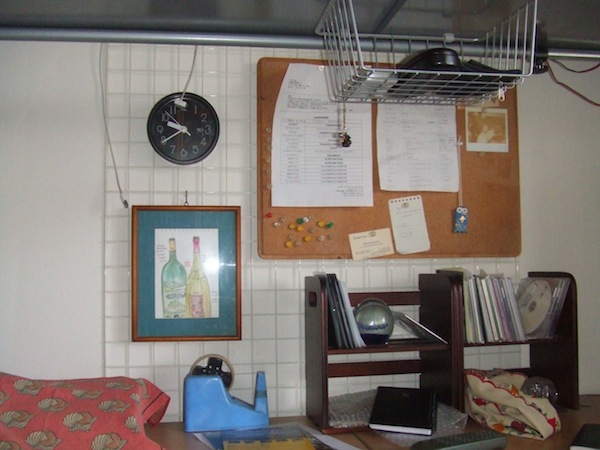
Extendable grid panel used as coat rack

In the most recent newsletter published our landlord, the semi-public housing corporation UR, and deposited in our mailbox there’s a specious “conversation” between a theoretical apartment renter and a theoretical apartment owner about the respective advantages of each mode of living. Discounting the whole economic side of the issue, the most obvious distinction is that owners can “freely change and remodel their apartment and replace or install amenities.” The renter counters by saying it may be nice to change your apartment the way you want, but what a pain in the neck! You have to hire someone to do the work and then move out while the work is being done. And, in any case, you can’t actually change the size of an apartment the way you can a house; whereas with some rentals, (s)he argues, the landlord will gladly remodel the unit to the tenant’s specification before the latter moves in. What’s perplexing about this line of thinking is that, while it may be true in “some” cases, as the speaker says, it isn’t true in the case of UR rentals. You have to take it the way you see it. The only part of the renter’s argument that holds water is that renters have more freedom to choose, meaning once they move in they can always move out and find something more suitable or desirable. Owners don’t have that freedom; or, they do, but it depends on how easily they can sell their property and how much of their initial investment they get back, and those points are hardly guaranteed in Japan.

Stand-alone grid panel for office use

Still, remodeling needs to be addressed. In UR apartments, as with most rental units, tenants are very limited with regard to how they can decorate, since almost all rental agreements include a term that says the tenant must leave the apartment in the exact same state as he or she found it. And while usually contracts don’t specifically say you can’t make holes in the wall, that is how most people interpret it. In any case, we’ve heard of people having had money taken out of their security deposit because of holes in the wall–but then, private landlords will find any excuse to keep that money. Read More

Too late?

Last Friday, several media reported that the land ministry released a new white paper on land and property usage based on research carried out last year. The conclusion of the study is hardly earth-shaking to anyone who reads this blog, but it’s nevertheless noteworthy. The paper says that the market for older homes and commercial properties should be expanded by maximizing their value through renovation and rebuilding. Though the Cabinet Office’s recognition that Japan is overwhelmed by superannuated, deteriorating structures is a step in the right direction, it’s difficult to understand if anything can be done about the problem as long as policies for promoting new building continues as it is.

According to the government’s findings, more than 30 percent of office buildings in Japan are at least 30 years old, meaning they were constructed before current earthquake-proof standards were implemented. Consequently, 90 percent of “real estate investors” are not interested in these buildings. The paper recommends that they be quake-proofed in order to “increase the stock of good quality” structures. It also advocates promoting energy efficiency so as to make the buildings more desirable. Such renovation will “increase the value of real estate” in general by reducing running costs. The government also concluded that as a result of last year’s major earthquake people’s “thinking about real estate” has changed: they are now more aware of “land quality.”

None of the news reports we’ve read have indicated what the government will do, if anything, to follow up on the findings of the white paper. Tax breaks for people who fix up older properties? That might work but seems unlikely given the government’s current craze for tax increases. The construction industry will certainly welcome any renovation boom sparked by tax cuts but it isn’t going to be happy if such renovation comes at the expense of new building, which is where the money is. Increasing property values in that way has never really been in the government’s interest.

Home Truths, June

Here is this month’s Home Truths column in the Japan Times. Almost everything we discuss in the article we’ve already discussed in more detail somewhere on this blog, but this is a fairly concise overview of the whole cramped housing development issue. Since this is a situation that almost anyone who buys a house must contend with, we’d be grateful to hear comments from readers, especially those who have direct experience with the problem–if, in fact, it is a problem. We’ve sort of come to the conclusion it’s something you have to live with.

The enduring stigma of renting

In April, the government decided to extend its subsidy for temporary emergency housing in the Tohoku region by one year. Originally, they allowed for two years, so that means people who are currently approved to live in temporary (kasetsu) housing can remain where they are until at least April 2014. Most of the media coverage of this issue centers on the new housing that was built specifically for the refugees of the March 11 disaster, but in truth most of the units being used for this purpose are existing houses and apartments that the government is leasing from their owners. According to Tokyo Shimbun, in Miyagi Prefecture alone, there are 26,000 minashi–units being rented from landlords–units in use and 21,500 specially built units.

Not everybody was pleased when the government announced the extension. A group of people who own the land on which some of the temporary housing was built expressed concern that they wouldn’t be able to sell their land for another year, and are worried that the government could continue extending the period of habitation indefinitely, which is what happened in Kobe after the Great Hanshin Earthquake. Another dissatisfied group is an association made up of Miyagi realtors and landlords. One would think that landlords would be happy with the extension, since it guarantees income for another year, and probably at inflated rates since the government is paying. However, one Sendai realtor told Tokyo Shimbun that many of the refugees who are living in these minashi units are not homeowners who lost their houses but rather people who were renting apartments or houses that were destroyed or damaged. The realtor says that local governments assigned these renters to minashi dwellings “without properly checking their situations,” meaning, presumably, that the temporary housing program does not discriminate but it should, since there is a difference between renters and owners. Some “adjustment” (merihari) should have been made before the government decided to extend the program another year. Exactly what “adjustment” means in this case isn’t spelled out, but the only natural conclusion is that the renters should be evicted. Read More

NHK looks at ‘akiya’ problem

Last Wednesday, NHK’s in-depth news series, Closeup Gendai, covered the issue of abandoned houses (akiya) in Japan, a topic we’ve addressed several times on this blog. Though the report left out a number of points that we think are essential to the discussion, there is only so much NHK can cover in half an hour, and what they did cover was well considered. Of the major broadcast media, perhaps only NHK can do this since they do not have to worry about offending advertisers. Right now house manufacturers and developers, both of which rely on new housing construction for their livelihoods, buy huge amounts of broadcast time. Certainly the most important point that NHK made in the report is that the nation’s focus on new housing as a means of keeping the economy afloat is not sustainable.

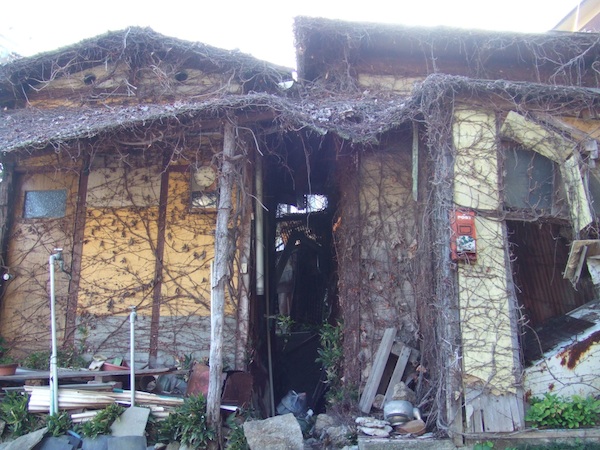
The program reiterated a lot of statistics that we’ve already reported, in particular the figure of 7.57 million homes–single-family houses and condos–that stand vacant in Japan. That’s 13 percent of all residences. Of these, 1.81 million are classifed as being abandoned, meaning not only are they vacant, they are not for sale or rent either. They are just sitting there, about to collapse, all the while attracting garbage and arsonists. Thus they are not only eyesores but safety hazards, and the source of complaints by neighbors, who ask their local governments to do something about them. As we discussed in an earlier post, some localities have passed regulations that allow them to confront the problem, which is difficult to do because, as NHK pointed out, there is a “taboo” against public entities forcing themselves into matters having to do with private property. The model of this new public action is the city of Daisen in Akita Prefecture, where, as of 2011, there were 1,415 akiya. The problem was so bad that the city passed a law allowing authorities to demand of owners that such firetraps be torn down and if the owner did not respond then the city can move in a carry out the demolition itself. Sixty-one houses were initially targeted for action, but so far only two have actually been torn down. The main problem is locating the owners. As it turns out, many have never even registered the properties, which, of course, is illegal, and the first question that we thought of was: If a house was not on the city rolls, it means the owner never payed property taxes, so what was the city doing all these years? NHK didn’t ask that question. It did find the owner of one derelict house who said he had inherited it from his aunt but didn’t have the money (¥700,000) to tear it down. He thought he might be able to sell the land and then use the proceeds to pay for demolition, but he couldn’t find a buyer. So the city tore the house down and, presumably, absorbed the cost. Though the program didn’t say as much, it seems obvious that such a small city cannot afford to tear down every abandoned house in its jurisdiction. Read More

Home Truths, April ’12

Minami Senju

Here’s this month’s Home Truths column, which is about cramped urban neighborhoods that could turn into death traps in the event of a major earthquake. Though much is made in the column about the Tokyo Metropolitan Government’s measures to address this problem, we don’t really think it will make much of a difference. Anyone who has read Edward Seidensticker’s fascinating, peculiar, and often frustrating history of the city will understand one thing, that Tokyo defies any notion of city planning with an almost rabid resolution. The “low city” that is Seidensticker’s main subject is portrayed as an organic entity, one that resists any foreign (i.e., governmental) claim to its control as if it were a virus. Most of these neighborhoods sprang up almost overnight after disasters devastated other portions of shitamachi. Working class people moved on to farmland in the outer portions of the city because the place they used to live was destroyed by an earthquake, a fire, or American bombs. Economies of necessity superseded any authoritative prerogatives and communities were born. Those communities are still there. Romantic types love these neighborhoods because they represent what it is they appreciate most about Tokyo, its makeshift conviviality and resistance to conventional ideas of city order. And because those neighborhoods did develop organically, they really do characterize the urban experience in its purest form. But part of the appeal has to do with that hoariest of Japanese cliches, the beauty of transience. These neighborhoods were created by disaster and they will disappear by disaster again. The authorities’ means of addressing this situation may seem flat-footed and ill-advised, but the reasoning is unassailable. In their present state, these neighborhoods will go under, and they will take their inhabitants with them. Maybe there’s nothing anyone can do about that, but it doesn’t mean we shouldn’t at least think about it.

Negative legacies

We’ve often talked about how the media has glossed over the worsening housing crisis. Though newspapers, magazines, and TV will occasionally run stories about specific cases of foreclosure in order to illustrate structual economic problems, they almost never connect these examples to the structural problems inherent in the nation’s housing policy, which hasn’t really changed for forty years. Our feeling is that the media itself has too much at stake in terms of advertising to point out these structural problems and that, fundamentally, the idea that new housing fuels the economy as a whole is so unassailable that it doesn’t even occur to many reporters that problems related to housing could be systemic and related to other social problems. But a few weeks ago, Shukan Bunshun ran an article that reflected, at least in part, much of what we’ve been trying to explain on this blog.

The article was about properties as legacies, which most people tend to view as “assets.” However, the reporter discovered that in many cases properties have turned out to be considerable liabilities for heirs, some of whom would prefer not inheriting them at all. The first illustration they give is the most potent. A 53-year-old man who lives and works in Tokyo recently traveled to his home town in Hiroshima Prefecture to dispose of his parents’ house, a 50-year-old wooden structure built on a steep grade. His father died six years ago and his mother, who suffers from dementia, entered a nursing home two years ago. The house is in disrepair and the small piece of land around it is overgrown with vegetation. The neighbors have repeatedly complained to local authorities, and the son understands that he has to do something. He decided to tear the structure down, but the lowest demolition estimate he could get was ¥2 million, owing to the fact that access to the property is difficult. Since he had no intention of using the land and couldn’t afford the demolition, he put it off. One could reasonably assume the cost might have been covered by selling the land, but that was another problem. The title was still under his father’s name, which meant, according to the law, it belonged to his mother. Since she was not legally competent to handle the matter, it fell to the next in line, his older brother, who had been estranged from the family for many years. No one knew how to get in touch with him. So in order for the second son to dispose of the property, he would first have to go to court to assume title, a process that would require a great deal of time and money, neither of which he had. Meanwhile, the neighbors become more angry, but the local authorities can’t do anything. Read More

Unreal estate

“Property prices go up and down, but the main thing is not to pay them a blind bit of notice, unless and until you have a good reason to move. I learnt that a rising price will not rise forever; that when prices stop rising, it will be difficult to sell your flat, because the reason the price has stopped rising is because the climate has changed. The money you have in your house is not liquid money; it’s not money which can easily be converted into something else other than your house. It’s stupid to feel richer beause the value of your house has gone up, since the resulting rise almost always isn’t money you can use or spend. If you’re going to move, you still need somewhere to live, and the cost of that place too will have gone up, so there will be no net gain from the increase in your property’s value.”

In the above passage from his book about the credit crunch, I.O.U., John Lanchester is mainly talking about the United Kingdom, where he lives. However, his remark about needing somewhere to live and the notion that property value means little in the world where most people do live has stayed with me. Elsewhere in the book he tosses off the idea that the value of your house or apartment or land is only as much as the other guy is willing to pay you for it, in the end. Read More

On home ownership

Yesterday Dr. Christian Dimmer tweeted about a Bloomberg article that covered Japan’s housing market, specifically the boost to the Japanese economy that will be brought about by sales of new homes to “echo boomers” (or “junior boomers,” as some in the Japanese media refer to them), the children of the baby boom generation. It’s a good article in that it contains lots of helpful statistics in one place. However, one number stuck out for its incongruity, at least as far as we’re concerned. In the middle of the article, the reporters state that, according to a survey taken by the housing research company Zentakuren, “about 86 percent of Japanese own their own home.” First of all, the diction is imprecise: Does this mean that 86 percent of every single person in Japan owns a home? Of course not. So what does it mean? We assume it means that the home ownership “rate” is 86 percent, but in that regard one has to understand how such a figure is reached. Most likely it means: What percentage of homes are owned by the people who live in them? If that’s what the sentence is saying, it’s a shock to us. We have been working under the assumption that Japan’s home ownership rate has been in the low 60-percentile ranks for decades, and so we double checked. Japanese reports tend to cite the Ministry of Internal Affairs surveys and the most recent one we could find, for 2006, put Japan’s home ownership rate at 61 percent. This sounds about right. Toyama’s, the prefecture with the highest home ownership rate, is 79 percent, while Tokyo’s is about 44 percent. So we looked up Zentakuren’s survey (7,145 respondents) and found that it did not register home ownership but rather how many people “wanted” to own a home.

This is very different from what the Bloomberg article implied, and doesn’t make any sense anyway. If 86 percent of Japanese people owned their own homes, that would probably mean almost all the “echo boomers” already do, so one wouldn’t be able to expect any related economic boost. But in any case, it’s a small error on the part of the writers in relation to the whole article, whose tone is upbeat in that, since housing plays such a huge role in GDP, Japan’s economy will be better off, at least in the short run. What the article doesn’t touch on at all is the previously-owned housing market. As always in financial reports having to do with housing, “house starts” are the main indicator of fiscal health, because new housing spurs construction and sales of more products. Such a statistic is only hopeful in certain contexts, such as the United States, where the population continues to grow thanks to influx of new immigrants and the families they are raising. Japan’s population is shrinking, and every new house that’s built for an echo boomer is one less older house that gets sold, and thus one less opportunity for a current homeowner to capitalize on his or her investment. Unfortunately, these sorts of statistics never figure in most financial reporting about housing in Japan, mainly because no one really knows what sort of impact it will have in the long run, but as we’ve stated many times on this blog, there are millions of vacant homes in Japan that will never be sold, and the number is growing every day. The generation after the echo boomers is already famous as a “lost generation,” meaning a good portion of them have never secured the kind of long-term employment that sustains a country which was once the second biggest economy in the world. Ten years from now, when they come of home-buying age, they probably won’t be able to afford new homes. Maybe they’ll buy older homes, which will definitely be very cheap, in every sense of the word.