Highrises revisited

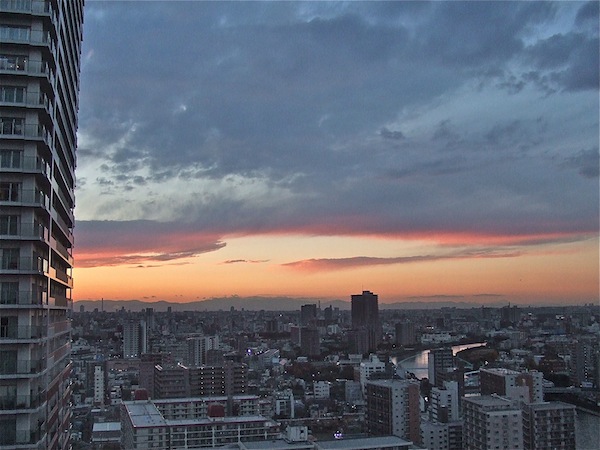
DSCF1857Though we miss living in Tokyo, especially shitamachi, we don’t really miss the highrise kodan where we spent eleven years. Until the earthquake our main complaint was the mostly insular nature of highrise life, the feeling that it was always difficult to get in and out, but during those weeks after the temblor it became a nerve-wracking experience, even as we became convinced that the structure was safe. We wrote a number of posts here about that experience and even one related column for the Japan Times (though it seems to have been taken off the JT site). For a while the media and the market seemed to concur with us that highrises may not be a wise option for a city that could be hit with its own big earthquake at any time, but eventually fears subsided and highrise condos started selling again; quite well, in fact, so we assumed our fears were just our own and didn’t extend to the general population. Even Tsutomu Yamashita, a housing journalist who is unusually frank about these sorts of matters, has come around and said that investing in a highrise Tokyo condo is a good idea since they’ve become even safer since the quake.

A recent article in Aera, however, has confirmed our initial sentiments. Opening with a frightening “what-if” scenario describing a 7.3 magnitude quake happening under the capital, the feature makes the case that even though these highrises will not collapse, life will essentially be impossible in them indefinitely. The most immediate concern, and the one that made the biggest impression on us in the aftermath of the 311 quake, whose epicenter was hundreds of kilometers away, was the loss of elevators, which shut down automatically when a building shakes. According to law, they can only be turned on by a certified technician, which means even when the shaking stops residents will have to wait for that technician to show up, and he may be inspecting other highrises. This problem multiplies with the intensity of the jolt. And if the quake is strong enough to knock out electricity, then the elevator problem is exacerbated. Under such circumstances, the residents on higher floors become like “people stranded on the top of a mountain in bad weather.” The idea of walking down and then up emergency stairways to run errands or whatever is just impractical, and virtually impossible for the elderly, the handicapped, and pregnant women. Most highrises have emergency generators, but these are for contingencies and thus only have enough power for maybe two hours. So if the elevators are out due to loss of power, that means the stairways are also dark. And even if the building structure is sound, some elements, such as doorframes, could be compromised, making it difficult to get out of an apartment. All highrises have emrgency ladders connecting verandas for use during fires, but it will be very difficult to use them to get all the way to the ground. The Tokyo metropolitan government has said that in the event of a major quake their estimate is that it will take at least a week to recover electrical power. Also, highrise residents will likely be lower down on the list of people receiving attention during rescue operations because of the difficulty for crews to access higher floors. Emergency services will first attend to victims they can reach more easily. Read More

Time’s up

Kobe 1997

Kobe 1997

While victims of the 2011 earthquake and tsunami continue to struggle with housing issues almost two years into their ordeal, a group of refugees from an earlier natural disaster has been given notice that they will soon be on their own. Ever since the 18th anniversary on Jan. 17 of the Great Hanshin Earthquake, various media have reported on the notifications distributed by local governments to residents of 6,600 rental units saying that they have two years to vacate their apartments. These people were living in public housing for low-income residents when the earthquake struck in 1995, and most of their dwellings were destroyed, so the governments of Hyogo Prefecture and six cities made contracts with private landlords. The residents paid as much rent as they could in accordance with their incomes and the local governments made up the rest. The deal was limited to 20 years, which means that between 2015 and 2017, depending on when they moved in, the tenants will have to move out of their current apartments, either to public housing or somewhere else. Most of these people are elderly, and the public housing (shiei jutaku) that has been built in the meantime tends to be located far from where they presently live. They are reluctant to move at their age, having formed bonds with their neighborhoods and their neighbors, which are extremely important in terms of mental and physical well-being.

The authorities say they have given the tenants ample notice. According to an article in the Tokyo Shimbun, announcements were first distributed in 2010, and the contracts the residents signed when they first moved is stipulated the 20-year limit, though supporters of the tenants point out that this term is vaguely stated and buried in small print. Most of the apartment buildings were hastily constructed by developers right after the earthquake in anticipation of just such a need for low-income housing. With local governments guaranteeing the rents of tenants, it was a virtual goldmine for landlords, which include semi-public housing juggernaut UR, and one can easily imagine that the landlords are fully supportive of the residents who are protesting the pending evictions since they themselves will lose revenue as a result–the rental housing market is not in good shape. The mayor of Nishinomiya recently received a petition with 3,251 signatures.

The local governments have said there’s nothing they can do about the situation since the 20-year limit is built into the civil code and Public Housing Law, even though the law itself was revised right after the earthquake to allow commercial properties to be used for public housing (kariage fukko jutaku). Some media, including the Japan Communist Party organ Akahata, mention that the controversy has ramifications for the current situation in Tohoku. As in Hyogo, private developers have been invited to build rental housing for people who lost homes to the tsunami or nuclear disaster, and apparently the authorities learned their lessons in Kobe because they are explaining to tenants that there is a 20-year limit. Of course, in Tohoku there are considerations that people in Kobe didn’t have to worry about, so at the moment a 20-year lease may be the least of their problems.

Get on it

Small item in the Tokyo Shimbun reported that on Sept. 8 the land ministry announced a policy to “step forward” in developing a system to provide potential homeowners with information about earthquake-proofing and renovation histories of used properties put on the market. As it stands, real estate agents who list homes for sale include information about price, layout, size, age, and location, but usually not much else unless you ask, and even then they are sometimes reluctant about things like quake-proofing since they don’t want to be responsible for such information. As far as renovations go, if the work was done recently in order to improve the value of a property, then, of course, the realtor will mention it, but if the work was done in the past there’s not much reason to if the cosmetic benefits are negligible.

The purpose of the land ministry policy is to expand the housing market to include more used homes. In 2008, only 13.5 percent of all homes sold in Japan were used, while the portion (in 2009) of same in the U.S. was 90.3 percent and in the UK 85.8 percent. The ministry thinks that if consumers had “more confidence” in used properties they would buy more. Typically, the ministry doesn’t have any concrete measures in mind to accomplish this confidence-building, but in the next budget they plan to ask for ¥50 million for “study,” meaning, presumably, looking into ways to help realtors include this information in their listings. Would they actually pass a law making it mandatory for realtors to tell potential buyers if a property was quake-proofed? That would be quite an undertaking since a lot of homeowners don’t even know the extent of the quake-proofing on their structures, or if there is any at all. All homes and condos constructed after 1980 are supposed to have been built to quake-proof standards, but given lead times on construction the standard probably didn’t become a full standard until the mid-80s. In any case, no one has done a proper study to find out how strictly the standards were carried out. One problem the ministry will have to consider when it spends its measly 50 million is what potential buyers can do to find out about quake-proofing. If a realtor doesn’t have that information and a buyer wants to know, who is going to pay for the inspection? For a single-family home a quake-proofing inspection can cost hundreds of thousands of yen; for a condominium building, a cool million. It’s easy to see why realtors, and the sellers they represent, want to avoid the subject, but the ministry doesn’t have that luxury. They say they want to stimulate the used housing market, but if there’s no reliable and reasonably priced system of assessing something as basic as quake-proofing then maybe the market isn’t even worth it.

Home Truths, Aug. 2012

Here is this month’s Home Truths column in the Japan Times, about pets. Though we have two cats ourselves, and basically believe that anyone who has a pet should be able to live where they want, we’re not entirely comfortable with the increasingly open acceptance of pets in collective residences. As we suggest several times, it’s a two-way street. Tenants and condo owners who do not demonstrate sufficient understanding of what it means to have an animal companion should not have them, though we’re not sure how that point can be driven home in a way that doesn’t discriminate against people who do demonstrate responsibility and understanding. Is it right to keep large dogs in small apartments? Should all dog owners who live in collective housing be obliged to train their pets? Should cats be confined indoors or allowed to roam free, and if the latter is allowed, should they be required to be spayed/neutered? Rules are unavoidable, but education is essential.

Tall order

Kimiko Uehara (Tokyo Shimbun)

More than a decade ago, we were following the situation in Kunitachi, Tokyo. A developer, Meiwa Jisho, wanted to build an 18-story condominium in the city and was being opposed by locals. As is often the case with public contretemps that go to court, we lost the thread and our attention fixed on something else. The case was initially interesting because it seemed like a good and rare example of locals standing up to a developer in a concerted, effective fashion. It’s not unusual for residents to protest buildings going up in their midst, but normally such protests are so parochial in impact and fruitless in purpose–involving anything from protection of “right to sunlight” to keeping out “undesirable” elements, like single women working in the so-called water trade–that, by themselves, they offer little that would help us understand the housing situation. The Kunitachi affair was different, and while we were interested in it we thought the residents might actually have a chance to prevail.

The outcome turned out to be more complicated. A recent article in Tokyo Shimbun profiled 63-year-old Kimiko Uehara, the one-time mayor of Kunitachi who was instrumental in bringing the suit against Meiwa. She has been out of politics for years now but is still involved in the Meiwa affair, except that now she is the target of a lawsuit–prosecuted by her fellow Kunitachians. Read More

We’re the top

What we’re talking about: Palm Springs in Inzai!

Earlier this week the Sankei-affiliated web magazine Zakzak published this year’s results of business journal Toyo Keizai’s annual survey of “urban power,” meaning the most livable cities in Japan. Toyo has been doing the survey since 1993 in conjunction with the publication of a periodical data book that compiles statistics about local economies. The survey uses “14 types of information” released by a number of government organs, including the Ministry of Economy, Trade and Industry, comprising five criteria for satisfactory urban living: safety, convenience, comfort, affluence, and housing standards. The survey covered 787 cities and the 23 wards of Tokyo, and this year the municipality that came out on top was Inzai in Chiba Prefecture, which just happens to be where we live.

Our reaction was pleasant surprise mixed with doubt, and as we read the Zakzak article it became clear what Toyo Keizai’s priorities are with regard to a satisfactory living situation. Inzai ranked #3 in the nation in the convenience category because of its retail accessibility. There are lots of discount stores that are easy to reach and with plenty of free parking. People of a certain aesthetic disposition will, of course, find this aspect of Inzai life somewhat off-putting. The retail outlets in question line route 464, which runs parallel to the Hokuso train line through three stations. Many of these outlets are gathered into rather sterile shopping malls. The article also quotes a 35-year-old resident as praising the “large choice of restaurants” along the main road, though such effusiveness should be qualified by the information that almost all these restaurants belong to national chains. For sure, if there’s one thing that characterizes Inzai’s abundance of commercial choice it’s the almost total lack of distinction. There’s nothing here that’s any different from other suburban commercial districts in Japan except maybe more of it; or less, since you’d be hard pressed to find anything that could be described as “typically Japanese.” If anything, the retail tone is strikingly American. Read More

Nailed

Extendable grid panel used as coat rack

In the most recent newsletter published our landlord, the semi-public housing corporation UR, and deposited in our mailbox there’s a specious “conversation” between a theoretical apartment renter and a theoretical apartment owner about the respective advantages of each mode of living. Discounting the whole economic side of the issue, the most obvious distinction is that owners can “freely change and remodel their apartment and replace or install amenities.” The renter counters by saying it may be nice to change your apartment the way you want, but what a pain in the neck! You have to hire someone to do the work and then move out while the work is being done. And, in any case, you can’t actually change the size of an apartment the way you can a house; whereas with some rentals, (s)he argues, the landlord will gladly remodel the unit to the tenant’s specification before the latter moves in. What’s perplexing about this line of thinking is that, while it may be true in “some” cases, as the speaker says, it isn’t true in the case of UR rentals. You have to take it the way you see it. The only part of the renter’s argument that holds water is that renters have more freedom to choose, meaning once they move in they can always move out and find something more suitable or desirable. Owners don’t have that freedom; or, they do, but it depends on how easily they can sell their property and how much of their initial investment they get back, and those points are hardly guaranteed in Japan.

Stand-alone grid panel for office use

Still, remodeling needs to be addressed. In UR apartments, as with most rental units, tenants are very limited with regard to how they can decorate, since almost all rental agreements include a term that says the tenant must leave the apartment in the exact same state as he or she found it. And while usually contracts don’t specifically say you can’t make holes in the wall, that is how most people interpret it. In any case, we’ve heard of people having had money taken out of their security deposit because of holes in the wall–but then, private landlords will find any excuse to keep that money. Read More

Too late?

Last Friday, several media reported that the land ministry released a new white paper on land and property usage based on research carried out last year. The conclusion of the study is hardly earth-shaking to anyone who reads this blog, but it’s nevertheless noteworthy. The paper says that the market for older homes and commercial properties should be expanded by maximizing their value through renovation and rebuilding. Though the Cabinet Office’s recognition that Japan is overwhelmed by superannuated, deteriorating structures is a step in the right direction, it’s difficult to understand if anything can be done about the problem as long as policies for promoting new building continues as it is.

According to the government’s findings, more than 30 percent of office buildings in Japan are at least 30 years old, meaning they were constructed before current earthquake-proof standards were implemented. Consequently, 90 percent of “real estate investors” are not interested in these buildings. The paper recommends that they be quake-proofed in order to “increase the stock of good quality” structures. It also advocates promoting energy efficiency so as to make the buildings more desirable. Such renovation will “increase the value of real estate” in general by reducing running costs. The government also concluded that as a result of last year’s major earthquake people’s “thinking about real estate” has changed: they are now more aware of “land quality.”

None of the news reports we’ve read have indicated what the government will do, if anything, to follow up on the findings of the white paper. Tax breaks for people who fix up older properties? That might work but seems unlikely given the government’s current craze for tax increases. The construction industry will certainly welcome any renovation boom sparked by tax cuts but it isn’t going to be happy if such renovation comes at the expense of new building, which is where the money is. Increasing property values in that way has never really been in the government’s interest.

Home Truths, June

Here is this month’s Home Truths column in the Japan Times. Almost everything we discuss in the article we’ve already discussed in more detail somewhere on this blog, but this is a fairly concise overview of the whole cramped housing development issue. Since this is a situation that almost anyone who buys a house must contend with, we’d be grateful to hear comments from readers, especially those who have direct experience with the problem–if, in fact, it is a problem. We’ve sort of come to the conclusion it’s something you have to live with.