The “custom” myth

Today we wrote a letter to the Japan Times about an article they printed last week about rentals for foreigners. Here it is:

In the May 15 article “Housing glut opens door to foreign tenants” Takahide Ezoe of the Shinjuku Japanese Language Institute states that “Japanese…know that you don’t usually get the amount of deposit back” when they move out of a rental property, and thus potential foreign renters have to be made to understand this point since, According to Ezoe, “to foreigners, a deposit is something that will be returned fully.”

In principle, the purpose of a security deposit, or shikikin, is to provide reserve funds in the event that the tenant is delinquent with his or her rent. However, many landlords consider it money that can be used after the tenant moves out for repairs and maintenance. In most developed countries, landlords are legally responsible for normal wear-and-tear on a rental property, not the tenant. Foreigners who have not caused any unusual damage to their residences should by all rights expect to receive their security deposits in full when they leave, as should Japanese tenants. In fact, many Japanese have sued landlords to recover their security deposits and won.

As the article points out, potential renters should read their contracts. If they don’t understand the security deposit issue then they should have it clarified by the landlord or agent. When they move out and do not receive their deposits back, they should confront the landlord and demand an explanation. Many landlords use security deposits, key money (reikin), and contract renewal fees as tools to gouge tenants, whose rights in these matters are not clearly defined by Japanese law. To call these conditions “customs,” which is what realtors tend to do, is to obfuscate their questionable legality. They are certainly unethical.
Illegitimacy

The column for legitimacy

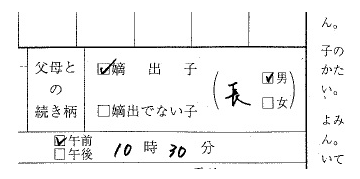
In Japan, if you are the mother of a newborn baby you have to check a column on the birth report you file with your local government office acknowledging that your baby is “legitimate.” On May 5th, which is Children’s Day in Japan, the justice ministry issued a directive saying that the authorities can now accept birth reports with the “legitimacy” column left blank.

The Koseki (family registration) Law stipulates that a child’s legitimacy must be indicated in writing on the birth report. If the parents refuse to check the column, the report will not be accepted. That means your newborn baby cannot be included in your family registration form (koseki), which in turn means that the newborn baby doesn’t exist legally. The child cannot receive any services from the local government because the child cannot be issued a residence card, which is based on the existence of a koseki; although, depending on the particular local govenment, some babies without kosekis have been issued residence cards in the past under special circumstances so that the child can receive services such as public education or medical insurance.

If the local government offers these services regardless of legitimacy, then as long as the child remains in Japan he or she will have no problem, but if he or she wants to get married or wants to travel overseas, then there is a big problem.  Without a koseki a passport cannot be issued, nor can the person register his or her marriage. In the past few decades several parents and children have appealed to the authorities, including the justice ministry and the foreign ministry, which issues passports, to repeal this rule, but they have not been successful.  The government uses the passport law as a means to assert its authority over the matter of legitimacy, thinking that parents who disapprove of the law will eventually yield and make a koseki for their children. It means that the parents acknowledge that their children are not legitimate persons. Many of the parents who have refused to check the column do so as a kind of protest against Japan’s legal discrimination of “illegtimate” children.  So even though the authorities now no longer have to force them to check the column, discrimination is still built into the law.  More than two decades ago the UN Human Rights Commission asked Japan to abolish this law.

Last resort

The central government would like nothing better than to rid itself of its public housing organ, UR, which is actually a semi-public corporation but bleeds so much money that the government constantly has to prop it up. Recently, the government committee tasked by the new ruling party to screen budget requests by the overstuffed bureaucracy took aim at UR, and for good reason. The public housing organ has attracted all sorts of superfluous amakudari (“descent from heaven,” or offices/agencies that basically exist just to give work to retired bureaucrats) projects that should be excised posthaste. And, in fact, UR should probably be privatized, but before the government does that it should first study why UR is so popular and try to figure out a way of retaining those features through law. Read More

Tentative tenants

The latest statistics from the Ministry of Internal Affairs and Communications confirms that the number of rental property vacancies is growing. Nationwide there are some 17.7 million rental units, of which about 4.1 million are unoccupied. That’s a vacancy rate of 23 percent.

In Tokyo things aren’t quite as bad, but they’re bad enough if you’re a landlord. The vacancy rate in the capital district is about 16 percent. The highest vacancy rate in the country is in Fukui Prefecture, where it’s a whopping 44 percent. (Fukui’s neighbor, Toyama Prefecture, is famous for having the highest percentage of home ownership in Japan).

You don’t have to be Paul Krugman to understand the reason. The population is dropping and there’s a glut of properties, but as one consultant recently told the Asahi Shimbun the statistics may have a chilling effect on investment. Lately, realtors and developers have been pushing people with money to buy rental properties as an investment since interest rates have been impossible low for more than a decade. But without the promise of tenants such investments won’t provide much in the way of returns. People with money are going to have to find something else to do with it.

Taking out the dead

In a recent letter to the editor of the Asahi Shimbun a landlord told the story of an elderly tenant of his. The woman was an acquaintance of his mother who lost her apartment when the building she lived in was demolished. She was living on welfare and the letter writer’s mother offered her one of the smaller apartments in her building at a lower rent than normal, presumably as a favor to an old friend. She didn’t charge her a deposit or any gift money.

Eventually, the tenant died, and the landlord could not locate any close relatives. All her worldly possessions were in that apartment. His mother called the local authorities, who told her that when a person receiving public assistance died the cremation costs would be borne by the local government, but as far as disposing of the deceased’s possessions, that was the responsibility of the property owner. And since the mother had not asked her friend for a deposit and she had no savings, they would have to dispose of the effects and clean the apartment with their own money. (As it happens, the tenant was in the hospital for the last several months of her life and was unable to pay her rent during that time also.)

In the end, the man wrote, he paid around ¥150,000 out of pocket to clean up the apartment, which doesn’t sound like very much, but without a system to address such situations, it’s likely that landlords are not going to rent properties to elderly people of little or no means since they might get stuck with a huge cleaning bill if the tenant dies suddenly. And who can blame them?