All fall down

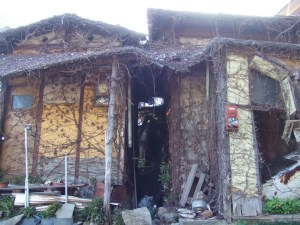
In the months after the March 11 earthquake, a condominium management association conducted a survey of the Tohoku region to find out the damage sustained by multi-resident buildings. Almost all those that were built since 1981, when stricter earthquake-proofing codes went into effect, survived with minimal damage, but there were quite a few built before 1981that didn’t do as well. In fact, the survey found that about 60 structures in Sendai alone had been declared zenkai (“completely damaged”; in other words, legally uninhabitable).

The Asahi Shimbun looked at several of these buildings. One, the somewhat optimistically named Sunny Heights Takasago, was built in 1976 and was actually damaged in 1978 during a large earthquake that struck Sendai. However, the damage wasn’t “complete” and repairs were made. The building was not so lucky this time. The condominium is actually two 14-story buildings positioned in an L-shape. During the initital earthquake the two structures knocked against each other, but afterward inspectors declared them yochui–residents should take caution but they could keep living there. But the condos sustained further damage in the aftershock of April 7: window and door frames deformed, cracks appeared on outside corridors, steel beams were exposed. Even worse, the ground itself was “damaged.” Consequently, the properties were condemned. Read More

No parking

It takes two

Yesterday at our sister blog, Yen for Living, we posted an article about big cars that probably needs some clarification. By no means are we fans of big cars and, in fact, we sort of denounced cars in general when we sold ours in 2006. We aren’t necessarily against cars in principle, but the automobile is privileged way too much in Japan and America (we can’t vouch for Europe and the rest of Asia). We simply wanted to comment ironically on what we thought was the strange marketing logic of GM, and also wanted to use this photo of a Hummer that is parked not far from our apartment. The fact that the owner needs to rent two parking spaces says a lot about Japan’s car-ownership situation, though it should be pointed out that these spaces only cost ¥4,000 each. For another look at how parking explains Japan’s car-ownership situation, after the jump is an article we wrote for the Asahi Shimbun in 2004, when we were still car owners ourselves. Read More

Gas attack

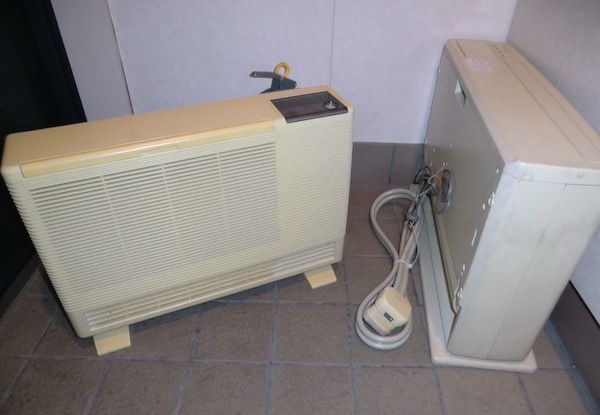
In the previous post we talked about Tokyo Gas’s relationship with the public housing corporation UR and how we were left with no choice but to throw away two perfectly good space heaters because they couldn’t be used in our new UR apartment and there was no system set up to sell or even give them to people who might be moving into our old UR apartment. As it turns out Tokyo Gas has UR tenants coming and going. Out new apartment does not have a stove, though our old one did. This is a facet of rental living in Japan that I had forgotten all about: the total lack of appliances. In the U.S. when you rent an apartment, you almost always get a stove, an oven, a refrigerator, sometimes even a washer/dryer, not to mention central heating. You don’t necessarily get any of those things in Japanese rentals, though, as I mentioned, our last UR apartment did have a stove, and recently some UR apartments have had floor heating or wall heating units built into the rooms. We have gas-powered floor heating in our new apartment in the living room only, but for some reason it’s billed separately from the other gas we use in the apartment, which means it requires a separate contract and, thus, a separate contract signing fee: ¥7,500 just to turn the system on. We were told, however, that if we did use floor heating we would get a “discount” on our total gas bill in any month we used the floor heating. We assume that means floor heating is very expensive. Since there are no gas outlets in our new apartment, we would have to heat the place with electric space heaters or kerosene heaters if we decided not to use the floor heating. In any case, it won’t be cheap. Read More

Wasted

Planned obsolescence

Moving house is a pain in the ass, but it can also be a rush. Basically, you shlep your entire life to a new abode and in the process assess that life in concentrated form. Inevitably, you are forced to pick and choose what you want to keep from it and what you want to discard. Some things you get rid of simply because you want to get rid of them, and some things you get rid of simply because you have to.

Yesterday we threw away two perfectly good heaters because we can’t use them in our new apartment. We also can’t sell tor even give them away, and it’s hard to shake the feeling that it was somehow planned to be this way. The heaters are made and sold by Tokyo Gas. Unlike standard gas heaters, which directly convert “city gas” piped into your home into heat, these draw hot water from your boiler (or, to use the redundant Americanism “hot water heater”). In that way they function in much the same way that baseboard heating does, except for one very significant difference. Baseboard heating is built into a house or apartment, and is generally designed in such a way that it doesn’t get in the way. These water heaters, on the other hand, are stand-alone boxes that do get in the way since they connect to wall outlets via thick hoses. Ideally, Tokyo Gas wants you to buy one for every room in your apartment, and priced at between ¥28,000 and ¥45,000, they can add up to quite an investment. Read More

Cheap fix

Here is a housing-related article we wrote for our sister blog at the Japan Times about a recent government study about reserve funds for condo repairs. It relates to a lot of the themes we have covered in this blog.

Taking shopping arcades seriously

Shotengai in Sanya, Tokyo

Shotengai, or shopping arcades, have been moving toward extinction for several decades now, the victim of increased motorization, new laws favoring large chain retailers, and the economic slump in general. Composed of small, family-run stores that invariably coalesced into merchant associations, shotengai were the social and commercial hearts of communities in both rural towns and huge cities. The death of the shotengai in the countryside has given rise to a new phenomenon called shopping refugees (kaimono nanmin): residents, most of them elderly, who are effectively cut off from retail areas because local family merchants have closed down and they have no easy access (i.e., driver’s licenses, vehicles) to shopping malls. Some local governments and chain retailers are addressing this problem by helping the refugees reach retailers, but there are also communities that refuse to let their shopping arcades fade into memory. Read More

Absentee owners

Last night NHK’s documentary series A to Z covered the phenomenon of abandoned houses. Based on local government statistics, it’s assumed that there are 100,400 unoccupied houses in Tokyo alone, a 40 percent increase since 1998. The number of abandoned homes in Tokyo increases at a rate of about 3,000 a year. NHK limited its coverage to the mostly residential areas of Setagaya and Suginami Wards, finding “at least” 500 houses that looked to be abandoned, of which they isolated 103 for more detailed study.

Study in this case meant talking to neighbors and local officials about the state of these homes, most of which were in severe states of disrepair, as well as finding out who the owners were and why they weren’t living there or keeping the properites up. Understandably, neighbors were quite concerned, not just with the eyesore aspects–some properties were magnets for refuse and overgrown with weeds and vines–but because they were fire hazards. Abandoned homes are often the targets of arsonists.

Ward officials receive complaints from neighbors about abandoned homes on a daily basis, but legally there is little they can do. It’s a Catch-22 situation: They need permission from the owner of a property before they can set foot on it, and in most cases they cannot locate the owner. In some instances, the owner has died and no heirs can be found; or, as in the case of one woman, a painter who died several years ago, her son was eventually located by NHK and said he had had “no connection” with his mother for many years. One owner of a house in Adachi Ward died with a lot of debt, so it’s assumed that his relatives have not come forward to claim the property because they are afraid they will have to assume that debt along with the property.

However, in some cases the neglect is on purpose. Officials know of some cases where the title of a property was taken over by a relative after the death of the owner or was sold to a third party. These new owners are simply waiting for the value of the plots to increase so that they can sell them for profit, but in the meantime they aren’t maintaining the properties. Of course, the houses in almost all these cases are worth zero, but in any of the 23 wards of Tokyo the land on which they stand could be quite valuable. One property in Setagaya that NHK checked was worth ¥200 million, but no one has seen the owner in at least ten years.

Burned at both ends

The Democratic Party of Japan has disappointed many of its supporters since coming to power a year-and-a-half ago. Some of the party’s most progressive proposals have either been shelved or abandoned. One of the less discussed promises has to do with chukai tesuryo, or “intermediary fees” that are charged by realtors when they broker a sale of a house by the owner.

In its INDEX 2009 statement of policy, the DPJ pledged to move away from home ownership as the primary housing policy goal and boost rights for renters, whom previous Liberal Democratic Party governments all but ignored. In addition, the DPJ said it would limit realtors to charging intermediary fees to only one of the parties in a housing sale. According to the law, when a previously occupied home is sold, the realtor can charge a fee equal to no more than 3 percent of the price of the house + ¥60,000 + consumption tax. For a ¥25 million house or condo, the fee would be ¥855,000. What bothered the DPJ is that the realtor can charge this fee to both the seller and the buyer, meaning for that ¥25 million home it can clear a cool ¥1,710,000. The party pledged to make it a law that the realtor can only charge this fee to one or the other party but not both. (Note: there are no fees when the realtor itself is selling a house or when the house is new and being sold by a developer.)

As with the pledge to support renters, the promise to control fees remains in limbo, and it’s not clear what exactly the DPJ hopes to bring about by limiting the fee to one party in a home sale. For sure, the extraneous fees that come with buying a home can be intimidating: title registration, bank fees for loans, loan insurance. In the end, a buyer pays anywhere between 5 and 10 percent of the price of the property in fees. In any case, no realtor charges less than the 3 percent ceiling, which means that the whole industry acts like a cartel. There’s no competition, though theoretically there could be. Most properties list with multiple real estate companies, so it’s possible a prospective buyer could play one against the other: Give me a deal on the tesuryo and I’ll work with you instead of the other guy.

Matsudo as microcosm

Many municipalities in Japan have local natural history museums, and the one in Matsudo, a Chiba Prefecture bedroom community about 45 minutes by train from central Tokyo, is typical even if its summary explanation of purpose may sound inadvertently funny: “From the birth of humanity to the Tokiwadai housing complex.” It’s the juxtaposition of the epic with the plebeian, but the exhibit itself, which does exactly what it claims to do, provided a thorough encapsulation of socioeconomic development in Japan from the standpoint of what can only be described as “the average person.”

As with all natural history museums, Matsudo’s traces the area’s geological makeup and how its proximity to the river that flowed from the north into what is now Tokyo Bay, which shifted greatly over time, determined its economy. However, with no natural resources or development of special technologies that could take root and turn into ongoing regional industries (salt processing and pear growing were successful endeavors, but only for short, isolated periods), Matsudo’s most salient feature was and still is its topography: valleys called “yatsu” etched between plateus called “dai” and lowlands that straddled rivers called “shitaya.” Each was distinct geographically (dai were at least 30 meters above sea level, yatsu 10 meters, and shitaya 2 to 5 meters) and economically. Rice farmers lived in the shitaya, which often flooded during the typhoon season. The houses and, especially, grain storage facilities were built on man-made elevations to keep them dry. They were also built close to one another and in columns that stretched north to south, with the entrances facing south, often in “terrace” formations. The direction was important because the often destructive winds that would seasonally race through the lowlands came from the north and the west. This might explain the Japanese obsession with positioning housing is a southward orientation, regardless of the view such positioning provides. Read More

The tako squat

Otako manager redirects traffic from former site to future location

On the morning of Dec. 16, the famous Otako takoyaki (octopus dumplings) stand in Osaka’s thriving Dotonbori district finally pulled up stakes under pressure from municipal authorities, who were set on removing the stand later that day. The stand had been doing business at that particular location since 1972 and was a certifiable if not necessarilly certified local landmark since it was actually featured in an official tourist brochure for Osaka. However, Otako has always been squatting; that is, using public property without permission. And it might have gone on using the small patch of concrete near the entrance to Tazaimon Bridge in perpetuity if it hadn’t tried to take advantage of an obscure legal principle. Read More