Not cool

According to news reports, the extreme heat we’ve had to put up with this summer is going to be a normal thing from now on. For a while it seemed as if Japan was going to be spared the worst of it, but that isn’t the case any more and forecasters are saying we’ll be sizzling until early October. The authorities warn people, especially the elderly, to use their air conditioners whenever necessary because heat stroke can creep up on you, even when you’re indoors and out of the sun. According to the land ministry, 89 percent of Japanese homes have air conditioners, but that portion drops along with income. Of households that earn less than ¥3 million a year, 84 percent have AC. 

There’s one demographic, however, that lacks AC almost altogether, and mainly for systematic reasons: people who live in public housing. An August 1 report in the Asahi Shimbun told of a 43-year-old woman who lives with her three children in a 3DK apartment run by the Tokyo Metropolitan Government for low income families. The rent and management fees for the apartment come to about ¥30,000 a month, which is half what the woman paid for a private rental apartment before she moved into the prefectural building 3 years ago. At the time, the apartment did not have an air conditioner, so she bought one for ¥70,000, including installation, at a discount appliance shop. Her apartment is situated on the corner of the 6th floor and gets a lot of sun, so nights can still be intolerable due to poor air circulation. The woman and her 13-year-old daughter share a six-mat room, leaving her two sons, one 19 years old, the other 17 years old, with a room each to themselves, but in the summer they all sleep in the same room because that’s the only one with AC, which isn’t strong enough to cool the whole apartment. Consequently, the sleeping arrangements in the summer are close and uncomfortable. During the day, they place electric fans strategically throughout the hallways to distribute the cool air, but it doesn’t work very well. The woman would like to buy a second AC, but there’s no place to put it. Her room is next to the veranda, so the fan unit can be placed there, but there are no other places in the apartment where a second AC could be installed. The building, which is 40 years old, was not designed with AC in mind. The electrical current in each apartment is set at 20 amperes, though it can be increased to 30, which still would not be enough. If the AC is on, she has to  be careful not to use too many other appliances, otherwise the circuit breaker will trip. And, of course, her electric bills are high. Public housing is notorious for having bad insulation, and her salary as a caregiver is only ¥220,000 a month. Besides, if and when she leaves the apartment, she is required to leave it as she found it, which means she will have to remove the AC and take it with her. 

There are 2.16 million public housing units in Japan, all run by local governments. The central government requires that all have kitchens, flush toilets, wash rooms, and bath rooms. AC is not required. The land ministry says that 60 percent of public housing units are more than 30 years old and 60 percent contain a head-of-household over 60. The Tokyo Metro government only provides 260,000 units (individual wards may run their own low-income public housing), 79,000 of which were built before 1970. None of the public housing in Tokyo comes with AC, though newer buildings have features that make it possible to install AC units. When Asahi contacted the relevant prefectural authorities, they said that older buildings are regularly renovated but not in terms of improving insulation or making it possible to install AC units. One staff member said, “We formulate design policies in terms of cost effectiveness.” 

A professor of environmental engineering told Asahi that all public housing in Japan is concrete-based and poorly insulated compared to wooden buildings. That means that temperatures don’t drop appreciably at night. Even if a unit in such a building has AC, it’s possible that the interiors will remain above 30 degrees. This is particularly worrisome for elderly tenants, who are more susceptible to heat stroke. Top floors are particularly dangerous since rooms sit right under the roof. According to medical statistics, about half the people who suffer from heat stroke and live on the first floor of a collective housing facility end up hospitalized while 90 percent of heat stroke patients from top floors are hospitalized. 

Another professor who studies low income households says that even when they have AC installed, elderly people in public housing often don’t use it because of the electricity costs. He cited statistics showing that most of the people hospitalized in Tokyo for heat stroke were old people who simply did not turn on their AC, especially this summer after electrical utilities nationwide raised prices considerably. He has demanded for years that local governments not only improve insulation in public housing, but that they install air conditioners in all apartments, because the problem of heat stroke among lower income people is only going to get worse from now on.
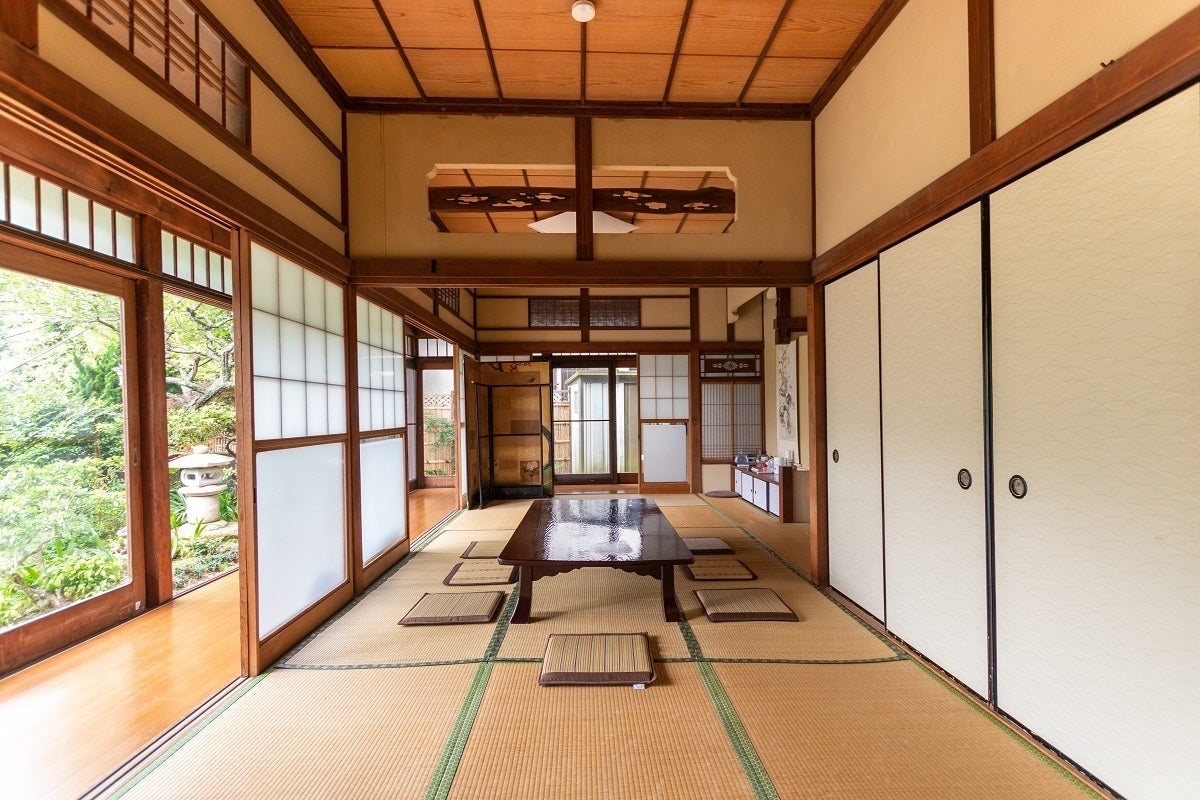
Go with the flow

Kominka interior. Note roka on the left.

Last week the Wall Street Journal ran a story about how proper ventilation of rooms can help prevent the spread of COVID-19 indoors. Japanese twitter responded in particularly derisive fashion by pointing out that in Japan proper ventilation was considered a pillar of the country’s anti-COVID measures as long ago as February as part of the government’s san-mitsu strategy, which told people to avoid “close” contact with others in “closed” rooms. Generally speaking, this strategy covered commercial, educational, or work spaces, since those were the most problemantic places in terms of keeping people safe from the spread of the virus. The operational logic then and now is that the virus doesn’t survive as long in the open, and so bringing the outdoors inside is a good way of keeping it at bay. For businesses, that means opening windows and/or optimizing ventilation systems to keep air moving through the space.

In Japan, however, greater attention is now being paid to transmission within homes, among family members. Coverage tends toward the inevitability of being infected by a loved one, since there is little you can do about your living situation. However, we would be very interested in seeing a study showing the relationship between intra-household infection rates and specific home layouts and other structural conditions. The first question that comes to mind is whether air conditioning systems help or hinder the spread of the virus. Generally speaking, the virus is in its best element in droplets of saliva expelled while talking or breathing, but scientists also talk about aerosol transmission, meaning the virus itself is carried on air currents. These particles can travel greater distances than droplets because they are much lighter and can still infect others by passing into their lungs when they inhale. Scientists are still debating the scale of infection due to aerosol transmission, but one thing that seems certain is that air currents in closed spaces are instrumental in propelling the virus and keeping it viable for longer periods of time than would happen outdoors or in indoor spaces with air flow passages that connect to the outdoors. Air conditioners are typically heat exchange mechanisms, and the public may misinterpret that to mean they exchange outside air for inside air, but that’s not really the case. Mainly they recirculate inside air and expel the ambient heat through outdoor fans. Consequently, there’s the possibility that if there are virulent particles in the inside air AC units may increase the possibility of causing those particles to enter into the bodies of humans in that space, and this is the main issue, especially in Japan where air conditioning, at least in residences, is a modular affair. Central air conditioning usually comes with filters that may be able to take out virulent particles (though viruses are really, really small). Apparently, some manufacturers have been touting anti-COVID features this summer, but one has to take such claims with a handful of salt. Daikin, to its credit, has been up front about air circulation and says that people should open their windows and use circulators and fans to facilitate ventilation. In other words, don’t count on their air conditioners. Because in the end the cooling efficacy of AC is dependent on how closed the room is and the efficiency of the insulation. That means all windows have to be closed tight and that there be no drafts in order to make full use of your AC. The entire home becomes a closed system, and the potential ventilation advantages of the AC unit-fan relationship is reduced by that much. The thing is, we just don’t really know now how this plays into viral infection rates. Read More

Getting warm

CIMG3110Because we are building a house from nothing, basically, the number of choices we were forced to make was sometimes overwhelming. If we had bought a house already built, we would have simply looked at what was there, decided what we didn’t like, and then replace it all. If the house was being built according to a builder’s plan we would have seen what was available and haggled over what we did want and what we didn’t. In a sense, A-1 was close to this model, but the main reason we chose them is because there were many more options involved, and not just in terms of design. But our salesman, N, did try to push certain items on us, presumably because he and and A-1 would get a cut of anything they sold. We’ve already talked about the visit to House Tec, the housing supply and service company that A-1 deals with, and how because of our budget we were limited to certain fixtures and facilities we didn’t really care for. Fortunately, we held our ground on the bathroom sink (no plastic vanity, which is A-1’s default), but were not as forthright with the bathtub and the kitchen cabinets. We ended up getting a unit bath, which we don’t like, but that probably couldn’t be helped because the custom made baths we checked out were very expensive, and we’re not really bath people, anyway. The cabinets may have been a mistake, though. When we went to House Tec to pick them out, because of our budget we were shown only the cheapest line, and we took it without really asking. Had we spent a little more we could have gotten better stuff–i.e., drawer cabinets instead of the conventional door types.

But for other fixtures we decided to tell A-1 that we would go about it ourselves, and not just because we thought it would be cheaper. For instance, the initial estimate included all lighting fixtures, which A-1 would purchase through its agent and then pass on to us. They told us outright that they could buy these fixtures cheaper and we believed them, but we have some lighting fixtures already that work fine and look OK, so it seemed like a redundant expense. In any case, we don’t like the kind of garishly bright overhead lights that Japanese people favor, so while we did have rosettes installed in the ceiling, most will be equipped with fans, not lights. A-1 gave us a catalogue of one of their lighting suppliers and we looked through that and then went on line and purchased the fixtures that we needed ourselves. They were sent to our apartment so we will just bring them over to the new house to have them installed when the electrical work is done. Read More