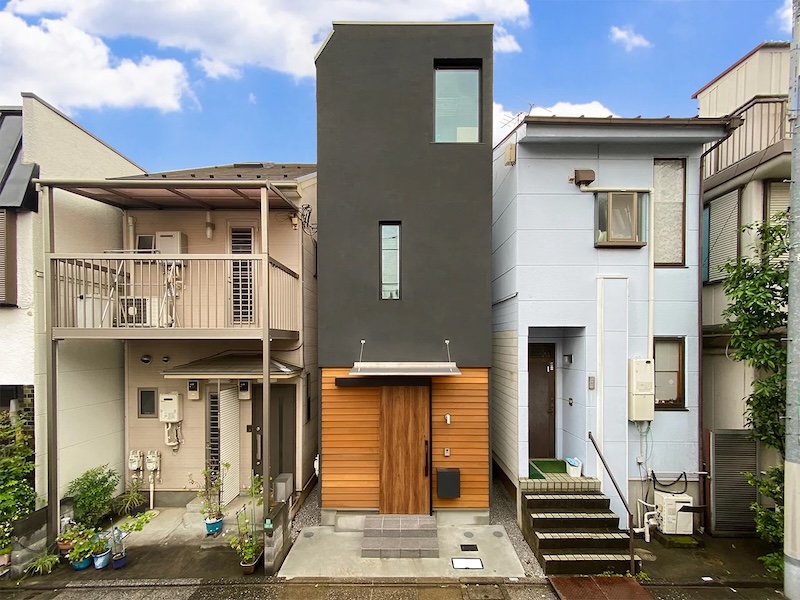
The title of this blog refers to two old cliches about Japanese housing that address size. The first refers to a common rejoinder to casual inquiries about somebody buying a piece of land, wherein the buyer would answer that the purchased plot “is only as big as a cat’s forehead,” meaning it’s tiny, when, of course, it’s never that small. However, recent news reports about sales of properties in Tokyo may cause new landowners to revive the saying with some justification.
As we’ve reported here numerous times in the past few years, condominium prices in Tokyo have soared beyond the reach of most average families, and yet Tokyo continues to be the only prefecture in Japan whose population is growing. An article last week in the Asahi Shimbun featured a woman in her 40s who said she recently bought a new house in Nerima Ward right after she got married. Before buying the house, she and her new husband had searched for a new condo within Tokyo’s 23 wards for about six months, but almost all the ones they liked were being offered through auction sales that started above ¥100 million. Obviously, she thought, they should have started looking more tha 5 years ago. In addition to the high price and the mortgage interest they would have to pay hefty monthly management and repair fees, so she gave up on the condo and instead bought a new house through a lottery system, beating out three other contenders for a building that was 20 percent cheaper than what her budget had been for a condo.
The total floor area for the house is 85 square meters, which is quite small and one would assume, given the land use rates in Tokyo, the size of the land is probably not much more than 60 square meters. The location is 18 minutes by foot to the nearest train station, which the woman, who works in central Tokyo, says is tolerable. More significantly, she says the mortgage terms are “not difficult” and fit her financial situation.
Asahi is covering the woman because new houses have become much more popular in Tokyo in the past several years owing to the scarcity of affordable new condominiums. The Real Estate Information Network (REINS) for East Japan reports that the sale of new and used houses in the Tokyo metropolitan area has increased for three years in a row, probably because while prices of new houses have also increased during that period, they have increased at a slower rate than that for condos. The average price of a new house in the metro area in 2025 increased by 4.6 percent compared to 2024, while the price of new condos increased by a whopping 20.3 percent, boosted mainly by investors.
The appeal of houses over condos is probably obvious to most people, but size isn’t necessarily one of those appeals. The Real Estate Business Research Laboratory says that the average size of new condos in the Tokyo metro area has remained less than 70 square meters for the last decade, and continues to shrink. Developers have taken note. Sumitomo Real Estate’s City Garden brand allows buyers to design their own 100-square meter house in the Tokyo area, or about 30 square meters more than the average condo, and while prices are not much different than those for condos (¥80 to ¥150 million), sales have been good. Another builder/developer, Tokyo Tatemono, stopped building single-family homes some time ago but recently got back into the game and has a plan to build about 100 houses in the 23 wards in coming months.
The majority of these new houses are classified as kyosho jutaku, or “very small houses.” A number of architectural firms specialize in kyosho jutaku, which is defined as being designed for lots that are less than 60 square meters. The sales of such houses in Tokyo have increased over the past 5 years by 3.2 times. Because of special design needs, often these houses are more expensive per square meter than larger houses, but buyers know this and are splurging because often the only vacant lots they can find anywhere near the center of Tokyo are very small. The average price per tsubo (3.3 square meters) of land in Nerima Ward, for instance, is ¥1.76 million.
A recent TV report for Kansai News focused on kyosho jutaku in Osaka, whose increase over the last year in condo construction was the highest in the world. The example they used was a new three-story house built in central Osaka on 20 tsubo of land for ¥27 million. Though that sounds cheap, it does not include the price of the land itself. For the family profiled the land price was not a problem since the property was owned by the wife’s father, but 60 square meters of land in Osaka or Tokyo is going to cost at least ¥50 million, so in most cases the land is going to be much more expensive than the structure, which will invariably lose value over time, as it often does in Japan, even in large cities. Nevertheless, these houses will be sellable in the long run, something that can’t be said for comparable new houses in the suburbs or the countryside, given Japan’s dwindling population.
The issue that Asahi doesn’t address is the availability of land for houses in Tokyo. In truth, Tokyo also has an akiya (vacant house) problem, but because of the location of many of these empty houses it’s difficult to remove them and free up the land for new structures. That’s because these akiya were originally built in cramped locations that have since become specially zoned so that if the house is removed, the plot is redrawn so as to make access roads wider, meaning that the plots become even smaller. For the most part, these plots, which tend to be common in the eastern shitamachi region of Tokyo, though many can be found in central Tokyo as well, remain derelict because the owner of the property doesn’t think they can sell it at the price it’s worth. What often happens, especially in neighborhoods with old machiya, or townhouse-like structures where neighboring houses share walls, is that the owner simply renovates the house, which can be done without losing any land, but that means the neighborhoods remain cramped and dangerous. Of course, these are the kind of neighborhoods that people find quaint and uniquely Tokyo, but in a major disaster they would become death traps, regardless of the quality of the housing.
So likely the price of these cat forehead-sized parcels of land in Tokyo will continue to rise due to their scarcity, thus making houses just as expensive as condos. Something’s gotta give if Tokyo wants to continue to grow, but whether that’s a good thing is open to debate.


Hi,
Another interesting article.
Just to give a comparison to here in Australia, the price of land in Nerima as cited in the article is around the average price per square metre in Brighton, Victoria. It’s higher closer to the beach and around $A4000 or so a kilometre away.
The price is higher for parcels of land with a size of 1000 square metres or more as multistorey condo buildings can be put up.
Condo prices vary, but finding a 100 square metre unit (condo) puts one into the luxury range and the price reflects that. Those are usually 3 bedroom condos and the average price will be around $A1.8 million or about 200,000,000 yen.
The last condo I looked at was 133 square metres, a 2 bedroom for A$1.6 million.
But the biggest problem with these condos is that the monthly fees are huge and many are around the A$10,000 a year area without any fancy swimming pool, gym, or gardens.
So I guess Japan is still cheap compared to Australia.
LikeLike
“The total floor area for the house is 85 square meters, which is quite small and one would assume, given the capacity rates in Tokyo, the size of the land is probably not much more than 60 square meters”
Help me here. Foesn’t it make the land area smaller than the house???
LikeLike
Total floor area means the total area of all the floors. The house in question is probably three stories. Land use rates in Tokyo are usually around 50%, depending on the local government and type of building (they can range from 30% to 80%), so if the house is 85 square meters in total and it’s three stories, each story would be under 30 square meters, which would be the maximum footprint for a house on a plot that is 60 square meters. But it also depends on the legal capacity rate, which is the total floor area divided by the size of the land.
LikeLike
ahhh, right. I was thinking one storey. Thank you.
LikeLike
I wonder whether the popularity of very small apartments and houses is connected to people not wanting to marry or have children.
LikeLike
That 18-minute walk being described as “tolerable” really strikes me — I’ve
LikeLike
The lottery system for buying a house sounds intense, but I guess that’s the reality when new builds are 20% cheaper than condos. Walking 18 minutes to the station would feel like a dealbreaker to me, though—I’d probably factor in a bike or bus route.
LikeLike