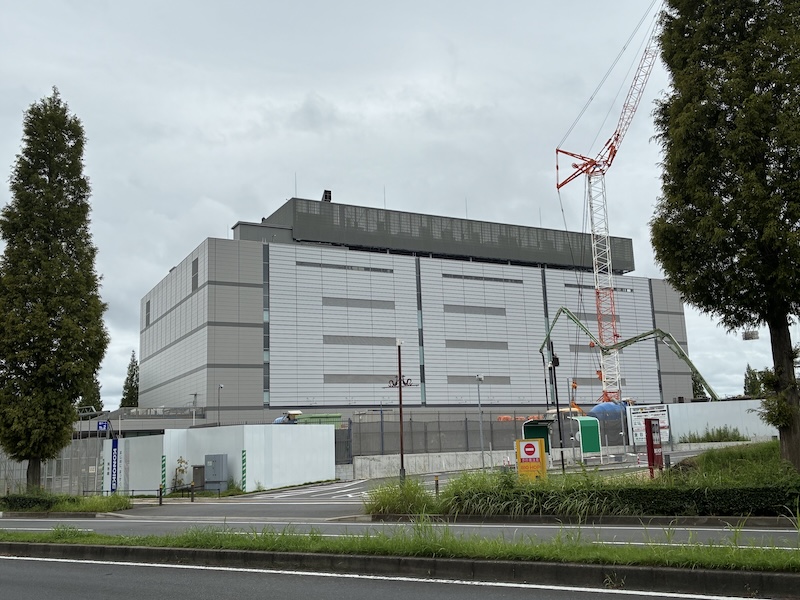
The Japan Times ran a very good article last June that we found particularly interesting because it focused on the construction of data centers in the Chiba Prefecture city of Inzai, where we happen to live. According to the article, Inzai is called “the Ginza of data centers,” and we have seen firsthand how the city has become a magnet for not only data centers but large-scale logistics facilities. Though the article does a good job of explaining how all these data centers came to be built in Inzai without any input or much attention from residents, it doesn’t really get into what makes Inzai such a popular location for data centers.
We first heard the term “data center” almost 15 years ago when we started looking for a home in Inzai. More than one real estate agent told us that property values would always be stable in the city because so many companies were building data centers here. They were talking about data centers for specific companies, mainly banks and financial institutions (Japan Post has its own data center in Inzai), and when we asked why Inzai was such a good location for such facilities, we were invariably told that the area is, relatively speaking, geologically stable, meaning that earthquakes aren’t expected to be as severe as they might be in other areas of the Kanto Plain. Since then we’ve come to accept this bit of seemingly conventional wisdom with more than a grain of salt, but have also heard other reasons for the spread of data centers in Inzai, one being that the city is close to where the trans-Pacific optical cable from the U.S. enters Japan, an explanation that also may buckle under close scrutiny.
We have our own theory, which is that the real estate situation in Inzai is perfect for such development. As many people now know, the problem with data centers is that they use an inordinate amount of electricity and water, which is why it is difficult to build them in densely populated urban areas. Tokyo, being not only the Japanese capital but the center of all business activity in the country, will require a huge amount of data processing capability as AI tightens its grip on information technology in general, but providing that level of capacity close to the city is going to be difficult because of the paucity of available land. Like nuclear power stations, data centers work more efficiently the closer they are to the places that use them. In the case of nuclear power, the longer the power lines that connect the station to the user base, the more electricity is lost. Nevertheless, the Tokyo Electric Power Co. (TEPCO), had to build reactors in far-flung places like Niigata and Fukushima to provide the enormous amount of electricity necessary for the Tokyo metropolitan area because of the density of residential development in the area. According to a recent article in Tokyo Shimbun, if data centers are also located far from users, “communication delays” can affect the “precision of information processing,” so the closer the better.
Inzai is ideal in this regard because it is close to Tokyo. And the reason—we think—that so many data centers have been built here is because of the existence of Chiba New Town, the ambitious urban development project launched by the central government and Chiba Prefecture back in the 60s. As with all New Towns in Japan, the aim was to create self-contained regions of commercial and industrial activity linked to nearby residences, but for various reasons, Chiba’s never achieved the ambitions its boosters envisioned. Consequently, the enormous amount of land set aside for Chiba New Town by the government, land that was inherited by the semi-public corporation UR after the government housing authority was mostly privatized in the 90s, remained undeveloped for decades, losing value in the process and becoming a financial burden on deep-in-debt UR and, in turn, the government, which insisted that UR unload the land somehow.
Consequently, zoning in Chiba New Town has been in constant flux in order to allow more residential development on land that was previously reserved for commercial or industrial use (losing money in the process). Most of this land is near train stations on the Hokuso Railway. Data center developers jumped in and took advantage of this cheap sell-off by buying up private land presumably still zoned for commercial and industrial use and then building data centers on it, often within spitting distance of residences. People bought apartments next to vacant lots that would eventually contain data centers that would block their view, a point of contention that is at the heart of the Japan Times article. The backlash against data centers in Japan is not as acute as it is in the U.S., where data center construction is being met increasingly by resident opposition. In Japan, such development is naively accepted as being a boost to property values, as our experience with real estate agents more than ten years ago demonstrated, but from what we’ve heard prices of such apartments are already dropping once it’s learned that a data center is being built nearby. The Japan Times report showed that Japanese residents, or at least some in Inzai, are finally realizing that close proximity to such facilities may erode their quality of life.
And as Tokyo Shimbun also pointed out, Chiba New Town does not just encompass Inzai. It also includes the city to the west, Shiroi, which has also become a haven for data center construction, though less so since Shiroi was already more developed than Inzai, being a bit closer to Tokyo.
Due to the speed at which AI has developed, thus prompting an immediate need for more data centers, governments in the so-called developed world have yet to implement laws to regulate them. In the U.S., Senator Bernie Sanders has called for a moratorium on data center construction until the government studies the matter and devises regulations to protect the public from their encroachment on people’s lives. Tokyo Shimbun makes the same point, saying that neither the Japanese government nor local governments that have approved data center construction in their bailiwicks have any regulations in place regarding protections for residents.
What would these regulations entail? Certainly they should include protecting water resources (data centers get very hot, and thus need a lot of water for cooling purposes) and ensuring that data centers’ massive electricity needs don’t adversely affect nearby households.
But there are other latent problems that should be addressed. One was mentioned by Tokyo Shimbun but without elaboration: data centers could become military targets. This aspect of the matter was explicated in an August 6 article by the Korean news service Hankyoreh, which pointed out that in its current war with the U.S. and Israel, Iran has specifically targeted data centers in the Middle East. On August 3 alone, Iran attacked 5 data centers in the UAE and Bahrain, including one operated by Amazon, that were developed in part with help from the U.S. Since AI is becoming a vital tool in military operations, data centers are seen as strategic facilities. Iran has stated it will continue to attack them. The U.S. and Israel attacked two in March in Iran operated by the Revolutionary Guard. And since data centers are also considered central to economic growth, the U.S. will further concentrate on destroying Iran’s now that the war has entered a mostly economic realm. The countries of the Middle East, perhaps looking forward to a future where oil becomes less of a vital resource, are now trying to position themselves as the third data center hub after China and the U.S. Saudi Arabia has created a fund worth about $1 trillion to invest in AI.
As Japan continues to increase its defense budget and buy more weapons for deterrence purposes, it has to think about those parts of its infrastructure that are vulnerable to foreign attack, including nuclear power stations and data centers. Nuclear reactors have mostly been built in areas that are not densely populated, but Inzai is now a rapidly growing city, so the presence of so many data centers puts more people in danger if Japan is ever involved in a war, which nowadays is mainly fought from the air with missiles, bombs, and drones. The likelihood of such fighting is perhaps small, but the very fact that the government is now bent on spending a bigger chunk of its GDP on defense and revising the constitution in order to facilitate a more conventional military force means it is trusting less to diplomacy as a means of solving its regional security problems. We don’t live near a data center, but as residents of Inzai that still makes us uneasy.

