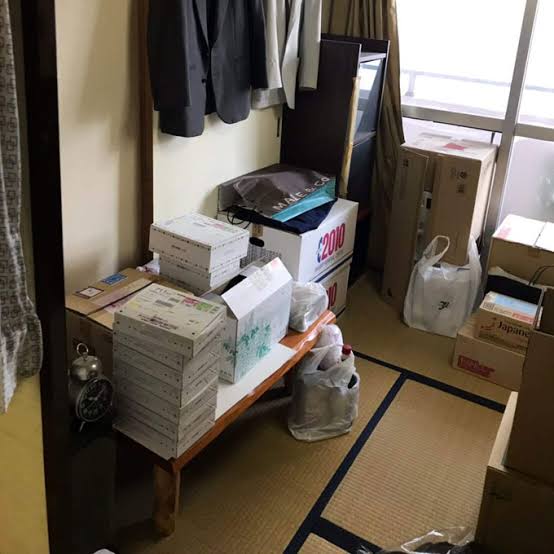
The problem of rental properties for the elderly has been widespread for many years, but as the predicted aging of Japanese society has progressed apace, the problem has become a full-blown crisis. Thirty percent of the population is now 65 or older, and nothing has really been done to guarantee that people in this cohort can rent apartments if they need to.
That’s because landlords don’t want tenants who they think are more likely to die on them. Besides the possibility of losing a paying tenant, there is the more serious problem of tenants who die alone without anyone to handle their remains or possessions. A demographic that has been studied excessively by the media lately is single-person households, many of which are occupied by elderly people with no close ties to any family.
The problem was revisited by NHK recently on its in-depth news report Closeup Gendai. The renter that NHK interviews is 65. He currently lives by himself in a building that has no elevator or air conditioning. Having developed a bad knee, he finds it increasingly difficult to go up and down the stairs, and is concerned about the hotter summers in Japan, so he’s looking for a new apartment. He still works, but on a contract basis for an IT company, meaning it isn’t guaranteed employment. He has no problem covering his rent, but there are no relatives on whom he can rely in the event of an emergency. He says that almost all the ads he’s seen online say right up front that they don’t rent to older people, and those who do insist that a relative be his guarantor, so for the time being, at least, he has to stay where he is.
NHK then talks to a landlord, who tells the reporter frankly that he is “afraid” to rent to older people “unless there is a strong guarantee.” Elderly applicants must have a financially solvent relative as their guarantor—no friends or even employers. The reason is obvious. In addition to being there if the resident falls behind on their rent, the relative will automatically have a legal responsibility to remove the resident’s remains and possessions if they die while in the rental unit.
The landlord talks about a 70-year-old female tenant of his who died in July of 2025. She lived alone and her body was not discovered for an entire month. Someone she knew tried to get in touch with her and couldn’t, and so the landlord called the fire department, which forced the door open. They found the woman’s body, which had already started to decay and had leaked bodily fluids all over the floor. The corpse of her dog was also in the apartment. “It was the first time this happened to me,” the landlord said.
The regular cleaning fee for removing and disposing of the woman’s things cost ¥248,000. Then there was a special cleaning fee to get rid of the stains and odors that cost another ¥250,000. Because of the stains and other damage, the apartment had to be renovated, and that cost ¥1 million. On top of that, he couldn’t rent out the apartment for almost a year and so lost more than ¥400,000 in rent. Since the woman had no relative, the landlord had to shoulder all these expenses himself. “That’s why I am imposing more conditions on future tenants,” he said, and that includes younger applicants.
NHK then talked to a major realtor who manages 8,000 rental units in the Tokyo metropolitan area. Over the last 3 years, 135 tenants have died while occupying their apartments: 21 people in their 80s, 37 in their 70s, 43 in their 60s, and 25 in their 50s. One out of four of the deceased was of working age.
The realtor offers a specialized “check-in” system to all its tenants as an option. The system monitors the electricity use within the apartment and contacts a designated person when an irregularity in electrical usage is recorded. The contact then gets in touch with the tenant immediately. The company is thinking of making the system mandatory for tenants above a certain age.
An expert tells NHK that despite the long lead time that the authorities have had to prepare for an aging society, they are not ready for the huge number of elderly living alone in rental properties. The housing policy as its set up is designed for the traditional life trajectory: live with parents until a certain age, move out on one’s own and get a job, marry and have a family, buy a house, retire and live with/be taken care of by children/family. Too many people no longer follow that pattern.
The public sector has not kept up with these changes and any related needs have been taken up by the private sector. The monitoring system mentioned above is often provided by courier services, since they have delivery people who can check up on customers during their rounds. Yakult, the traditional morning beverage delivery service, offers a daily check-in option for regular customers. At present, however, only about 10,000 people nationwide take advantage of such services.
Another option is called kyoju shien hojin, companies that essentially act as proxies for family members. In most cases, this service is run by non-profit organizations (NPO). NHK talked to one that had 120 customers. The NPO is the liaison between the elderly tenant and the landlord, meaning the NPO arranges for the rental and is the guarantor, making sure that the tenant takes care of themself (shopping, keeping doctor’s appointments). The NPO also contacts welfare offices and medical institutions if there is a specific need for either. The NPO NHK talked to said that so far none of their charges has died on them.
The problem with this system is that it is becoming more difficult for the NPO to find suitable rentals, especially in the Tokyo metropolitan area, as rents continue to increase substantially every year. Most elderly tenants are on fixed incomes. The number of inquiries these NPOs receive has doubled in the past two years because elderly people are having more trouble securing apartments.
In addition, the NPOs cannot break even. In most cases, the tenant pays their rent to the NPO and the NPO adds a margin to cover their expenses and salaries. It’s basically a subleasing system: the NPO’s name is on the rental agreement. Now, many NPOs have to increase the margin due to inflation and their elderly charges can’t afford it because their fixed income hasn’t kept up with inflation. Sixty-four percent of these NPOs operate in the red.
What these NPOs are doing is essentially acting as caregiving services, which would seem to be redundant since everyone over 65 pays into and is eligible for kaigo (caregiving) insurance. However, the system as managed by the government is woefully inadequate to meet the needs of many of the people who rely on it, and care goalposts keep having to be moved further away.
Many local governments, then, have to supplement the kaigo insurance system with specific services. The city of Tachikawa has what it calls a “one-stop window” for elderly people who are having housing problems. There is one city office that will assist them in finding a place to live by working directly with outside NPOs and realtors.
NHK implies that local governments are going to have to become more involved if elderly people want to live on their own. And it isn’t just in the big cities, where the problem gets most of the attention. In suburban and rural areas there are very few available rentals.
The best solution, of course, would be more public housing, but the Japanese government, as well as local governments, is no longer in the business of building and managing public housing on anything but a limited scale. In contrast, South Korea has recognized that public housing is the only solution to its own elderly housing problem and is constructing apartments for just that reason.
Another expert who is studying the Korean system told NHK that the Japanese authorities’ attitude toward the elderly housing problem is to bolster private rentals by subsidizing landlords specifically so that they will allow old folks to move in, but that’s tantamount to bribing property owners to be nice to the elderly when in fact they don’t want elderly tenants in the first place. If anything, such a policy makes the situation even worse.


The thirty percent figure really puts this in perspective — with nearly a third of Japan’s population now 65 or older, housing for this cohort stopped being a niche concern a long time ago. What struck me is how nothing has really been done to guarantee that older people can rent apartments when they need to, and how that failure has quietly compounded into what you rightly call a full-blown crisis. When landlords simply won’t rent to them, staying housed becomes a struggle for people who have nowhere else to turn. It’s a problem other rapidly aging societies should study before they end up in the same place. Thanks for laying out just how long this has been allowed to fester.
LikeLike