The awful truth

We often go out in the field to do research, but it’s always a two-pronged activity. On the one hand we study the housing situation and the market in an up close and personal manner. On the other hand, we’re still thinking about buying property ourselves someday, and though after more than fifteen years of searching off-and-on we haven’t bought anything, it doesn’t mean we never will. Still, the longer this goes on and the more we learn, the more frustrated we become, especially as our income situation remains precarious owing to the ongoing recession. Having a permanent abode that we can’t be kicked out of, regardless of our job circumstances, is a vital consideration, but looking at what we can afford we invariably fall into a funk wondering why we have to settle for such places. Inevitably, you prevaricate: This may be livable.

Our latest subject is old danchi/kodan for sale, which have become semi-popular due to media coverage of “danchi moe,” or fans of old public housing. We’ve written before about enterprising people who’ve bought old apartments in buildings constructed during the 50s-70s and remodeled them as attractive modern spaces, which they often sell for a profit. Because they only cost a few million yen to buy and a few million yen to fix up, they can be had quite cheap in the end, but most of the units that have been covered on TV and in magazines are small; fine for a single person but still a bit cramped for a couple and certainly not big enough for a family, though in all likelihood they were occupied by a family when they were new.

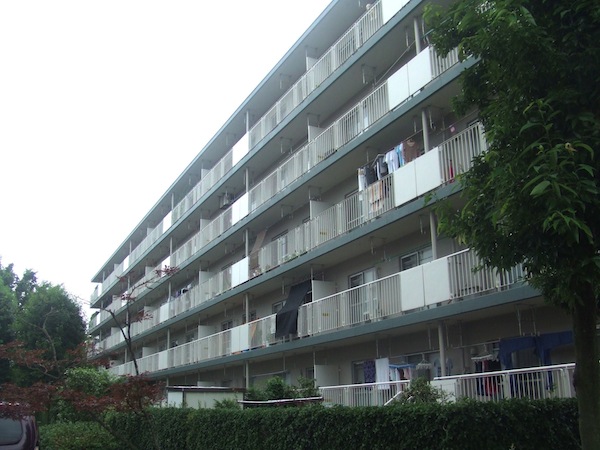
When you get out of the main cities, these danchi and kodan get bigger and even cheaper. And in most cases they’re also newer, which means more amenities. However, they still look like danchi, meaning they’re usually contained in dull concrete buildings of three to five stories without elevators. The fact that they are designed with these parameters in mind means that the apartment layouts tend to be more sensible than those in newer buildings. The classic kodan design has a staircase and apartment entrances on each side of the landings, which means you usually enter at ninety degrees to the length of the apartment. That allows for windows on both ends of the apartment, which means there is not only more sunlight, but cross-ventilation, an important consideration until the 1980s, when air conditioning started to become a fixture of apartment life. It also means the rooms are more practically positioned, unlike modern apartments where the entrances open up to a common outside hallway or light well, which means all the light and air comes from only one direction. In order to maximize space for commercial purposes, the rooms are basically carved out of a boxy shape, thus creating what is often referred to as “kamaboko” living spaces. Kamaboko are those rectangular fish paste loaves that you divide into smaller rectangular pieces.

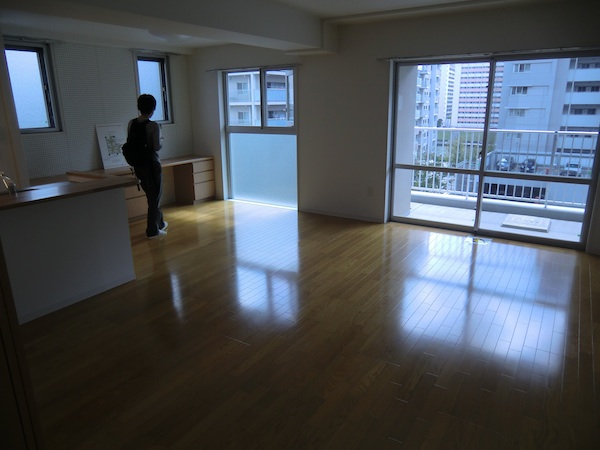
So discounting the unappetizing exteriors, older danchi, especially when they’ve been fixed up, can be quite desirable, and in this spirit we called a few real estate agents and had them show us some in northern Chiba. Read More

The rest of the story

What you see is not what you get

We’ve received two letters in response to our Aug. 2 Home Truths column about renewal fees, both from landlords who obviously want to relate, as Paul Harvey used to put it, the rest of the story. Both letters were sent to the Japan Times, one for the Readers in Council page and the other indirectly to us with a directive that it not be published. Moreover, the RIC letter was published anonymously, so while both of these persons hold strong opinions as to their own situations as property owners neither seems to feel that strong that they might risk exposing themselves to whatever sort of negative reaction landlords can normally expect. This is probably unavoidable. The landlord-tenant relationship is almost by definition an adversarial one; the dynamic fraught with defensiveness. Both landlords basically wanted to show the difficulties of maintaining properties for rental purposes in Japan, and in the process defended the collection of supplemental fees such as reikin (gift money), shikikin (deposits), and koshinryo (rental agreement renewal fees) as essential to their businesses. Read More

Higher ground

Aobayama Park, overlooking Sendai

The land ministry has decided to monitor real estate transactions in the disaster-affected areas of the Tohoku region. As evacuees start moving out of temporary shelters and rebuilding their lives, many will likely seek new properties on higher ground, thus causing steep appreciation in land prices on elevations considered out of the reach of future tsunami. The ministry, along with the prefectural governments of Iwate, Miyage, and Fukushima, is afraid that real estate companies will try to corner the market on these tracts of land.

The ministry has already asked local governments to gather information about land transactions. The idea is for the local authorities to designate certain choice areas for monitoring purposes based on the Land-use Planning Law, which regulates the buying and selling of properties. Any transactions that take place within the monitored areas will have to be approved by the pertinent prefectural governor before any contracts are concluded in order to preempt deals deemed “improper” by the law. If the governor does not approve the transaction he can have it voided or ask that the terms be changed.

It’s obviously a necessary policy, but it may be difficult to carry out. Local governments are still hashing out whether or not to allow people who own certain low-lying properties to rebuild on the same land. Until they decide, those families are in limbo. Meanwhile, families who have already decided to move to higher ground may be in the process of looking for land and will thus get a jump on everyone else. The competition could end up being fierce, so it will be difficult to judge what constitutes an “improper” deal in some cases if the buyer and the agent come to an agreement. Also, if the local government decides that certain plots of land on lower elevations should be left clear, they will probably have to compensate the owners, something that could take time. And until those families receive their compensation they won’t be able to move. This will be particularly difficult for fishermen and other people in the seafood business, who want to live as close to the sea as possible.

According to the Tokyo Shimbun smaller, more isolated coastal communities aren’t waiting for the government. Some have already started rebuilding. Since tsunamis have been a fact of life in those villages for many centuries, a kind of lore has developed that instructs the villagers where it is safe to build and where it isn’t. After a tsunami, everybody moves to higher ground, and then over the course of decades they slowly work their way closer to the sea, since they’re all fishermen, until the next tsunami hits. It’s an inevitable, tragic cycle.

Home Truths #2

Caveat emptor

Our latest column in the Japan Times was published today. You can read it here. It’s about the recent Supreme Court decision regarding koshinryo (renewal fees). One small clarification: The photo caption mentions that cheaper rents may mean higher renewal fees and “gift” money. In many cases if the landlord has set the rent lower for the purpose of attracting potential tenants, he/she may also not charge gift money for the same reason. Renewal fees, however, are more hidden because they are usually only mentioned in the fine print, meaning they kick in later, when the tenant has to renew the contract a year or two after moving in. Also, some landlords, especially corporate ones, are making their rental agreements longer, say five years, and then setting the renewal fee a bit higher than average. Another theory associated with renewal fees that we neglected to mention is that some landlords use it to generate higher turnover. Since supplemental fees allow the property owner to make a bit more money in a slumping market, logic says that you make more money if the turnover is higher because more new tenants mean more supplemental fees. This is the same economic logic behind the shaken (regular vehicle inspection), which all car owners have to pay for every two years (or every year, depending on the age of your automobile). When the shaken, which is expensive, comes due, many car owners simply trade their vehicle in for a new one. The first shaken for a new car is three years. The same concept is supposedly used for renewal fees: People will move to a new place because they don’t feel like paying it. The reason we didn’t mention this theory is because we’re not really sure it’s credible. People’s attachment to the place where they live is different from their attachment to their car. If people move because they don’t want to pay the koshinryo it probably means they don’t like the dwelling in the first place.

Make mine menshin

The Asahi Shimbun reports that more and more companies are interested in fortifying their buildings with so-called menshin technology. Menshin involves placing shock absorbers in the foundations to mitigate the vibration accompanying earthquakes. Quite a bit of media attention was directed at the 18-story Sendai MT Building, which not only survived the March 11 earthquake in the largest city of the affected area, but made it through with minimal shaking, according to people who were in the building at the time. Sendaki MT Building is a commercial building run by Mori Trust, and it acted as a kind of makeshift refugee center for office workers who couldn’t get home the night of March 11. Though there were aftershocks all through the night, most people in the building said they didn’t feel them as much as they did in their own office buildings. After the quake, the building’s occupancy rate increased 20 percent and is now almost completely filled.

And it wasn’t just high-rises. The two-story distribution center for Suzuden Logistics in Matsudo is menshin-equipped. None of the goods stored in the building were damaged at all. Another menshin building is the Aizu Central Hospital in Aizu Wakamatsu, Fukushima Prefecture. Though it also underwent 5-plus shaking, the building suffered no damage and regular treatment continued normally. No in-patients had to be moved out or transferred.

The Asahi reports that, while menshin features add between 10 to 20 percent to the cost of construction, major contractors have seen inquiries into the system triple since March 11, and just as many are for factories and warehouses as they are for office buildings.

Dynasty end

Unwanted

In 1941, 22 percent of all dwellings in Japan were owned by the people who inhabited them. By 1948, the portion had swelled to 48 percent in the cities and 67 percent nationally. Even before the war housing was at a premium, but thanks to the wholesale destruction of the Japanese archipelago during the final years of the war, it had become even more dear when the American occupation started. Inflation was rampant, and in order to make sure property prices didn’t spiral out of control a directive was issued in 1946 to freeze land prices and rents. It wasn’t the first time. Similar directives were issued in 1939 and 1940, but they were provisional. The 1946 directive was more open-ended, and the result was that landlords couldn’t raise rents. One of their countermeasures, at least in Tokyo, was to implement the now infamous koshinryo system: Every time the rental agreement expired, the landlord would charge the tenant an extra month or two worth of rent as a renewal fee. (This will be the topic of our next “Home Truths” column in the Japan Times on Tuesday) However, most landlords, unable to pass on maintenance costs, simply sold the properties to their tenants. Moreover, there was no incentive to build new rental properties, so construction companies started building houses for the few people who could actually afford to buy them. Ever since then, there have been more homeowners than renters in Japan.

The home ownership rate first peaked to 71 percent in 1958, then slid down to 64 percent by 1963 and 60 percent by 1968. The main reason is that more people migrated to cities for jobs. They couldn’t afford to buy houses, so more rental properties were built in urban and suburban areas. However, by this point home ownership became a national priority, since it spurred growth. With the population increasing and nuclear families replacing extended families as the household norm it wasn’t difficult for the government to promote home ownership through schems such as the Home Finance Law (1950), which made mortgages affordable; and the Public Housing Law (1955), which set up a government corporation to oversee the building of affordable rental properties in cities so that young families had a stepping stone to home ownership. The main problem is that in order to make home-ownership possible for the new generation of urban workers they had to be made relatively cheaply, since land prices have always been high. In other words, the houses themselves weren’t meant to outlast their mortgages. Read More

Sourced

Masako was used as the framing voice in an article by Hiroko Tabuchi in this morning’s New York Times about the Tokyo high-rise market following the quake. You can read it here, though you may have to register first.

All fall down

In the months after the March 11 earthquake, a condominium management association conducted a survey of the Tohoku region to find out the damage sustained by multi-resident buildings. Almost all those that were built since 1981, when stricter earthquake-proofing codes went into effect, survived with minimal damage, but there were quite a few built before 1981that didn’t do as well. In fact, the survey found that about 60 structures in Sendai alone had been declared zenkai (“completely damaged”; in other words, legally uninhabitable).

The Asahi Shimbun looked at several of these buildings. One, the somewhat optimistically named Sunny Heights Takasago, was built in 1976 and was actually damaged in 1978 during a large earthquake that struck Sendai. However, the damage wasn’t “complete” and repairs were made. The building was not so lucky this time. The condominium is actually two 14-story buildings positioned in an L-shape. During the initital earthquake the two structures knocked against each other, but afterward inspectors declared them yochui–residents should take caution but they could keep living there. But the condos sustained further damage in the aftershock of April 7: window and door frames deformed, cracks appeared on outside corridors, steel beams were exposed. Even worse, the ground itself was “damaged.” Consequently, the properties were condemned. Read More

No parking

It takes two

Yesterday at our sister blog, Yen for Living, we posted an article about big cars that probably needs some clarification. By no means are we fans of big cars and, in fact, we sort of denounced cars in general when we sold ours in 2006. We aren’t necessarily against cars in principle, but the automobile is privileged way too much in Japan and America (we can’t vouch for Europe and the rest of Asia). We simply wanted to comment ironically on what we thought was the strange marketing logic of GM, and also wanted to use this photo of a Hummer that is parked not far from our apartment. The fact that the owner needs to rent two parking spaces says a lot about Japan’s car-ownership situation, though it should be pointed out that these spaces only cost ¥4,000 each. For another look at how parking explains Japan’s car-ownership situation, after the jump is an article we wrote for the Asahi Shimbun in 2004, when we were still car owners ourselves. Read More