Not quite

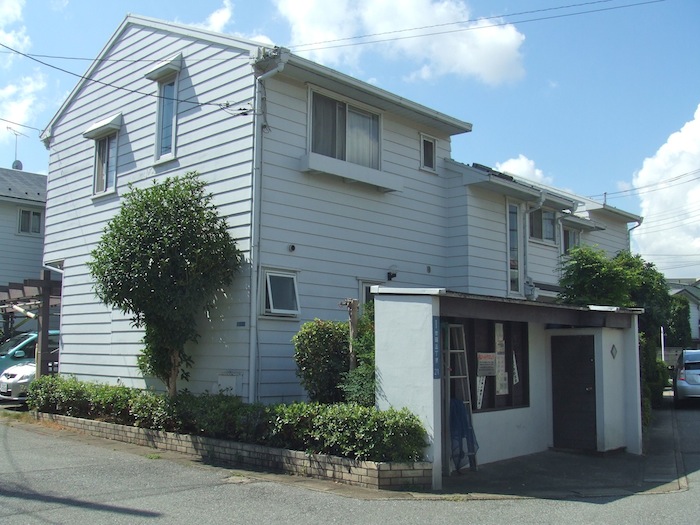
We’ve always been interested in town houses and are still thinking of dedicating a Japan Times column to them. Town houses were briefly popular in the late 70s and early 80s. Japan has always had an indigenous town house, called nagaya or machiya depending on which part of the country you’re in, but the structures called “town houses” in English (sometimes “terrace houses”) were more like their Western cognates: two-story structures with walls adjoining their neighbors. In urban environments town houses offer more effective utilization of land than normal detached houses while providing a similar level of creature comfort. However, once land prices skyrocketed in the mid-80s town houses were considered economically inefficient, even in the suburbs, which is where you normally found them anyway. Everybody started building condos with boxy floor plans in order to get as much cash out of a block of air as possible. Every so often we come across an old town house on sale and check it out, but because of their relative scarcity they tend to be overpriced. Of course, “overpriced” is all a matter of perception. Because town houses are relatively unusual, owners think that makes them more valuable, but they’re still old and always need a lot of work, as much as a detached house of the same vintage does if it hasn’t been renovated (and usually they haven’t been). A few weeks ago, as a matter of fact, we were amused to see a listing in which town houses were qualified as being “popular.” They aren’t, at least not in the general definition of the word. They are simply “rare,” which means it’s assumed some people will pay a bit more to have one. Read More

Get on it

Small item in the Tokyo Shimbun reported that on Sept. 8 the land ministry announced a policy to “step forward” in developing a system to provide potential homeowners with information about earthquake-proofing and renovation histories of used properties put on the market. As it stands, real estate agents who list homes for sale include information about price, layout, size, age, and location, but usually not much else unless you ask, and even then they are sometimes reluctant about things like quake-proofing since they don’t want to be responsible for such information. As far as renovations go, if the work was done recently in order to improve the value of a property, then, of course, the realtor will mention it, but if the work was done in the past there’s not much reason to if the cosmetic benefits are negligible.

The purpose of the land ministry policy is to expand the housing market to include more used homes. In 2008, only 13.5 percent of all homes sold in Japan were used, while the portion (in 2009) of same in the U.S. was 90.3 percent and in the UK 85.8 percent. The ministry thinks that if consumers had “more confidence” in used properties they would buy more. Typically, the ministry doesn’t have any concrete measures in mind to accomplish this confidence-building, but in the next budget they plan to ask for ¥50 million for “study,” meaning, presumably, looking into ways to help realtors include this information in their listings. Would they actually pass a law making it mandatory for realtors to tell potential buyers if a property was quake-proofed? That would be quite an undertaking since a lot of homeowners don’t even know the extent of the quake-proofing on their structures, or if there is any at all. All homes and condos constructed after 1980 are supposed to have been built to quake-proof standards, but given lead times on construction the standard probably didn’t become a full standard until the mid-80s. In any case, no one has done a proper study to find out how strictly the standards were carried out. One problem the ministry will have to consider when it spends its measly 50 million is what potential buyers can do to find out about quake-proofing. If a realtor doesn’t have that information and a buyer wants to know, who is going to pay for the inspection? For a single-family home a quake-proofing inspection can cost hundreds of thousands of yen; for a condominium building, a cool million. It’s easy to see why realtors, and the sellers they represent, want to avoid the subject, but the ministry doesn’t have that luxury. They say they want to stimulate the used housing market, but if there’s no reliable and reasonably priced system of assessing something as basic as quake-proofing then maybe the market isn’t even worth it.

Overexposed

One of our main bugbears with used houses is the obsession with a southern exposure. Though we perfectly understand the rationale–Japan is in the northern hemisphere and thus a southern facade provides more natural heating in the wintertime–we can’t fathom the insistence of builders and designers that all rooms in a house will face south and all “utilities,” meaning bathrooms and kitchen, will be located on the north side of the structure. Given the normally small plots of land in Japan, this results in a kind of domino distribution: all houses in a development “face” south, which inevitably means facing the “north” side of your neighbor. When we’ve asked builders about orienting a house toward the west or even north in order to take advantage of some attractive natural feature of the land, we’re invariably met with consternation and concern. It’s entirely possible, they say, but inadvisable. Some things just aren’t done.

Our reasons for shunning southern exposures are mostly aesthetic, but a recent article in the Tokyo Shimbun suggests that maybe southern exposures are not economical or even healthy. The University of Tokyo Engineering Department built an experimental house on the roof of one of its buildings to study the effect of direct sunlight on interior environments. Like almost all modern Japanese housing, the part of the building facing south had large plate glass windows so as to allow more light in. On sunny winter days when the exterior temperature was 10 degrees C, the interior temperature was as much as 35 degrees C, which is actually bad for the people who live there. In essence, the large windows make it difficult to control the interior temperature, which means the home owner may actually use more energy. According to the professor in charge of the project, it depends on the type of glass that is used, but in most houses the windows allow visible and near infrared light to pass into the house, where it is reflected off of the floor in the form of far infrared light, warming the room. Far infrared light cannot pass back out the window and thus more heat is trapped in the room. Direct sunlight contains a great deal of energy. Moreover, at night, when temperatures drop even further and there is no sunlight, more heat escapes from the house because of these big windows. Read More

Semi-detached

Though we still look at condos, it’s mostly for academic purposes. We have nothing against condos aesthetically or practically, but collective living automatically brings with it certain restrictions that we don’t really want to buy into. That may sound strange coming from people who still rent, but the responsibilities inherent in owning a property are more pronounced when the property is collective. For one thing, the condominiums we tend to like in terms of layout and design are actually those that were built by the housing authority, now called UR, and most of those still don’t allow pets. (We plan to cover the pet problem in more detail in a later article.) This small but significant restriction is indicative of the condo experience: people who own are understandably more caught up in the collective enterprise and thus pay closer attention to their neighbors. Renters are relatively forgiving, maybe because they tend to think they won’t be staying here forever. Owners have more of a stake and thus there are more rules and the rules are enforced. We’re not against rules, but it seems less stressful to own a house, where you can pretty much do whatever you want, than a condo, where you may not be sure what you can do until you move in. Read More

Nailed

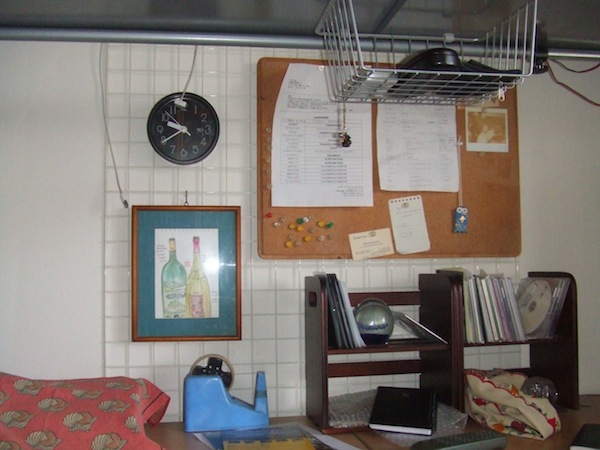
Extendable grid panel used as coat rack

In the most recent newsletter published our landlord, the semi-public housing corporation UR, and deposited in our mailbox there’s a specious “conversation” between a theoretical apartment renter and a theoretical apartment owner about the respective advantages of each mode of living. Discounting the whole economic side of the issue, the most obvious distinction is that owners can “freely change and remodel their apartment and replace or install amenities.” The renter counters by saying it may be nice to change your apartment the way you want, but what a pain in the neck! You have to hire someone to do the work and then move out while the work is being done. And, in any case, you can’t actually change the size of an apartment the way you can a house; whereas with some rentals, (s)he argues, the landlord will gladly remodel the unit to the tenant’s specification before the latter moves in. What’s perplexing about this line of thinking is that, while it may be true in “some” cases, as the speaker says, it isn’t true in the case of UR rentals. You have to take it the way you see it. The only part of the renter’s argument that holds water is that renters have more freedom to choose, meaning once they move in they can always move out and find something more suitable or desirable. Owners don’t have that freedom; or, they do, but it depends on how easily they can sell their property and how much of their initial investment they get back, and those points are hardly guaranteed in Japan.

Stand-alone grid panel for office use

Still, remodeling needs to be addressed. In UR apartments, as with most rental units, tenants are very limited with regard to how they can decorate, since almost all rental agreements include a term that says the tenant must leave the apartment in the exact same state as he or she found it. And while usually contracts don’t specifically say you can’t make holes in the wall, that is how most people interpret it. In any case, we’ve heard of people having had money taken out of their security deposit because of holes in the wall–but then, private landlords will find any excuse to keep that money. Read More

Too late?

Last Friday, several media reported that the land ministry released a new white paper on land and property usage based on research carried out last year. The conclusion of the study is hardly earth-shaking to anyone who reads this blog, but it’s nevertheless noteworthy. The paper says that the market for older homes and commercial properties should be expanded by maximizing their value through renovation and rebuilding. Though the Cabinet Office’s recognition that Japan is overwhelmed by superannuated, deteriorating structures is a step in the right direction, it’s difficult to understand if anything can be done about the problem as long as policies for promoting new building continues as it is.

According to the government’s findings, more than 30 percent of office buildings in Japan are at least 30 years old, meaning they were constructed before current earthquake-proof standards were implemented. Consequently, 90 percent of “real estate investors” are not interested in these buildings. The paper recommends that they be quake-proofed in order to “increase the stock of good quality” structures. It also advocates promoting energy efficiency so as to make the buildings more desirable. Such renovation will “increase the value of real estate” in general by reducing running costs. The government also concluded that as a result of last year’s major earthquake people’s “thinking about real estate” has changed: they are now more aware of “land quality.”

None of the news reports we’ve read have indicated what the government will do, if anything, to follow up on the findings of the white paper. Tax breaks for people who fix up older properties? That might work but seems unlikely given the government’s current craze for tax increases. The construction industry will certainly welcome any renovation boom sparked by tax cuts but it isn’t going to be happy if such renovation comes at the expense of new building, which is where the money is. Increasing property values in that way has never really been in the government’s interest.

Home Truths, June

Here is this month’s Home Truths column in the Japan Times. Almost everything we discuss in the article we’ve already discussed in more detail somewhere on this blog, but this is a fairly concise overview of the whole cramped housing development issue. Since this is a situation that almost anyone who buys a house must contend with, we’d be grateful to hear comments from readers, especially those who have direct experience with the problem–if, in fact, it is a problem. We’ve sort of come to the conclusion it’s something you have to live with.

NHK looks at ‘akiya’ problem

Last Wednesday, NHK’s in-depth news series, Closeup Gendai, covered the issue of abandoned houses (akiya) in Japan, a topic we’ve addressed several times on this blog. Though the report left out a number of points that we think are essential to the discussion, there is only so much NHK can cover in half an hour, and what they did cover was well considered. Of the major broadcast media, perhaps only NHK can do this since they do not have to worry about offending advertisers. Right now house manufacturers and developers, both of which rely on new housing construction for their livelihoods, buy huge amounts of broadcast time. Certainly the most important point that NHK made in the report is that the nation’s focus on new housing as a means of keeping the economy afloat is not sustainable.

The program reiterated a lot of statistics that we’ve already reported, in particular the figure of 7.57 million homes–single-family houses and condos–that stand vacant in Japan. That’s 13 percent of all residences. Of these, 1.81 million are classifed as being abandoned, meaning not only are they vacant, they are not for sale or rent either. They are just sitting there, about to collapse, all the while attracting garbage and arsonists. Thus they are not only eyesores but safety hazards, and the source of complaints by neighbors, who ask their local governments to do something about them. As we discussed in an earlier post, some localities have passed regulations that allow them to confront the problem, which is difficult to do because, as NHK pointed out, there is a “taboo” against public entities forcing themselves into matters having to do with private property. The model of this new public action is the city of Daisen in Akita Prefecture, where, as of 2011, there were 1,415 akiya. The problem was so bad that the city passed a law allowing authorities to demand of owners that such firetraps be torn down and if the owner did not respond then the city can move in a carry out the demolition itself. Sixty-one houses were initially targeted for action, but so far only two have actually been torn down. The main problem is locating the owners. As it turns out, many have never even registered the properties, which, of course, is illegal, and the first question that we thought of was: If a house was not on the city rolls, it means the owner never payed property taxes, so what was the city doing all these years? NHK didn’t ask that question. It did find the owner of one derelict house who said he had inherited it from his aunt but didn’t have the money (¥700,000) to tear it down. He thought he might be able to sell the land and then use the proceeds to pay for demolition, but he couldn’t find a buyer. So the city tore the house down and, presumably, absorbed the cost. Though the program didn’t say as much, it seems obvious that such a small city cannot afford to tear down every abandoned house in its jurisdiction. Read More

Field diary: Matsudo-Mabashi

The house we inspected was in Matsudo, the nearest station Mabashi on the Joban Line, but the Joban line that connects with the Chiyoda subway line, not the one with the express stops that goes all the way to Tohoku. It was an eleven-minute walk from the station, and since Mabashi is 22 minutes from Nishi Nippori on the Yamanote Line, it makes it quite a convenient location with regards to Tokyo. This is significant since the house price is ¥12.8 million. That could be considered quite cheap; or expensive since it was built in 1975: 65 square meters of floor space comprising two floors on 75 square meters of land. There was another house on sale 15 minutes from the station, of approximately the same age, slightly smaller, but that one cost only ¥6.2 million. Read More

The influence of proximity

Yesterday we inspected a house built by A-1 near Monoi Station on the Sobu line in Chiba Prefecture. A-1 was the subject of one of the Japan Times’ entrepreneur columns a few weeks ago and the writeup was very intriguing in that here was basically a housing design company that tried to keep costs down by overseeing construction. Their home page proved to be even more intriguing in that the designs were simple and practical, the materials attractive (wood interiors, in particular), and the prices well within almost anyone’s budget. One of the ways they keep their prices down is eschewing expensive promotion. For instance, they don’t build model homes but rather pay people who are now living in A-1 homes a small fee to show prospective buyers around their dwellings. That’s what we did, in the company of an A-1 salesman. Read More