Where there’s smoke

Last Sunday morning at about 7 o’clock, a fire broke out at the Rose House Higashi apartment building in the Okubo section of Shinjuku, Tokyo. More than half of the two-story structure was destroyed. Four residents died and two remain in critical condition. Of the 26 units in the building, 22 were occupied by 23 residents. That means one unit had two people, which is sort of remarkable since each apartment is only 4.5 tatami mats in size, or about 8 square meters.

Rose House is fifty years old. Each room has a cold water faucet and a gas burner. The toilets are communal. There is no bath, which is characteristic of these kind of wooden apartment buildings. Rents were between ¥51,000 and ¥53,000 a month, which is cheap for Shinjuku but quite expensive for this kind of residence. For ¥10,000 more you can probably find a six-mat apartment not far away with its own private bathroom, but as media have reported 17 of Rose House’s residents were on welfare, and most of them were “very old.” The Shinjuku welfare office told reporters that they did not “recommend” Rose House to any of the people they administer, but it’s common for welfare recipients to “live in the same building.” That’s because their incomes are extremely limited and most landlords will not rent to welfare recipients. As it happens, welfare recipients in Tokyo tend to receive a higher housing allowance than people in other cities in Japan, the maximum being ¥53,000. Rose House apparently catered to welfare cases, which makes sense. Landlords usually can’t demand that much money for such old, cramped apartments, even in Shinjuku, and public housing is usually off-limits to single people; but since welfare recipients don’t have a lot of choices the Rose House landlord could ask them to pay that much. Also, Rose House didn’t demand a guarantor. Even at less than full capacity the place makes more than a million yen a month.

So far the police have not isolated the cause of the fire. Some media initially suspected it had something to do with “old wiring,” since there was a small electrical fire in one of the apartments several months ago, but the Asahi Shimbun has reported that theory has been discounted. Though the building was situated on the edge of a parking lot, Rose House is what is called a saikenchikufuka, a structure that “can’t be rebuilt” because it was erected in the middle of block, thus making it very difficult for firemen to gain access. Nobody will be moving back in, which means the surviving residents now have to find some other hovel to accept them.

Does ownership = entitlement?

Damages: Worse for some

There was a very interesting letter in today’s Tokyo Shimbun. A 51-year-old company executive from Kodaira, Tokyo, wrote that he recently visited his sales department in Sendai, and one of the employees told him that the residents of the condominium where he lived until the earthquake of Mar. 11 all received “charity donations,” presumably from the Red Cross, totaling ¥450 million, or ¥3 million for each of 150 households. Since the building was declared “zenkai,” or uninhabitable due to the extent of the damage, all the condo owners have had to move. Obviously, thought the executive, ¥3 million is not enough money to replace their apartments.

But what really bothered the letter writer was that he soon learned that other, presumably less deserving victims of the disaster also received donated funds. Another “acquaintance” was given ¥2.5 million. His apartment was also condemned, but it was a rental. The executive said that the person hardly needed that much money, because all he required was “maybe ¥200-300,000 to move to a new rental apartment.” Even more outrageous was the intelligence that someone who lived in a public apartment (koei, meaning that the amount of rent is pegged to the tenant’s income) also received “a lot of money” from the fund. The executive couldn’t understand why, since all that person had to do was “move to another public apartment.” In the end, the letter writer said, “I have doubts that this donated money was spent meaningfully on victims who really needed it, and a lot of people I know in Sendai feel the same way.”

Most of those people are probably home owners themselves, and the letter brings up a matter that has simmered under the surface of disaster coverage for months now: Do home owners deserve more help than other people? Obviously, they think so, but one of the basic tenets of “ownership” is that the thing owned is the owner’s responsibility. He has dominion over that thing and no one can take that away from him. This belief forms the sacred core of capitalism and free enterprise: You can do anything you want with your property, and the unavoidable corollary is that you and only you are responsible for what happens to it.

But ever since the disaster home owners in the affected areas have demanded that the authorities (including TEPCO) help them rebuild, and not just with loans, but with direct payments. In response to the Great Hanshin Earthquake, the government passed the Disaster Relief Act, which provided funds for people affected by natural disasters. Owners of homes assessed to be zenkai can receive up to ¥3 million toward rebuilding. Many homeowners say this is not enough, and there is even a plan for the government to buy up private land along the coast that has become uninhabitable due to changes in the shoreline.

The magnitude of the disaster has, however, obscured an important point. Japan is a capitalist democracy, so why should the government give any free money to home owners? By using tax money to help them, even people who don’t own homes pay to help replace lost private property. This concept violates the spirit of “ownership” and certainly constitutes what libertarians would call a moral hazard.

We don’t necessarily support this view. The lives of people in the stricken areas have been destroyed, and we believe it is a social obligation for all of us to help them get back on their feet, whether through the agency of the government or through charitable concerns like the Red Cross. However, the man who wrote the letter to the Tokyo Shimbun has his priorities twisted. Why is a home owner–who tacitly accepts the risk attendant to ownership–eligible for greater charitable assistance (on top of the money he/she will receive from the government) than is someone who rents? Because he has “lost more”? Perhaps, but loss is an unavoidable component of ownership, so why should a renter be penalized for risking less? It’s a class distinction; no more, no less.

Shift that burden

Professor Yosuke Hirayama of Kobe University, probably Japan’s foremost scholar on the subject of housing and social policy, was the subject of a fairly long interview in the Asahi Shimbun recently, and though everything he said has been discussed at length in this blog, his explanation of what’s wrong with Japan’s official housing policy deserves to be summarized, especially in light of the current worldwide movement to close the income gap. For sure, Hirayama’s belief that government must shift its policy away from home ownership may raise the hackles of free market advocates and libertarians since it basically takes for granted the idea that housing is such a basic need for all members of society that the authorities need to be involved. What’s notable is that his ideas are based on classic, some might say prosaic economic principles; but in any case it was government that created the problem in the first place.

In a nutshell, Hirayama says that Japan’s long-time housing policy, which is based on promoting home ownership, has hit a wall, and that the government should shift this policy to promoting rentals. He begins by citing the disaster in the Tohoku region, where home ownership is even higher than the national average and where a good portion of these homeowners are elderly people who live alone. They are already in debt, and to encourage them to build new houses is simply to push them further into debt. Instead, the government should promote the construction of more rental housing and offer subsidies to renters. He mentions that he himself lived through the Great Hanshin Earthquake of 1995, and at the time was renting. Compared to homeowners, he survived the situation without as much emotional or financial trouble, because all he had to do was move. Of course, earthquakes are unpredictable, and by themselves can not be used to argue against home ownership (though he also points out that seismologists predict a better than even chance of a major earthquake hitting a large populated area in Kanto or Tokai in the next 30 years). The point is that renting has its advantages, a notion that has no traction in Japan. Read More

The rest of the story

What you see is not what you get

We’ve received two letters in response to our Aug. 2 Home Truths column about renewal fees, both from landlords who obviously want to relate, as Paul Harvey used to put it, the rest of the story. Both letters were sent to the Japan Times, one for the Readers in Council page and the other indirectly to us with a directive that it not be published. Moreover, the RIC letter was published anonymously, so while both of these persons hold strong opinions as to their own situations as property owners neither seems to feel that strong that they might risk exposing themselves to whatever sort of negative reaction landlords can normally expect. This is probably unavoidable. The landlord-tenant relationship is almost by definition an adversarial one; the dynamic fraught with defensiveness. Both landlords basically wanted to show the difficulties of maintaining properties for rental purposes in Japan, and in the process defended the collection of supplemental fees such as reikin (gift money), shikikin (deposits), and koshinryo (rental agreement renewal fees) as essential to their businesses. Read More

Higher ground

Aobayama Park, overlooking Sendai

The land ministry has decided to monitor real estate transactions in the disaster-affected areas of the Tohoku region. As evacuees start moving out of temporary shelters and rebuilding their lives, many will likely seek new properties on higher ground, thus causing steep appreciation in land prices on elevations considered out of the reach of future tsunami. The ministry, along with the prefectural governments of Iwate, Miyage, and Fukushima, is afraid that real estate companies will try to corner the market on these tracts of land.

The ministry has already asked local governments to gather information about land transactions. The idea is for the local authorities to designate certain choice areas for monitoring purposes based on the Land-use Planning Law, which regulates the buying and selling of properties. Any transactions that take place within the monitored areas will have to be approved by the pertinent prefectural governor before any contracts are concluded in order to preempt deals deemed “improper” by the law. If the governor does not approve the transaction he can have it voided or ask that the terms be changed.

It’s obviously a necessary policy, but it may be difficult to carry out. Local governments are still hashing out whether or not to allow people who own certain low-lying properties to rebuild on the same land. Until they decide, those families are in limbo. Meanwhile, families who have already decided to move to higher ground may be in the process of looking for land and will thus get a jump on everyone else. The competition could end up being fierce, so it will be difficult to judge what constitutes an “improper” deal in some cases if the buyer and the agent come to an agreement. Also, if the local government decides that certain plots of land on lower elevations should be left clear, they will probably have to compensate the owners, something that could take time. And until those families receive their compensation they won’t be able to move. This will be particularly difficult for fishermen and other people in the seafood business, who want to live as close to the sea as possible.

According to the Tokyo Shimbun smaller, more isolated coastal communities aren’t waiting for the government. Some have already started rebuilding. Since tsunamis have been a fact of life in those villages for many centuries, a kind of lore has developed that instructs the villagers where it is safe to build and where it isn’t. After a tsunami, everybody moves to higher ground, and then over the course of decades they slowly work their way closer to the sea, since they’re all fishermen, until the next tsunami hits. It’s an inevitable, tragic cycle.

All fall down

In the months after the March 11 earthquake, a condominium management association conducted a survey of the Tohoku region to find out the damage sustained by multi-resident buildings. Almost all those that were built since 1981, when stricter earthquake-proofing codes went into effect, survived with minimal damage, but there were quite a few built before 1981that didn’t do as well. In fact, the survey found that about 60 structures in Sendai alone had been declared zenkai (“completely damaged”; in other words, legally uninhabitable).

The Asahi Shimbun looked at several of these buildings. One, the somewhat optimistically named Sunny Heights Takasago, was built in 1976 and was actually damaged in 1978 during a large earthquake that struck Sendai. However, the damage wasn’t “complete” and repairs were made. The building was not so lucky this time. The condominium is actually two 14-story buildings positioned in an L-shape. During the initital earthquake the two structures knocked against each other, but afterward inspectors declared them yochui–residents should take caution but they could keep living there. But the condos sustained further damage in the aftershock of April 7: window and door frames deformed, cracks appeared on outside corridors, steel beams were exposed. Even worse, the ground itself was “damaged.” Consequently, the properties were condemned. Read More

No parking

It takes two

Yesterday at our sister blog, Yen for Living, we posted an article about big cars that probably needs some clarification. By no means are we fans of big cars and, in fact, we sort of denounced cars in general when we sold ours in 2006. We aren’t necessarily against cars in principle, but the automobile is privileged way too much in Japan and America (we can’t vouch for Europe and the rest of Asia). We simply wanted to comment ironically on what we thought was the strange marketing logic of GM, and also wanted to use this photo of a Hummer that is parked not far from our apartment. The fact that the owner needs to rent two parking spaces says a lot about Japan’s car-ownership situation, though it should be pointed out that these spaces only cost ¥4,000 each. For another look at how parking explains Japan’s car-ownership situation, after the jump is an article we wrote for the Asahi Shimbun in 2004, when we were still car owners ourselves. Read More

Gas attack

In the previous post we talked about Tokyo Gas’s relationship with the public housing corporation UR and how we were left with no choice but to throw away two perfectly good space heaters because they couldn’t be used in our new UR apartment and there was no system set up to sell or even give them to people who might be moving into our old UR apartment. As it turns out Tokyo Gas has UR tenants coming and going. Out new apartment does not have a stove, though our old one did. This is a facet of rental living in Japan that I had forgotten all about: the total lack of appliances. In the U.S. when you rent an apartment, you almost always get a stove, an oven, a refrigerator, sometimes even a washer/dryer, not to mention central heating. You don’t necessarily get any of those things in Japanese rentals, though, as I mentioned, our last UR apartment did have a stove, and recently some UR apartments have had floor heating or wall heating units built into the rooms. We have gas-powered floor heating in our new apartment in the living room only, but for some reason it’s billed separately from the other gas we use in the apartment, which means it requires a separate contract and, thus, a separate contract signing fee: ¥7,500 just to turn the system on. We were told, however, that if we did use floor heating we would get a “discount” on our total gas bill in any month we used the floor heating. We assume that means floor heating is very expensive. Since there are no gas outlets in our new apartment, we would have to heat the place with electric space heaters or kerosene heaters if we decided not to use the floor heating. In any case, it won’t be cheap. Read More

Wasted

Planned obsolescence

Moving house is a pain in the ass, but it can also be a rush. Basically, you shlep your entire life to a new abode and in the process assess that life in concentrated form. Inevitably, you are forced to pick and choose what you want to keep from it and what you want to discard. Some things you get rid of simply because you want to get rid of them, and some things you get rid of simply because you have to.

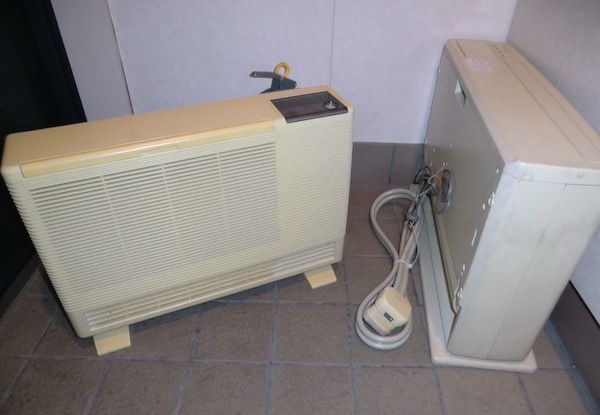
Yesterday we threw away two perfectly good heaters because we can’t use them in our new apartment. We also can’t sell tor even give them away, and it’s hard to shake the feeling that it was somehow planned to be this way. The heaters are made and sold by Tokyo Gas. Unlike standard gas heaters, which directly convert “city gas” piped into your home into heat, these draw hot water from your boiler (or, to use the redundant Americanism “hot water heater”). In that way they function in much the same way that baseboard heating does, except for one very significant difference. Baseboard heating is built into a house or apartment, and is generally designed in such a way that it doesn’t get in the way. These water heaters, on the other hand, are stand-alone boxes that do get in the way since they connect to wall outlets via thick hoses. Ideally, Tokyo Gas wants you to buy one for every room in your apartment, and priced at between ¥28,000 and ¥45,000, they can add up to quite an investment. Read More

Cheap fix

Here is a housing-related article we wrote for our sister blog at the Japan Times about a recent government study about reserve funds for condo repairs. It relates to a lot of the themes we have covered in this blog.