The burden of expectations (1)
What we have to work with

What we have to work with

Once you embark on a certain course of action, even if the motivation is basically speculative, matters often progress of their own accord. Though we hadn’t yet secured the plot of land we liked, the fact that for a month it was ours for the taking made us feel strangely possessive of it. It is only a ten-minute bike ride from our apartment, and in the weeks after our visit to A-1 we would drop by just to have a look at it and imagine what a house might look like sitting on it. Sometimes we would address a pressing consideration, such as: What is the Internet capability in this leafy corner of the city? It was a real consideration since our work depends on online access, and one day we asked the carpenter next door, who just happened to be outside puttering around, what sort of access he had. He didn’t, and didn’t seem to know anything about it since he didn’t need the Internet for his work and wasn’t a technophile. While we admired his resistance to the irresistible pull of modern life we also felt slightly taken aback. Were we thinking of moving into the Ozarks?

Later, we met another neighbor who assured us that optical fiber connections were available in the area, but the seed had already been planted. What about the water we’d be consuming from the well we’d have to dig? The carpenter said it tasted terrible and that he only used it for washing, while the other neighbor thought it tasted better than the city water he used to drink. We knew there was no accounting for taste, but that’s quite a gap in perception. The realtor said something about the depth of the wells: that the carpenter’s was shallow and the other neighbor’s much deeper, but that information only made us more confused and obligated to do even more research into the matter. In other words, coming to a decision about the land was going to be even more complicated than we’d thought. Read More

Easy go

New housing will always be a prime economic mover in Japan even as the population drops, so the sector needs all the help it can get. Right now new housing is seeing a boost due to the expected consumption tax increase next year. Buyers are trying to make deals before the tax goes into effect, but what happens afterwards? Real estate and housing companies are worried there will be an even bigger slump once that happens, so the government says it plans to allow financing rates of up to 100 percent for long-term fixed rate loans, or so-called Flat 35 mortgages. That means borrowers who qualify don’t have to put any money down. At present, a borrower has to put at least 10 percent down.

This happened once before. In 2009, when the recession was at its worst, the government allowed no-down-payment loans but it was a temporary measure and ended in March 2012. Of course, some people are worried since such loans are considered risky, so as part of the proposal screening of applicants will be made stricter, though the details have yet to be worked out. In addition, some of the Liberal Democratic Party’s ruling coalition partners want to provide handouts of up to ¥300,000 to people who are approved for housing loans but whose income is less than ¥5.1 million a year. This handout would offset the effect of the consumption tax increase. Read More

Comeback

housestocks13Last week Tokyo Shimbun published a brief piece about possible good stock picks for next year, and it seems most analysts in Japan are saying that anything related to housing is a good bet. “It’s one of the few industrial sectors with promise,” said one. The main reason, as we’ve already mentioned in our other blog, is the consumption tax hike. It’s assumed that many people who are considering buying a home will want to beat the rise in the rate, which means they will have to sign a contract for the home sometime in 2013 since the rate will go up from 5 to 8 percent on April 1, 2014, so the completed house or condo has to be “transferred” (hikiwatashi) to the buyer before that date if the buyer wants to avoid the higher tax. Consequently, a lot of people will be trying to buy a home at the last minute. (Land sales are exempt from the consumption tax)

According a construction research laboratory attached to the land ministry (obviously an amakudari outfit), the number of new homes that will be built in 2013 will exceed 921,000, the first time the 900,000 mark has been breached in five years, representing a 5.2 percent increase over this year. Consequently, two other economic research centers, Nissei’s and Daiichi Seimei’s, project investment growth in the housing sector to grow by 10.8 percent and 11.4 percent, respectively. Two-digit growth in any sector is considered really, really good in this economy, and should benefit everyone from house manufacturers and condominium developers to realtors, lighting equipment makers, and construction material suppliers. The big house manufacturers like Pana Home, Daiwa House, Sekisui Heim, and Asahi Kasei (Hebel Haus), will rake in the most because they can respond to mass orders more quickly and thus help those last-minute buyers get their place built before the tax deadline.

It should be noted that this only applies to new homes, since the consumption tax is only levied on companies that make more than a certain amount of money. For the most part used homes don’t apply since most of them are transactions between individuals with realtors simply acting as go-betweens–which means you pay the tax on their fee, but not on the price of the house or condo itself. So, again, there won’t be much stimulus for the used housing market.

Too late?

Last Friday, several media reported that the land ministry released a new white paper on land and property usage based on research carried out last year. The conclusion of the study is hardly earth-shaking to anyone who reads this blog, but it’s nevertheless noteworthy. The paper says that the market for older homes and commercial properties should be expanded by maximizing their value through renovation and rebuilding. Though the Cabinet Office’s recognition that Japan is overwhelmed by superannuated, deteriorating structures is a step in the right direction, it’s difficult to understand if anything can be done about the problem as long as policies for promoting new building continues as it is.

According to the government’s findings, more than 30 percent of office buildings in Japan are at least 30 years old, meaning they were constructed before current earthquake-proof standards were implemented. Consequently, 90 percent of “real estate investors” are not interested in these buildings. The paper recommends that they be quake-proofed in order to “increase the stock of good quality” structures. It also advocates promoting energy efficiency so as to make the buildings more desirable. Such renovation will “increase the value of real estate” in general by reducing running costs. The government also concluded that as a result of last year’s major earthquake people’s “thinking about real estate” has changed: they are now more aware of “land quality.”

None of the news reports we’ve read have indicated what the government will do, if anything, to follow up on the findings of the white paper. Tax breaks for people who fix up older properties? That might work but seems unlikely given the government’s current craze for tax increases. The construction industry will certainly welcome any renovation boom sparked by tax cuts but it isn’t going to be happy if such renovation comes at the expense of new building, which is where the money is. Increasing property values in that way has never really been in the government’s interest.

First-timers

In real estate parlance, there is a term for people who are buying a home for the first time: ichiji shutokusha. In fact, there are homes that are specially designated for these buyers. Almost all are condominiums, and to qualify for the ichiji shutokusha designation they have to have at least 60 square meters of floor area and cost less than ¥35 million. To put it succinctly, they are designed for families and are cheap.

According to the Asahi Shimbun, in 2010 80,204 brand new condominiums designated for ichiji shotuksha were put on sale in the Tokyo metropolitan area. That’s a little more than 18 percent of all the new condos that went on sale in the area that year and a little more than one percent less than the number put on sale in 2009. In fact, the share of new first-time condos among all new condos in Tokyo and its environs has been dropping since the turn of the millennium. In 2001, they accounted for 38 percent of all new condos, and for the next five years the share remained in the 30 percentile range. In 2007, the share dropped to about 25 percent and has been steadily dropping ever since.

The Asahi article doesn’t analyze why this is happening, though one could get a fairly good idea of why such condominiums would become less popular. The above-mentioned criteria would exclude the vast majority of new condos built within Tokyo proper, which is where most people in the region work. The majority of first-time condos are probably located in the far suburbs on inconvenient train lines, which means that their value depreciates even more quickly than condos in Tokyo or other major cities. They are also more difficult to sell, thus contradicting one of the salient features of a first home–it’s appeal as an investment, as a stepping stone to a larger house down the line. The standard middle class narrative says you buy a first house young and then trade up to something better and larger as your family grows. But if the value of your property shrinks over time, that sort of upward mobility is difficult to achieve, since you’re not going to get as much money as you paid for it; and the longer you hold on to the property, the less it’s worth and the less likely you can use the sale money to buy a “better” place. At least with a detached home, the land value may at least stay the same, but there is very little land value involved in condo sales. And since developers are always building new first-time condos that are more appealing than used ones, it becomes almost a self-fulfilling prophecy.

The farther Japan gets from the bubble period of the late 1980s–the last time when condo owners believed the value of their homes would increase–the more likely first-time condo buyers will opt for something that they think they can live in their whole lives, and that doesn’t necessarily include condos designated for ichiji shutokusha. Or, at least, that’s our analysis.

Home Truths: property taxes

Our Home Truths column this month, which appears in the Japan Times today, is about property taxes, a fact of economic life that is taken for granted. As we imply in the article, most first-time home buyers don’t really take taxes into consideration when they embark on the biggest purchase of their lives, presumably because, like death and…well, taxes, it’s something you can’t avoid so there’s no reason to worry about it. And maybe it isn’t, depending on where you buy property. Outside of large cities and productive suburbs, property taxes can be minimal. What we found troubling, and the reason we decided to write about it, was the frequent looks of bewilderment we received from real estate agents when asked how much a particular property would run a buyer in terms of annual taxes. Some knew approximately, but some said they didn’t know at all and would check at the office (and then never called back because they sensed–rightly, in most cases–that we weren’t that interested in buying in the first place). This was odd in more ways than one. In the most significant way, property tax should be something a realtor knows by heart, since it has a direct bearing on the financial ability of the buyer to maintain whatever loan repayment schedule he or she will be responsible for. In a less signficant but more bizarre way, many real estate companies actually print the annual property tax levy in the ads for properties, so for their agents to profess ignorance is just downright laziness, and also indicates that none of them are ever asked such questions by potential buyers. In other words, the inevitability of property taxes has rendered them a moot concern; maybe people just prefer not knowing. Read More

Dynasty end

Unwanted

In 1941, 22 percent of all dwellings in Japan were owned by the people who inhabited them. By 1948, the portion had swelled to 48 percent in the cities and 67 percent nationally. Even before the war housing was at a premium, but thanks to the wholesale destruction of the Japanese archipelago during the final years of the war, it had become even more dear when the American occupation started. Inflation was rampant, and in order to make sure property prices didn’t spiral out of control a directive was issued in 1946 to freeze land prices and rents. It wasn’t the first time. Similar directives were issued in 1939 and 1940, but they were provisional. The 1946 directive was more open-ended, and the result was that landlords couldn’t raise rents. One of their countermeasures, at least in Tokyo, was to implement the now infamous koshinryo system: Every time the rental agreement expired, the landlord would charge the tenant an extra month or two worth of rent as a renewal fee. (This will be the topic of our next “Home Truths” column in the Japan Times on Tuesday) However, most landlords, unable to pass on maintenance costs, simply sold the properties to their tenants. Moreover, there was no incentive to build new rental properties, so construction companies started building houses for the few people who could actually afford to buy them. Ever since then, there have been more homeowners than renters in Japan.

The home ownership rate first peaked to 71 percent in 1958, then slid down to 64 percent by 1963 and 60 percent by 1968. The main reason is that more people migrated to cities for jobs. They couldn’t afford to buy houses, so more rental properties were built in urban and suburban areas. However, by this point home ownership became a national priority, since it spurred growth. With the population increasing and nuclear families replacing extended families as the household norm it wasn’t difficult for the government to promote home ownership through schems such as the Home Finance Law (1950), which made mortgages affordable; and the Public Housing Law (1955), which set up a government corporation to oversee the building of affordable rental properties in cities so that young families had a stepping stone to home ownership. The main problem is that in order to make home-ownership possible for the new generation of urban workers they had to be made relatively cheaply, since land prices have always been high. In other words, the houses themselves weren’t meant to outlast their mortgages. Read More

The price you pay

The following is an article I wrote in 2004 for an occasional column that I and several other non-Japanese wrote for the Asahi Evening News about the “expat” experience in Japan. In a way it explains our skittishness about buying property today.

Naive days: The land when it was pure

In the early 90s, my partner and I discussed the possibility of buying a condominium or a house. Both of us had recently become self-employed and our financial situation wasn’t assured, so we talked about buying property as if it would occur sometime in the middle-distant future, meaning not soon enough that we needed to start looking right away.

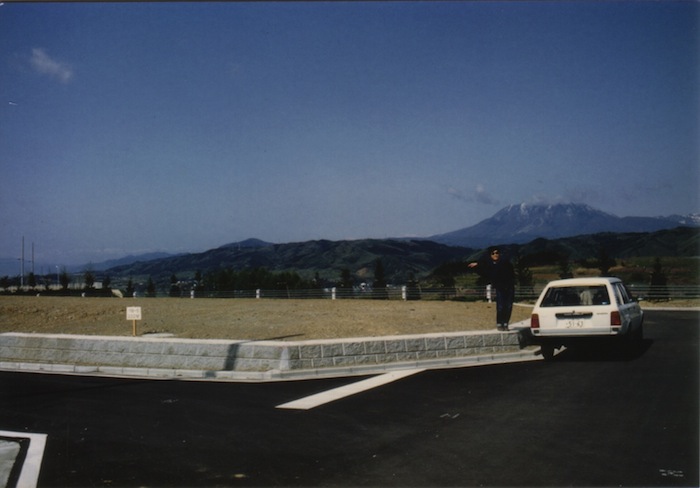
Our friends knew of this vague plan, and once, while visiting a couple we knew in Nagano prefecture, they told us of a housing scheme being promoted by a nearby local government. The city was developing a large piece of land on the top of a hill and offering plots by lottery at below-market prices. The stated aim was to attract new people to the city, which had been losing population over the past decade.

We went to the lottery drawing not thinking that we would participate, but our friends talked my partner into picking a number out of the hamper just for fun. The odds against actually winning were almost ten-to-one. But she did.

Everything suddenly changed. The prospect of buying property had so far been theoretical, but now we had to face the decision head on because we had been given an opportunity.

We returned home and agonized over whether or not we should buy the land. On the plus side, it was very cheap and the lot we had “won” was located on a corner of the hill with an unblocked view of a green valley. On the minus side, we would have to move to Nagano and we would have to build a house, but as we talked these negatives slowly moved over into the positive column. Because of the nature of our work (mostly writing and translating) we didn’t need to live near Tokyo, and having to build our own house meant that we could build the house we wanted. Read More

Beware the realtor

Future dream home or heartache?

According to the land ministry, in 2009 60,000 properties were put on the auction block due to failure to meet mortgage payments. That’s a 30 percent increase over the number of auctions in 2008. Meanwhile, 800,000 new homes, including condos, were built in 2009.

The Asahi Shimbun yesterday ran a story about two such delinquencies that happened to neighbors in a town in Chiba. Both of the houses involved were built in 2001 in a small, cramped development of six buildings about 10 minutes walk from the nearest train station, which the article declines to identify. Three of the houses have changed ownership since they were first sold.

One of them is a two-story, 130-square-meter house that still looks relatively new. It was originally bought by a dump truck driver, who is now 61, for ¥22 million, which is a fairly reasonable price for a house that size which is 90 minutes from the center of Tokyo. Read More

Interest drops

Think you can afford it now?

For the first time in seven years the long-term interest rate in Japan dropped below 1 percent, which should be good news for people in the housing and construction business, not to mention potential homeowners. The reason is less encouraging. Because the US economy continues to be sluggish, more people are purchasing Japanese government bonds and yen.

Consequently, the government will reduce the interest rate for Flat 35 housing loans starting in August, which are government-supported mortgages for between 21 and 35 years. Depending on how many years your mortgage is for, the interest rate will be from 2.3 to 3.2 percent, which compares to about 4.6 percent in the U.S. right now.

Though this development will certainly spur home purchases, it would be better if savings interest rates weren’t so low and salaries were rising. As it is, a lot of people just don’t have enough faith in the future to sink everything they have into a house or condominium.