Make mine maglev (6)

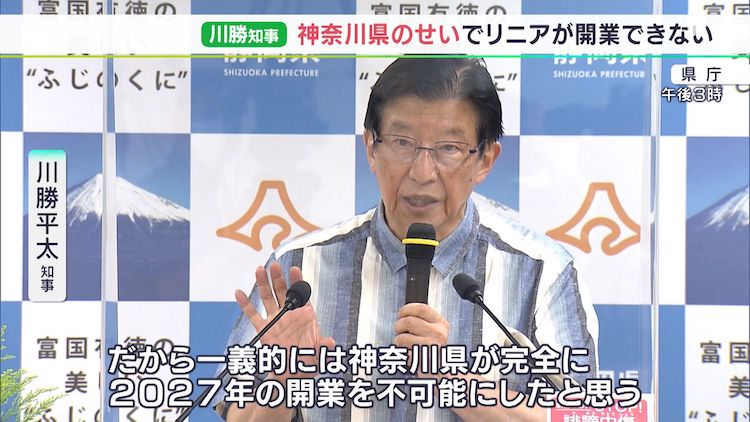
After years of delays, the Shizuoka section of the ambitious Chuo Shinkansen project, better known in Japanese as the “linear motorcar” and in English as the maglev, which will be able to shuttle passengers from Tokyo to Nagoya in as little as 40 minutes, has finally been given the formal go-ahead by the prefecture, thus prompting JR Tokai, the company in charge of it, to declare that now the real work starts. Given that the project was initiated around the turn of the century and the excavation of the 256 kilometers of tunnels needed to complete the route from Shinagawa in Tokyo to Nagoya has been ongoing for more than ten years, JR Tokai’s declaration requires clarification; but, indeed, in the larger scheme of things the Shizuoka section of the tunnel, though a mere 8.9 km in length, is perhaps more central to the project than any other in that it is probably the most difficult to carry out technically.
According to a series on the maglev in the Asahi Shimbun that commenced July 23, experts have said that building the Shizuoka tunnel section may be the most difficult construction project in the history of Japanese civil engineering. Twenty-five kilometers of the tunnel needed for the maglev—almost 90 percent of the Shinagawa-Nagoya route is underground—runs below the Southern Alps, some of which towers 3,000 meters above sea level. The Shizuoka section is smack dab in the middle of this portion and will be located between 500 and 1,400 meters below the surface. The deepest tunnel in Japan ever excavated is the Oshimizu Tunnel on the Joetsu Shinkansen line, which opened in 1982 and is 1,300 meters deep. But while there is some experience to fall back on, the Shizuoka section still poses some formidable challenges.
Two tunnels have to be built: the primary tunnel that contains the tube for the train, and the “advance” tunnel that delivers the equipment and personnel to the underground site where the tunnel is being excavated. The dimensions of the primary tunnel are 13 meters in width and 8 meters in height. Eventually, the advance tunnels will be refitted later as evacuation and maintenance tunnels.
According to one expert interviewed by Asahi, the area of bedrock that the tunnel will pass through is located at a nexus between two tectonic plates, and the friction between these two plates means that one of them rises 3-4mm a year, a substantial shift in geological terms. The pressure on the tunnel tube will constantly be affected. As the tunnel is excavated, some of this pressure is alleviated, thus causing possible deformation of the tunnel over time.
JR Tokai says it will use controlled explosions to cut through the bedrock at sections of between 1 and 2.5 meters. These blasted sections are then connected and reinforced with concrete to form an arch using steel supports with thick bolts driven deep into the surrounding bedrock so as to distribute the pressure more evenly. The expert, however, points out that since the tunnel is being built through two faults and different consistencies of bedrock, challenges the construction of the Oshimizu Tunnel did not have to address, they don’t know how things will work out until they actually do it.
Read More