Nihongo needed

Last April the city of Fukui adopted a “guideline” in its municipal public housing regulations that stated non-Japanese who applied for low-income housing must be able to “communicate in Japanese.” Applications for those who cannot will not be accepted. Since then various groups that work with foreigners in Japan have protested the guideline, but it still stands. Some of these groups have said that they are aware that some non-Japanese applicants, though they qualify for public housing otherwise, have been prevented from applying for housing due to the new guideline.

There are nine cities in Fukui Prefecture, but only Fukui City has such a rule. The city official in charge of public housing told a local newspaper that his office had received complaints from community associations (jichikai) of individual public housing complexes. These associations said that some non-Japanese residents were unable to communicate “very well” in Japanese, and thus it was difficult for them to understand and follow association rules regarding the “sorting of refuse” and “noise.” For that reason, the city government adopted this new guideline. Read More

Public housing on the ropes

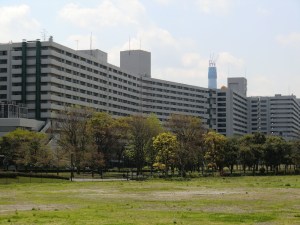
Housing complex along Sumida River run by Tokyo-to

There are two types of public housing available in Japan. A national public corporation called UR runs semi-public housing whose rents are pegged to property values. Meanwhile local governments at the prefectural and municipal levels provide housing for low-income families and individuals. Last week, the Asahi Shimbun surveyed this latter category among Japan’s 47 prefectures and 19 major cities. The newspaper found that 1/3 of these entities planned to reduce the number of units of low-income housing in the future.

In fact, the only two local governments who said they planned to increase low-income public housing was the prefecture of Okinawa and the city of Sagamihara in Kanagawa Prefecture. Everyone else said they either would keep the number they already have, or had not made any plans at all.

The governments who said they would decrease public housing stated as their main reason the declining population. The second most common reason was difficulty in securing funds for maintenance of existing housing. Two prefectures said they were planning on rebuilding their housing facilities, since the bulk of low-income public apartments were built in the 60s and 70s. When they carry out the reconstruction work, they will probably reduce the number of units per building. Another reason that wasn’t mentioned as often but certainly had a significant impact is the fact that subsidies for public housing from the central government have dropped by 40 percent in the past ten years. Read More

Vacancy rate to soar

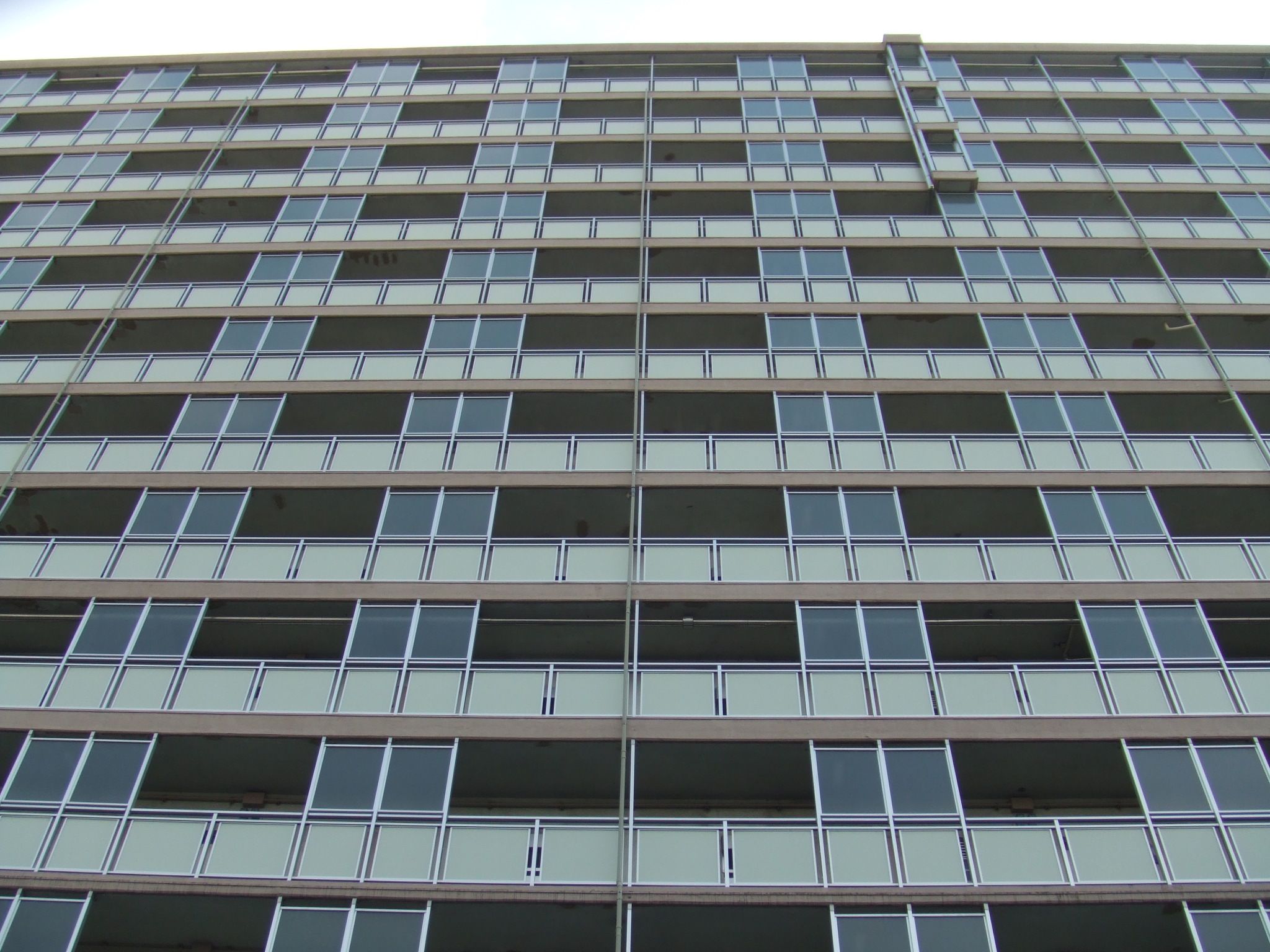
This baby’s only 40 years old!

Japan will shortly start paying for its shortsighted housing policy with a depressed real estate market that will probably never recover, according to findings by Nomura Research Institute. If the depreciation of home values continues at its current rate and the number of new home construction is the same as it was in 2003 (1.2 million units), then the vacancy rate for all dwellings in Japan will be 43 percent in 2040. And even if new home construction is halved over this period of time, the vacancy rate in 2040 will be 36 percent.

Of course, that’s a completely hypothetical situation and probably doesn’t reflect what will really happen since in 2015 it’s projected that the total number of households in Japan will start to decline. In 2008 there were 50 million households in Japan and 57.5 million housing units, meaning that the vacancy rate in that year was 13 percent. Read More

Passing unnoticed

It’s a long way to the bottom

A recent article in the Mainichi Shimbun mentioned a study carried out by 98 local governments that operate public housing. In 2009, this study found, 1,191 people who lived in these public housing units died alone and in most cases their deaths were not discovered for at least several days. The vast majority of these people were over 65, about 74 percent. In addition, the Mainichi said that UR, the semi-private housing corporation attached to the national government, reported that 472 people over 65 died alone in apartments they run nationwide in 2009.

This seems to be the first time any housing entities have recorded and publicized statistics related to kodokushi (dying alone), which will become much more common as the population ages. A greater percentage of elderly people live in public housing, not just because it can be cheaper (UR rents, however, are market rates), but because private landlords usually don’t like to rent to older people who plan to live by themselves, for reasons that aren’t difficult to figure out.

Another reason why older people tend to live in public housing is that they’re already there. A lot of public apartments were built in the 60s and 70s. People moved in and had families. Their children moved out and a spouse died, thus leaving them alone.

A more troubling aspect is why these people die alone and aren’t discovered days or even weeks after they do. The vast majority tend to live in cities, and urban apartment life discourages the kind of community life that nurtures relationships. It’s difficult for older people to leave their apartments, take the elevator down, and go out to see people; and obviously it’s less likely for acquaintances to drop by the way they would if the older person lived on the ground.

UR 2010

We took in the new Heart Island Shinden public housing complex a few weeks ago, which is scheduled to start accepting residents sometime in November. Heart Island Shinden is essentially a strip of land between the Arakawa and Sumida Rivers where they come the closest to each other, and though the closest stations are Oji on the Keihin Tohoku Line and Oji Shinya on the Namboku subway line, both of which are in Kita Ward, Heart Island Shinden is in Adachi Ward. It’s more than a 20-minute walk from either station, even if you move fast, so most people take a bus.

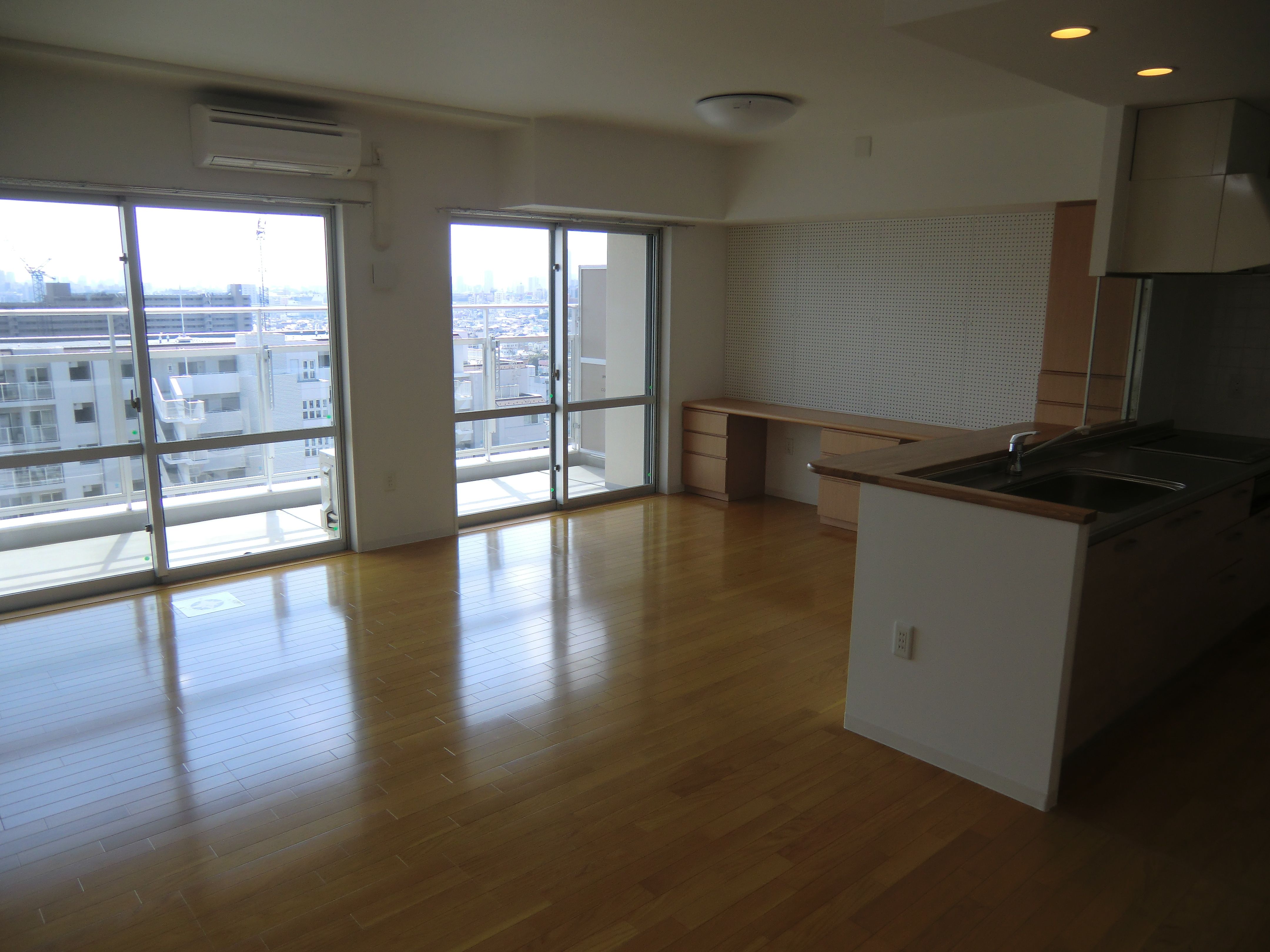
Even before the new complex was built, the area was already home to a number of apartment complexes, both private and public. In fact, it’s a veritable forest of mini-skyscrapers. The one we visited is operated by UR (Urban Renaissance), the main semi-public housing corporation in Japan. We live in a UR building that was completed in 2000, and in the decade since then we’ve often visited newer UR buildings to see what improvements they’ve made. What we’ve found is that which each new project ameninites get added but the basic problem with Japanese apartment living–namely, impractical layouts–remains, due to a habit of prioritizing 3-dimensional efficiency over baseic livability. In other words, floor plans are dictated by box-like patterns that allow developers to maximize space and fit as many units as possible given the land area and height of the building. The two wings of the HIS complex are 9 stories and 14 stories, which is about the same as the other buildings in the area, thus indicating that there is a height limit. (The building we live in is 38 stories) Read More

Name game

Eight of Japan’s biggest real estate companies have joined forces to run a website called Major 7 (why 7 and not 8 I have no idea), which features articles about condominiums. Last summer the group conducted its annual survey to find which urban location is the one where people would most like to buy a condo if they could. For the sixth year in a row the number one answer in the Kansai region was Ashiya, which isn’t surprising. Ashiya, in Hyogo prefecture, has always had a high class reputation owing to the simple fact that rich people tend to live there and most of the city is located on a hill.

The most popular place in the Tokyo Metro area was Kichijoji, for the third year in a row. (For the record, the next nine preferences in descending order are Jiyugaoka, Yokohama, Futago Tamagawa, Ebisu, Hiroo, Kamakura, Meguro, Kagurazaka and Naka Meguro) The website doesn’t explain why Kichijoji is popular, but it isn’t difficult to guess. Tokyoites see it as youth haven filled with trendy retailers and which is close to a famous park. The preference is aspirational rather than practical, however, especially if you look at what’s available. Most available units for sale near Kichijoji station are small, cramped and expensive. You have to go at least 15 minutes from the station before you find something that might be habitable for a family: ¥31 million for a 60 square meter 2LDK, which is also a bit old and probably run down. If you want something new, you’ll pay through the teeth. A new 70 square meter apartment will put you back a whopping ¥75 million. The prices are, on average, much higher than comparable units in areas closer to the center of Tokyo.

It’s completely a name thing, and realtors know that. Kichijoji is in Musashino City, and when advertising condos or even rental apartments, many real estate agents list the nearest station to a Musashino property as being Kichijoji, even if it’s much closer to, say, Mitaka. Of course, if you live in Mitaka you can always get off at Kichijoji station and take a bus home. That way you can tell your friends you live in Kichijoji, but sooner or later they’re going to catch on.

What’s that smell?

Though Japan remains a relative oasis for smokers, rules and regulations regarding demon tobacco continue to get more stringent, and some 50 percent of smokers have said in surveys they plan to quit when cigarette taxes are increased next month. The thing is, it’s getting more and more difficult to find a place where you can smoke in peace. It’s even getting difficult to light up at home.

This is especially true of smokers who live in apartment buildings or condos. A neologism that has popped up recently is “hotaru,” which means “firefly” and refers to men (it always seems to be men) who go out on their balconies to have a smoke. They are called “fireflies” because the glowing ash of their cigarettes give them away in the dark. Either these men are saving their families from their habit or the families have banished them to out-of-doors, but in any case their exile to the veranda often irks the neighbors, especially those who live upstairs. Newspapers are increasingly filled with letters to the editor complaining of the hotaru scourge, with writers claiming that the smoke from neighbors’ cigs aggravates their children’s asthma or discolors the window sashes or forces them keep the windows shut in hot weather.

In condominiums these hotaru-zoku (tribe of fireflies) cause all sorts of communal rifts, especially since verandas are considered “common space,” and in more and more coops smoking is banned in common spaces. Building managers have to enforce these rules, which is pretty difficult to do. After all, what kind of punishment do you impose? You can’t kick the guy out, he owns the apartment.

The single life

Statistics recently released by the Health, Labor and Welfare Ministry show that the number of single parents is on the increase, and has been since 2006. This makes sense since the divorce rate is also rising, but what’s makes the statistics noteworthy is that more and more single mothers are women who have either never been married or were married but gave birth after their marriage ended.

Right now, the ministry estimates there are about 1,520,000 households in Japan headed by single monthers, and about 200,000 headed by single fathers. Though the statistics are a bit old, the Ministry of Internal Affairs conducted surveys of “never-married” single mothers in 2000 and 2005, and between those two years the number of single mothers between the ages of 15 and 49 increased by 39 percent. However, when you break this number down by age groups, you find that the biggest increases are among women over 30: 57 percent for 30-34; 45 percent for 35-39; and 56 percent for 40-44. In terms of real numbers these increases don’t represent very much since the portion of children born out of wedlock in Japan is only about 1 percent. Read More

Yuzawa’s last resorts

Yuzawa-machi

In 1987, at the height of the so-called bubble era, when land and stock prices were on a bender, the Diet passed the Law for the Development of Comprehensive Resort Areas, whose idea was to make the development of leisure facilities a national project. Developers and local governments were given financial incentives, and property laws were relaxed so that more holiday-oriented projects could be carried out. One of the outcomes of the law was the invention of the “resort mansion,” condominium complexes that were built in outlying areas where city folk could spend their vacations. Read More

Beware the realtor

Future dream home or heartache?

According to the land ministry, in 2009 60,000 properties were put on the auction block due to failure to meet mortgage payments. That’s a 30 percent increase over the number of auctions in 2008. Meanwhile, 800,000 new homes, including condos, were built in 2009.

The Asahi Shimbun yesterday ran a story about two such delinquencies that happened to neighbors in a town in Chiba. Both of the houses involved were built in 2001 in a small, cramped development of six buildings about 10 minutes walk from the nearest train station, which the article declines to identify. Three of the houses have changed ownership since they were first sold.

One of them is a two-story, 130-square-meter house that still looks relatively new. It was originally bought by a dump truck driver, who is now 61, for ¥22 million, which is a fairly reasonable price for a house that size which is 90 minutes from the center of Tokyo. Read More