Big One

A view to die for

I certainly don’t believe any of that “divine retribution” crap, which happens to unify the philosophies of right wing broadcaster Glenn Beck and Tokyo governor Shintaro Ishihara; but I can appreciate a cosmic joke. The massive earthquake that hit northeast Japan on Mar. 11 came right in the middle of moving season. The Japanese fiscal year, not to mention the school year, begins April 1 or thereabouts, and traditionally many people move house during the month of March, because of job transfers, university admission, or they just like to do what everybody else is doing. Consequently, there were a few trucks outside our 38-story building the weekend after the quake, carrying furniture for folks who were moving in. Fortunately, the freight elevator was operational again by the morning of the 12th, but what did those new arrivals think standing in their new apartment while it swayed back and forth during one of the many aftershocks?

Who knows? Maybe they were in a high-rise before, but in any case the quake helped test a theory, at least partially: Would all these earthquake-proofed structures actually withstand a massive quake? Of course, the epicenter of the one we experienced was a hundred kilometers off the coast of Iwate Prefecture, but according to reports, no buildings collapsed in Sendai, the nearest large city to the quake and one with its own share of skyscrapers. So the technology seems to work, and while it certainly saves lives and property, it doesn’t solve a more intractable problem: Once you’ve been in a large earthquake in a high rise, you don’t want to be in another one. Read More

The price you pay

The following is an article I wrote in 2004 for an occasional column that I and several other non-Japanese wrote for the Asahi Evening News about the “expat” experience in Japan. In a way it explains our skittishness about buying property today.

Naive days: The land when it was pure

In the early 90s, my partner and I discussed the possibility of buying a condominium or a house. Both of us had recently become self-employed and our financial situation wasn’t assured, so we talked about buying property as if it would occur sometime in the middle-distant future, meaning not soon enough that we needed to start looking right away.

Our friends knew of this vague plan, and once, while visiting a couple we knew in Nagano prefecture, they told us of a housing scheme being promoted by a nearby local government. The city was developing a large piece of land on the top of a hill and offering plots by lottery at below-market prices. The stated aim was to attract new people to the city, which had been losing population over the past decade.

We went to the lottery drawing not thinking that we would participate, but our friends talked my partner into picking a number out of the hamper just for fun. The odds against actually winning were almost ten-to-one. But she did.

Everything suddenly changed. The prospect of buying property had so far been theoretical, but now we had to face the decision head on because we had been given an opportunity.

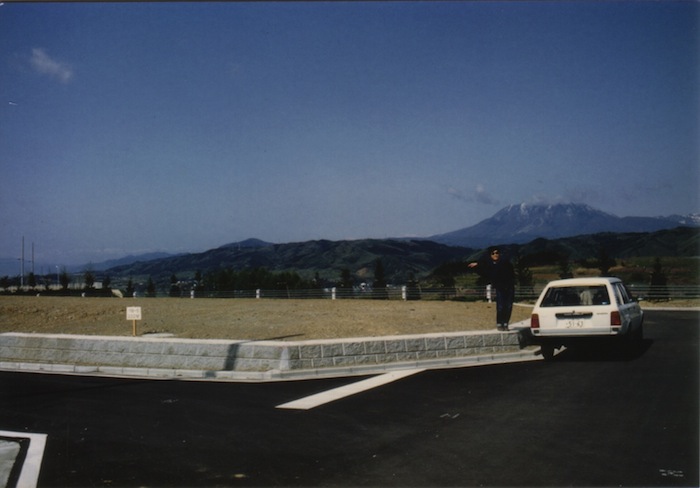
We returned home and agonized over whether or not we should buy the land. On the plus side, it was very cheap and the lot we had “won” was located on a corner of the hill with an unblocked view of a green valley. On the minus side, we would have to move to Nagano and we would have to build a house, but as we talked these negatives slowly moved over into the positive column. Because of the nature of our work (mostly writing and translating) we didn’t need to live near Tokyo, and having to build our own house meant that we could build the house we wanted. Read More

A tale of two properties

Dark floor, dark room

Across and further down the Sumida River from our apartment is a large condominium complex that has intrigued us ever since we moved here. Legend has it that the late rocker Yutaka Ozaki had just moved into it when he was found not far away in an alleyway one night, dying. It’s a good legend, and like many legends it’s not true. At the time Ozaki was renting a much more commonplace sort of “mansion” in the same neighborhood. But it’s easy to understand why this particular complex has attracted that sort of speculation. Every so often somebody moves out and you see a flier in the mailbox advertising the unit, which tends to fetch a price comparable to new condos even though it was built in 1991. The layouts are more imaginative and seem more livable than those of most condos. Rather than cut a box into rectangles, the designers staggered the position of the rooms along corridors and shaped the building in such a way that every unit looks out on at least two views, meaning there’s more sunlight; or that’s the impression one gets looking at the layout and then at the building’s exterior.

Last week, we finally visited the complex after we saw a flier announcing that two adjacent units on the 14th floor were on sale: a 67-square-meter 2LDK for ¥28 million and a 94-square-meter 3LDK for ¥38 million. Though both of these prices were out of our league we wanted to see what was really there, and were quite shocked at what we found. Read More

UR Ogikubo

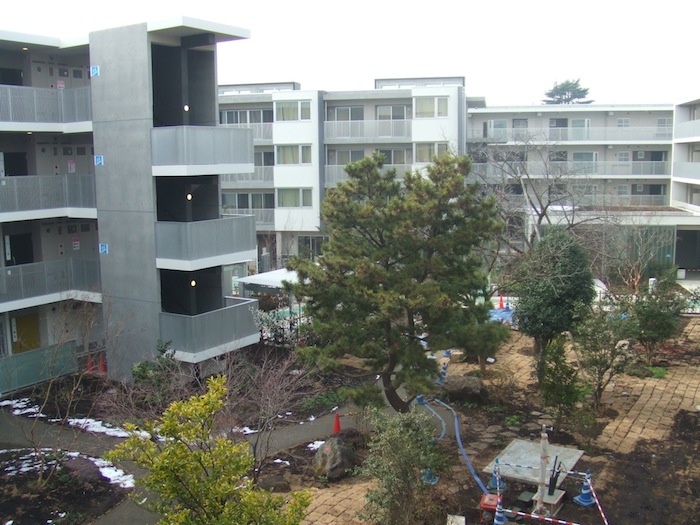
Unfinished courtyard

Japanese apartment complexes often have pretentious, unwieldy names that are meant to add a touch of cosmopolitanism to otherwise nondescript residences; something you might expect from an industry that managed to convince people to adopt the English word “mansion” for condominiums. Earlier this week when we went over to Ogikubo in Tokyo’s western Suginami Ward to inspect the new UR apartments that are starting to accept applications for tenants I couldn’t quite make out the name, which sounded French, and I neglected to write down the romaji iteration after we got there, though I do remember is started with a “C” and had an “X” and some consecutive combination of “E” and “I.” Maybe a “U,” too; but whatever it was I couldn’t pronounce it on sight. Having returned home I see it rendered in katakana as シャレール. So let’s just drop the whole thing and call them the Ogikubo UR apartments. Read More

Insulate it

Polystyrene

Recently, there was a conversation on Twitter about insulation, which outside of Hokkaido has only caught on recently in Japan. I’ve heard more than once that Japanese homes are built for summer, but older, traditional Japanese houses did a fair job of conserving heat, since most were designed with roka (hallways) around the perimeter of the house, which meant there was a space between the walls of the inner rooms and the exterior walls and windows. But since the war and even before, Japanese houses have become boxier in order to accommodate smaller parcels of land near large cities so that middle class families could afford them. Since insulation per se wasn’t an integral consideration of traditional homes, no one really thought to incorporate it in the new style. People just bought more kerosene. Read More

Taking shopping arcades seriously

Shotengai in Sanya, Tokyo

Shotengai, or shopping arcades, have been moving toward extinction for several decades now, the victim of increased motorization, new laws favoring large chain retailers, and the economic slump in general. Composed of small, family-run stores that invariably coalesced into merchant associations, shotengai were the social and commercial hearts of communities in both rural towns and huge cities. The death of the shotengai in the countryside has given rise to a new phenomenon called shopping refugees (kaimono nanmin): residents, most of them elderly, who are effectively cut off from retail areas because local family merchants have closed down and they have no easy access (i.e., driver’s licenses, vehicles) to shopping malls. Some local governments and chain retailers are addressing this problem by helping the refugees reach retailers, but there are also communities that refuse to let their shopping arcades fade into memory. Read More

Excited about nothing

Sort of exotic

The TBS consumer news variety show Gatchiri Academy is usually pretty thorough about its advice, since it features a panel of economists and financial journalists whose opinions vary widely from one to the other. However, the other night, during a segment about resort condominiums, the information provided was maddeningly incomplete. As described here and here on this blog, resort condos are pretty cheap owing to the simple fact that too many were built and demand isn’t so hot any more. Gatchiri visited several vacation areas, including the Izu Peninsula and the Naeba ski resort in Niigata. The whole point of the segment was to jolt the audience with prices too low to believe. Actually, what was difficult to believe was that people paid so much for these cubbyholes when they were built twenty years ago. In one segment, a talent-reporter, in the company of a local real estate agent, inspected a 60-square meter condo in Izu that originally sold for about ¥25 million, and her jaw dropped when the realtor revealed how it now goes for less than 10. Mandibles literally hit the floor in Naeba, however: one and two-room condos for as low as ¥500,000?! Where do I sign?

That was the general vibe, anyway. What was infuriating was that nobody mentioned the real reason why these places were such bargains. For a split second, each property’s particulars were flashed on the screen, and these particulars may have included the yearly property tax fee you’d have to pay. But I didn’t see or hear any mention of the maintenance (kanri) or common repair (shuzen) fees that a resort condo owner has to pay every month. So when one of the financial writers commented that at such low prices it didn’t really matter whether or not the property continued losing value (which is most certainly would), he was, purposely or not, deceiving viewers who might be considering dropping a mill or two for a nice getaway. Maintenance fees normally run between ¥10,000 and ¥50,000 a month, and repair fees about half that, so the cost of keeping a resort condo could conceivably end up outstripping the value of the property after a few years. That’s fine if you plan to use it often, but the main reason these places are so cheap is that the majority of people don’t have that much free time, something that they realize too late. The financial writer also hinted that, with prices this low, you could just abandon the property without much trouble; but that’s a lie. You still have to pay the fees and the taxes, forever.

Go here to get a better idea of what’s available.

Nouvelle Akabanedai

#7 & #6 blocks

It’s tempting to wonder what Akabanedai would have turned into had various government bodies not decided to turn it into an almost exclusive zone for danchi, meaning public housing complexes, back in the 1960s. It was the first major danchi complex within the 23 wards of Tokyo, located on a hill that steeply overlooks Akabane Station in Kita-ku, not far from the Saitama border, and it was considered cutting edge by danchi standards when it opened in 1962, on a par with Matsudo. When I lived near Ukima-Funado Station on the Saikyo Line during the latter half of the 90s, I often walked to Akabane Station, which meant climbing the hill from the north side and walking through the danchi, which was huge, a veritable mini-state with its own complement of retailers that, at the time, appeared to languish in a commerical funk. Akabane, which teemed with restaurants and funky little drinking establishments; a large and well-used Ito-Yokado; and even a fair-sized bawdy district with Philippine hostess clubs and “cabarets,” was just a few minutes away, down a steep flight of steps at the edge of the tunnel that ran below the housing complex. Though the danchi was still the home to thousands of families, the dissipated atmosphere characterized by the sad retail component gave it a cast of desperation. I don’t remember ever seeing anyone patronizing these establishments.

But had it not been developed as a danchi, Akabanedai might have attracted a richer sort of homeowner. (It was a factory district on nationally controlled land before the danchi was built) There are lots of trees and vegetation up there and a fairly extensive park system; and the view, when it isn’t blocked by another public apartment building, can be breathtaking. Read More

Absentee owners

Last night NHK’s documentary series A to Z covered the phenomenon of abandoned houses. Based on local government statistics, it’s assumed that there are 100,400 unoccupied houses in Tokyo alone, a 40 percent increase since 1998. The number of abandoned homes in Tokyo increases at a rate of about 3,000 a year. NHK limited its coverage to the mostly residential areas of Setagaya and Suginami Wards, finding “at least” 500 houses that looked to be abandoned, of which they isolated 103 for more detailed study.

Study in this case meant talking to neighbors and local officials about the state of these homes, most of which were in severe states of disrepair, as well as finding out who the owners were and why they weren’t living there or keeping the properites up. Understandably, neighbors were quite concerned, not just with the eyesore aspects–some properties were magnets for refuse and overgrown with weeds and vines–but because they were fire hazards. Abandoned homes are often the targets of arsonists.

Ward officials receive complaints from neighbors about abandoned homes on a daily basis, but legally there is little they can do. It’s a Catch-22 situation: They need permission from the owner of a property before they can set foot on it, and in most cases they cannot locate the owner. In some instances, the owner has died and no heirs can be found; or, as in the case of one woman, a painter who died several years ago, her son was eventually located by NHK and said he had had “no connection” with his mother for many years. One owner of a house in Adachi Ward died with a lot of debt, so it’s assumed that his relatives have not come forward to claim the property because they are afraid they will have to assume that debt along with the property.

However, in some cases the neglect is on purpose. Officials know of some cases where the title of a property was taken over by a relative after the death of the owner or was sold to a third party. These new owners are simply waiting for the value of the plots to increase so that they can sell them for profit, but in the meantime they aren’t maintaining the properties. Of course, the houses in almost all these cases are worth zero, but in any of the 23 wards of Tokyo the land on which they stand could be quite valuable. One property in Setagaya that NHK checked was worth ¥200 million, but no one has seen the owner in at least ten years.

Burned at both ends

The Democratic Party of Japan has disappointed many of its supporters since coming to power a year-and-a-half ago. Some of the party’s most progressive proposals have either been shelved or abandoned. One of the less discussed promises has to do with chukai tesuryo, or “intermediary fees” that are charged by realtors when they broker a sale of a house by the owner.

In its INDEX 2009 statement of policy, the DPJ pledged to move away from home ownership as the primary housing policy goal and boost rights for renters, whom previous Liberal Democratic Party governments all but ignored. In addition, the DPJ said it would limit realtors to charging intermediary fees to only one of the parties in a housing sale. According to the law, when a previously occupied home is sold, the realtor can charge a fee equal to no more than 3 percent of the price of the house + ¥60,000 + consumption tax. For a ¥25 million house or condo, the fee would be ¥855,000. What bothered the DPJ is that the realtor can charge this fee to both the seller and the buyer, meaning for that ¥25 million home it can clear a cool ¥1,710,000. The party pledged to make it a law that the realtor can only charge this fee to one or the other party but not both. (Note: there are no fees when the realtor itself is selling a house or when the house is new and being sold by a developer.)

As with the pledge to support renters, the promise to control fees remains in limbo, and it’s not clear what exactly the DPJ hopes to bring about by limiting the fee to one party in a home sale. For sure, the extraneous fees that come with buying a home can be intimidating: title registration, bank fees for loans, loan insurance. In the end, a buyer pays anywhere between 5 and 10 percent of the price of the property in fees. In any case, no realtor charges less than the 3 percent ceiling, which means that the whole industry acts like a cartel. There’s no competition, though theoretically there could be. Most properties list with multiple real estate companies, so it’s possible a prospective buyer could play one against the other: Give me a deal on the tesuryo and I’ll work with you instead of the other guy.