Wasted

Planned obsolescence

Moving house is a pain in the ass, but it can also be a rush. Basically, you shlep your entire life to a new abode and in the process assess that life in concentrated form. Inevitably, you are forced to pick and choose what you want to keep from it and what you want to discard. Some things you get rid of simply because you want to get rid of them, and some things you get rid of simply because you have to.

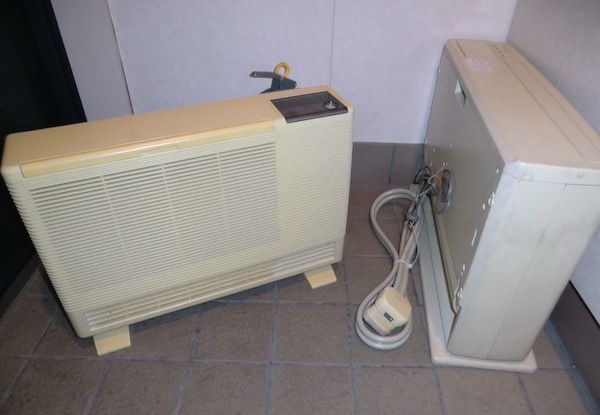
Yesterday we threw away two perfectly good heaters because we can’t use them in our new apartment. We also can’t sell tor even give them away, and it’s hard to shake the feeling that it was somehow planned to be this way. The heaters are made and sold by Tokyo Gas. Unlike standard gas heaters, which directly convert “city gas” piped into your home into heat, these draw hot water from your boiler (or, to use the redundant Americanism “hot water heater”). In that way they function in much the same way that baseboard heating does, except for one very significant difference. Baseboard heating is built into a house or apartment, and is generally designed in such a way that it doesn’t get in the way. These water heaters, on the other hand, are stand-alone boxes that do get in the way since they connect to wall outlets via thick hoses. Ideally, Tokyo Gas wants you to buy one for every room in your apartment, and priced at between ¥28,000 and ¥45,000, they can add up to quite an investment. Read More

High anxiety

You can’t get there from here

Since the earthquake of Mar. 11, I have been extra sensitive to stories of people living in Tokyo high-rises and have expected to see more dispatches like the one I wrote above. Interestingly, they’ve been few and far between, and mostly dwell on how well these high-rises performed during the earthquake. I said as much in my blog post, but that’s not the most salient observation I took away from the experience and I doubt if others who live in tall buildings did as well. Then, last week Asahi Shimbun printed an article relating the experiences of two koso mansion owners. Unfortunately, since then the story is gone from the Asahi.com site, either locked behind a pay wall or taken off completely. I doubt the latter, but M. says she read a few tweets from people who thought Asahi might have been pressured by developers or real estate companies, who are big advertisers. That seems a fairly conspiratorial take on the matter, but one thing’s for sure: New high-rise luxury condos have been one of the few reliable success stories in the Tokyo real estate market in the past few years.

In the article, a 32-year-old full-time housewife was in her 55th floor apartment in Chuo Ward when the quake struck. She ducked under a table. The swaying lasted for a full five minutes. Terrified, she remained under the table during the subsequent aftershocks while she tried to call her husband, a doctor, and the day care center where her two children were. (M.: “She’s a full-time housewife. Why are her two kids in day care?”) She couldn’t get through to either. Read More

Big One

A view to die for

I certainly don’t believe any of that “divine retribution” crap, which happens to unify the philosophies of right wing broadcaster Glenn Beck and Tokyo governor Shintaro Ishihara; but I can appreciate a cosmic joke. The massive earthquake that hit northeast Japan on Mar. 11 came right in the middle of moving season. The Japanese fiscal year, not to mention the school year, begins April 1 or thereabouts, and traditionally many people move house during the month of March, because of job transfers, university admission, or they just like to do what everybody else is doing. Consequently, there were a few trucks outside our 38-story building the weekend after the quake, carrying furniture for folks who were moving in. Fortunately, the freight elevator was operational again by the morning of the 12th, but what did those new arrivals think standing in their new apartment while it swayed back and forth during one of the many aftershocks?

Who knows? Maybe they were in a high-rise before, but in any case the quake helped test a theory, at least partially: Would all these earthquake-proofed structures actually withstand a massive quake? Of course, the epicenter of the one we experienced was a hundred kilometers off the coast of Iwate Prefecture, but according to reports, no buildings collapsed in Sendai, the nearest large city to the quake and one with its own share of skyscrapers. So the technology seems to work, and while it certainly saves lives and property, it doesn’t solve a more intractable problem: Once you’ve been in a large earthquake in a high rise, you don’t want to be in another one. Read More

A tale of two properties

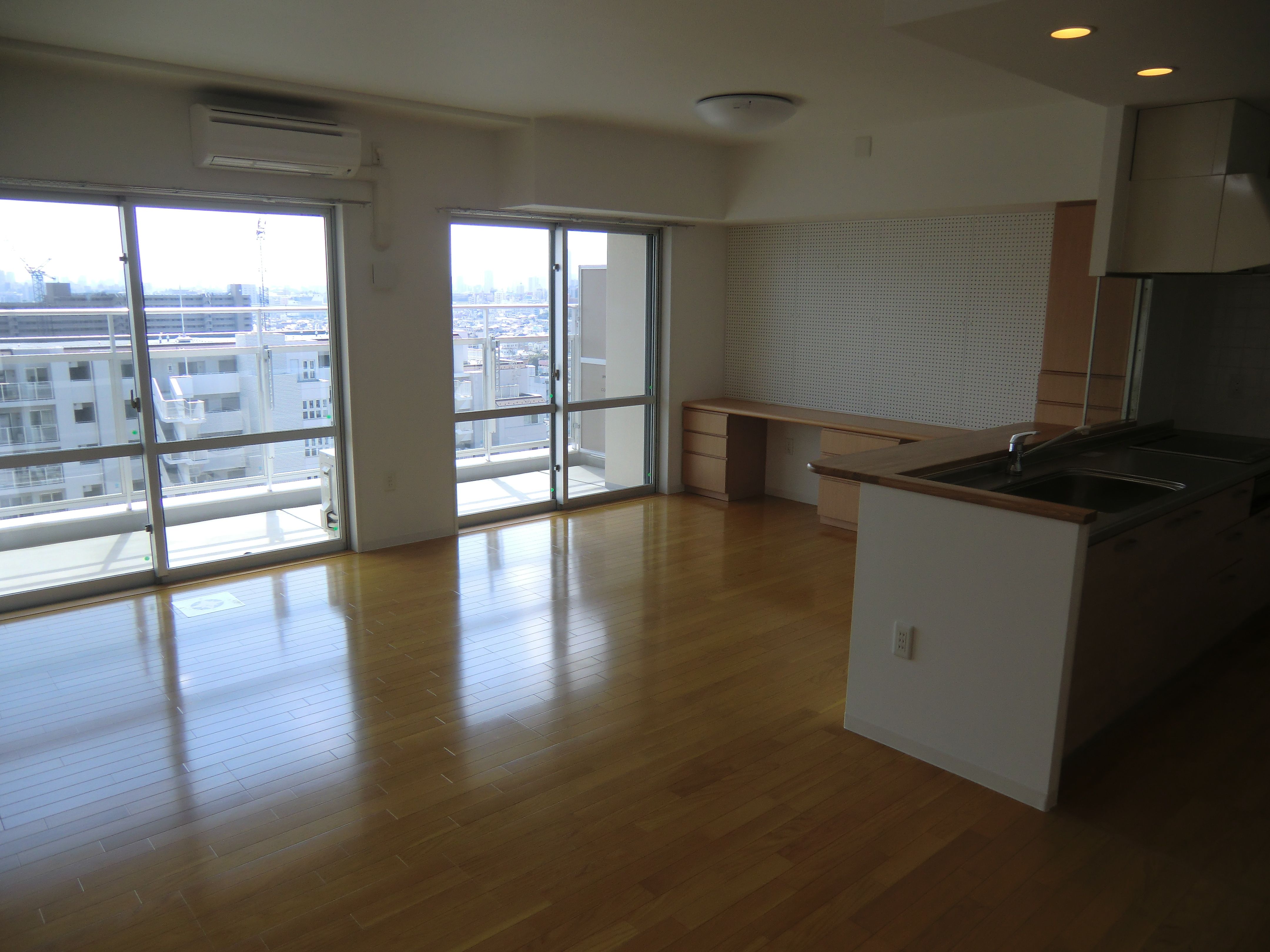
Dark floor, dark room

Across and further down the Sumida River from our apartment is a large condominium complex that has intrigued us ever since we moved here. Legend has it that the late rocker Yutaka Ozaki had just moved into it when he was found not far away in an alleyway one night, dying. It’s a good legend, and like many legends it’s not true. At the time Ozaki was renting a much more commonplace sort of “mansion” in the same neighborhood. But it’s easy to understand why this particular complex has attracted that sort of speculation. Every so often somebody moves out and you see a flier in the mailbox advertising the unit, which tends to fetch a price comparable to new condos even though it was built in 1991. The layouts are more imaginative and seem more livable than those of most condos. Rather than cut a box into rectangles, the designers staggered the position of the rooms along corridors and shaped the building in such a way that every unit looks out on at least two views, meaning there’s more sunlight; or that’s the impression one gets looking at the layout and then at the building’s exterior.

Last week, we finally visited the complex after we saw a flier announcing that two adjacent units on the 14th floor were on sale: a 67-square-meter 2LDK for ¥28 million and a 94-square-meter 3LDK for ¥38 million. Though both of these prices were out of our league we wanted to see what was really there, and were quite shocked at what we found. Read More

UR Ogikubo

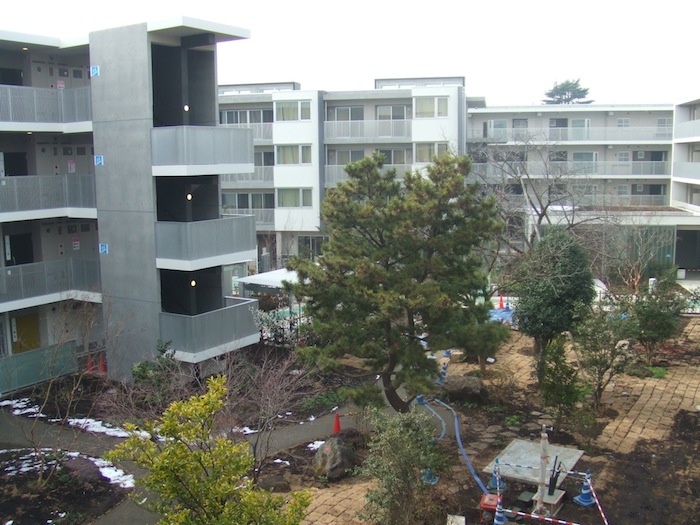
Unfinished courtyard

Japanese apartment complexes often have pretentious, unwieldy names that are meant to add a touch of cosmopolitanism to otherwise nondescript residences; something you might expect from an industry that managed to convince people to adopt the English word “mansion” for condominiums. Earlier this week when we went over to Ogikubo in Tokyo’s western Suginami Ward to inspect the new UR apartments that are starting to accept applications for tenants I couldn’t quite make out the name, which sounded French, and I neglected to write down the romaji iteration after we got there, though I do remember is started with a “C” and had an “X” and some consecutive combination of “E” and “I.” Maybe a “U,” too; but whatever it was I couldn’t pronounce it on sight. Having returned home I see it rendered in katakana as シャレール. So let’s just drop the whole thing and call them the Ogikubo UR apartments. Read More

Excited about nothing

Sort of exotic

The TBS consumer news variety show Gatchiri Academy is usually pretty thorough about its advice, since it features a panel of economists and financial journalists whose opinions vary widely from one to the other. However, the other night, during a segment about resort condominiums, the information provided was maddeningly incomplete. As described here and here on this blog, resort condos are pretty cheap owing to the simple fact that too many were built and demand isn’t so hot any more. Gatchiri visited several vacation areas, including the Izu Peninsula and the Naeba ski resort in Niigata. The whole point of the segment was to jolt the audience with prices too low to believe. Actually, what was difficult to believe was that people paid so much for these cubbyholes when they were built twenty years ago. In one segment, a talent-reporter, in the company of a local real estate agent, inspected a 60-square meter condo in Izu that originally sold for about ¥25 million, and her jaw dropped when the realtor revealed how it now goes for less than 10. Mandibles literally hit the floor in Naeba, however: one and two-room condos for as low as ¥500,000?! Where do I sign?

That was the general vibe, anyway. What was infuriating was that nobody mentioned the real reason why these places were such bargains. For a split second, each property’s particulars were flashed on the screen, and these particulars may have included the yearly property tax fee you’d have to pay. But I didn’t see or hear any mention of the maintenance (kanri) or common repair (shuzen) fees that a resort condo owner has to pay every month. So when one of the financial writers commented that at such low prices it didn’t really matter whether or not the property continued losing value (which is most certainly would), he was, purposely or not, deceiving viewers who might be considering dropping a mill or two for a nice getaway. Maintenance fees normally run between ¥10,000 and ¥50,000 a month, and repair fees about half that, so the cost of keeping a resort condo could conceivably end up outstripping the value of the property after a few years. That’s fine if you plan to use it often, but the main reason these places are so cheap is that the majority of people don’t have that much free time, something that they realize too late. The financial writer also hinted that, with prices this low, you could just abandon the property without much trouble; but that’s a lie. You still have to pay the fees and the taxes, forever.

Go here to get a better idea of what’s available.

Nouvelle Akabanedai

#7 & #6 blocks

It’s tempting to wonder what Akabanedai would have turned into had various government bodies not decided to turn it into an almost exclusive zone for danchi, meaning public housing complexes, back in the 1960s. It was the first major danchi complex within the 23 wards of Tokyo, located on a hill that steeply overlooks Akabane Station in Kita-ku, not far from the Saitama border, and it was considered cutting edge by danchi standards when it opened in 1962, on a par with Matsudo. When I lived near Ukima-Funado Station on the Saikyo Line during the latter half of the 90s, I often walked to Akabane Station, which meant climbing the hill from the north side and walking through the danchi, which was huge, a veritable mini-state with its own complement of retailers that, at the time, appeared to languish in a commerical funk. Akabane, which teemed with restaurants and funky little drinking establishments; a large and well-used Ito-Yokado; and even a fair-sized bawdy district with Philippine hostess clubs and “cabarets,” was just a few minutes away, down a steep flight of steps at the edge of the tunnel that ran below the housing complex. Though the danchi was still the home to thousands of families, the dissipated atmosphere characterized by the sad retail component gave it a cast of desperation. I don’t remember ever seeing anyone patronizing these establishments.

But had it not been developed as a danchi, Akabanedai might have attracted a richer sort of homeowner. (It was a factory district on nationally controlled land before the danchi was built) There are lots of trees and vegetation up there and a fairly extensive park system; and the view, when it isn’t blocked by another public apartment building, can be breathtaking. Read More

UR 2010

We took in the new Heart Island Shinden public housing complex a few weeks ago, which is scheduled to start accepting residents sometime in November. Heart Island Shinden is essentially a strip of land between the Arakawa and Sumida Rivers where they come the closest to each other, and though the closest stations are Oji on the Keihin Tohoku Line and Oji Shinya on the Namboku subway line, both of which are in Kita Ward, Heart Island Shinden is in Adachi Ward. It’s more than a 20-minute walk from either station, even if you move fast, so most people take a bus.

Even before the new complex was built, the area was already home to a number of apartment complexes, both private and public. In fact, it’s a veritable forest of mini-skyscrapers. The one we visited is operated by UR (Urban Renaissance), the main semi-public housing corporation in Japan. We live in a UR building that was completed in 2000, and in the decade since then we’ve often visited newer UR buildings to see what improvements they’ve made. What we’ve found is that which each new project ameninites get added but the basic problem with Japanese apartment living–namely, impractical layouts–remains, due to a habit of prioritizing 3-dimensional efficiency over baseic livability. In other words, floor plans are dictated by box-like patterns that allow developers to maximize space and fit as many units as possible given the land area and height of the building. The two wings of the HIS complex are 9 stories and 14 stories, which is about the same as the other buildings in the area, thus indicating that there is a height limit. (The building we live in is 38 stories) Read More

What’s that smell?

Though Japan remains a relative oasis for smokers, rules and regulations regarding demon tobacco continue to get more stringent, and some 50 percent of smokers have said in surveys they plan to quit when cigarette taxes are increased next month. The thing is, it’s getting more and more difficult to find a place where you can smoke in peace. It’s even getting difficult to light up at home.

This is especially true of smokers who live in apartment buildings or condos. A neologism that has popped up recently is “hotaru,” which means “firefly” and refers to men (it always seems to be men) who go out on their balconies to have a smoke. They are called “fireflies” because the glowing ash of their cigarettes give them away in the dark. Either these men are saving their families from their habit or the families have banished them to out-of-doors, but in any case their exile to the veranda often irks the neighbors, especially those who live upstairs. Newspapers are increasingly filled with letters to the editor complaining of the hotaru scourge, with writers claiming that the smoke from neighbors’ cigs aggravates their children’s asthma or discolors the window sashes or forces them keep the windows shut in hot weather.

In condominiums these hotaru-zoku (tribe of fireflies) cause all sorts of communal rifts, especially since verandas are considered “common space,” and in more and more coops smoking is banned in common spaces. Building managers have to enforce these rules, which is pretty difficult to do. After all, what kind of punishment do you impose? You can’t kick the guy out, he owns the apartment.

Yuzawa’s last resorts

Yuzawa-machi

In 1987, at the height of the so-called bubble era, when land and stock prices were on a bender, the Diet passed the Law for the Development of Comprehensive Resort Areas, whose idea was to make the development of leisure facilities a national project. Developers and local governments were given financial incentives, and property laws were relaxed so that more holiday-oriented projects could be carried out. One of the outcomes of the law was the invention of the “resort mansion,” condominium complexes that were built in outlying areas where city folk could spend their vacations. Read More