Home Truths #3

Here’s this month’s Home Truths column in the Japan Times, about UR housing. The article is mainly a how-to piece and doesn’t really get into the details of what the buildings and apartments themselves are like. We’ve written about UR a lot in this blog, as well as in our sister blog Yen for Living, since we’ve been living in UR units since 2000. Below are links to some of these posts that provide more specific information.

Security deposits / Tour of Nouvelle Akabanedai / Amenities / Tour of UR Ogikubo / Matsudo public housing / Japanese needed? / Low-income housing / Tour of Heart Island Shinden / ‘kudokushi’ savings / Tour of East Core Hikifune

The awful truth

We often go out in the field to do research, but it’s always a two-pronged activity. On the one hand we study the housing situation and the market in an up close and personal manner. On the other hand, we’re still thinking about buying property ourselves someday, and though after more than fifteen years of searching off-and-on we haven’t bought anything, it doesn’t mean we never will. Still, the longer this goes on and the more we learn, the more frustrated we become, especially as our income situation remains precarious owing to the ongoing recession. Having a permanent abode that we can’t be kicked out of, regardless of our job circumstances, is a vital consideration, but looking at what we can afford we invariably fall into a funk wondering why we have to settle for such places. Inevitably, you prevaricate: This may be livable.

Our latest subject is old danchi/kodan for sale, which have become semi-popular due to media coverage of “danchi moe,” or fans of old public housing. We’ve written before about enterprising people who’ve bought old apartments in buildings constructed during the 50s-70s and remodeled them as attractive modern spaces, which they often sell for a profit. Because they only cost a few million yen to buy and a few million yen to fix up, they can be had quite cheap in the end, but most of the units that have been covered on TV and in magazines are small; fine for a single person but still a bit cramped for a couple and certainly not big enough for a family, though in all likelihood they were occupied by a family when they were new.

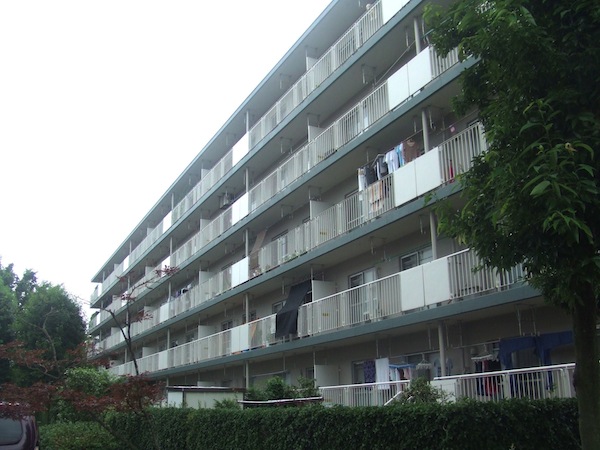
When you get out of the main cities, these danchi and kodan get bigger and even cheaper. And in most cases they’re also newer, which means more amenities. However, they still look like danchi, meaning they’re usually contained in dull concrete buildings of three to five stories without elevators. The fact that they are designed with these parameters in mind means that the apartment layouts tend to be more sensible than those in newer buildings. The classic kodan design has a staircase and apartment entrances on each side of the landings, which means you usually enter at ninety degrees to the length of the apartment. That allows for windows on both ends of the apartment, which means there is not only more sunlight, but cross-ventilation, an important consideration until the 1980s, when air conditioning started to become a fixture of apartment life. It also means the rooms are more practically positioned, unlike modern apartments where the entrances open up to a common outside hallway or light well, which means all the light and air comes from only one direction. In order to maximize space for commercial purposes, the rooms are basically carved out of a boxy shape, thus creating what is often referred to as “kamaboko” living spaces. Kamaboko are those rectangular fish paste loaves that you divide into smaller rectangular pieces.

So discounting the unappetizing exteriors, older danchi, especially when they’ve been fixed up, can be quite desirable, and in this spirit we called a few real estate agents and had them show us some in northern Chiba. Read More

The right thing

The blur of memory: After the cleanup in Tokyo

In the last few posts we’ve ragged a bit on UR, specifically their dodgy ties to outside providers like Tokyo Gas and local cable outfits, but that shouldn’t be interpreted as disillusionment. For all its anal bureaucratic culture and general air of mismanagement, Japan’s only national semi-public housing corporation is also the only place in Japan where renters get a fair shake. We found that out when we received the refund for our security deposit a few days ago.

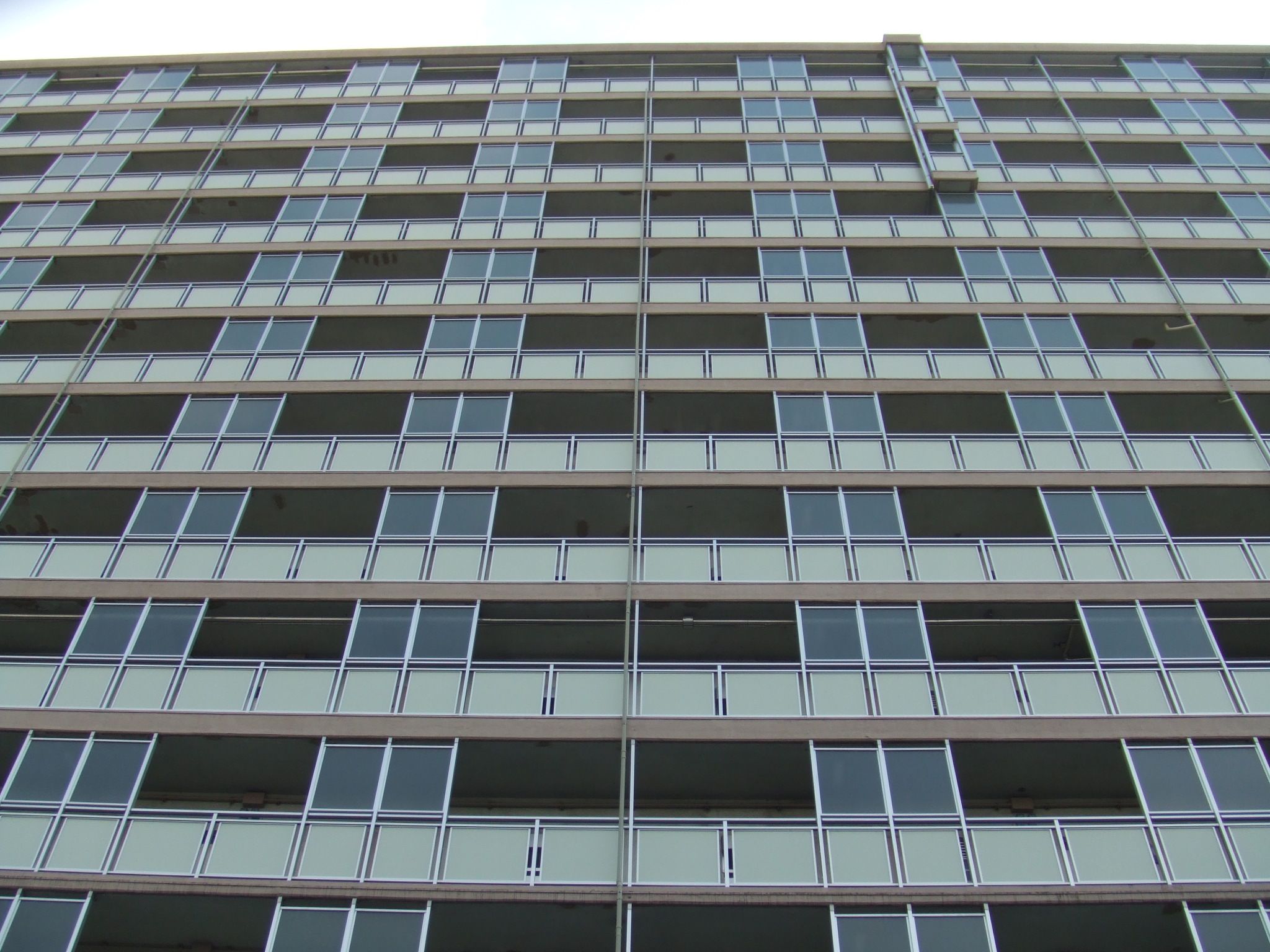
We moved from a UR high-rise in Tokyo to a low-rise UR complex in northern Chiba Prefecture. UR makes it relatively easy to move from one of its buildings to another one. The tenant doesn’t have to go through the screening process again (unless he/she is moving to a decidedly more expensive residence), and the security deposit (shikikin) that was paid for the former apartment is transferred to the new one, with the difference either being made up by the tenant or refunded to him/her. In our case it was the latter. Though the new apartment is the same size as the one we rented in Tokyo, it is almost ¥70,000 cheaper per month. The security deposits for UR typically amount to the equivalent of three months’ rent, which is a bit higher at the moment than security deposits for private rentals, but the important thing to remember about UR is that they don’t charge “gift money” (reikin) or contract renewal fees (koshinryo), and also don’t require guarantors or co-signers. Read More

Gas attack

In the previous post we talked about Tokyo Gas’s relationship with the public housing corporation UR and how we were left with no choice but to throw away two perfectly good space heaters because they couldn’t be used in our new UR apartment and there was no system set up to sell or even give them to people who might be moving into our old UR apartment. As it turns out Tokyo Gas has UR tenants coming and going. Out new apartment does not have a stove, though our old one did. This is a facet of rental living in Japan that I had forgotten all about: the total lack of appliances. In the U.S. when you rent an apartment, you almost always get a stove, an oven, a refrigerator, sometimes even a washer/dryer, not to mention central heating. You don’t necessarily get any of those things in Japanese rentals, though, as I mentioned, our last UR apartment did have a stove, and recently some UR apartments have had floor heating or wall heating units built into the rooms. We have gas-powered floor heating in our new apartment in the living room only, but for some reason it’s billed separately from the other gas we use in the apartment, which means it requires a separate contract and, thus, a separate contract signing fee: ¥7,500 just to turn the system on. We were told, however, that if we did use floor heating we would get a “discount” on our total gas bill in any month we used the floor heating. We assume that means floor heating is very expensive. Since there are no gas outlets in our new apartment, we would have to heat the place with electric space heaters or kerosene heaters if we decided not to use the floor heating. In any case, it won’t be cheap. Read More

Wasted

Planned obsolescence

Moving house is a pain in the ass, but it can also be a rush. Basically, you shlep your entire life to a new abode and in the process assess that life in concentrated form. Inevitably, you are forced to pick and choose what you want to keep from it and what you want to discard. Some things you get rid of simply because you want to get rid of them, and some things you get rid of simply because you have to.

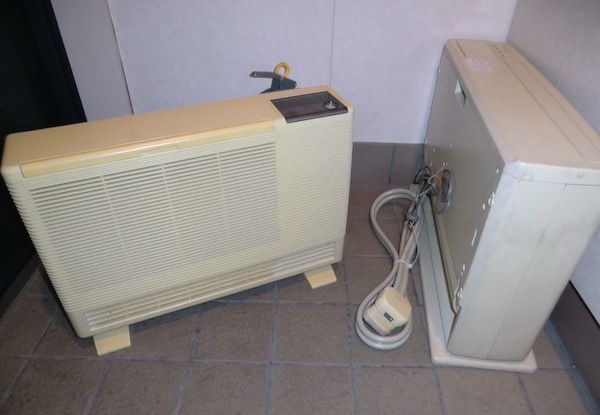
Yesterday we threw away two perfectly good heaters because we can’t use them in our new apartment. We also can’t sell tor even give them away, and it’s hard to shake the feeling that it was somehow planned to be this way. The heaters are made and sold by Tokyo Gas. Unlike standard gas heaters, which directly convert “city gas” piped into your home into heat, these draw hot water from your boiler (or, to use the redundant Americanism “hot water heater”). In that way they function in much the same way that baseboard heating does, except for one very significant difference. Baseboard heating is built into a house or apartment, and is generally designed in such a way that it doesn’t get in the way. These water heaters, on the other hand, are stand-alone boxes that do get in the way since they connect to wall outlets via thick hoses. Ideally, Tokyo Gas wants you to buy one for every room in your apartment, and priced at between ¥28,000 and ¥45,000, they can add up to quite an investment. Read More

UR Ogikubo

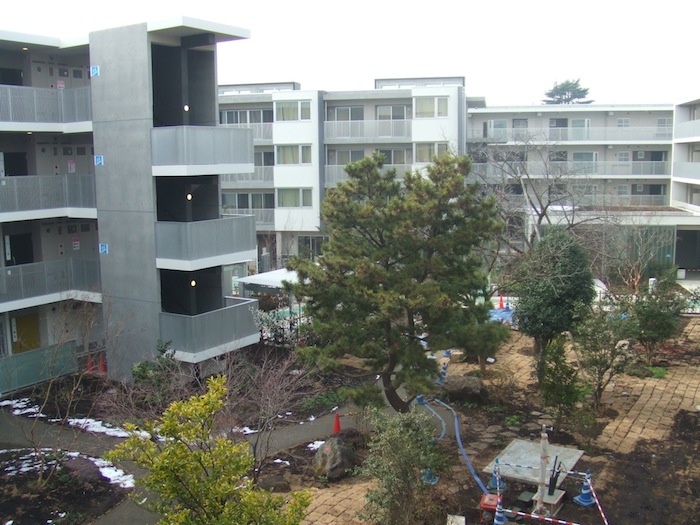
Unfinished courtyard

Japanese apartment complexes often have pretentious, unwieldy names that are meant to add a touch of cosmopolitanism to otherwise nondescript residences; something you might expect from an industry that managed to convince people to adopt the English word “mansion” for condominiums. Earlier this week when we went over to Ogikubo in Tokyo’s western Suginami Ward to inspect the new UR apartments that are starting to accept applications for tenants I couldn’t quite make out the name, which sounded French, and I neglected to write down the romaji iteration after we got there, though I do remember is started with a “C” and had an “X” and some consecutive combination of “E” and “I.” Maybe a “U,” too; but whatever it was I couldn’t pronounce it on sight. Having returned home I see it rendered in katakana as シャレール. So let’s just drop the whole thing and call them the Ogikubo UR apartments. Read More

Nouvelle Akabanedai

#7 & #6 blocks

It’s tempting to wonder what Akabanedai would have turned into had various government bodies not decided to turn it into an almost exclusive zone for danchi, meaning public housing complexes, back in the 1960s. It was the first major danchi complex within the 23 wards of Tokyo, located on a hill that steeply overlooks Akabane Station in Kita-ku, not far from the Saitama border, and it was considered cutting edge by danchi standards when it opened in 1962, on a par with Matsudo. When I lived near Ukima-Funado Station on the Saikyo Line during the latter half of the 90s, I often walked to Akabane Station, which meant climbing the hill from the north side and walking through the danchi, which was huge, a veritable mini-state with its own complement of retailers that, at the time, appeared to languish in a commerical funk. Akabane, which teemed with restaurants and funky little drinking establishments; a large and well-used Ito-Yokado; and even a fair-sized bawdy district with Philippine hostess clubs and “cabarets,” was just a few minutes away, down a steep flight of steps at the edge of the tunnel that ran below the housing complex. Though the danchi was still the home to thousands of families, the dissipated atmosphere characterized by the sad retail component gave it a cast of desperation. I don’t remember ever seeing anyone patronizing these establishments.

But had it not been developed as a danchi, Akabanedai might have attracted a richer sort of homeowner. (It was a factory district on nationally controlled land before the danchi was built) There are lots of trees and vegetation up there and a fairly extensive park system; and the view, when it isn’t blocked by another public apartment building, can be breathtaking. Read More

Nihongo needed

Last April the city of Fukui adopted a “guideline” in its municipal public housing regulations that stated non-Japanese who applied for low-income housing must be able to “communicate in Japanese.” Applications for those who cannot will not be accepted. Since then various groups that work with foreigners in Japan have protested the guideline, but it still stands. Some of these groups have said that they are aware that some non-Japanese applicants, though they qualify for public housing otherwise, have been prevented from applying for housing due to the new guideline.

There are nine cities in Fukui Prefecture, but only Fukui City has such a rule. The city official in charge of public housing told a local newspaper that his office had received complaints from community associations (jichikai) of individual public housing complexes. These associations said that some non-Japanese residents were unable to communicate “very well” in Japanese, and thus it was difficult for them to understand and follow association rules regarding the “sorting of refuse” and “noise.” For that reason, the city government adopted this new guideline. Read More

Public housing on the ropes

Housing complex along Sumida River run by Tokyo-to

There are two types of public housing available in Japan. A national public corporation called UR runs semi-public housing whose rents are pegged to property values. Meanwhile local governments at the prefectural and municipal levels provide housing for low-income families and individuals. Last week, the Asahi Shimbun surveyed this latter category among Japan’s 47 prefectures and 19 major cities. The newspaper found that 1/3 of these entities planned to reduce the number of units of low-income housing in the future.

In fact, the only two local governments who said they planned to increase low-income public housing was the prefecture of Okinawa and the city of Sagamihara in Kanagawa Prefecture. Everyone else said they either would keep the number they already have, or had not made any plans at all.

The governments who said they would decrease public housing stated as their main reason the declining population. The second most common reason was difficulty in securing funds for maintenance of existing housing. Two prefectures said they were planning on rebuilding their housing facilities, since the bulk of low-income public apartments were built in the 60s and 70s. When they carry out the reconstruction work, they will probably reduce the number of units per building. Another reason that wasn’t mentioned as often but certainly had a significant impact is the fact that subsidies for public housing from the central government have dropped by 40 percent in the past ten years. Read More

Passing unnoticed

It’s a long way to the bottom

A recent article in the Mainichi Shimbun mentioned a study carried out by 98 local governments that operate public housing. In 2009, this study found, 1,191 people who lived in these public housing units died alone and in most cases their deaths were not discovered for at least several days. The vast majority of these people were over 65, about 74 percent. In addition, the Mainichi said that UR, the semi-private housing corporation attached to the national government, reported that 472 people over 65 died alone in apartments they run nationwide in 2009.

This seems to be the first time any housing entities have recorded and publicized statistics related to kodokushi (dying alone), which will become much more common as the population ages. A greater percentage of elderly people live in public housing, not just because it can be cheaper (UR rents, however, are market rates), but because private landlords usually don’t like to rent to older people who plan to live by themselves, for reasons that aren’t difficult to figure out.

Another reason why older people tend to live in public housing is that they’re already there. A lot of public apartments were built in the 60s and 70s. People moved in and had families. Their children moved out and a spouse died, thus leaving them alone.

A more troubling aspect is why these people die alone and aren’t discovered days or even weeks after they do. The vast majority tend to live in cities, and urban apartment life discourages the kind of community life that nurtures relationships. It’s difficult for older people to leave their apartments, take the elevator down, and go out to see people; and obviously it’s less likely for acquaintances to drop by the way they would if the older person lived on the ground.